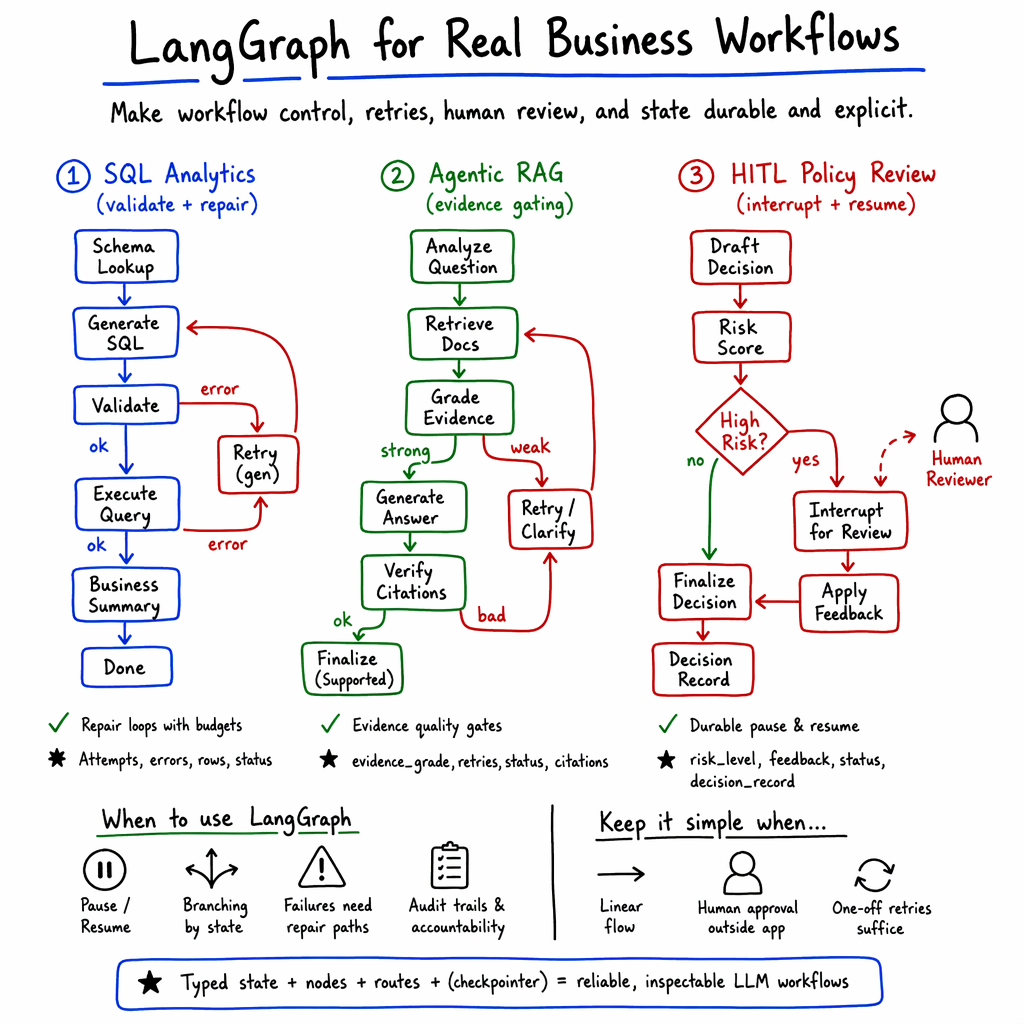
- The paper presents LangGraph, a framework that enables durable, auditable, stateful workflows with explicit pause/resume and human-in-the-loop operations.
- The methodology leverages a graph-based state abstraction with typed state objects, nodes, and conditional routing to enforce precise workflow control.
- The study demonstrates practical applications, including SQL analytics, retrieval-augmented generation, and HITL policy reviews, emphasizing auditability and error recovery.
Graph-Based Agentic AI with LangGraph: Structured Orchestration for Stateful Business Workflows
Motivation and Problem Framing
The paper "Graph-Based Agentic AI with LangGraph: Workflow Pathways for Long-Running Stateful Business Processes" (2607.19297) offers a practitioner-focused examination of LangGraph, a low-level orchestration framework for stateful agentic workflows. The key motivation is to provide transparency, durability, and explicit control in LLM-powered business applications that require long-duration, branched, auditable sequences with persistent state and human-in-the-loop (HITL) operations. Rather than optimizing for model performance or prompt engineering, the paper delineates the types of workflow requirements—such as pause/resume, conditional routing, retry/repair paths, traceability, and durable state—that justify the graph-based paradigm.
The paper argues that conventional approaches, including ReAct-style reasoning-act loops [yao2023react], schema-first validation agents [geng2025jsonschemabench, pydanticai2026], and program-optimization frameworks like DSPy [khattab2024dspy], are each best suited for distinct problem classes. Graph orchestration with LangGraph is uniquely valuable when workflow management, not just LM invocation, is central to the software product's contract.
LangGraph Architecture and Principles
LangGraph exposes core primitives—typed shared state, nodes, conditional edges, persistent checkpoints, and explicit interrupts—as first-class constructs. Unlike higher-level agent libraries or end-to-end frameworks, it does not subsume domain tool logic or define modeling protocols but makes workflow control flow concrete and inspectable.
The architecture maps to a StateGraph abstraction, in which:
- Typed state objects carry user inputs, intermediate results, route decisions, retry counts, and outputs across nodes,
- Nodes represent executable code units: tool invocations, validation steps, retrieval actions, or review pauses,
- Conditional edges (routing functions) determine subsequent nodes based on explicit state evaluation,
- Checkpointing is integrated for durable persistence and HITL pause/resume,
- Traceability and auditability are by design: workflow decisions and their rationale are manifest in state and routing, not buried in logs or LM outputs.
The separation of concerns is emphasized both in repository layout (graph structure versus node logic) and in the interaction between workflow and domain semantics.
Executable Recipes: Three Canonical Pathways
The paper advances three executable "recipes" as canonical instantiations where LangGraph's abstraction provides engineering advantages over alternative paradigms:
1. SQL Analytics with Repair Loops
Use Case: Natural language-to-SQL agents where validation and execution failures require persistent, auditable, and retryable repair loops.
- Core State: Tracks question, schema, candidate SQL, error messages, retry attempts, query results, and status.
- Key Structure: Schema lookup, SQL generation, validation, execution, business summary.
- Routing: Explicit conditional logic directs the path on validation/execution failure—back to generation up to a retry limit, or to terminal failure; successful execution routes to summarization.
This pattern is justified in audit-focused or regulated settings, or where non-terminal failures must be managed distinctly from fatal errors.
2. Agentic RAG with Evidence Gating
Use Case: Retrieval-Augmented Generation where decisions to answer, retry, or refuse are governed by explicit evidence quality thresholds.
- Core State: Includes question, retrieved documents, evidence grade, answer, citations, retry count, and status.
- Key Structure: Question analysis, targeted retrieval, evidence grading, answer generation, citation verification.
- Routing: Weak evidence and failed verification propagate through retry or clarify loops; only sufficient support proceeds to finalized responses.
This enforces product behavior—such as non-hallucination, failure closure, or citation gating—as externalized workflow policy, not silent prompt heuristics.
3. Human-in-the-Loop (HITL) Policy Review
Use Case: High-risk, compliance-sensitive decision processes that require pausing for human input and resuming with preserved state and audit records.
- Core State: Captures draft answer, risk assessment, identified policies, approval, reviewer feedback, and final decisions.
- Key Structure: Drafting, risk scoring, conditional branching for human review, feedback application, and decision logging.
- Routing: High risk, as determined by explicit state, triggers an interrupt and checkpoint; system execution halts and resumes only upon authenticated human feedback, enabling robust compliance and governance.
This paradigm is central where durable workflow boundaries, strong audit trails, and resumable human-in-the-loop operations are contractually mandated.
Design Patterns and Technical Implementation
Across all recipes, the framework generalizes several architectural patterns:
- Shared typed state and deterministic tool nodes underpin explicit, inspectable workflow progression, facilitating debugging, reproducibility, and audit.
- Conditional routing and branch labels make operational decisions explicit, allowing programmatic testability and regulatory traceability.
- Retry loops and escalation are encoded in routing functions, not in implicit or foreign logic.
- Checkpointing and interrupt primitives enable decoupled, asynchronous human review without loss of execution fidelity.
- Audit traces are constructed as part of the state schema and transitions, not as after-the-fact log artifacts.
The paper provides concrete, minimal Python implementations of each workflow archetype, highlighting the separation of the orchestration layer (graph and routing functions) from the application/business logic (node implementations).
Trade-offs, Limitations, and Framework Selection
The authors underscore the added cognitive and engineering overhead of the graph abstraction: state schemas, explicit builders, routing and recovery logic, checkpointing, and invocation configuration, which are often unjustified for simple, linear, or stateless tasks. Overuse leads to unnecessary complexity; the decision process should be requirements-driven.
LangGraph is strongly preferred when:
- The workflow must pause and resume (especially for human approval or long-running external dependencies),
- Explicit state and branching are central to the operational semantics,
- Tool failures require repeatable, testable, and auditable recovery paths,
- Precise route tracing and compliance are product requirements,
- Multiple heterogeneous components (tools, model calls, reviews) must operate over shared, durable state.
Alternative stacks (plain SDK, schema-first, DSPy) are preferred when workflows are linear, stateless, or focused on prompt/program optimization rather than orchestration.
Implications and Speculation on Future Directions
The formalization of controllable, auditable, and stateful workflows is increasingly important as LLM-driven systems move from isolated question-answering or tool-use demos into production business contexts, regulatory environments, and long-running operational processes. The agentic/graph-based approach provides a structured methodology for managing system state, human supervision, and explicit error handling.
As large-scale AI systems assume more complex roles in enterprise, compliance, and regulated domains, demand for transparent, auditable, and robust workflow orchestration will increase. Future developments are likely to merge the strengths of schema-driven validation and graph-based control planes, perhaps further abstracted for declarative specification while maintaining deterministic and auditable semantics. The pressure for seamless HITL integration, resilient checkpointing, and operational traceability will continue to drive architectural choices, with abstraction boundaries between orchestration and tool logic remaining a key site of engineering trade-off.
Conclusion
This paper advances the engineering utility of graph-based workflow orchestration in LLM-powered business applications, providing executable, auditable patterns for SQL analytics, evidence-gated RAG, and HITL policy review. The work clarifies when and why explicit graph orchestration is justified, codifies reusable design patterns, and positions LangGraph as a control-plane primitive for applications requiring persistent state, explicit branching, durable pause/resume, and traceable route history. The decision to employ such an abstraction must be governed tightly by workflow complexity, audit requirements, and the need for transparent operational contracts.