- The paper introduces a predictive framework for modeling the optical flash and ejecta plume dynamics during the 2026 Falcon 9 lunar impact.
- It outlines coordinated, multi-modal observational strategies that blend high-cadence imaging with spectroscopic follow-up to detect elusive signals.
- The findings offer critical insights for calibrating impact physics models and assessing anthropogenic debris hazards in the cislunar environment.
Observational Prospects and Modeling of the 2026 Falcon 9 Upper Stage Lunar Impact
Introduction
The direct observation of artificial lunar impacts offers unique opportunities to calibrate methods for studying impact dynamics, regolith mechanics, and secondary hazards associated with anthropogenic lunar debris. This study examines the 2026 August 5 impact of a Falcon 9 upper stage near the Einstein Crater, detailing the expected physical phenomena, observable signatures, and strategies for coordinated, multi-modal observation. Emphasis is placed on bridging observational execution with predictive modeling, leveraging both empirical and simulation-driven approaches.
Contextualizing Artificial Lunar Impacts
While meteoroid bombardment is a dominant geophysical process on the lunar surface, artificial impacts are rare but highly instructive for controlled experiments. They provide sources with known mass, speed, and geometry, allowing for more precise modeling of the resulting seismic, optical, and ejecta phenomena. Historical artificial impacts (e.g., Luna 2, LCROSS, SMART-1, Chang’e 5-T1) have incrementally advanced our understanding, but systematic, multi-instrumental campaigns remain infrequent, particularly for impacts on the sunlit lunar hemisphere—an observational regime with significant diagnostic value.
Event Geometry and Impact Parameters
The Falcon 9 upper stage, abandoned post-lunar injection of Blue Ghost-1 and Hakuto-R Resilience landers, is predicted to strike the eastern lunar limb (88°W, 15°N) at 06:35 UT on 2026 August 5. Impact velocity is calculated at 2.43 km/s, with an incidence angle of 34° from vertical. The spacecraft mass, estimated at ~4000 kg (fully expended), yields a kinetic energy of 11.8 GJ and momentum of 9.7 MN·s, with a non-negligible component tangent to the surface. Lunar libration ensures the site remains visible from Earth at around the last quarter phase (56% illuminated), a critical consideration for observers.
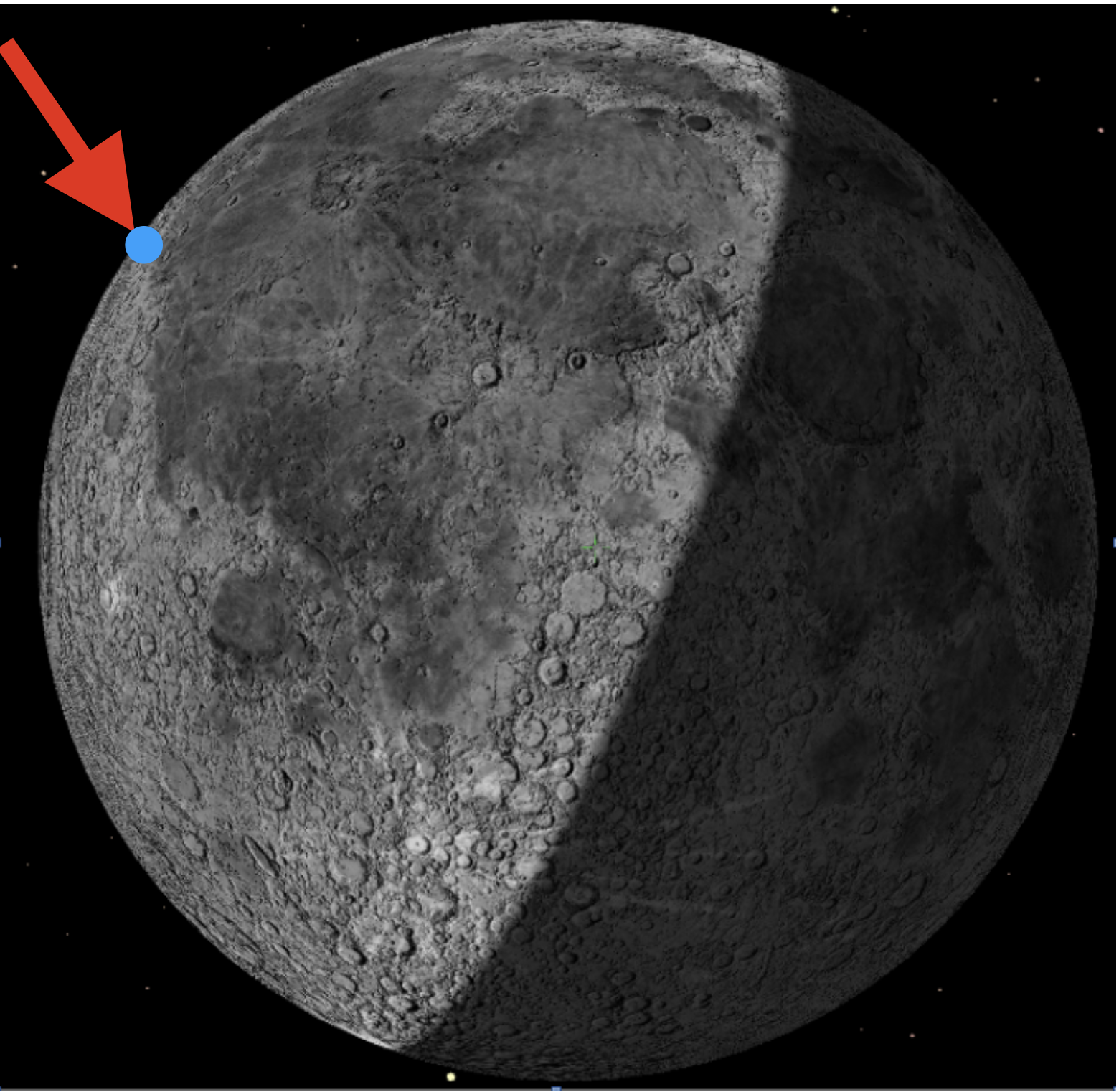
Figure 1: The predicted impact site on the lunar limb, with libration correction ensuring visibility from Earth during the event.
This scenario is distinguished by both the large mass and relatively low velocity of the impactor compared to natural meteoroids, influencing luminous efficiency and ejecta kinematics.
Expected Observables
Impact Flash
The detectability of the impact flash is highly uncertain due to its occurrence on the dayside and its subsonic or transonic entry relative to lunar lithologies. Modeling yields an estimated flash brightness ranging from M=+3 to M=+15, depending heavily on regolith depth, attenuation, and local bedrock exposure. This nonlinearity arises from the transition between shock-driven vaporization (predominant in supersonic impacts) and plastic deformation with inefficient radiative yield as velocity drops below the sound speed of the target. No artificial or natural impact flash has previously been detected in sunlit lunar regions, underscoring the significance of successful observation.
High-cadence (<50 ms frame rate) visible/NIR imaging with moderate to large aperture telescopes is recommended. J-band imaging is specifically encouraged for daylight observations to exploit reduced sky background. There is an operational imperative for both professional and amateur networks to coordinate, maximize longitudinal coverage, and employ redundant narrow-band and broadband filters.
Ejecta Plume Dynamics
Plume modeling is conducted using the HOSS finite-discrete element framework, under the end-member assumption of an axisymmetric, vertical impact. The simulation resolves scales down to 0.37 m, with initial results indicating that the majority of resolved ejecta are in a transient curtain, rapidly dispersing with a broad but velocity-weighted v−3 distribution. The total excavated mass approaches 1.12 × 10⁶ kg, consistent with scaling predictions and equating to ∼200 times the impactor mass. Estimated peak resolved ejecta velocities (∼130 m/s) fall below theoretical maxima due to the under-resolution of sub-0.4 m fragments, suggesting that significant populations of fast, micron-scale ejecta escape simulation capture.
Approximately 50% of simulated particles return to the lunar surface within 5 s, while the longest-lived remain aloft for several minutes. Maximum plume altitudes for resolved ejecta approach 1.5 km, with smaller, faster particles expected (but not simulated) to reach higher altitudes.

Figure 2: Snapshots from HOSS simulations showing the spatial and velocity distribution of ejecta, highlighting the rapid transient phase and long ballistic tails.
The predicted optical depth (τ∼0.001) parallels post-processed LCROSS results, placing constraints on plume detectability in scattered light. Spectroscopic follow-up targeting alkali species and possible lithium signatures (linked to spent propellants) is justified.
Crater Morphology and Surface Modifications
Pi-scaling yields an anticipated crater diameter of 20–30 m, with continuous ejecta blankets spreading over 70 m and select high-velocity fragments reaching ballistic ranges approaching 1,000 km. There is a strong likelihood of non-circular or even double crater geometries due to the elongated, underdense (and possibly tumbling) nature of the Falcon 9 upper stage, paralleling the Chang’e 5-T1 double crater event. Subsurface exposure is expected to differ from natural impacts, increasing the diagnostic value of targeted remote sensing post-impact via LRO and KPLO. The presence of unspent propellants could further enhance explosion energy, yielding additional complexity in crater thermodynamics and morphologies.
Coordinated Observational Strategy
Commendably, time has been allocated at flagship facilities (APO 3.5m, LDT 4.3m, VLT UT2/UVES), focusing on high-cadence imaging and target-specific spectroscopy. Simultaneously, citizen science initiatives and coordinated amateur efforts expand potential coverage, particularly in darkness-optimized longitudinal zones in the Americas. The collaboration between professional and enthusiast communities will be essential given the flash magnitude’s uncertainties and the difficulty of post hoc detection in sunlit conditions.
Recommendations for observers include thorough equipment validation with rehearsal observations on the lunar night prior to the event (mimicking illumination and libration), deployment of image-differencing workflows for elusive detection, and rapid data sharing through central portals to enable composite event reconstruction.
Theoretical and Practical Implications
A strong claim is made regarding the disproportionate dimness of flashes produced by slow (~2–3 km/s) space debris impacts, even for massive (∼4000 kg) projectiles, which substantially complicates prediction and detection. This anomaly underscores the need for calibrated model validation—the 2026 Falcon 9 event provides a uniquely controlled test case for thermal and optical parameterizations of impact physics.
Practically, characterizing the ejecta and flash from such events is directly relevant for assessing future hazards posed by anthropogenic debris in the rapidly developing cislunar domain. The potential for wide-spread secondary ejecta, and the calibration of seismic and optical localization pipelines, carries implications for Artemis-era infrastructure and planetary protection guidelines. Moreover, the increasing frequency of large, uncontrolled lunar debris encounters stresses the urgency in tracking and cataloguing cislunar objects, where ground-based and space-based assets must converge for surveillance and real-time hazard assessment.
Conclusion
The 2026 Falcon 9 upper stage lunar impact is an infrequent but invaluable opportunity for empirical study of artificial impact phenomena. Its outcome will provide critical constraints for luminous efficiency models, inform our understanding of ejecta plume evolution, and shape best practices for the detection and monitoring of anthropogenic hazards in the lunar environment. The transdisciplinary, open nature of the planned observational campaign sets a precedent for future coordinated efforts as lunar activities accelerate in both governmental and private spheres.

