- The paper’s main contribution is demonstrating that LLM evaluators exhibit significant language-dependent bias, affecting absolute scores across 23 languages.
- The experiments uncover that lower-resource languages receive more generous scores despite higher model uncertainty, revealing a counterintuitive calibration drift.
- The study recommends per-language thresholding and language-aware calibration to mitigate bias and enhance safety in multilingual LLM deployments.
Language-Dependent Bias in LLM Evaluators: A Comprehensive Analysis
Introduction
The evaluation of LLMs increasingly relies on automated systems—LLM-as-a-Judge and trained reward models—that are assumed to deliver language-neutral judgments for identical content across different languages. The paper "LLM Evaluators are Biased across Languages" (2607.14480) systematically discredits this assumption, presenting robust evidence that LLM-based evaluators introduce substantial, consistent, and directionally strong bias depending on the language of evaluation. Through extensive experiments spanning 23 languages, eight open-weight evaluators, and multiple evaluation paradigms, the work demonstrates that absolute scores, but not pairwise rankings, are subject to significant language-dependent drift. The analysis reveals both mechanistic origins and practical implications, challenging the prevailing reliance on pairwise accuracy, highlighting vulnerabilities in safety-critical applications, and charting directions for multilingual evaluation protocol design.
Systematic Cross-Language Scoring Bias
By leveraging semantically identical instruction–response pairs across 23 languages, the study measures pointwise scores assigned by both prompted LLM-as-a-Judge systems and trained reward models. Strong, statistically significant scoring differences emerge as a function of evaluation language, consistent across all tested architectures and training paradigms.
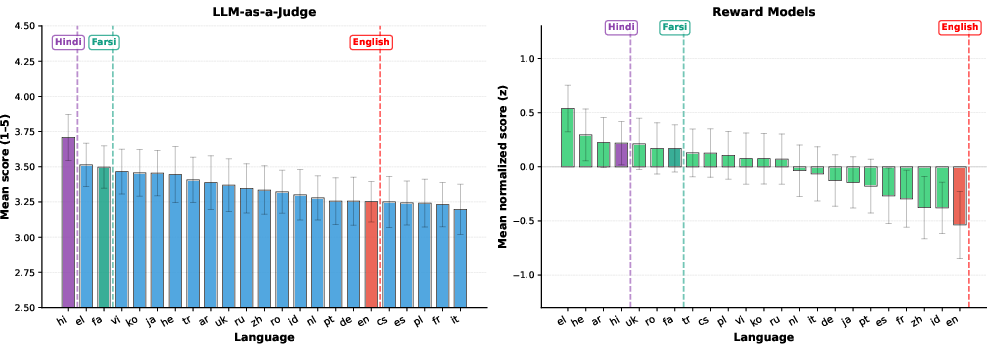
Figure 1: Mean pointwise scores assigned by LLM-as-a-Judge models (left, 1–5 Likert scale) and mean z-normalized scores from trained reward models (right), clearly demonstrating language-dependent score shifts.
The observed bias is of considerable magnitude (up to 0.5 points on a 1–5 scale), not explainable by content or item difficulty, and is robust even in professional human-validated benchmarks. Notably, the bias is not idiosyncratic to particular model families: both LLM-as-a-Judge and reward models show highly similar language rankings, especially in the tails, with low-resource and non-Latin-script languages (e.g., Hindi, Hebrew, Arabic) consistently receiving the most generous scores, and high-resource Western European languages (e.g., English, French, Italian) the most stringent.
Empirical analysis of cross-model agreement further corroborates this pattern.
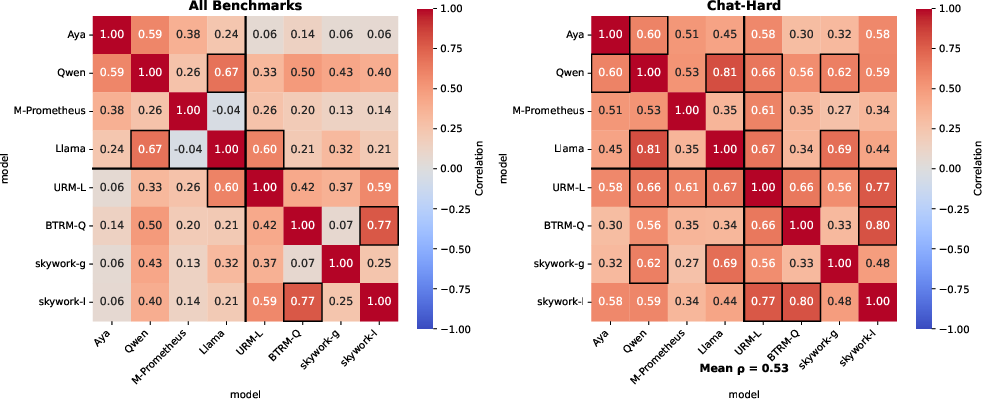
Figure 2: Pearson correlations between per-language mean scores assigned by pairs of evaluators; high agreement in the extremes is highlighted, supporting the hypothesis of a systematic, not idiosyncratic, cross-linguistic bias.
Resource Dependence and Writing System Effects
A central and unexpected finding is the directionality of the bias: models are lenient in their scoring for lower-resource languages, despite their well-established lower generative capabilities in these settings.
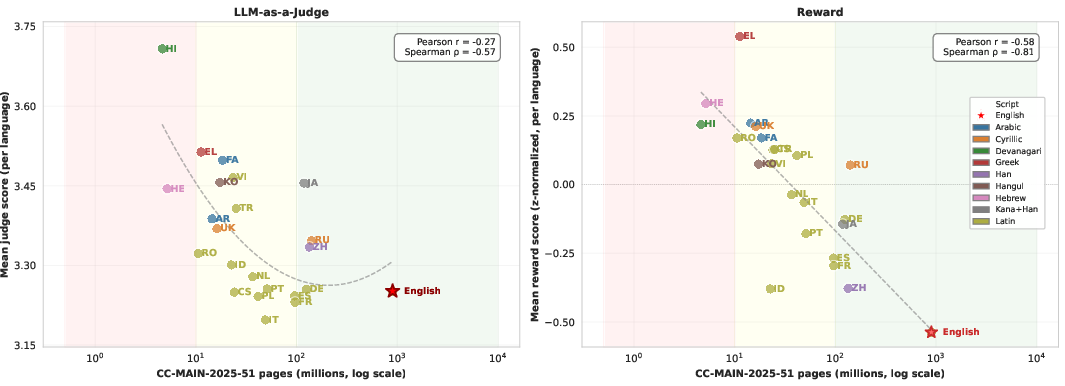
Figure 3: Relationship between mean evaluation scores and resource availability (proxied by CC-MAIN web data coverage); clear monotonic negative correlation indicates that languages with less training data receive higher scores.
This effect is consistent even when controlling for writing system, with some advantages for Latin script languages but substantial outliers. For reward models in particular, the Spearman correlation between resource rank and mean score reaches as high as −0.81, indicating a strong monotonic trend counter to naïve expectations about model confidence and performance.
Inadequacy of Pairwise Accuracy as a Sole Metric
The entrenched practice in LLM evaluation—using pairwise accuracy to validate evaluators—proves critically insufficient, as this metric is fundamentally insensitive to absolute shifts in scoring distributions. Pairwise accuracy saturates above 90% across all languages and models, failing to surface language-dependent calibration drift. Downstream decisions that depend on absolute thresholds, however, become highly non-uniform.
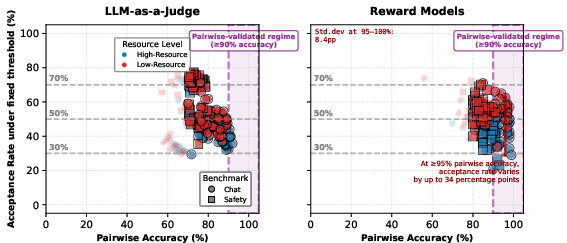
Figure 4: Acceptance rate divergence under a fixed global threshold compared to high and stable pairwise accuracy; reward models show up to 43% acceptance rate difference across languages, undetected by pairwise metrics.
Consequences in deployed settings are acute: harmful or unqualified content in lower-resource languages is more likely to evade safety filtering, and RLHF may inadvertently incentivize cross-lingual reward hacking.
Mechanistic Origins: Model Uncertainty and Language Identity
The counterintuitive elevation of scores for lower-resource languages is interrogated from a mechanistic standpoint. Quantitative analyses reveal a strong correlation between model uncertainty (measured via summed negative log-likelihood, NLL) and mean reward score at the language level.
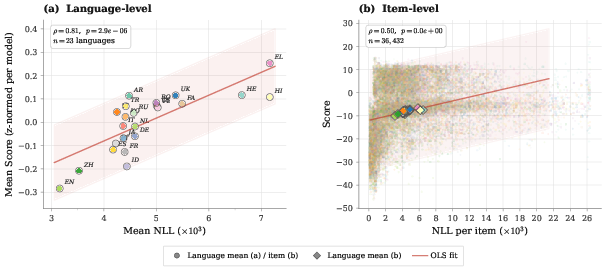
Figure 5: Higher model uncertainty (as NLL) is associated with elevated reward scores, both at the language and instance level.
Nevertheless, language identity remains a significant predictor of score even after controlling for uncertainty, as shown via model-based variance decomposition.
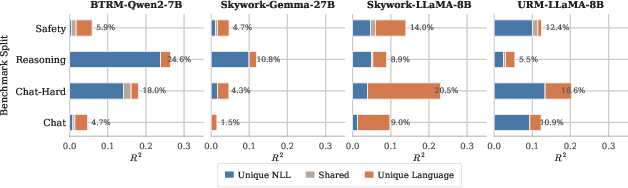
Figure 6: Variance in reward scores is partitioned into components attributed uniquely to NLL, uniquely to language, and jointly shared; language identity exerts substantial independent explanatory power, especially for certain domains and models.
Instance-level analyses clarify that within-language NLL–score correlations are inconsistent and often negative in conversational domains, indicating the bias cannot be reduced to a simple content-difficulty or uncertainty-driven effect.
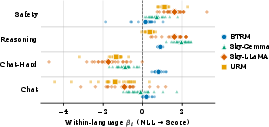
Figure 7: Within-language NLLtoScore slopes vary by domain and model, even reversing sign, evidencing that structural, language-level priors rather than item-level difficulty shifts drive the bias.
Broader Implications and Recommendations
The presence of robust, model-agnostic language-dependent scoring bias has far-reaching implications:
- Deployment Risks: Threshold-based filtering, safety auditing, and RLHF using current evaluator design propagate cross-lingual unfairness, creating security and fairness vulnerabilities in multilingual model deployments.
- Calibration Strategies: The most immediate fix—per-language thresholding—dramatically reduces acceptance-rate gaps (by 60.9%), but leaves substantial residuals and introduces operational complexity around language identification, which is brittle to code-switching and adversarial input construction.
- Recommended Protocols: More fundamental improvements call for language-aware reward model calibration, normalization during RLHF, balanced multilingual preference data, and evaluation frameworks that explicitly account for cross-language score consistency, not merely ranking agreement.
Conclusion
This work furnishes compelling evidence that LLM-based evaluators manifest substantial, cross-model-consistent, language-dependent scoring bias, invalidating the language-agnosticity assumption in multilingual settings. The effect is pervasive and directionally strong: lower-resource languages are systematically scored more generously. This structural bias is not explicable via pairwise accuracy, content difficulty, or uncertainty alone, but operates at a global language-identity level. Future research in multilingual LLM evaluation must embrace evaluation metrics and training paradigms that robustly quantify and mitigate this miscalibration, especially as safety and fairness in multilingual AI become increasingly critical.

