- The paper proposes a novel spin mapping framework that enforces spatial confinement by converting displacement fields into spin operators, resulting in a finite-dimensional Hilbert space.
- It demonstrates that the confined 1D phonon system exhibits a gapped spectrum with low-energy excitations described by a massive Dirac fermion model, eliminating conventional acoustic modes.
- The study identifies a quantum phase transition to a nonreciprocal state characterized by spontaneous time-reversal symmetry breaking and finite polarization charge currents.
Emergent Nonreciprocity in Confined 1D Phonon Systems: A Spin Mapping Framework
Introduction
The paper "Phonons in low-dimensional confined systems: Emergent non-reciprocity in 1D" (2607.14232) presents a formalism for capturing the physics of spatial confinement on phononic degrees of freedom in one-dimensional systems. In physical realizations such as low-dimensional materials (e.g., monolayers, nanowires) on substrates, and cold atoms in optical lattices, spatial confinement leads to a qualitative modification of phonon spectrum and collective excitations, notably gapping out the conventional acoustic branch associated with out-of-plane motion. The authors propose a non-canonical approach, termed "soft-corization," that directly enforces confinement by mapping real-space displacement fields to spin operators. This method leads to a gapped, finite-dimensional Hilbert space, naturally reflecting restrictions on ionic/atomic motion and enabling analysis of unconventional collective phenomena and symmetry breaking in reduced dimensionality.
Soft-corization: From Displacement Fields to Spins
The conventional phonon description, based on quantized harmonic oscillators with unlimited bosonic occupation, does not capture the essential physics of strong spatial confinement, principally because real-world constraints bound the motion and thus the maximal displacement/occupation at each site. The soft-corization mapping substitutes bosonic fields with spin operators—most simply spin-1/2—so that occupation per site is restricted (either 0 or 1 for hard-core bosons/spins). This leads to a finite-dimensional local Hilbert space even at high temperatures, encoding the quantum statistical mechanics of the system under confinement constraints.
The formal mapping yields a spin Hamiltonian for a 1D chain with couplings that depend on local occupation configurations. The symmetries of the system shift: while the conventional U(1) associated with total occupation/spin conservation is absent, there remains a global U(1) associated with staggered (alternating) spin, interpretable as conservation of "polarization charge"—the occupation difference between two sublattices (A, B). This mimics the conserved charge in certain charge density wave (CDW) and Rice-Mele-like models, but in this context is not the true electronic/ionic charge.
Exact Solution: Massive Dirac Fermions and Absence of Acoustic Modes
Upon application of the Jordan-Wigner transformation, the system maps to a fermion Hamiltonian with both quadratic and pairing-like terms, but without total particle number conservation. The resulting band structure consists of two gapped bands separated by $4h$ (where h is the onsite potential tuned by confining interactions). This is made explicit after a Bogoliubov transformation, which diagonalizes the Hamiltonian and yields low-energy excitations described by a massive Dirac fermion spectrum. At long wavelengths, bosonization demonstrates that the effective field theory is a sine-Gordon model with a relevant mass perturbation, i.e., the system lacks gapless acoustic modes due to spatial confinement—a direct hallmark of the approach.
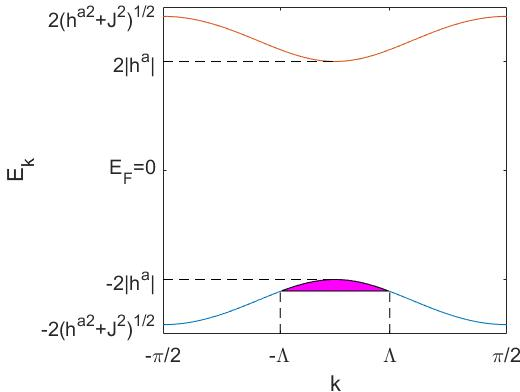
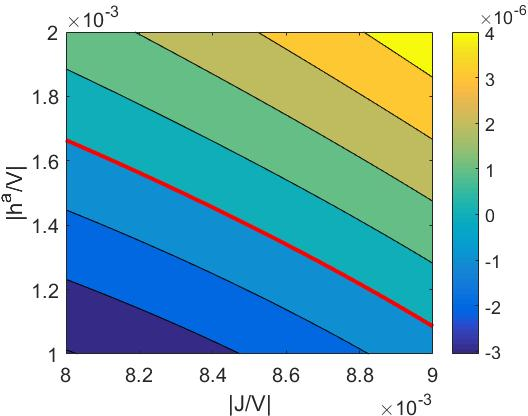
Figure 1: Dispersion relation of the confined 1D model shows a gapped spectrum and highlights the energy shell where interaction-driven instabilities emerge.
This formalism bridges the gap between conventional (ungapped) 1D phonon spectra and the observed gapped, confined behavior in realistic low-dimensional/lattice systems.
Emergent U(1) Symmetry and Polarization Charge Dynamics
The mapped model, though lacking conventional phonon number conservation, preserves a continuous symmetry under rotations of the bipartite Nambu spinor. The generator of this U(1) is the difference in occupation between the two sublattices (polarization charge). This symmetry supports collective transport phenomena distinct from those in traditional phononic/electronic systems. Both charge and heat currents are analyzed via continuity equations, yielding expressions that reflect the pair-creation/annihilation nature of transport, rather than simple one-body hopping.
Interactions, Nonreciprocity, and Spontaneous TRS Breaking
Introducing anharmonicity (in the bosonic language) or equivalently density-density interactions (in the spin/fermion mapping), the system supports a quantum phase transition above the gap into a nonreciprocal phase. In this phase, spontaneous time-reversal symmetry (TRS) breaking of the type T2=+1 occurs—distinct from the TRS protecting Kramers degeneracy in electronic topological phases, which is of the T2=−1 class.
A key result is the emergence of a nonzero order parameter Δ, directly proportional to the expectation value of an odd-parity triplet pairing term. Nonzero Δ leads to finite polarization charge and heat currents, constituting a nonreciprocal state. The paper identifies the phase boundary by solving the self-consistency equation for U(1)0 at zero temperature using the path-integral technique, where the transition is triggered for sufficiently strong attractive interactions.
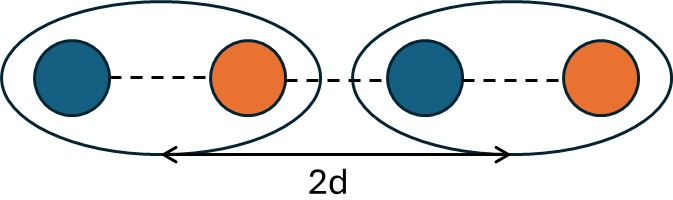
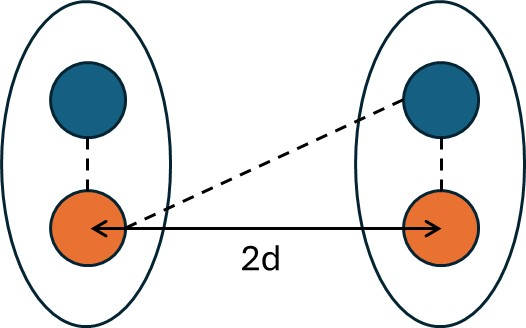
Figure 2: Left: Real-space schematic of the sublattice structure in the realistic basis. Right: Representation in the featureless basis, highlighting the abstraction of confinement and the artificial U(1)1 charge.
The phase boundary is calculated explicitly (Figure 1, right panel), and the region of nonreciprocal (TRSB) order is delineated as a function of the effective model parameters.
Coupling to Artificial Gauge Fields and Experimental Probes
Though the system is charge neutral, the emergent polarization charge can be coupled to artificial U(1)2 gauge fields (e.g., via synthetic electromagnetism in cold atom setups). The formulation in the so-called "featureless basis" clarifies the identification of the canonical momentum and the minimal substitution prescription for gauge coupling. Linear response yields a paramagnetic inductive susceptibility, whose variation with the nonreciprocity order parameter allows probing the TRSB phase experimentally via changes in inductivity.
Implications and Future Directions
The paper provides a systematic route for modeling confined collective modes in low-dimensional settings, establishing gapped phonon-like excitations with nontrivial symmetry and current properties. The observation of a quantum phase transition to a TRSB, nonreciprocal state with finite "polarization charge" current is robust at U(1)3, but in 1D is expected to be destabilized by thermal/quantum fluctuations at any finite U(1)4. However, extensions to long-range interactions or to higher dimensions may stabilize the ordered phase.
Experimentally, these findings are pertinent to nanostructures, cold atom systems, and potentially phonon engineering in mesoscopic circuits. The framework motivates further investigation into soft-corization with higher spins, interactions with electrons (e.g., in polaronic or mixed systems), and the design of active materials with tailored nonreciprocal properties. The approach can in principle be generalized to 2D and 3D geometries, where the interplay with established topological phonon and magnon states might yield further novel collective phenomena.
Conclusion
By mapping spatially confined bosonic degrees of freedom to spin operators, the formalism establishes a new theoretical pathway for analyzing phonon-like excitations under confinement. The emergent nonreciprocal phase, characterized by finite polarization charge and heat currents and spontaneous TRSB in a U(1)5 class, demonstrates the essential role of interaction effects in low-dimensional quantum systems under strong geometrical constraints. The predicted responses to artificial gauge fields provide concrete avenues for experimental verification and suggest broader applicability in the design and investigation of confined quantum materials and engineered lattices.