- The paper presents a Clifford-only realization of a quantum Reed-Solomon code constructed from a classical [7,3,5] RS code, enabling efficient error correction for biased-noise cat qubits.
- It employs a two-layer Tornado concatenation that combines an outer RS code with an inner three-qubit bit-flip repetition code to achieve a logical error suppression scaling of p^6.
- Numerical simulations indicate that the concatenated code reduces logical errors by up to 34-fold at a physical bit-flip rate of 0.1, outperforming its individual components.
Clifford-Only Quantum Reed-Solomon Codes and the Tornado Concatenation for Biased-Noise Cat Qubits
Introduction and Motivation
The study presents a direct Clifford stabilizer realization of quantum Reed-Solomon (RS) codes for biased-noise, dissipative cat qubits—an approach that leverages the extreme noise asymmetry available in bosonic encodings. In cat qubits, one of the Pauli channels (usually phase flip) can be exponentially suppressed, leaving only the bit-flip channel as the dominant noise. This permits the direct use of classical binary codes in quantum error correction: any binary linear code can be promoted to a quantum code that corrects only the dominant error. The work introduces a fully explicit [[21,9,6,1]] quantum RS code, realized Clifford-only, followed by a two-layer Tornado concatenation, enhancing the logical performance while maintaining efficient decoder implementation.
Quantum Reed-Solomon Code Construction
The basis of the methodology is the Clifford realization of a quantum RS code. Beginning with the classical [7,3,5] Reed-Solomon code over GF(23), a binary expansion yields a [21,9,6] code over GF(2), where each field symbol is represented by three bits. The systematic generator and parity-check matrices are explicitly constructed, allowing for state preparation and encoding solely with CNOTs:
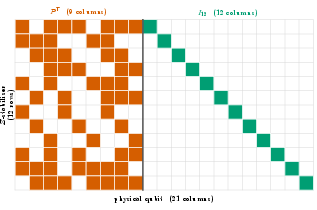
Figure 1: The systematic parity-check matrix H=[PT∣I12] of the binary-expanded quantum Reed–Solomon code; each row specifies a Z-type stabilizer on the physical qubits.
In this construction, the code’s stabilizers and logical operators are inherited directly from the classical code, and all operations are Clifford, admitting efficient simulation and implementation. The syndrome space coincides with that of the classical code, and error correction is performed with a lookup table decoding strategy that is optimal for the considered code size.
The Tornado Concatenation Architecture
To address the trade-off between the high rate of the RS code and the fragility associated with its modest distance, the paper concatenates the [[21,9,6,1]] RS code with an inner three-qubit bit-flip repetition code, forming the Tornado architecture:
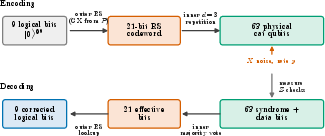
Figure 2: Encoding proceeds via the RS code (outer layer), with each of the 21 positions protected by an inner distance-three repetition code; decoding is performed in two stages: inner majority vote and outer lookup.
This yields a [[63,9,18]] code: 9 logical qubits are encoded into 63 physical cat qubits, with an X-distance of 18, suppressed phase-flip vulnerability ([7,3,5]0-distance 1), and rate [7,3,5]1. The decoder operates in two stages—first a blockwise majority vote (for each repetition code), then the RS lookup table—both exploiting the high noise bias.
Extensive numerical simulations demonstrate steep logical error suppression for the Tornado architecture relative to its parents. The logical error rates as a function of physical bit-flip rate [7,3,5]2 reveal asymptotic scalings for the different codes: [7,3,5]3 for repetition, [7,3,5]4 for RS, and [7,3,5]5 for Tornado.
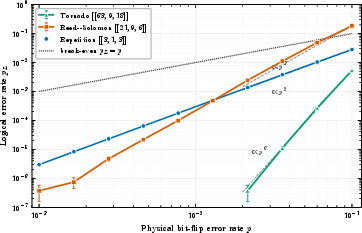
Figure 3: Logical error rate as a function of physical bit-flip rate [7,3,5]6 for repetition, Reed–Solomon, and Tornado codes, demonstrating the superior suppression rate of the Tornado architecture.
At [7,3,5]7, the Tornado code achieves a logical error rate of [7,3,5]8—improving over both parent codes by factors of 5.3 (repetition) and 34 (RS). As [7,3,5]9 decreases, the Tornado code’s advantage expands multiplicatively due to its steeper suppression exponent. Notably, under the implemented two-stage hard decision decoder, the scaling exponent is 6 (matching the minimum number of flips leading to failure), and the approach falls short of the full code distance limit (GF(23)0) that would be reachable by optimal soft-decision decoding over the concatenated code.
Resource Analysis and Decoder Realism
The construction trades rate for suppression. While the Tornado code employs more physical qubits per logical (GF(23)1) than repetition (GF(23)2) or standalone RS, it outperforms repetition for fixed error suppression at higher distance. The explicit code and decoder are compact—decode via lookup tables is scalable only for small codes, but the Reed-Solomon framework is extensible to larger instances, where alternative algebraic or belief propagation decoders must be used.
The results pertain to code-capacity noise (single-shot, no measurement or gate errors). In a realistic fault-tolerant setting, repeated syndrome extraction and resilience to GF(23)3-type noise must be addressed, especially given GF(23)4. The current proof-of-concept demonstrates code performance under ideal noise bias; generalization to the full circuit noise model will require further architectural augmentation.
Relation to Prior Work
This construction diverges from Grassl–Beth quantum RS codes, avoiding non-Clifford operations and instead opting for a fully Clifford, simulable circuit tailored for extreme noise bias in cat qubits. The two-layer concatenated architecture is reminiscent of classical Tornado codes, but is structurally simplified for quantum bias and distinguished by its use of a high-rate algebraic outer code. The design aligns with architectural trends in bosonic quantum error correction, e.g., repetition cat codes, LDPC-cat codes, and Elevator codes, but offers explicit constructions and analysis in the small-code limit.
Theoretical and Practical Implications
The explicit Clifford-only quantum RS code and the Tornado concatenation highlight the potential of high-rate classical codes in quantum error correction when the underlying hardware exhibits strong error bias. This approach enables the repurposing of powerful algebraic codes, previously unsuitable for quantum settings due to their complexity or decoding requirements, as practical quantum codes with efficient, optimal decoders. The central implication is that the bias of physical noise channels dramatically alters the design landscape of quantum error correcting codes, prioritizing rate, simplicity, and error suppression exponent over symmetry or dual correction capabilities.
The Tornado concatenation, through verified scaling, signals that algebraic code concatenation is substantially more resource-efficient for achieving a given suppression rate than naive repetition, especially in the strongly biased regime. Practically, as hardware implementations improve, the paradigms here are directly relevant to the design of logical memories and intermediate-scale processors with error asymmetry (cat qubits, etc.).
Conclusion
The work provides a constructive demonstration that, in the presence of high error bias, Clifford-only versions of maximum distance separable classical codes become highly attractive for quantum error correction. The Tornado concatenation, with its GF(23)5 logical error suppression in code-capacity simulations, offers an explicit and efficient framework bridging classical coding theory and quantum hardware realities. The approach prompts further work in constructing scalable code families, optimizing concatenation/decoder strategies, and extending to realistic circuit noise models, with immediate relevance for cat qubit and other correlated-bias hardware platforms.
Reference: "Clifford-Only Quantum Reed-Solomon Codes and a Tornado Concatenation for Biased-Noise Cat Qubits" (2607.13105)

