Spin Chain Quantum Communication on a Trapped-Ion Processor
Abstract: Efficient communication between distant qubits is one of the central challenges in scaling quantum processors. Although engineered spin chain protocols have been extensively investigated theoretically, their experimental realization has remained comparatively limited. Here, we experimentally realize engineered quantum communication protocols through digitally simulated spin Hamiltonian on IonQ's Forte 1/ Forte Enterprise 1 trapped-ion quantum processor. Combining exact numerical simulations with quantum hardware experiments, we benchmark uniform nearest-neighbour and engineered coupling profiles and demonstrate that engineered interactions significantly enhance the fidelity of quantum state transfer. We further show that exploiting the commutation structure of the spin Hamiltonian enables a parallel Trotter decomposition that more faithfully reproduces the target dynamics while substantially reducing the circuit depth and execution time compared to the conventional sequential implementations. Our results demonstrate that programmable quantum processors can effectively realize and efficiently implement quantum communication protocols, bringing Hamiltonian-based quantum communication closer to practical quantum technologies.
Paper Prompts
Sign up for free to create and run prompts on this paper.
Top Community Prompts
Explain it Like I'm 14
What is this paper about?
This paper shows a new way to move quantum information across a small quantum computer by letting the qubits’ natural interactions do the work, instead of using long chains of swap gates. The team uses a trapped‑ion quantum processor (from IonQ) to digitally “play out” the behavior of a line of spins (a spin chain) so that a quantum state placed on one end appears at the other end with high accuracy.
What questions did the researchers ask?
- Can a programmable quantum computer act like a “quantum data bus,” carrying a state along a spin chain without manually swapping it step by step?
- Do specially designed (engineered) interaction strengths between neighboring qubits move the state more cleanly than simple, uniform interactions?
- Can we implement the spin‑chain rules in smarter ways (in parallel) to make circuits shorter and results better?
- How well do these methods work on real hardware, and what kinds of errors show up?
How did they do it?
Think of a line of people passing a ball from the first person to the last. In a normal approach, you’d pass the ball person‑to‑person (many swaps). Here, the researchers set up the whole line so that, after a certain time, the ball just “waves” its way from one end to the other by itself.
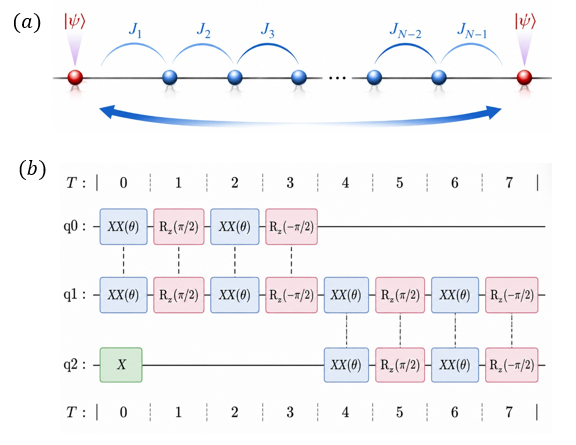
- The “line of people” is a chain of qubits (tiny quantum systems). The “rules” for how the ball moves are given by an XY spin Hamiltonian—basically, a set of instructions that make excitations (a “1” among “0”s) hop along the chain.
- Two kinds of chains were tested:
- Uniform chain: every neighbor pair interacts equally (simple but not ideal).
- Engineered chain: the neighbor interactions are carefully chosen (stronger in the middle, weaker at the ends) so the excitation travels without spreading out, enabling “perfect state transfer” in theory.
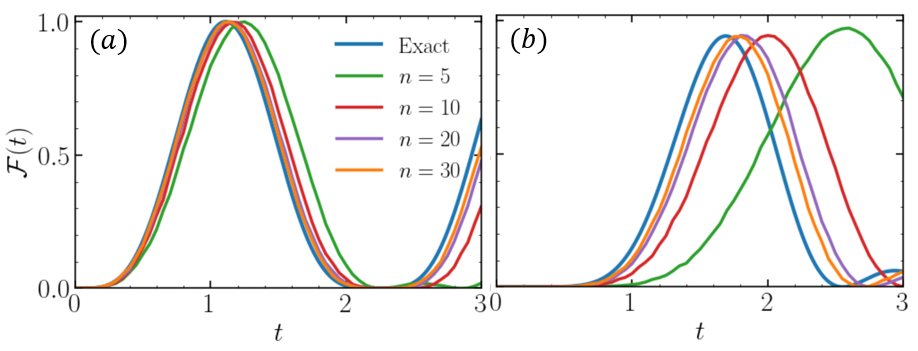
- Because real quantum computers are gate‑based, the team digitally mimicked continuous time evolution by breaking it into many tiny steps (this is called Trotterization). It’s like approximating a smooth glide with many quick, small moves.
- They also noticed that some pairs of qubits don’t affect each other at the same time (their operations “commute”). That means those interactions can be applied in parallel, shrinking the circuit depth and making the digital imitation closer to the ideal behavior.
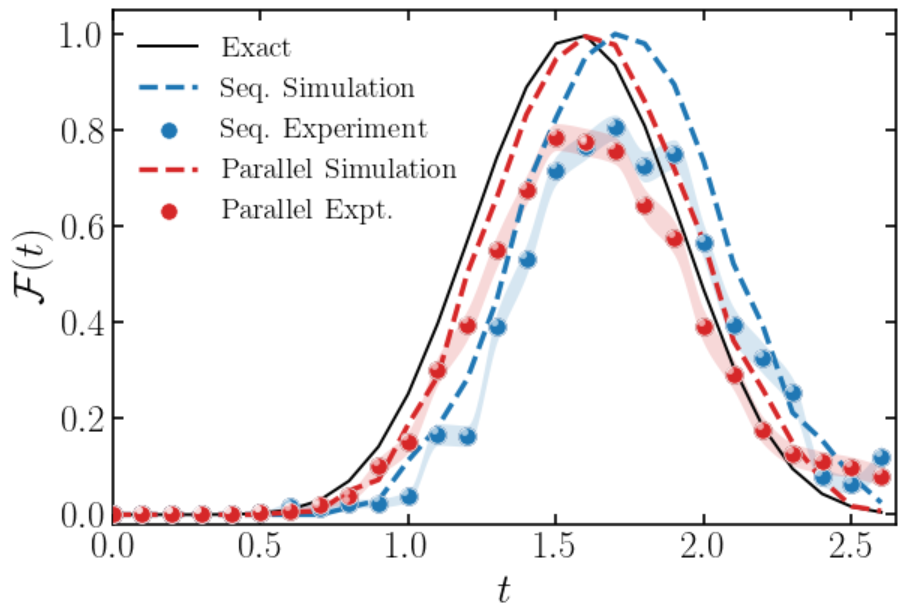
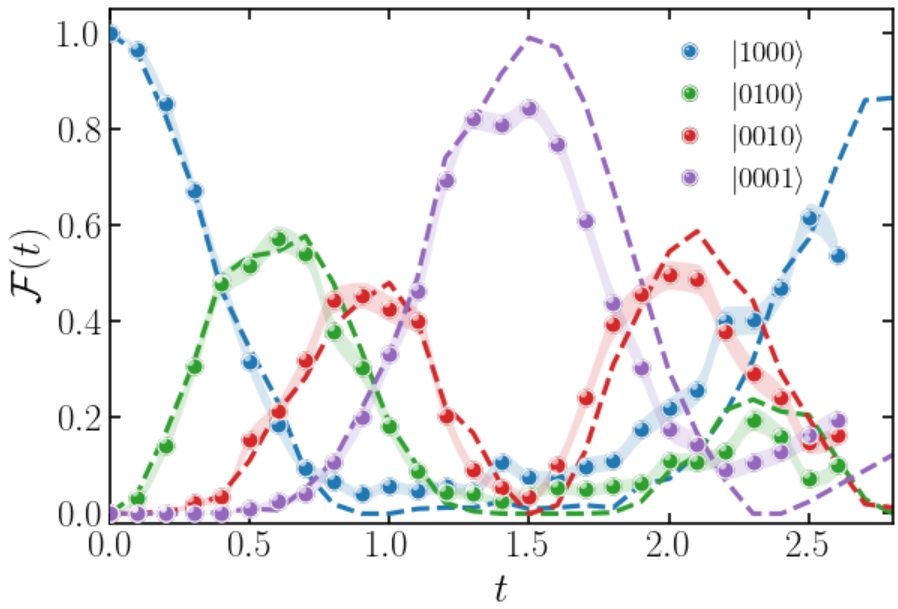
- They initialized a single “1” on the leftmost qubit (like putting the ball at the first person), ran the circuit for different durations, and measured how likely it was to find the “1” on the rightmost qubit—the state‑transfer “fidelity.” They compared hardware results to exact computer simulations.
Key terms in everyday language:
- Hamiltonian: the rulebook that tells a quantum system how to evolve in time.
- Trotterization: approximating a smooth action by many fast, small steps.
- Commuting interactions: operations that don’t get in each other’s way, so you can do them at the same time.
- Fidelity: a score from 0 to 1 for “how close did we get to the target state?”
What did they find, and why is it important?
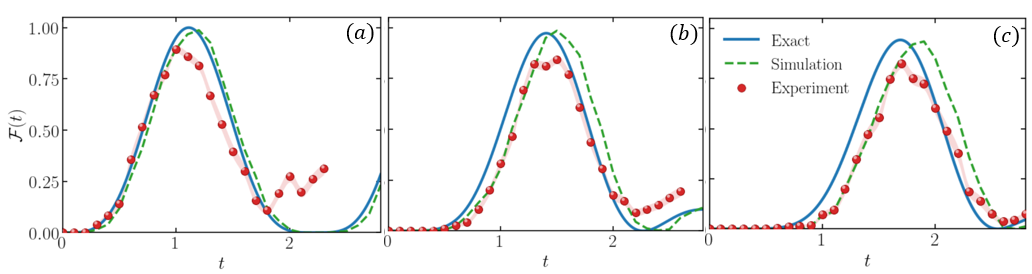
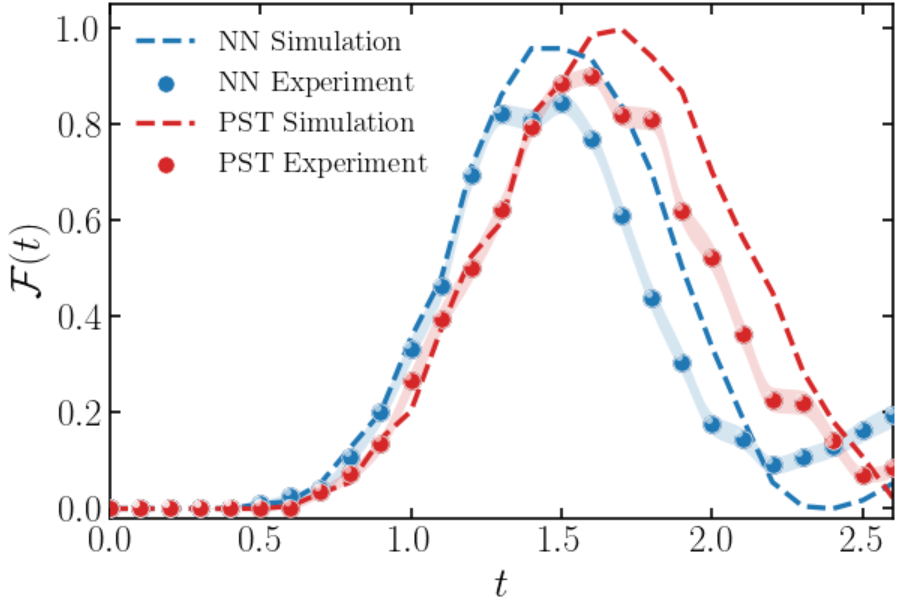
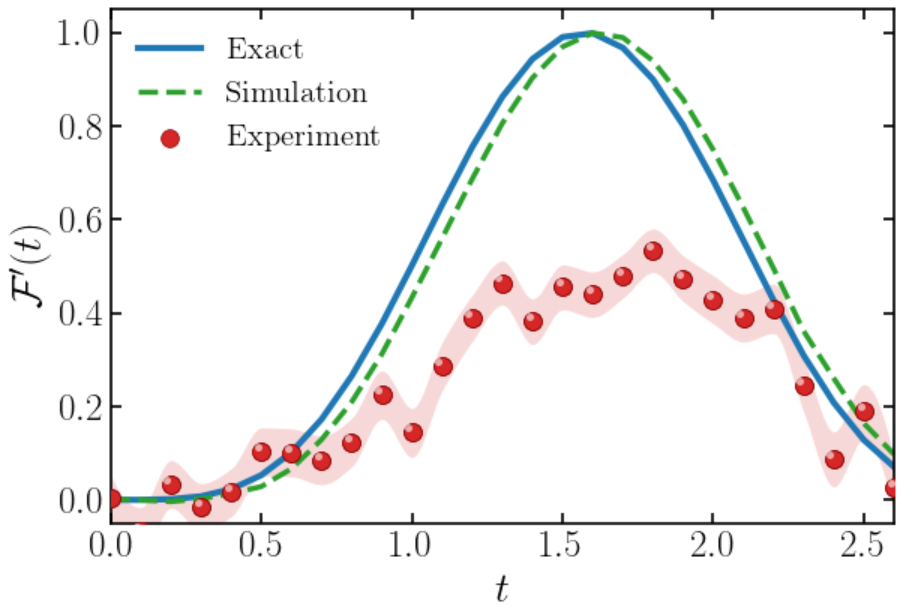
- Engineered couplings boost transfer quality: On the trapped‑ion processor, the engineered chain sent the state across the line more faithfully than the uniform chain, matching theory. That means careful “shaping” of interactions really helps.
- Clear quantum advantage: Even with uniform couplings, the best transfer fidelities were above the classical benchmark of $2/3$ for chains of 3, 4, and 5 qubits—evidence that the transfer was genuinely quantum.
- Faster, better with parallel steps: Grouping non‑interfering interactions and running them in parallel made circuits shorter and the results closer to the ideal evolution. It also reached the best transfer point sooner, reducing runtime and the chance for errors to pile up.
- Visualizing the journey: Measurements showed the excitation didn’t “teleport”; it flowed through intermediate qubits before arriving at the far end—just like a wave traveling along a string.
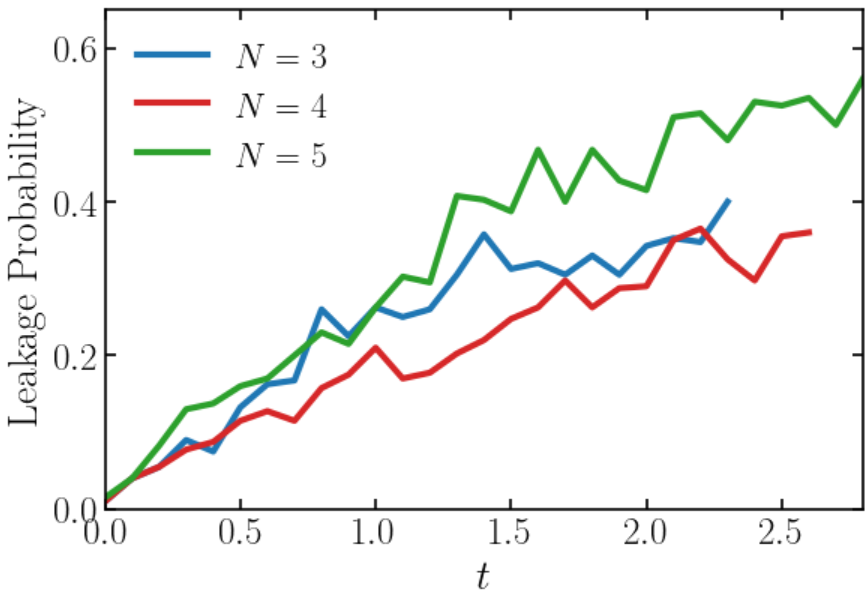
- Real‑world limits matter: Errors that change the total number of excitations (“leakage”) grew with longer circuits and larger chains. Hardware differences (calibration and platform version) also affected performance, reminding us that timing and device quality matter in experiments.
Why it matters: Moving quantum states quickly and accurately across a chip is essential for building larger, more useful quantum computers. This work shows a practical, programmable way to do that—using the system’s natural dynamics—on real hardware today.
What could this lead to?
- More scalable quantum machines: Communication is a bottleneck in big quantum processors. Spin‑chain‑based transport can cut down on long sequences of swaps and reduce errors.
- Smarter designs and bigger systems: Future work can explore longer chains, different interaction patterns (including long‑range ones), and complex layouts to route states and share entanglement across a device.
- Beyond single states: The same ideas could help distribute multi‑qubit entanglement and enable remote quantum operations, important for modular quantum computers and small quantum networks.
In short, the paper demonstrates that with the right interaction design and efficient digital techniques, today’s programmable quantum processors can already act as effective “quantum data buses,” bringing Hamiltonian‑based quantum communication closer to practical use.
Knowledge Gaps
Unresolved knowledge gaps, limitations, and open questions
Below is a concise, actionable list of what remains missing, uncertain, or unexplored in the paper, intended to guide future research:
- Scaling beyond small chains:
- Only N≤5 was tested; behavior of transfer fidelity, leakage, and error accumulation for larger N remains unknown, as do the system sizes at which engineered couplings maintain advantage over uniform NN on current hardware.
- Arbitrary-state transfer and channel characterization:
- Experiments largely probe single-excitation basis transfer; preservation of phase and transfer of an arbitrary qubit state (average state fidelity over the Bloch sphere) were not demonstrated via tomography.
- The reported >2/3 “quantum advantage” is based on basis-state transfer with post-selection; the unconditional average state (or process) fidelity benchmark remains unmeasured.
- Post-selection and unconditional performance:
- Fidelities are conditioned on remaining in the single-excitation subspace; unconditional end-to-end success probability and fidelity (including leakage and SPAM) were not reported, obscuring true application-level performance.
- Error budget and mitigation:
- No quantitative breakdown of error sources (two-qubit gate infidelities, dephasing, crosstalk, readout errors) or their relative contributions to leakage and fidelity loss.
- No application of standard error-mitigation techniques (readout-error mitigation, zero-noise extrapolation, symmetry verification as an active check, leakage reduction units); their impact on transfer fidelity is unknown.
- Optimal Trotterization and error bounds:
- Only first-order (Lie–Trotter) product formula was used; higher-order (e.g., Strang), randomized compiling (e.g., qDRIFT), or adaptive step-size strategies were not explored.
- No quantitative Trotter-error bounds or empirical trade-off analysis between Trotter error and hardware noise; the optimal number of steps as a function of N and target accuracy remains undetermined.
- “Parallel” Trotterization on trapped-ion hardware:
- The claimed depth/latency reduction via even–odd layering is not tied to demonstrated hardware concurrency limits (trapped ions typically have constraints on simultaneous two-qubit gates). Wall-clock speedup and actual two-qubit depth reduction were not quantified.
- Scheduling constraints (e.g., whether disjoint-pair gates with different angles can be physically executed simultaneously) and the resulting practical parallelism are not specified.
- SWAP baseline not empirically benchmarked:
- SWAP-based routing is only compared theoretically; a direct experimental comparison of fidelity, circuit depth, and runtime against Hamiltonian-mediated transfer under identical hardware conditions is missing.
- Engineered PST couplings at larger N:
- Improvement from PST couplings was only shown experimentally at N=4 (and compared against sequential/parallel at N=5); whether the engineered advantage grows with N, as predicted, is not validated on hardware.
- Robustness to imperfections:
- Sensitivity of PST performance to coupling-angle miscalibration, timing errors, and noise (static and time-dependent) is not quantified; tolerance thresholds for engineered profiles are unknown.
- Exact/free-fermionic compilations:
- The XY model is free-fermionic; exact circuit constructions (e.g., matchgate/Givens rotation networks or iSWAP-native compilations) that could avoid Trotter error were not investigated or compared.
- Long-range and alternative coupling profiles:
- Despite the platform’s all-to-all connectivity, only NN profiles were tested; engineered long-range profiles (predicted to expedite transfer) were not implemented or benchmarked.
- Statistical rigor and SPAM handling:
- Low shot counts (400) limit statistical precision; no bootstrapped confidence intervals or readout-error mitigation were applied, making uncertainty underestimation likely.
- Hardware variability and reproducibility:
- Data were collected on different processors at different times; there is no controlled cross-platform study or repeated runs to quantify drift. Calibration data and per-run device metrics are not provided.
- Resource accounting and scalability metrics:
- Gate counts, two-qubit depth, and total wall-clock execution time per circuit are not reported; the practical scalability (e.g., gate budget vs. N) and hardware throughput implications remain unclear.
- Commutator-error analysis for sequential vs parallel:
- No quantitative analysis or bounds for the reduction in Trotter error due to commuting-layer grouping; observed improvements are qualitative.
- Disorder and noise-resilient protocols:
- Robust transport under disorder, inhomogeneous couplings, or noise (e.g., optimized/robust profiles, error-robust control strategies) was not explored.
- Multi-excitation and entanglement distribution:
- Extensions beyond single-excitation dynamics (e.g., distribution of entanglement, multi-excitation transport, or remote gate implementation) were not experimentally demonstrated.
- Digital–analog or hybrid strategies:
- Potential benefits of hybrid digital–analog implementations on trapped ions (leveraging native analog interactions to reduce gate counts) were not investigated.
- Mapping and reproducibility details:
- The mapping from physical “time” t to rotation angles (θij=2JijΔt), calibration of J0, and exact circuit schedules/parameters are not fully documented; typos in equations further hinder reproducibility.
- Fair comparisons under depth budgets:
- Engineered PST and NN chains were not compared under matched two-qubit gate budgets or matched wall-clock times; performance-per-resource trade-offs remain unspecified.
- Crosstalk and spectator effects:
- Potential spectator-ion effects and crosstalk during entangling gates were not characterized; their contribution to leakage or fidelity degradation is unknown.
- Practical upper bound on chain length:
- The largest N feasible on current trapped-ion hardware (given gate errors, drift, and Trotterization overhead) is not estimated; a roadmap to N≈10–30 with concrete resource estimates is lacking.
Practical Applications
Practical applications derived from the paper
The paper demonstrates engineered spin-chain quantum communication on a trapped‑ion processor and introduces a parallel Trotterization strategy that improves fidelity and reduces circuit depth. Below are concrete applications that follow from the methods and findings.
Immediate Applications
- Engineered “quantum data bus” for remote qubit communication — sectors: software (compilers), hardware (trapped‑ion, superconducting), cloud quantum services
- What: Use engineered XY-chain blocks (PST couplings) to transmit states and distribute entanglement between distant qubits more efficiently than chains of SWAPs.
- Enabled by: Demonstrated higher transfer fidelity for engineered couplings over uniform NN; validated on IonQ hardware.
- Tools/workflows: A library of PST “communication primitives” callable in circuits; transpiler rule that replaces SWAP ladders with PST blocks when XY (XX+YY) is available; integration into cloud services (e.g., AWS Braket notebooks) for remote-state initialization.
- Assumptions/dependencies: Availability of native or compiled XX/YY gates; sufficient coherence for 10–30 Trotter steps; device supports scheduling of non-overlapping couplings; calibration of coupling angles.
- Compiler pass for parallel Trotterization of XX+YY Hamiltonians — sectors: quantum software/tooling, hardware-aware compilation
- What: Schedule commuting even–odd interaction layers in parallel to cut circuit depth from O(N) to O(1) per Trotter step.
- Enabled by: Paper’s even–odd layering and empirical fidelity improvement at reduced depth.
- Tools/workflows: Transpiler plug‑ins that (i) detect commuting subsets, (ii) generate two‑layer entangling schedules, (iii) auto‑tune Trotter steps vs hardware error.
- Assumptions/dependencies: Hardware/SDK supports parallel or time‑sliced execution of disjoint 2‑qubit gates; mapping must avoid shared qubits and crosstalk constraints.
- Communication‑fidelity benchmarking and calibration — sectors: hardware vendors, cloud providers, standards
- What: Use state‑transfer fidelity and leakage into non‑conserving sectors as a device‑level “communication metric.”
- Enabled by: Reported leakage trends vs chain length/time; >2/3 classical threshold achieved; sensitivity to calibrations highlighted.
- Tools/workflows: SpinChainCommBench: sweep N, time, Trotter steps; report max transfer fidelity, leakage rate, depth; regression tests across calibrations/updates.
- Assumptions/dependencies: Stable access to hardware and consistent calibration windows; standardized shot counts and post‑selection.
- Post‑selection and conserved‑quantity error mitigation — sectors: quantum algorithms, NISQ applications
- What: Use excitation‑number conservation to filter outcomes (single‑excitation subspace) and renormalize, improving observable estimates.
- Enabled by: Paper’s leakage analysis and SES post‑selection procedure.
- Tools/workflows: Reusable SES post‑selection wrapper for transport and XX‑model simulations; integrate into experiment runners.
- Assumptions/dependencies: Model must conserve excitation number ideally; post‑selection reduces effective sample size.
- Educational laboratory modules on Hamiltonian transport — sectors: education, training
- What: Hands‑on labs demonstrating dispersion vs engineered spectra, Trotter convergence, and parallelization benefits.
- Enabled by: Clear side‑by‑side uniform vs PST demonstrations; convergence figures; simple single‑excitation setup.
- Tools/workflows: Jupyter notebooks for cloud QPUs (IonQ via Braket); prebuilt circuit templates; automated analysis of fidelities/leakage.
- Assumptions/dependencies: Student access to cloud credits/devices; small N (3–5) to fit quota and coherence.
- Platform‑agnostic adaptation of PST blocks — sectors: superconducting circuits, neutral atoms
- What: Port engineered XX/YY transport to platforms with tunable couplers (superconducting) or controlled interactions (Rydberg arrays).
- Enabled by: Method uses generic XX/YY decomposition and Trotterization; prior works show feasibility on other platforms.
- Tools/workflows: Backend‑specific parameter mapping (pulse-level for tunable couplers; blockade‑assisted sequences for Rydberg).
- Assumptions/dependencies: Ability to approximate XX/YY with acceptable error; calibration infrastructure for nonuniform couplings.
- Communication‑aware layout and routing in variational and simulation workloads — sectors: quantum software, end‑user applications
- What: Reduce two‑qubit gate count and execution time by replacing SWAP ladders with PST transfers in VQE/QAOA/simulation circuits that require long‑range interactions.
- Enabled by: Demonstrated fidelity/time advantages and depth reductions from parallelization.
- Tools/workflows: Compile‑time “communication budget” optimizer that weighs PST vs SWAP vs measurement‑based teleportation given hardware parameters.
- Assumptions/dependencies: Accurate cost models of device errors and timings; access to device topology and concurrency constraints.
Long‑Term Applications
- Scalable on‑chip quantum interconnects via Hamiltonian buses — sectors: quantum hardware architecture (trapped‑ion, superconducting), systems engineering
- Vision: Incorporate engineered spin‑chain buses as persistent interconnects between logical regions/tiles to reduce routing overhead in large processors.
- Dependencies: Higher‑fidelity two‑qubit gates, robust calibration of non‑uniform couplings at scale, automated tuning; compatibility with crosstalk limits.
- Risks/assumptions: Scaling leakage and coherence constraints; integration with cryogenic/ion‑trap control electronics and timing.
- Remote entangling gates and logic buses for fault‑tolerant architectures — sectors: fault‑tolerant quantum computing
- Vision: Use PST buses to enact remote entangling gates between logical qubits/patches, reducing SWAP overhead in surface/LDPC code layouts.
- Dependencies: Fault‑tolerant implementations of XX/YY or encoded Hamiltonian segments; rigorous error analysis within code thresholds; synchronized parallel layers.
- Risks/assumptions: Error propagation through many‑body buses; syndrome extraction timing compatibility.
- Hybrid digital‑analog blocks co‑designed with compilers — sectors: hardware–software co‑design
- Vision: Create native analog “transport pulses” implementing PST spectra, exposed as first‑class compiler primitives to minimize Trotter error.
- Dependencies: Hardware support for shaped analog couplings and calibration; verification and certification tooling; standardized IR for analog blocks.
- Risks/assumptions: Drift and model mismatch; verification of analog behavior across devices.
- Communication standards and procurement metrics for quantum systems — sectors: policy, standards bodies, government/enterprise procurement
- Vision: Define standardized “quantum communication fidelity,” “leakage rate,” and “parallelization efficiency” metrics for device benchmarking and contracts.
- Dependencies: Community consensus, inter‑platform comparability, open benchmark suites (e.g., SpinChainCommBench); reporting guidelines.
- Risks/assumptions: Metric gaming; dependence on specific Hamiltonian capabilities (XX/YY availability) across platforms.
- Distributed and modular quantum computing with engineered links — sectors: quantum networking, modular architectures
- Vision: Combine on‑chip engineered buses with photonic or ion‑shuttle interconnects to route states within and across modules, enabling modular scale‑out.
- Dependencies: Synchronization across modules, low‑latency classical control, error‑resilient interfacing; cross‑module calibration.
- Risks/assumptions: Accumulated latency and loss; complexity of multi‑module scheduling.
- Accelerated state and excitation transport in quantum simulators — sectors: quantum simulation (chemistry, materials)
- Vision: Use engineered transport to move excitations/quasiparticles within simulator lattices for faster state preparation or measurement.
- Dependencies: Mapping model Hamiltonians to controllable XX/YY buses; integration into simulation workflows; preserved model fidelity.
- Risks/assumptions: Model distortion from engineered couplings; scaling Trotter error vs algorithmic gains.
- Automated discovery of coupling profiles beyond PST for specific hardware — sectors: quantum optimization, AI‑assisted design
- Vision: Use numerical optimization/ML to design hardware‑aware coupling schedules that maximize end‑to‑end task performance (fidelity × speed).
- Dependencies: High‑quality device models, differentiable compilers or black‑box optimization frameworks, robust calibration loops.
- Risks/assumptions: Overfitting to transient calibrations; transferability across devices and time.
- Reduced‑overhead entanglement distribution for quantum communication stacks — sectors: quantum networks, secure communications
- Vision: Employ engineered chains inside nodes to quickly prepare remote Bell pairs for inter‑node protocols (teleportation, QKD extensions).
- Dependencies: Integration with photonic interfaces, timing with heralding signals, robust error detection/mitigation on chains.
- Risks/assumptions: Interplay of chain errors with network losses; standardization across heterogeneous hardware.
Notes on feasibility across all items:
- Performance gains depend on device specifics: two‑qubit gate fidelities, coherence times, parallel gate execution capabilities, and crosstalk.
- Benefits grow with distance between qubits and system size; small‑N devices may see modest advantages over well‑calibrated SWAPs.
- Trotterization trade‑offs (discretization vs hardware error) require auto‑tuning; analog implementations could remove this in the long term.
- Conservation‑based post‑selection is model‑specific; generalization requires conserved quantities or symmetries in target dynamics.
Glossary
- all-to-all qubit connectivity: Hardware property where any qubit can directly interact with any other qubit without intermediate routing. "owing to their high-fidelity gate operations, all-to-all qubit connectivity, and the flexibility to digitally synthesize programmable spin Hamiltonians~\cite{Kielpinski2002,Blatt2012,Wright2019,Pino2021,Monroe2021}."
- binomial counting statistics: A model for estimating statistical uncertainty in measurement outcomes with two possibilities (success/failure) over repeated trials. "The statistical uncertainty arising from finite sampling was estimated assuming binomial counting statistics."
- circuit depth: The number of sequential gate layers in a quantum circuit, impacting error accumulation and runtime. "Increasing the number of Trotter steps reduces the discretization error but simultaneously increases the circuit depth and, consequently, the number of entangling gates executed on the trapped-ion processor."
- commutation structure: The pattern of which Hamiltonian terms commute, enabling simultaneous execution of compatible interactions. "We further show that exploiting the commutation structure of the spin Hamiltonian enables a parallel Trotter decomposition that more faithfully reproduces the target dynamics while substantially reducing the circuit depth and execution time compared to the conventional sequential implementations."
- decoherence: Loss of quantum coherence due to interaction with the environment, degrading quantum information. "The small reduction in the experimentally measured fidelities relative to the ideal simulations is primarily attributed to finite gate fidelities, decoherence, and readout errors accumulated during the digital implementation."
- digitally simulated spin chains: Emulation of spin-chain dynamics using discrete gate sequences on a quantum processor. "demonstrating that digitally simulated spin chains can be faithfully implemented on a trapped-ion quantum processor."
- entangling layer: A set of two-qubit entangling gates that can be executed in parallel in one time step. "A first-order Suzuki--Trotter decomposition then naturally implements each Trotter step using only two successive entangling layers, one containing all odd bonds and the other all even bonds."
- engineered coupling profile: Deliberately designed interaction strengths in a spin chain to achieve desired transport properties. "Next we consider the engineered coupling profile proposed by Christandl et al. \cite{Christandl2004},"
- even-odd decomposition: Partitioning of nearest-neighbour interactions into alternating (even/odd) commuting sets for parallel execution. "the even-odd decomposition requires only two entangling layers irrespective of the system size."
- excitation-number conservation: A symmetry where the total number of excitations remains constant during evolution. "We consider ferromagnetic couplings (), for which the Hamiltonian conserves the total excitation number, making it a convenient model for quantum state transfer \cite{Gier2017}."
- exchange coupling: The interaction strength mediating spin-exchange processes between qubits. "where and denote the Pauli operators acting on qubit , and is the exchange coupling between qubits and ."
- ferromagnetic coupling: An interaction favoring aligned spins, here indicated by negative coupling constants. "We consider ferromagnetic couplings (),"
- gate fidelities: Measures of how accurately quantum gates are implemented compared to their ideal operations. "The small reduction in the experimentally measured fidelities relative to the ideal simulations is primarily attributed to finite gate fidelities, decoherence, and readout errors accumulated during the digital implementation."
- Hamiltonian engineering: Tailoring a system’s Hamiltonian (interaction terms) to realize specific dynamics or protocols. "Together, these results establish Hamiltonian engineering and optimized digital simulation as powerful tools for realizing scalable quantum communication on future programmable quantum processors."
- leakage probability: The probability that the system leaves the intended computational subspace during execution. "To quantify the extent of this effect, we define the leakage probability as"
- Lie–Trotter product formula: A method to approximate the exponential of a sum of noncommuting operators by sequential exponentials of the parts. "Since the processor is gate-based, the continuous time evolution generated by Eq.~(\ref{eq:time_evolution}) is approximated using the first order Lie-Trotter product formula \cite{Trotter1959,Hall2015Ch2},"
- many-body dynamics: Collective behavior arising from interactions among multiple particles or qubits. "These developments established engineered spin chains as a promising framework for realizing efficient quantum communication through controlled many-body dynamics."
- nearest-neighbour (NN) coupling: Interactions restricted to adjacent qubits in a chain. "We first consider uniform nearest-neighbour (NN) couplings,"
- no-cloning theorem: The principle that unknown quantum states cannot be copied perfectly. "Unlike classical information, arbitrary quantum states cannot simply be copied because of the no-cloning theorem~\cite{Wootters1982}."
- Pauli operators: Fundamental single-qubit operators X, Y, Z used to describe spin and quantum gate operations. "where and denote the Pauli operators acting on qubit "
- parallel Trotter decomposition: A Trotterization strategy that executes commuting interaction terms simultaneously to reduce depth. "enables a parallel Trotter decomposition that more faithfully reproduces the target dynamics while substantially reducing the circuit depth and execution time compared to the conventional sequential implementations."
- perfect state transfer (PST): Transport protocol achieving unit-fidelity transfer of a quantum state across a chain at a specific time. "which produces an equally spaced energy spectrum and enables perfect state transfer (PST) in ideal spin chains."
- post-selection: Discarding measurement outcomes that indicate errors or leakage, followed by renormalizing the remaining data. "This post-selection removes leakage events and enables a direct comparison between the experimental results and the ideal single-excitation dynamics."
- quantum advantage: Performance surpassing what is achievable by classical methods for the same task. "Nevertheless, the measured fidelities remain above the classical threshold of $2/3$ for all system sizes investigated, demonstrating a quantum advantage."
- quantum data bus: A medium that transports quantum information between distant nodes using system dynamics. "In 2003 it was first proposed that spin chains could function as quantum data buses, allowing quantum information to propagate through the natural Hamiltonian evolution of coupled spins"
- quantum state transfer: Moving a quantum state from one qubit to another via system evolution or gates. "Quantum state transfer in spin chains provides a natural mechanism for communicating quantum information between spatially separated qubits through the intrinsic dynamics of interacting many body systems \cite{Bose2003}."
- readout errors: Measurement inaccuracies that lead to incorrect outcome reporting. "The small reduction in the experimentally measured fidelities relative to the ideal simulations is primarily attributed to finite gate fidelities, decoherence, and readout errors accumulated during the digital implementation."
- sequential implementation: Applying interaction terms one after another within each Trotter step, without parallelization. "compared to the conventional sequential implementations."
- single-excitation subspace (SES): The subspace spanned by states with exactly one excitation across all qubits. "where the summation is taken over all basis states belonging to the single-excitation subspace (SES)."
- spin chain: A linear array of interacting spin-1/2 systems used to study transport and communication. "Quantum state transfer in spin chains provides a natural mechanism for communicating quantum information between spatially separated qubits"
- state-transfer fidelity: The probability that the evolved state matches the desired target state at a given time. "Comparison of the state-transfer fidelity for a four-qubit spin chain with uniform NN and engineered PST coupling profiles."
- Suzuki--Trotter decomposition: A product-formula method improving Trotter approximations by organizing commuting sets; here used in first order. "A first-order Suzuki--Trotter decomposition then naturally implements each Trotter step using only two successive entangling layers, one containing all odd bonds and the other all even bonds."
- SWAP gate: A two-qubit operation that exchanges the states of two qubits. "On gate-based quantum processors, communication between distant qubits is conventionally achieved through sequences of nearest-neighbour SWAP gates."
- trapped-ion quantum processor: A quantum computer architecture using trapped ions as qubits with laser-mediated gates. "Here, we experimentally realize engineered quantum communication protocols through digitally simulated spin Hamiltonian on IonQ's Forte 1/ Forte Enterprise 1 trapped-ion quantum processor."
- Trotter step: A discrete time-slice in Trotterized evolution; more steps reduce approximation error but increase depth. "Throughout this work we employ 30 Trotter steps, which provide converged transfer fidelities and transfer times for the system sizes considered whilst keeping the circuit depth sufficiently low for reliable experimental implementation."
- unitary operator: A norm-preserving linear operator describing reversible quantum evolution. "The system evolves according to the unitary operator"
- XX interaction: A two-qubit interaction proportional to X⊗X, implementable as a native entangling gate on trapped ions. "The trapped-ion architecture of IonQ is particularly well suited to this implementation because the required and interaction terms can be efficiently synthesized"
- XY Hamiltonian: A spin model with nearest-pair XX and YY couplings used for excitation-preserving transport. "Throughout this work we consider a one dimensional spin chain of qubits described by the XY Hamiltonian,"
- YY interaction: A two-qubit interaction proportional to Y⊗Y, complementing XX in the XY model. "The trapped-ion architecture of IonQ is particularly well suited to this implementation because the required and interaction terms can be efficiently synthesized"

