- The paper introduces a framework that isolates and suppresses intrinsic spin-phonon errors in trapped-ion quantum simulations.
- It employs frame transformations and waveform optimization to decouple spin interactions from phonon-mediated errors, achieving orders-of-magnitude error reduction.
- Numerical benchmarks on multi-ion chains confirm low error levels while retaining programmability for complex Ising interaction graphs.
Suppressing Intrinsic Spin-Phonon Errors in Trapped-Ion Quantum Simulation
Introduction
Accurate analog quantum simulation of noncommuting spin models in trapped-ion platforms is fundamentally constrained by intrinsic spin-phonon errors arising from the phonon-mediated interaction mechanism. Unlike external decoherence or control imperfections, these errors are generated coherently by the boson "bus" mediating spin-spin coupling and persist even with standard loop-closing protocols designed for commuting Hamiltonians. This work introduces a constructive theoretical and computational framework for isolating and suppressing these intrinsic errors, employing frame transformations and waveform optimization to extend high-fidelity quantum simulation to noncommuting many-body Hamiltonians.
Intrinsic Spin-Phonon Error Mechanisms
The spin-boson Hamiltonian for trapped-ion simulators encapsulates the interplay between effective spin-21 degrees of freedom and collective phonon modes, with programmable Ising couplings generated by near-symmetric bichromatic light fields. For commuting models (e.g., Bj=0 in a transverse-field Ising model, TFIM), standard intuition guarantees error suppression via phonon loop closure: the displacement trajectories αjk(t) are engineered to vanish at the final time, thereby restoring spin-phonon separability and yielding ideal spin dynamics. However, in the presence of noncommuting fields (Bj=0), the evolution of the phonon trajectories becomes history-dependent due to nontrivial commutator structure, producing residual entanglement between the spins and phonons that is not removable by endpoint closure alone.
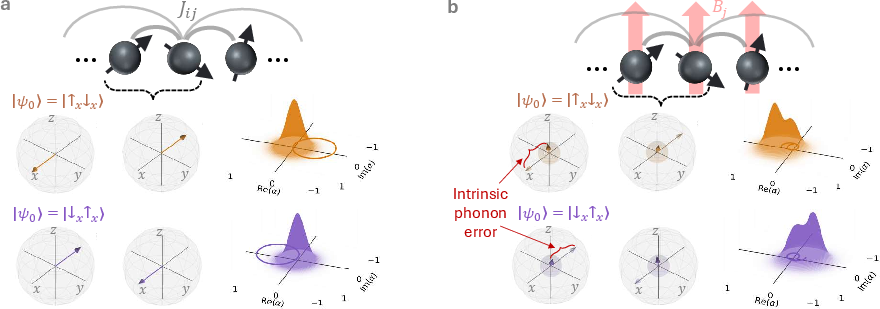
Figure 1: Simulated intrinsic phonon error for a two-spin, one-mode trapped-ion system; noncommuting fields yield non-Gaussian reduced phonon states and decohered spin Bloch spheres, in contrast to the error-free commuting case.
The simulation in Figure 1 demonstrates that even for waveforms yielding perfect loop closure at t=T, noncommuting transverse fields induce persistent spin-phonon correlations—visible as non-Gaussian projections in phase space and mixed reduced spin states—resulting in nonunitary spin channel dynamics post phonon tracing.
To suppress history-dependent residual errors, the work constructs a hierarchy of unitary transformations, successively decoupling target spin interactions from unwanted phonon dressing. By adopting a displacement frame informed by the instantaneous phonon equilibrium (dependent on spin configuration), the residual Hamiltonian separates into explicit TFIM dynamics and an error term ϵ^(t). The latter acts as a phonon-dependent spin rotation and can be eliminated up to desired order by enforcing closure not only of the phase-space displacement but also of its temporal moments.
Further, the introduction of a kick operator yields a transformed Hamiltonian where the remaining error terms are parametrically suppressed both by the small phonon displacement amplitude and the detuning scale, making them subdominant in practical regimes relevant for analog simulation.
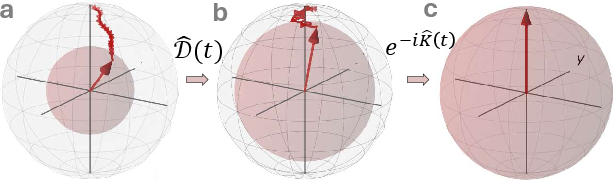
Figure 2: Schematic of multi-frame analysis showing the transition from mixed to nearly pure Bloch sphere trajectories via sequential displacement and kick operator transformations.
The authors define waveform constraints in terms of vanishing low-order shifted-Legendre moments of αjk(t) and enforce closure of both displacement and kick trajectory, thus suppressing secular (low-frequency) phonon excitation. Importantly, the Ising couplings depend on bilinear products of displacements and their derivatives, allowing for interaction programmability to be retained despite strong filtering of unwanted error channels.
Numerical Error Benchmarks
Full spin-boson simulations are performed for a four-ion chain, engineering various interaction graphs and benchmarking against standard analog-simulation drives and amplitude-modulated loop-closing pulses. By quantifying the nonunitarity of the reduced spin channel after subtracting the intended TFIM evolution, the method provides a direct diagnostic of intrinsic, irreducible errors beyond classical control defects.
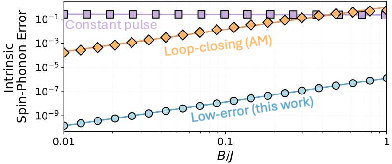
Figure 3: Benchmark showing orders-of-magnitude reduction in intrinsic spin-phonon error as a function of transverse field strength for the proposed waveform family compared to standard controls.
Over a broad range of transverse field strengths, the optimized controls suppress the error by several orders of magnitude compared to amplitude-modulated and constant pulses. Notably, the error remains low even in regimes where noncommuting dynamics dominate and previous protocols fail.
Retention of Programmability
A critical requirement for practical simulators is retention of interaction graph programmability under stringent error constraints. The vector space of waveform coefficients projected through the null space of the closure constraints admits nonlinear optimization targeting diverse Ising matrices Jij, including long-range, sign-flipped, and oscillatory coupling patterns.
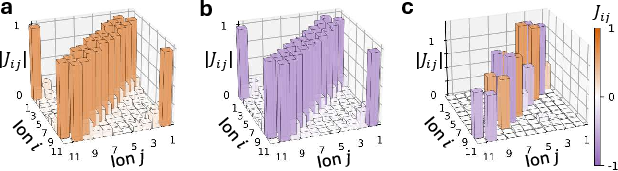
Figure 4: Representative Ising interaction graphs realized in an $11$-ion chain under low-error constraints, demonstrating versatility in programmable coupling design.
Programmability is thus not compromised by the imposition of error-suppressing constraints, enabling simulated investigation of frustrated, quasiperiodic, and Floquet-engineered phases in trapped-ion processors.
Practical and Theoretical Implications
The presented approach provides a robust and efficient procedure for the experimental realization of noncommuting spin models in bosonic-mediator architectures, with demonstrated applicability to finite-temperature phonon occupations. Classical preprocessing is limited to the solution of a constrained control problem and does not require simulation of the full target many-body quantum dynamics. Consequently, these developments remove a central theoretical and experimental barrier to high-fidelity analog quantum simulation in platforms with strong spin-phonon coupling.
This framework may be extended to general bosonic mediator scenarios, including open-system and multi-body interactions, and is compatible with narrow-bandwidth modulators commonly available in current experimental setups. The ability to program arbitrary interactions with low intrinsic error in this regime opens new avenues for investigating quantum criticality, nonequilibrium dynamics, and quantum information processing in large-scale trapped-ion systems.
Conclusion
This work presents a general and scalable solution to the longstanding problem of intrinsic spin-phonon errors in trapped-ion quantum simulation of noncommuting many-body Hamiltonians. By isolating the precise mechanism for irreducible error generation and introducing efficient history-dependent control conditions, orders-of-magnitude improvements are obtained in simulation fidelity without sacrificing programmability. The formalism and practical tools outlined here directly enable high-precision studies of spin-boson physics, Floquet engineering, and quantum phase transitions in next-generation qubit arrays.