Weighted Phase-Space Paths for Exact Wigner Dynamics
Published 7 May 2026 in quant-ph and math-ph | (2605.05764v1)
Abstract: A quantum state can be written in phase space, but the resulting object is not generally the probability density of a positive stochastic process on ordinary phase space. We spell this out for Wigner dynamics. If a positive phase-space process is required only to reproduce the Born density after integrating over momentum, the requirement fixes only an integrated current; the local drift and diffusion remain underdetermined. If one instead requires all Weyl-ordered expectation values, the phase-space object is fixed to be the Wigner function. For non-quadratic potentials the Wigner--Moyal generator contains higher-order, signed momentum-transfer terms, so it is not the Fokker--Planck generator of a positive Brownian diffusion. The exact Wigner function must therefore be reconstructed, in a stochastic representation, as a weighted empirical measure [ \FW(\z,t)=\E_{\Pp}[W_tδ(\z-\z_t)], \qquad \z=(q,p), ] rather than the unweighted density of sampled carrier trajectories. With classical Hamiltonian flow as the carrier, all nonclassical correction beyond classical transport sits in the Moyal residual and can be represented by signed weights or branching events. The same split defines a residual diagnostic that vanishes for quadratic Hamiltonians and measures what classical carrier transport misses in anharmonic dynamics. The formulation also gives a forward--reverse relation for signed Wigner path measures. The ratio of forward and reversed contributions separates into a positive magnitude factor and a sign factor. This sign records the parity of the Wigner interference contribution; it is not a thermodynamic entropy production.
The paper demonstrates that exact quantum phase-space dynamics require weighted, signed sampling to fully recover the Wigner evolution.
It introduces a split formalism where classical carrier paths are corrected by a weighted residual to account for quantum nonclassical effects.
The results emphasize that matching only position marginals is insufficient, necessitating full Weyl-ordered constraints to capture interference and Moyal residuals.
Weighted Phase-Space Paths for Exact Wigner Dynamics
Conceptual Foundations
This paper rigorously analyzes stochastic phase-space representations of quantum dynamics, focusing on the Wigner function's role and the limitations of positive stochastic analogs. In classical mechanics, path sampling via positive phase-space densities is straightforward; trajectories sampled from a positive measure collectively reconstruct the ensemble density. However, in quantum mechanics, the Wigner function—while fully encoding the quantum state and its evolution via the Wigner--Moyal equation—is generally a signed quasiprobability, not an ordinary probability density. The paper identifies a fundamental incompatibility: exact quantum phase-space dynamics cannot generally be recovered by sampling positive stochastic phase-space processes.
It is proven that matching the Born density through position marginals—while tempting—fixes only the integrated phase-space current, not the local drift and diffusion. Even with additional moment constraints, the positive phase-space Langevin process remains underdetermined. Only by enforcing all Weyl-ordered expectation values is the phase-space object uniquely defined as the Wigner function. Hudson's theorem and related results further constrain the possibility of non-negative Wigner functions to Gaussian states, highlighting the necessity of signed representations in general.
Failure of Positive Langevin Closure
A central technical claim is that, for non-quadratic potentials, the Wigner--Moyal generator contains higher-order (odd) derivatives in momentum:
these cannot be generated by any Fokker--Planck operator with a positive diffusion matrix. Thus, the Wigner function cannot generally be interpreted as the density of a positive phase-space Brownian process except in the quadratic case.
Weighted Stochastic Representation
The paper proposes a replacement: the exact Wigner function must be reconstructed as a weighted empirical measure. The carrier paths are sampled from a positive process (e.g., classical Hamiltonian flow), while the quantum state is their weighted empirical measure:
FW(z,t)=EP[Wtδ(z−zt)]
where Wt encodes nonclassical corrections (including signs), and the carrier paths zt follow classical dynamics. All genuine quantum effects beyond classical transport—captured in the Moyal residual—are represented in the weight dynamics. This formalism delivers a transparent classical limit and isolates quantum corrections as explicit residuals.
Numerical Benchmarks and Diagnostics
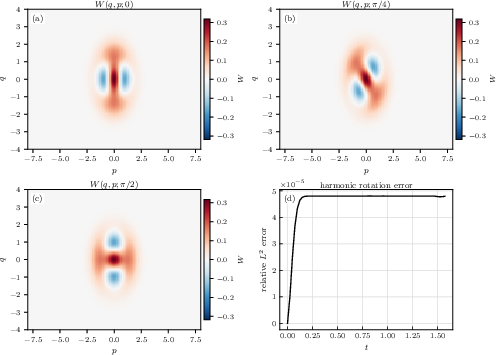
Benchmarking is performed in dimensionless units with oscillator states ∣0⟩, ∣2⟩ and their superpositions. With quadratic dynamics, the Moyal residual vanishes; classical carrier transport alone exactly propagates even signed, non-Gaussian Wigner functions (see Figure 1).
Figure 1: Harmonic oscillator null test for the initial state (∣0⟩+∣2⟩)/2, illustrating exact classical phase-space rotation for non-Gaussian Wigner functions.
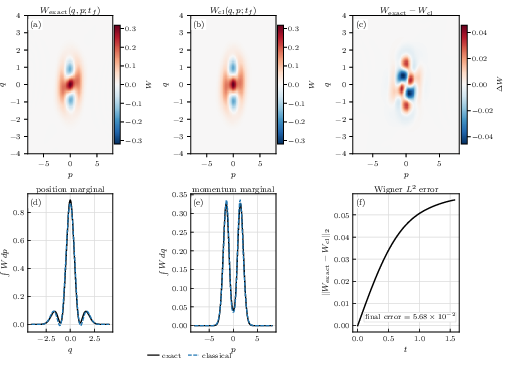
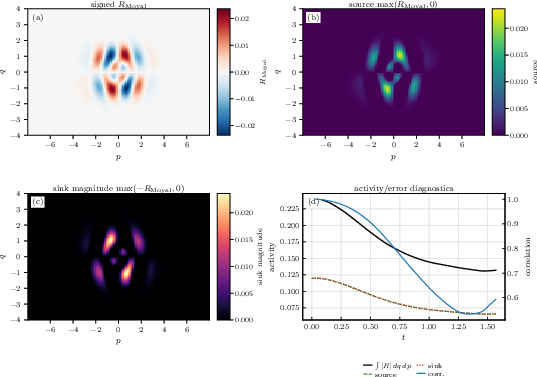
In quartic oscillator dynamics, classical Liouville transport omits the finite Moyal residual, yielding structured errors concentrated around interference lobes (see Figure 2). The results quantitatively show that agreement in marginal densities does not guarantee agreement in the full phase-space object, and the missing residual is responsible for measurable discrepancies (Figure 3).
Figure 2: Breakdown of classical carrier transport for V(q)=q2/2+λq4; exact Wigner evolution versus classical Liouville reveals the finite Moyal residual's impact.
Figure 3: Signed Moyal residual for the quartic benchmark; quantifies the source–sink, nonclassical correction RMoyal in phase space.
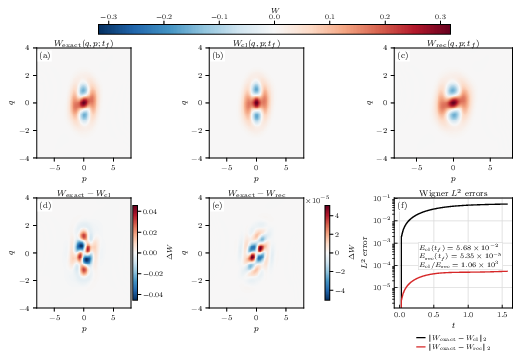
Restoring the signed residual recovers exact Wigner evolution with errors reduced by three orders of magnitude, validating the generator split formalism (see Figure 4).
Figure 4: Signed-residual reconstruction of the quartic Wigner evolution; correcting classical carrier transport with residual yields near-exact results.
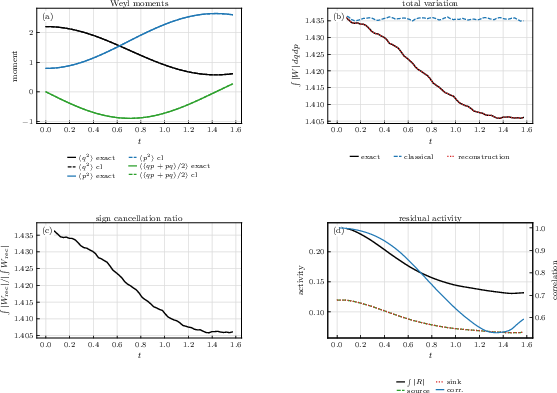
Comprehensive diagnostics (Figure 5) monitor Weyl moments, total variation, sign-cancellation ratios, and residual activity, confirming the improvement is not due to artifacts such as normalization drift or artificial damping.
Figure 5: Additional diagnostics for the quartic benchmark; checks for normalization drift, boundary leakage, and nonphysical damping.
Forward–Reverse Signed Path Comparison
The paper extends fluctuation relations to signed Wigner paths: the comparison between forward and reversed weighted paths decomposes into a positive magnitude factor and a sign factor, the latter interpreted as interference parity. This sign has no classical analog and quantifies quantum dynamical nonclassicality. The formal identity,
dμRΘdμF=eAχ,
with magnitude FW(z,t)=EP[Wtδ(z−zt)]0 and sign factor FW(z,t)=EP[Wtδ(z−zt)]1, is not an entropy production or heat dissipation term but instead characterizes the interference structure in quantum phase-space dynamics.
Implications and Future Developments
The results clarify that exact phase-space quantum dynamics demands weighted, potentially signed sampling schemes, particularly for stochastic representations and numerical simulations. Any approach insisting on positivity, phase-space structure, and exact quantum dynamics is limited to special cases or must abandon one constraint; positive stochasticity can inhabit configuration space, but exact phase-space quantum dynamics lives in weighted paths.
Practically, these insights guide the construction of unbiased Wigner Monte Carlo and branching methods, and theoretically, they support future diagnostics for dynamical nonclassicality at the path level. The formalism encourages a more rigorous separation between classical and quantum contributions in simulation frameworks and highlights the importance of signed weights in reconstructing genuine quantum effects.
Conclusion
The paper establishes that the positive phase-space Langevin program cannot be extended to generic quantum dynamics without loss of completeness; the Wigner function's evolution inherently necessitates weighted or signed sampling schemes. Numerical evidence corroborates the formal split: classical carrier flow plus signed residual recovers exact Wigner evolution, and error diagnostics confirm the necessity and sufficiency of signed representations. The approach provides new avenues for path-level analysis of quantum nonclassicality and sets stringent constraints on the applicability of positive stochastic phase-space dynamics to quantum systems.