- The paper introduces Mechanistic World Models that prioritize explicit mechanism discovery over mere prediction to yield deeper scientific insights.
- It presents a framework integrating latent variable discovery, mechanism extraction, and structured bindings for enhanced model interpretability and generalization.
- The model enables hypothesis generation and targeted adaptation by enforcing parsimony and compositional reuse, addressing challenges in continual learning.
Mechanistic World Models: A Mechanism-Centric Paradigm for Autonomous Scientific Discovery
Background and Motivation
Recent advances in foundation models and deep learning have drastically improved predictive capabilities in scientific domains, notably protein structure prediction and weather forecasting. However, these models focus exclusively on predictive mappings, which do not inherently reveal the reusable explanatory mechanisms underlying observed phenomena. The paper "From Observation to Insight: Mechanistic World Models and the Quest for Autonomous Discovery" (2607.12474) rigorously articulates the thesis that scientific discovery is fundamentally a problem of knowledge organisation. It advocates for Mechanistic World Models (MWMs): a design paradigm positioning mechanisms—not predictions—as the primary computational abstraction, thereby bridging the gap between forecasting and scientific understanding.
Distinction Between Prediction and Explanation
The paper draws heavily on philosophical foundations, emphasizing that genuine scientific understanding requires uncovering the causal mechanisms generating observations, not merely mapping inputs to outputs. Deductive-nomological, causal, and mechanistic explanation models demonstrate that explanatory power arises from identifying stable, reusable structure in a system, such as physical laws or biochemical pathways. MWMs embody this principle by representing mechanisms as variable-transform pairs, enabling explanations that are modular, parsimonious, and composable.
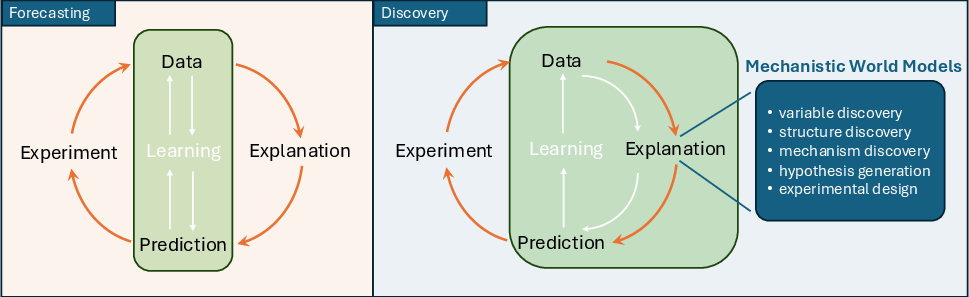
Figure 1: MWMs reconceptualize machine learning, shifting from pure forecasting to the discovery of mechanisms, thereby supporting hypothesis generation, variable discovery, and experimental design.
The authors dissect how contemporary machine learning paradigms capture aspects of the mechanism-centric idea, often in isolation:
- Mechanistic Interpretability: Techniques such as sparse autoencoders and circuit tracing aim to extract interpretable features from model activations, sometimes revealing scientific concepts, but often failing to internalize true mechanisms due to unconstrained training objectives.
- Causal Representation Learning (CRL): CRL provides formal guarantees and theoretical frameworks for identifying causal structures, but typically operates with fixed or predefined variables, limiting scaling and application to open scientific regimes.
- Equation Discovery: Symbolic regression methods integrate parsimony and strive for concise mathematical expressions to explain data but struggle with abstraction and composability outside isolated phenomena.
- Mixtures of Experts (MoE): Modular architectures empirically demonstrate functional specialization and efficiency but partition computation around predictive utility rather than scientific mechanisms.
None of these paradigms unify variable, mechanism, and structure discovery in a framework explicitly optimized for explanatory knowledge.
MWMs extend conventional world models to explicitly represent variables, mechanisms, and structure. The model's anatomy consists of:
- Variables: Latent quantities (with learned semantic types) representing system state, discovered jointly with mechanisms.
- Mechanisms: Typed transformations specifying how variable roles interact, defined as (Σm,fm), where Σm is the signature of input/output variable types, and fm is the functional map.
- Structure (Bindings): System-specific compositions binding latent variables to mechanisms, encapsulating how explanations adapt across environments.
MWMs formalize learning as minimizing representational complexity (parsimony) and maximizing compositional reuse (compositionality), jointly for variables, mechanisms, and structures.
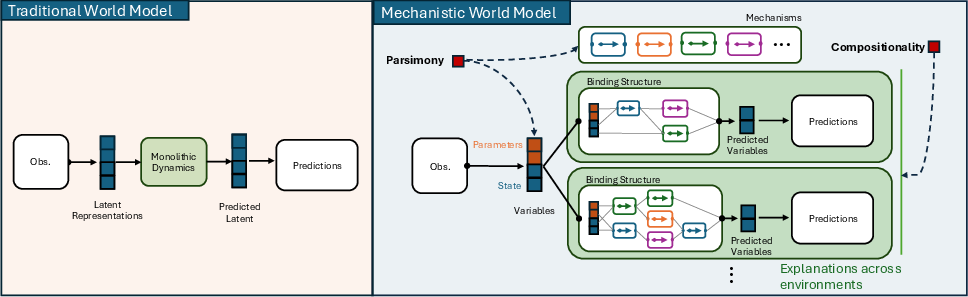
Figure 2: MWMs organize observations into latent variables, instantiate mechanisms via variable-role bindings, and represent systems through composed explanations. Parsimony and compositionality govern the evolution and reuse of explanatory components.
Capabilities and Advantages
Mechanistic World Models confer several notable properties:
- Interpretability: Explicit variables and mechanisms render the model transparent and tractable for scientific analysis.
- Compositional Generalization: Mechanisms, as modular units, support recombination and adaptation across diverse domains.
- Targeted Adaptation: Localized learning restricts updates to implicated mechanisms, mitigating catastrophic forgetting.
- Support for Scientific Inquiry: MWMs enable hypothesis generation and experimental design, closing the loop from prediction to explanation and intervention.
These features are unattainable with conventional, monolithic predictive models.
Implementation Challenges and Research Directions
The paper provides a detailed survey of progress toward MWMs, addressing:
- Variable Discovery: Approaches like SlotAttention, causal dynamics models, and object-centric representation learning highlight emergent abstractions but require coupling with mechanism recovery.
- Mechanism Discovery: Libraries of modular or programmatic transformations (e.g., RIMs, DreamCoder, COMET) demonstrate encapsulation and reuse but face scalability and integration challenges.
- Structure Recovery: Techniques for inferring interaction graphs (e.g., sparse attention in SPARTAN, relational masking in C-JEPA) support compositional binding but require explicit mechanism-type matching and scalable selection.
Critical challenges remain in integrating these facets, optimizing jointly under parsimony and compositionality, supporting active inquiry, and evaluating MWMs via benchmarks probing explanation, adaptation, and continual learning rather than prediction alone.
Implications and Future Prospects
Practically, MWMs lay groundwork for interpretable AI systems able to accelerate not just prediction but insight extraction, essential for automated scientific discovery. MWMs promise robustness under distribution shifts, effective continual learning, and transfer across scientific domains, addressing current limitations of data-hungry, brittle predictors. Theoretically, MWMs formalize explanatory intelligence in AI, connecting philosophy and statistical learning, and suggest new directions for causal abstraction, modularity, and mechanistic generalization.
While scaling predictive capacity may yield some explanatory properties incidentally, the authors assert that explicit mechanism-centric knowledge organization is a more principled and efficient route to explanatory AI. Integrating MWMs into automated science platforms, simulation-based reasoning, and hypothesis-driven experimentation presents substantial opportunity for the AI and scientific communities.
Conclusion
The framework of Mechanistic World Models constitutes a formal synthesis of scientific philosophy and machine learning, emphasizing explanation as a problem of modular information organization. By placing mechanisms at the core of learning, MWMs shift the trajectory of AI for Science from forecasting toward autonomous discovery and insight. Despite open challenges in integration, optimization, and evaluation, MWMs represent a conceptual and computational foundation for the next evolution of scientific artificial intelligence.