- The paper introduces biomedical world models that simulate multiscale biological dynamics and counterfactual outcomes through intervention-aware simulation.
- The methodology integrates longitudinal, multimodal data with hybrid latent space modeling, enabling long-horizon predictions and efficient planning.
- The framework offers actionable insights for personalized medicine and surgical simulation by coupling digital twin concepts with agent-based closed-loop discovery.
Biomedical World Models: Bridging Pattern Recognition and Prospective Simulation in Biomedicine
Introduction
Traditional machine learning systems in biomedicine have delivered advances in static pattern recognition but have largely failed to capture the inherently dynamic and multiscale nature of biological systems under perturbations. "Towards World Models in Biomedical Research" (2606.05925) introduces a paradigm shift, proposing biomedical world models as executable simulators that learn latent representations of biological and clinical states, together with their intervention-conditioned dynamics, allowing the forward simulation of biomedical trajectories prior to real actions. The paper articulates a comprehensive framework for world models in biomedicine, distinguishing their function, architecture, and intended utility from static foundation models, and provides a technical roadmap for their instantiation and deployment across biological scales.
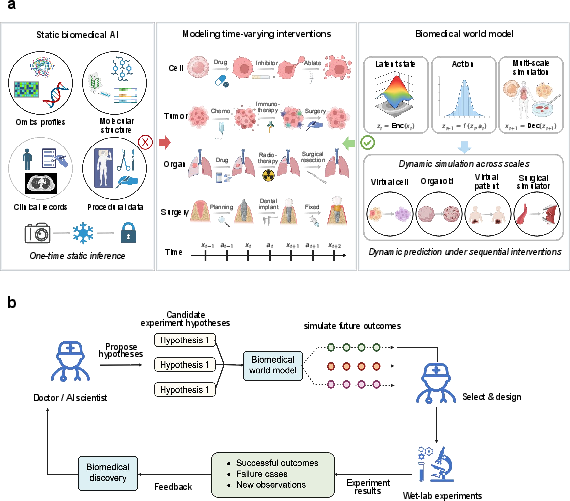
Figure 1: Conceptual framework of biomedical world models, spanning data ingestion, multiscale state representation, dynamic modeling, and agent-based simulation for biomedical systems.
Conceptual Distinction and Motivation
Biomedical world models diverge fundamentally from existing AI systems for biomedical analysis. Whereas foundation models, including LLMs and multimodal architectures, focus on correlational feature extraction and cross-domain transfer, world models are conceived as latent, generative simulators that encode the underlying mechanistic dynamics of biological systems. This design enables action/intervention-aware simulation, long-horizon prediction, and counterfactual reasoning. Drawing on cognitive science, reinforcement learning, and generative modeling literature, the paper formalizes the paradigm as learning an internal state zt=fθ(O≤t) from historical observations, and then iteratively applying p(zt+1∣zt,at,c) to project system futures under hypothetical interventions.
The paradigm is structurally distinct from digital twins or generative AI for static data generation. Here, the emphasis is on constructing latent spaces with biologically grounded, multiscale interpretability, and simulating intervention-dependent trajectories, critically supporting closed-loop scientific inquiry and adaptive experimental design.
Key Design Components
Data Regimes for World Models
A major divergence from classical ML infrastructure is the requirement for longitudinal, multimodal, and intervention-rich datasets. Biomedical world models are predicated on data that preserve temporal continuity, capture explicit perturbations (e.g., drug, genetic, surgical), and allow for closed-loop feedback. The manuscript highlights the essential transition from static cohorts and foundation model corpora towards integrated multimodal data streams, including real-time clinical records, high-throughput perturbation assays, and continuous molecular/physiological measurements. Progress demands substantial coordination in data infrastructure—harmonization, temporal alignment, and multimodal linking—across institutions and platforms.
Multiscale State Representation
Biomedical observations are high-dimensional and heterogeneous, spanning tokenized sequence data, continuous images, and structured clinical events. The authors advocate a hybrid discrete-continuous latent space for world models, integrating variational autoencoding, diffusion-based encoders, pretrained foundation model feature extractors, and discrete tokenization, as appropriate for the data type. This shared latent space is structured to facilitate downstream dynamics modeling, supporting variable temporal granularity and cross-modality integration.
Dynamics Modeling: Observation- and Latent-Space Perspectives
Two architectural paradigms are emphasized:
- Observation-space models: Directly generate intervention-conditioned observations (e.g., medical images, physiological waveforms) via autoregressive or diffusion-based generative architectures. This approach facilitates experimental validation, as simulated outcomes are observable, and is suited for settings like tumor evolution, tissue organization, and real-time physiological response modeling.
- Latent-space models: Evolve compact state representations, abstracting away modality-specific noise and focusing model capacity on system dynamics, extrapolation, and planning. Techniques include joint-embedding predictive architectures (e.g., V-JEPA2, DINO-WM), neural ODEs, and physics-informed neural operators, incorporating mechanistic constraints for interpretability and extrapolative fidelity.
Both approaches are presented as synergistic: observation-space simulation supports validation and hypothesis testing, while latent-space dynamics enable efficient rollouts and policy optimization for fine-grained intervention planning.
Agent-Coupled and Closed-Loop Discovery
The manuscript proposes cycling biomedical world models with LLM agents and lab automation to achieve closed-loop, hypothesis-driven scientific discovery. Here, the agent leverages the world model to simulate consequences of candidate interventions, employing internal predictive rollouts to optimize experimental utility, resource allocation, and safety. Acquisition functions rank actions by predicted information gain and risk; experiments then close the feedback loop with real data for continual model refinement.
Use Cases Across Scales
Molecular and Cellular World Models
At the protein level, the paper envisions learned simulators capturing conformational dynamics in response to sequence variants, chemical modifications, and environmental fluctuations, advancing protein engineering and allosteric drug design beyond static structure prediction. For single-cell systems, world models would capture regulatory network evolution under complex, combinatorial perturbations, enabling in silico design and analysis of gene circuits, cellular reprogramming, and phenotype switching.
Tissue and Organoid Simulation
By extending latent representations and dynamics modeling to the tissue and organoid level, virtual organoids emerge as testbeds for multicellular interaction, spatial patterning, and drug/toxicity response. Integrated with experimental organoid platforms, world models can accelerate the exploration of disease mechanisms and therapeutic interventions with high physiological fidelity.
Virtual Patient and Precision Medicine
The transition from static prediction to virtual patient trajectory simulation introduces the potential for hypothesis-driven treatment planning, dynamic prognosis, and evaluation of alternate intervention policies. World models can be instantiated as digital twins, predicting individual response trajectories across therapies, and operationalized within the clinical workflow for dynamic risk adjustment and closed-loop precision medicine.
Surgical Simulation and Embodied Autonomy
Surgical workflows are reformulated as a series of state–action–future state transitions. Biomedical world models enable planning-aware, embodied autonomy: simulating anatomic and procedural evolution under varying instrument actions, anticipating complications, and developing recovery strategies even for rare scenarios. Examples include SurgWM and SurgWorld, which couple video-based simulation with robotic policy learning, surpassing perception-centric models by enabling prospective procedural outcome simulation.
Challenges and Constraints
Data Infrastructure and Governance
Data sparsity, fragmentation, non-uniform sampling, and regulatory constraints significantly impede large-scale deployment. The authors call for harmonized, institution-agnostic infrastructures, robust privacy controls, and scalable annotation/curation workflows, potentially augmented by agentic AI for longitudinal integration.
Evaluation and Benchmarking
Conventional metrics focusing on static predictive accuracy are inadequate. The paper advocates for evaluative frameworks spanning observational realism, temporal coherence, interventional fidelity, uncertainty calibration, and downstream utility in scientific discovery. Community-shared hidden test suites and task leaderboards are proposed to standardize and stress-test the trajectory-level robustness of world models.
Safety, Privacy, and Fairness
Risks are magnified relative to static models: errors propagate through policy recommendations and intervention chains, with direct impact on experimental integrity or patient care. Privacy leakage through simulation and generative replay, as well as fairness and distributional bias over long-horizon simulations, require rigorous mitigation: federated learning, calibrated uncertainty, and population-wide prospective evaluation are essential.
Deployment and Scale
Computational and engineering challenges are substantial. Simulating high-dimensional, long-horizon dynamics with action conditioning necessitates efficient distillation, pruning, quantization, and green AI techniques. Real-world deployment further requires standardized interfaces, audit trails, and oversight for trustworthiness and reproducibility.
Theoretical and Practical Implications, Future Directions
The formalization of biomedical world models establishes a unifying framework for bridging high-dimensional, multiscale observations with prospective experimental planning and closed-loop autonomy. The potential to replace costly, sequential experimentation with in silico hypothesis-driven cycles could dramatically shift discovery and translational timelines. The trajectory-centric, intervention-aware modeling paradigm is equally poised to transform embodied medical AI (e.g., surgery, clinical decision support) and abstract hypothesis generation in cell biology and drug design.
Several theoretical avenues open from this work:
- Developing interpretable, mechanistically informed latent spaces that remain robust under cross-population, cross-domain generalization.
- Integrating causal discovery and counterfactual simulation into the planning loop, with explicit uncertainty quantification.
- Adapting world models for active learning under extreme data sparsity, incorporating human-in-the-loop correction.
- Scaling continuous, hierarchical simulation across molecular, cellular, organoid, and patient levels in a compositional manner.
Practically, the success and safety of biomedical world models will hinge on collaborative data infrastructure, multi-faceted validation, and responsible deployment within human-AI oversight frameworks.
Conclusion
The paradigm of biomedical world models represents a critical advance beyond static pattern recognition, aligning machine learning systems with the dynamic, multiscale, and interventional nature of biological research and clinical practice. By coupling multiscale state representation, observation/latent-space dynamics, and agent-based closed-loop reasoning, these models promise to internalize the scientific method—enabling scalable hypothesis generation, experimental prioritization, and adaptive discovery. However, realizing this vision is contingent upon significant progress in data infrastructure, evaluation methodology, safety assurance, and deployment engineering. The conceptual and practical roadmap detailed in this work provides a structured foundation for next-generation AI-driven biomedical science.