- The paper introduces a rigorous framework utilizing stochastic diffractive lensing to detect low-mass dark matter halos in LISA data.
- It decomposes the cumulative lensing effect into Gaussian and Poisson components, enabling an orthogonal 'Dark Timbre' mode analysis for robust detection.
- The methodology leverages event stacking and precise waveform modeling to constrain CDM predictions and limit beyond-CDM enhancements in small-scale structure.
Stochastic Diffraction Signatures of Low-Mass Dark Matter Halos in LISA
Motivation and Overview
Cold Dark Matter (CDM) predicts an abundance of low-mass halos ($10$--104M⊙), sensitive to both the microphysics of DM and the primordial power spectrum, yet these halos remain undetected due to their lack of baryonic tracers and feeble gravitational interactions. The propagation of gravitational waves (GWs) across cosmological scales imparts frequency-dependent amplitude and phase distortions from cumulative wave-optics lensing by unresolved DM substructure. This paper provides a rigorous formalism for modeling stochastic diffractive lensing from the ensemble of DM halos along the line of sight, demonstrating that the effect can be decomposed into an orthogonal basis ("Dark Timbre"), with statistical independence from binary source parameters for most harmonics. The Laser Interferometer Space Antenna (LISA) is identified as particularly sensitive to halos in the $10$--104M⊙ range, enabling statistical detection via stacking GW events.
Theoretical Framework: Stochastic Diffractive Lensing
The amplification factor for GWs traversing a universe populated with DM halos is modeled within the thin-lens, Born, and Eikonal approximations. The cumulative lensing effect, ΔF(w), is formally expressed as a sum over the lensing potentials of all halos, yielding amplitude and phase fluctuations across frequency owing to the wave-optics regime. The fluctuations admit a decomposition into two components:
- Gaussian Component: Sourced by numerous low-mass halos, converges to a non-circular complex Gaussian field due to the central limit theorem.
- Poisson Component: Originates from rare, high-mass halos, yielding non-Gaussian weak-lensing tails.
The frequency-dependent structure of the windowing functions mediating these effects is illustrated in detail.
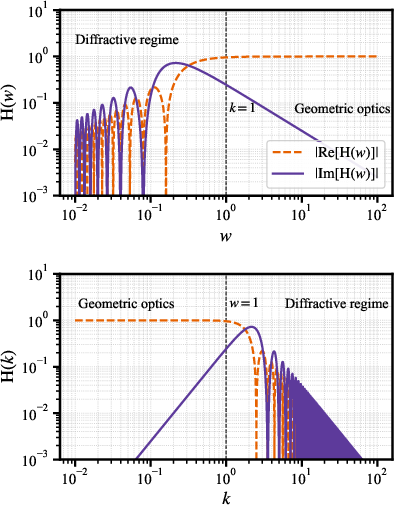
Figure 1: The real and imaginary components of the windowing functions H(k,w) delineate the transition from diffractive to geometric lensing regimes as a function of wavenumber and frequency.
The convergence power spectrum Pκ(k), computed for CDM using the NFW profile and empirical concentration–mass relations, serves as the primary observable governing the amplitude and frequency distribution of stochastic diffraction.
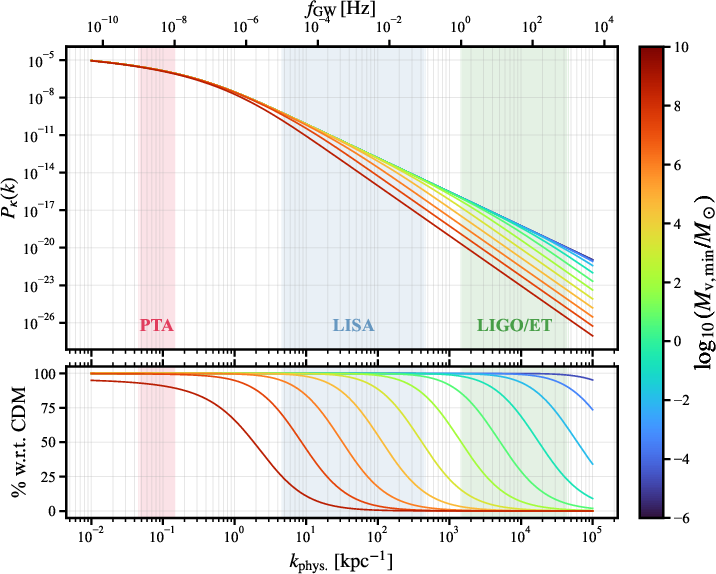
Figure 2: Pκ as a function of frequency and halo mass cuts, and its relative differences w.r.t. the CDM baseline, illuminate the optimal mass scales for different GW detectors.
Realisations and Frequency Sensitivity
Explicit realisations of stochastic diffraction reveal the sensitivity of LISA to the presence and properties of low-mass halos. Including halos down to ∼1M⊙ markedly enhances frequency-dependent fluctuations, especially in the phase (imaginary) component, while the geometric weak-lensing tail (dominated by massive halos) is frequency-independent and projected out by the detection statistic.
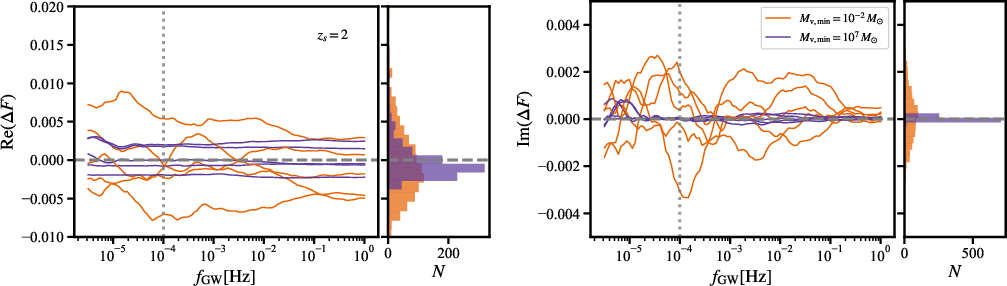
Figure 3: Real and imaginary parts of ΔF, demonstrating frequency-dependent fluctuations for varying minimum mass cuts; significant imaginary (phase) structure appears only when low-mass halos are included.
Eigenmode Decomposition: The Dark Timbre
The Karhunen–Loève decomposition of the lensing covariance produces an orthogonal basis that captures the dominant observable modes ("Dark Timbre"). Only the lowest-order mode is degenerate with binary parameters (particularly luminosity distance), with surviving detectable power concentrated in modes 104M⊙0--104M⊙1. This decomposition is critical for constructing the detection statistic by marginalizing over intrinsic source parameters.

Figure 4: Dark Timbre eigenmode decomposition; harmonics (colored) are uncorrelated, and the rightmost panel shows surviving detectable power after projecting out parameter degeneracies.
Detection Statistic, Stacking Strategy, and Population Requirements
The frequency-domain excess-variance statistic is derived from the KL-divergence between null and lensing hypotheses, yielding per-event detection significance 104M⊙2, with observed values 104M⊙3--104M⊙4 for LISA MBH binaries. Because the per-event signal in CDM is 104M⊙5, individual events are sub-threshold, necessitating stacking 104M⊙6--104M⊙7 loud binaries for 104M⊙8--104M⊙9 confidence depending on merger rates, waveform systematics, and halo concentration prescriptions. The catalogue size requirement is sharply sensitive to the adopted concentration–mass relation.
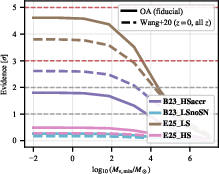
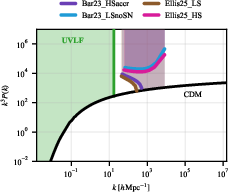
Figure 5: Cumulative evidence after 10 years of LISA observations for varying halo mass cuts/concentration–mass prescriptions and merger rates; top and bottom panels demonstrate both population sensitivity and limits on power spectrum enhancements, respectively.
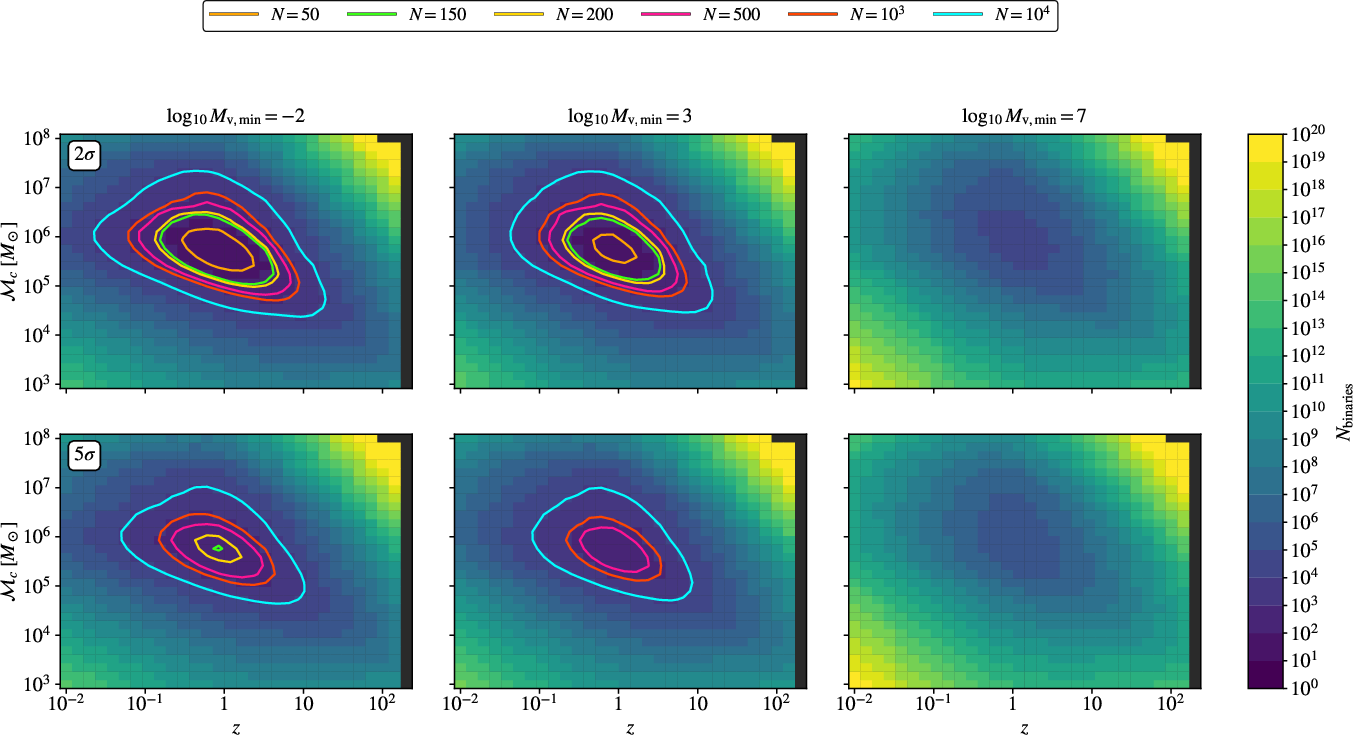
Figure 6: Number of binaries required for detection (as a function of chirp mass and redshift) for $10$0 and $10$1 confidence, across different minimum halo mass cuts.
Constraints on Enhanced Small-Scale Structure
In addition to confirming the presence of low-mass halos in CDM, stochastic diffraction enables competitive constraints on models with enhanced small-scale structure, such as axion miniclusters and primordial black holes (PBHs), parameterized through modifications of the matter power spectrum. The plateau width and onset scale (in wavenumber) are mapped to specific DM model parameters; constraints are strongest for models predicting high concentrations or abundance of compact structures.
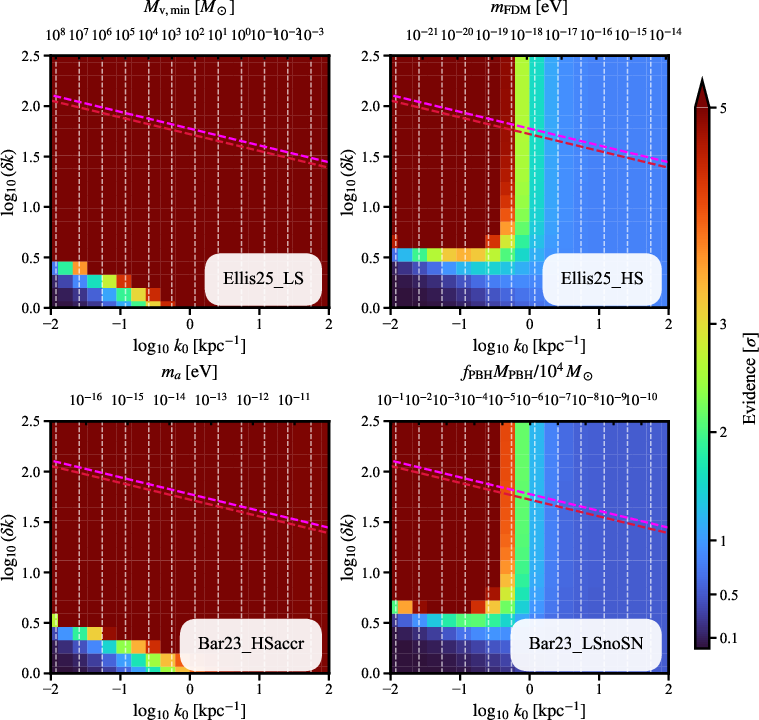
Figure 7: Expected evidence for a modified matter power spectrum, after 10 years of LISA observation, as a function of plateau width and onset scale; trajectories for axion minicluster and PBH models are overlaid.
Robustness and Systematics
The analysis validates the Born approximation in the linear regime against full wave-optics computations, finding agreement to within $10$2--$10$3 throughout the relevant frequency range, provided mean-field conventions are aligned. Explicit Poisson realisations are unreliable estimators of variance due to rare, massive halos, but the analytic covariance provides an exact, smooth description. The dominant systematic uncertainty arises from the extrapolation of concentration–mass relations below simulation thresholds; less optimistic prescriptions increase the detection threshold by an order of magnitude in catalogue size.
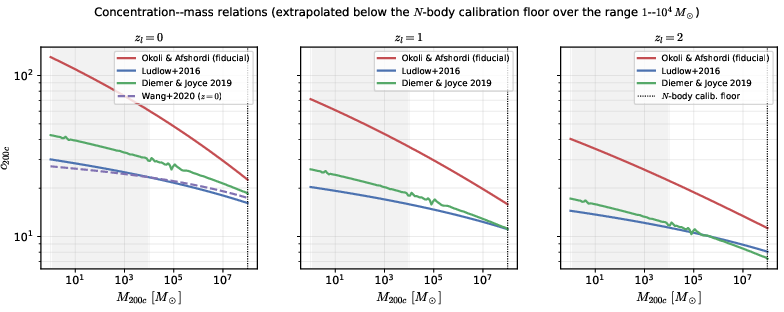
Figure 8: Concentration–mass relations for multiple prescriptions, highlighting their extrapolations over the LISA-relevant halo range and the degree of astrophysical uncertainty.
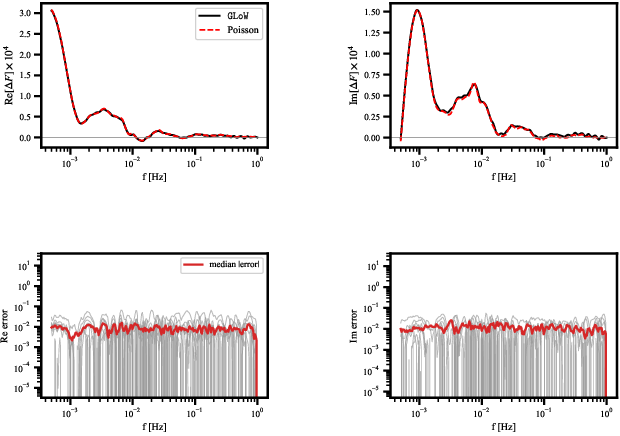
Figure 9: Comparison between linear Poisson method and full wave-optics code GLoW on identical catalogues; error remains below $10$4.
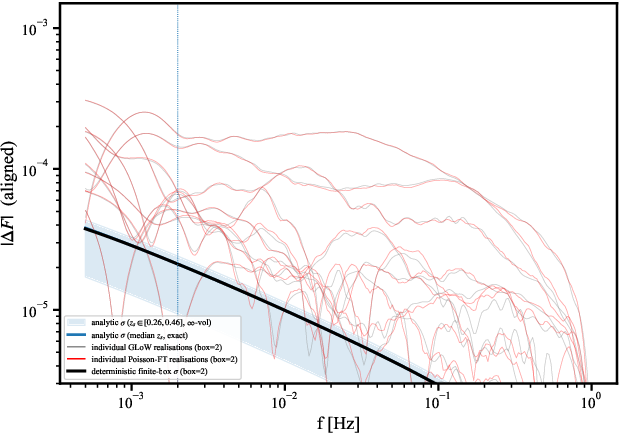
Figure 10: Explicit Poisson realisations exhibit heavy-tailed variance estimation; smooth analytic covariance correctly recovers the infinite-volume variance.
Marginalisation over spin and higher harmonics does not qualitatively alter the detectability. Aligned spins reduce per-event significance by $10$5--$10$6 and full precession by $10$7 in the fixed eigenmode basis, but self-consistent basis reconstruction compensates or sometimes enhances detectability. The inclusion of higher harmonics (IMRPhenomXPHM model) affects detection efficiency at the $10$8 level, with larger gains attributable to frequency band extension above the quadrupole cutoff.
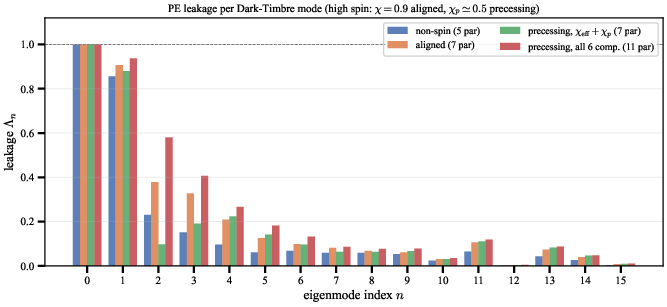
Figure 11: Leakage $10$9 of Dark Timbre modes into parameter manifold, demonstrating that 104M⊙0 is always reabsorbed; spin parameters increase leakage in low-order modes.
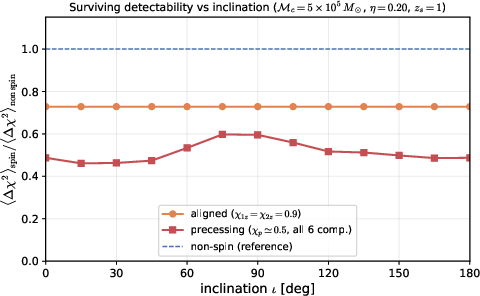
Figure 12: Surviving detectability as a function of inclination for aligned and fully precessing spin configurations; angle-dependence is significant only for the precessing case.
Implications and Future Directions
The methodology enables confirmation of 104M⊙1--104M⊙2 halos in CDM by stacking LISA GW events provided waveform modeling systematics are controlled below 104M⊙3. Non-detection yields stringent bounds on enhancements to the small-scale matter power spectrum, constraining parameter space for axion minicluster, PBH, and Fuzzy DM models, often reaching scales inaccessible with electromagnetic probes. The collective stochastic diffraction signature is an intrinsic feature of GW propagation in any structured universe and must be accounted for in precision GW astrophysics.
Future developments may include extending the formalism to other GW observatories (e.g., ground-based, PTAs), further refinement of halo concentration modeling, and implementation of dedicated Bayesian pipelines for catalog-level excess-variance searches.
Conclusion
This work establishes a robust analytic and statistical framework for the detection of low-mass DM halo populations via stochastic diffractive lensing in LISA data. The statistical approach—emphasizing population stacking and eigenmode decomposition—circumvents the rarity of individually resolvable lensing events and enables both confirmation of CDM predictions and constraints on beyond-CDM scenarios. The methodology is broadly applicable to other GW interferometers and has implications for DM phenomenology, cosmological structure formation, and precision GW astrophysics.