- The paper shows that macroscopic perturbations, including m3/m4 multipoles and radial variations, can explain the flux ratio anomalies observed in B1422+231.
- Methodology involves extracting perturbations from the TNG100 lens sample and testing SIE+γ and EPL+γ models under varying astrometric and photometric uncertainties.
- Implications challenge the exclusive role of dark matter substructure, advocating for complex, multi-component lens models to mitigate biases in flux ratio analyses.
Detailed Summary of Macroscopic Perturbations Explaining Flux Ratio Anomalies in B1422+231
Introduction
The paper investigates the persistent phenomenon of flux ratio anomalies in quadruply imaged quasars, using B1422+231 as a concrete example. Traditionally, such anomalies are taken as indirect evidence for small-scale clumpy perturbations (e.g., dark matter subhalos or line-of-sight halos) superposed on smooth macroscopic lens models such as SIE or EPL profiles plus external shear. This study asks whether typical non-clumpy macroscopic perturbations—specifically, third- and fourth-order multipole moments (m=3,4) and radial variations in the iso-density ellipse parameters (q, ϕq)—can successfully account for the observed image positions and flux ratios in B1422+231.
Methodology
The authors extract realistic macroscopic perturbations from a large sample of strong-lensing galaxies drawn from the TNG100 simulation. These include (i) global m3, m4 multipoles, and (ii) radial dependence of ellipticity and position angle. The perturbations are characterized by isophote-fitting procedures applied to both mass and light maps of simulated galaxies, enabling statistical comparison with real observational samples.
Two principal smooth macro-models are considered: SIE+γ and EPL+γ. These models are fit to the observed image data from B1422+231 under different astrometric (σp) and photometric (σf) uncertainties, both alone and with the extracted perturbations added.
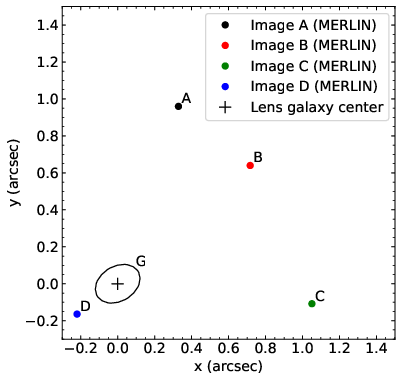
Figure 1: Image configuration of B1422+231, showing four quasar images and the lens galaxy’s observed ellipse.
The approach is exhaustive: for each perturbation category (individual and combined), the study constructs B1422 analogs by searching across the TNG100 lens sample, identifying successful fits according to stringent positional and flux ratio criteria.
Empirical Characterization of Macroscopic Perturbations
Macroscopic deviations from perfect ellipsoidal symmetry are quantified for both mass and light distributions. The comparison reveals that mass distributions are, on average, rounder than light, and that their position angles are closely aligned. Statistical analysis shows that both a3/a and q0 multipole strengths span typical values q1, with a prevalence of disky (q2) morphologies.
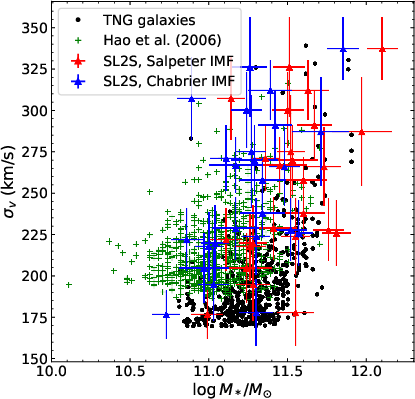
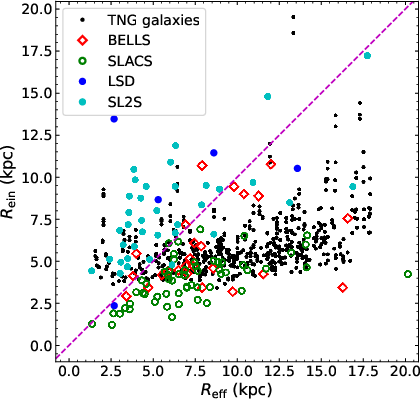
Figure 2: Velocity dispersions, stellar masses, and radius distributions for the lensing galaxy sample from TNG100, compared to SL2S and SDSS observational datasets.
Radial variation in ellipticity and orientation is apparent, particularly within the inner (below 6 kpc) regions of galaxies, accentuated by increased twisting and flattening toward galactic centers.
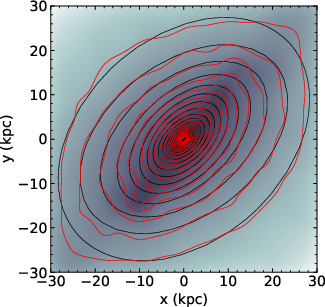
Figure 3: Isophote-fitting demonstration for a simulated galaxy; mass contours and fitted ellipses highlight morphological perturbations.
Lens Model Construction and Fitting Results
Position-Only Fitting
With moderate astrometric uncertainty (q3 mas), both SIE+q4 and EPL+q5 models, either alone or with perturbations, can reproduce image positions; anomalies do not arise at this precision.
At high astrometric precision (q6 mas), "astrometric anomalies" appear when using smooth models only. Inclusion of macroscopic perturbations recovers successful fits, especially with EPL+q7 (due to added flexibility from the free radial slope q8). However, degeneracy between macro-model and perturbative terms remains severe, hitting prior boundaries and yielding unphysical solutions when constrained by positions alone.
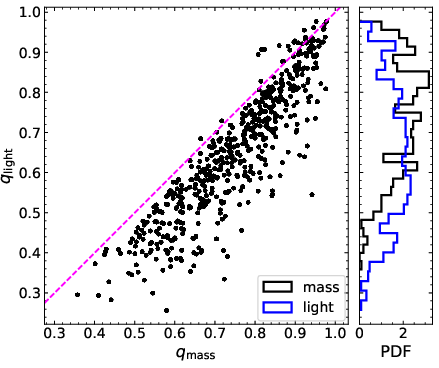
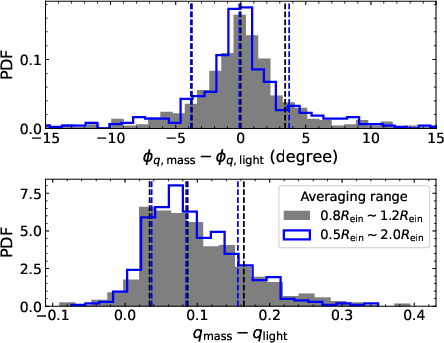
Figure 4: Comparative histograms for mass and light axis ratios and position angle differences in the simulated galaxy sample.
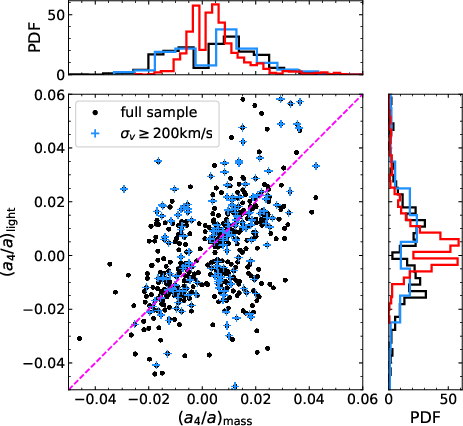
Figure 5: Distributions of q9 multipole strengths across mass and light, benchmarked against observational data.
Simultaneous Position and Flux Ratio Fitting
Flux ratio anomalies arise even at ϕq0 when using SIE+ϕq1 alone, and cannot be remedied by adding extracted perturbations; the model lacks sufficient degrees of freedom.
EPL+ϕq2, by contrast, fits both positions and flux ratios up to ϕq3 without invoking perturbations, but fails at ϕq4. Addition of global ϕq5 multipoles rescues the fit in ϕq6 of the TNG100 sample; inclusion of radial variations in ϕq7 and ϕq8 induces additional fluctuations, resulting in lower success rates unless these perturbations happen to be compatible with the detailed configuration.
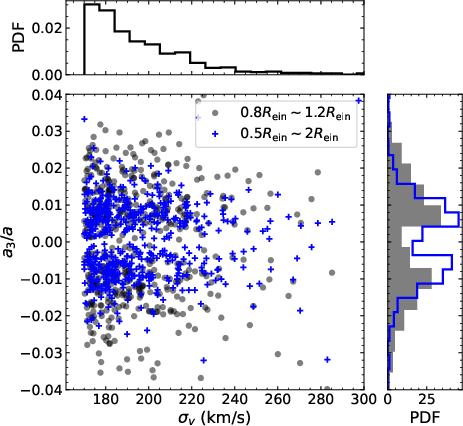
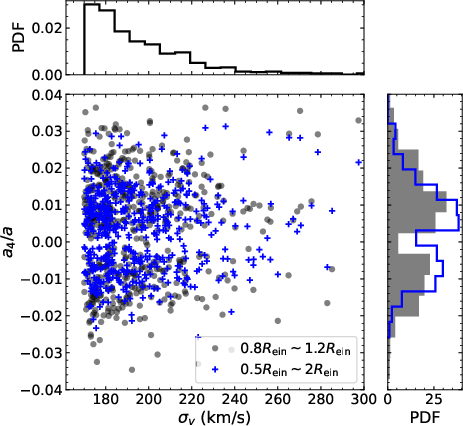
Figure 6: Relations between multipole perturbations and galaxy velocity dispersions for the TNG100 sample.
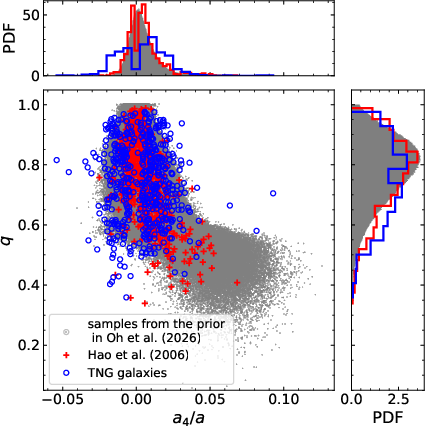
Figure 7: Joint distribution of ϕq9 multipole strength versus axis ratio m30—simulation versus observational prior.
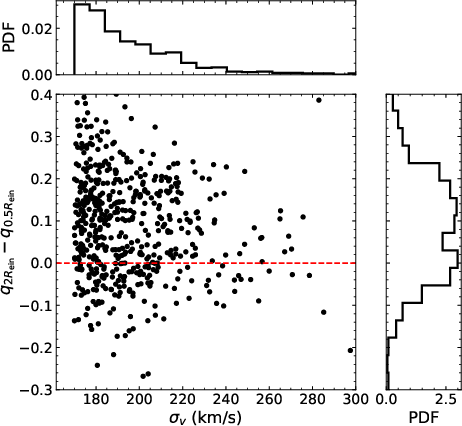
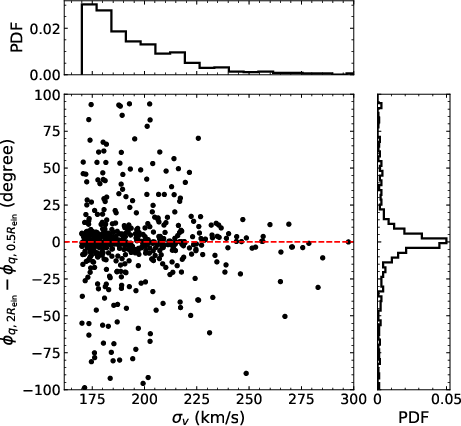
Figure 8: Radial variation in m31 and m32 versus velocity dispersion; larger scatter is observed for lower-mass galaxies.
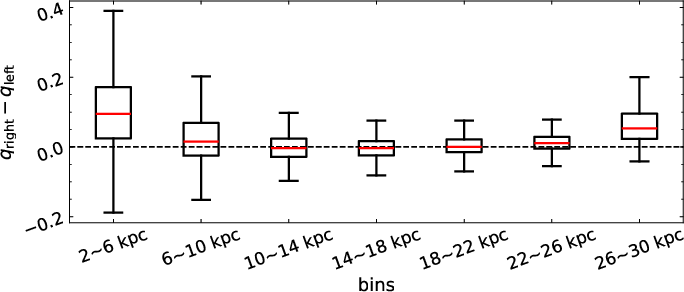
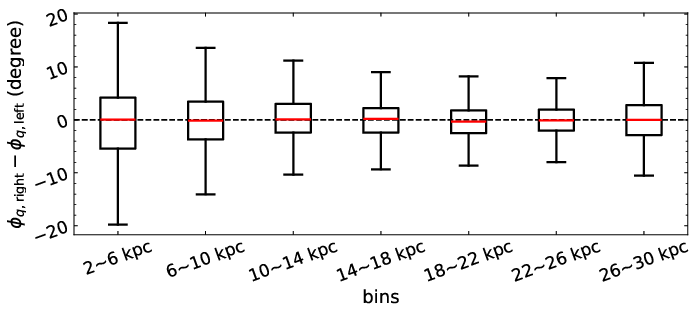
Figure 9: Detailed box plots for radial variation in m33 and m34 across galactic radius bins; strongest effects occur at small radii.
Notably, the rare but successful fits with combined m35 and radial variations confirm that typical, non-clumpy macroscopic perturbations can account for the observed B1422+231 image positions and flux ratios at high precision.
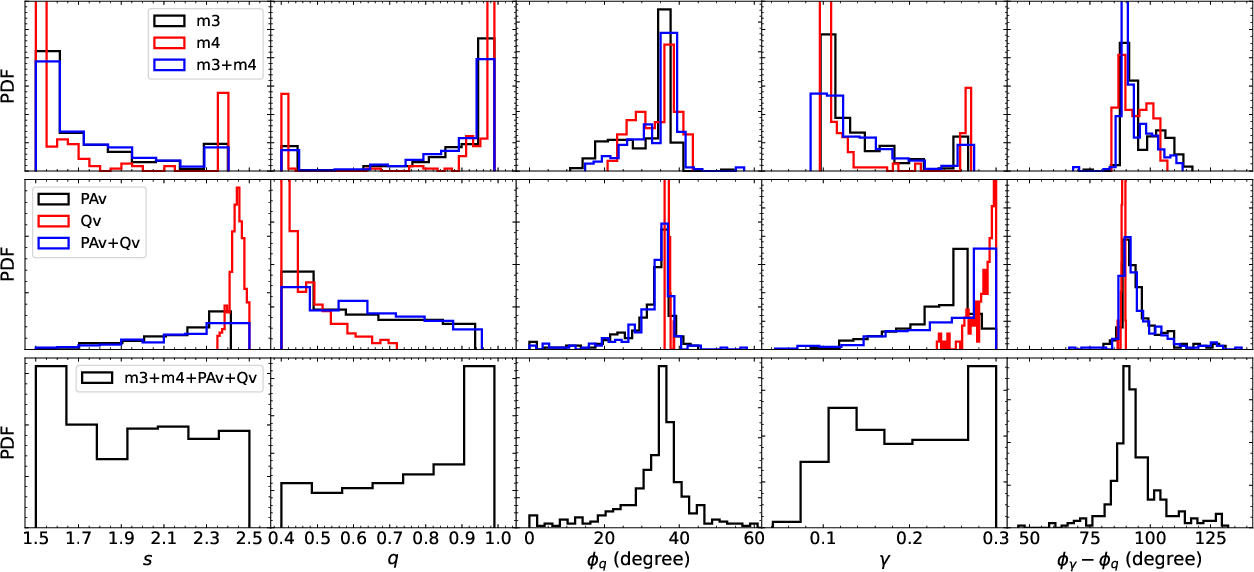
Figure 10: Distributions of best-fit macro-model parameters for various perturbation scenarios, highlighting the strong degeneracy and boundary effects.
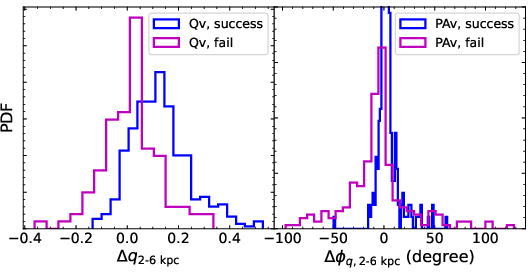
Figure 11: Radial difference distributions in axis ratio and position angle between successful and failed fits; rounder or less rotated outer ellipses promote model success.
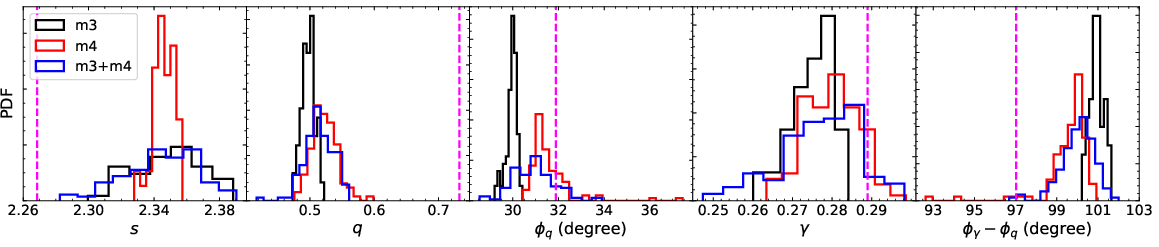
Figure 12: Macro-model parameter distributions for combined position/flux ratio fits, showing consistency across multipole perturbation scenarios.
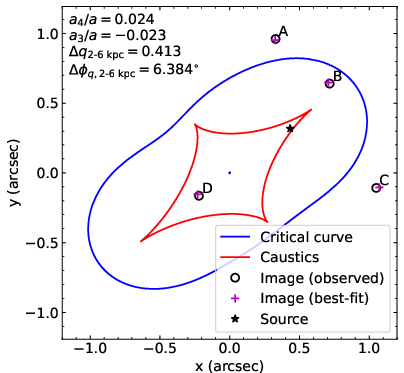
Figure 13: Critical curves and caustics for one of the best-fit models explaining B1422+231 with EPL+m36+m3+m4+PAv+Qv, matching observed image positions.
Implications and Lessons
The results challenge the exclusive interpretation of flux ratio anomalies as evidence for dark matter substructure. The flexibility of EPL+m37 models, especially with free slope, underscores the risk of biased inference if SIE models are adopted without supporting evidence for pure isothermality. Moreover, modeling degeneracies between multipole perturbations and subhalo effects, as demonstrated in recent studies (e.g., [Cohen2024]), threaten the reliability of using flux ratio anomalies as a probe of dark matter microphysics.
Increasing precision in astrometry and photometry will expose further model deficiencies—necessitating the use of more sophisticated macro-models or non-parametric approaches, which require additional constraints such as lensed arcs and surface brightness profiles. The subtle coupling between multipole terms and radial variations warns against the simplistic addition of global multipoles for substructure inference.
The study advocates for careful re-examination of lens modeling assumptions and broader consideration of macroscopic perturbations as legitimate contributors to flux ratio anomalies in strong lensing systems.
Conclusion
Astrometric and flux ratio anomalies in B1422+231 can be explained without resorting to clumpy substructure, through inclusion of characteristic macroscopic perturbations derived from cosmological simulations. However, model degeneracies remain profound, with axis ratio, radial slopes, and external shear hitting prior limits when flux ratios are fit by flexible macro-models. The interplay between multipole perturbations and radial variations in iso-density parameters is nontrivial and must be accounted for in future inference pipelines.
This work highlights the need for rigorous, multi-component lens models, ideally constrained by high-resolution imaging and arc reconstruction, for robust substructure and dark matter studies in quadruply lensed quasars. It calls for caution in interpreting flux ratio anomalies based solely on SIE-based models or insufficiently complex macro-models, and underscores the value of cosmological simulations for statistical characterization of lensing perturbations. The utilization of macroscopic perturbations should enter mainstream practice for lens modeling and dark matter inference.

