- The paper introduces a minimal Kitaev chain as an interqubit coupler using ABSs in SC-proximitized nanowires to achieve robust, tunable spin state transfer.
- It details two control schemes (detuning-based and ABS-based) that modulate the exchange coupling via elastic cotunneling and crossed Andreev reflection processes.
- Simulations show a 200-fold improvement in decoherence time at a sweet spot, highlighting potential for scalable, low-noise spin qubit architectures.
Robust Spin Qubit Coupling via Minimal Kitaev Chain
Overview and Motivation
This work introduces the minimal Kitaev chain (MKC) as an interqubit coupling module for spin qubit systems, leveraging Andreev bound states (ABSs) in a superconducting (SC)-proximitized nanowire segment. The paper addresses the critical challenge of scalable, robust interconnectivity in large spin qubit arrays, proposing an approach that achieves tunable, strong, non-local exchange coupling with enhanced immunity to charge and magnetic noise. The MKC-based coupling uses both elastic cotunneling (ECT) and crossed Andreev reflection (CAR) processes for coherent spin state transfer, and harnesses gate-tunable ABS chemical potentials as a novel control degree of freedom.
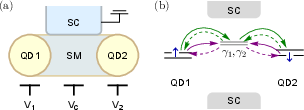
Figure 1: Minimal Kitaev chain layout and energy diagram illustrating tunable gates, SC-proximitized nanowire, relevant spin and Andreev levels, and exchange paths via ECT and CAR.
The system comprises two normal quantum dots coupled through a central SC segment, forming the MKC. The Hamiltonian is carefully constructed to include on-site and interdot terms, Zeeman splitting, and tunable parameters for orbital energies, tunnel couplings, and SOC-induced rotations. With fine-tuned gate control, only one orbital on each dot resides in the SC gap, and the dominant ABSs mediate virtual round-trip transitions between dots.
The ABSs act as extended, spatially coherent channels permitting long-range superexchange over distances governed by the SC coherence length. Importantly, this mechanism does not require direct wavefunction overlap between dot states, mitigating crosstalk and leakage found in conventional exchange coupling. The fourth-order perturbative treatment yields an anisotropic exchange Hamiltonian that generalizes Heisenberg coupling to local frame-rotated spin singlets.
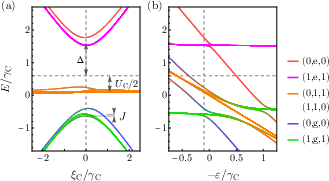
Figure 2: Energy levels of the system as a function of relevant dot and SC parameters, highlighting the (1,g,1) spin subspace and singlet-triplet splitting.
Control Schemes: Charge Stability, Detuning, and ABS Potentials
Two main control modalities are developed:
- Detuning-based control: Fixed ABS chemical potential with variable dot potentials, allowing J modulation by traversing regions of the charge stability diagram (CSD). Near level-crossing boundaries in the CSD, exchange J is sharply enhanced, with ECT and CAR paths providing multiple operational routes.
- ABS-based control: Fixed dot potentials, tuning J directly via the ABS chemical potential. This enables highly localized and selective interaction, with theoretical and numerical agreement in exchange energy calculations.
Critical boundaries are identified where the spin subspace's purity is compromised, but operation away from these regions enables high-fidelity coupling.
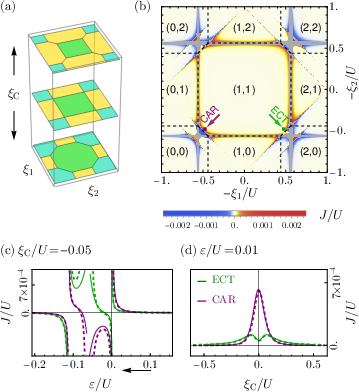
Figure 3: CSD of the MKC illustrating (1,1) and neighboring charge regions, with exchange energy J distribution, detuning paths for ECT/CAR processes, and J response to control parameters.
Sweet Spot Operation and Noise Immunity
A central result is the identification of a "sweet spot" in the multidimensional control space where J is maximized and the gradient with respect to all control parameters vanishes. This ensures first-order immunity to charge noise, a dominant decoherence source in spin qubits. At the sweet spot, the exchange coupling is strong, but the spin qubit subspace is not the global ground state; nevertheless, leakage is suppressed by the ABS energy barrier and thermal constraints.
Simulated benchmarks compare standard spin qubit, S−T0 encoding, and MKC-based qubits under charge and magnetic noise modeled as Gaussian $1/f$ processes, showing over 200-fold improvement in decoherence time for the MKC protocol.
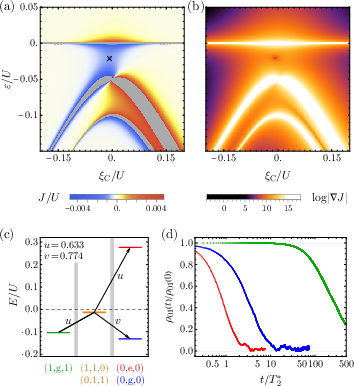
Figure 4: Exchange energy J0 versus control parameters at the CAR sweet spot, gradient norm mapping, QS energy ordering, ABS coherence factors, and coherence benchmarking under noise for MKC, J1, and standard encoding.
Architectural Implications for Large-Scale Quantum Chips
The MKC approach facilitates scalable, selective coupling in dense spin qubit arrays using classical control lines to modulate ABS potentials. Crosstalk is reduced through SC screening, and dot potentials remain fixed during operations, minimizing charge polarization and environmental sensitivity. The sweet spot operation enables robust gate protocols with minimal leakage and charge noise susceptibility.
From a theoretical perspective, the integration of ABS dynamics and fourth-order virtual transition paths expands the toolkit for quantum information processing in hybrid devices, bridging topological and conventional quantum computing architectures.
Conclusion
This paper rigorously establishes the minimal Kitaev chain as an effective, noise-resilient coupler for spin qubits through ABS-mediated superexchange processes. Analytical modeling, numerical simulations, and noise benchmarks have demonstrated tunable, strong coupling and high-fidelity operation at the protected sweet spot in control space. The approach provides a pathway toward robust, scalable spin qubit architectures employing hybrid semiconductor-superconductor elements. Future research avenues include further characterization of CAR-dominated sweet spot regimes, integration with surface code and all-to-all connectivity protocols, and experimental validation of improved decoherence performance.