- The paper demonstrates the first coherent control and manipulation of a Majorana parity qubit encoded in coupled minimal Kitaev chains, achieving Rabi oscillations with frequencies up to 110 MHz.
- It employs tunable quantum dot–superconductor arrays and pulsed charge-stability diagrams to establish the Majorana sweet spot with matched charge and pairing amplitudes.
- The results validate theoretical predictions by revealing parity-independent Rabi frequencies and robust qubit operations, paving the way for scalable topological quantum computation.
Majorana Parity Qubit in Coupled Minimal Kitaev Chains
Introduction and Experimental System
The work presents the first coherent control of a Majorana qubit encoded in the fermion parity of Majorana zero modes (MZMs) hosted in two coupled minimal Kitaev chains, each realized using quantum dot (QD)–superconductor arrays. Unlike conventional qubits, Majorana-based encoding leverages non-local fermion parity, with the expectation of reduced sensitivity to local noise due to topological protection. This study demonstrates both preparation and manipulation of such a parity qubit in an isolated regime, where the device's total parity is fixed, enabling long parity lifetimes and reliable single-shot readout.
The device employs an InSb semiconductor nanowire with bottom-placed gates defining two-site Kitaev chains (poor man's Majoranas) on left and right, interconnected via a central QD for tunable inter-chain coupling. Superconducting segments, acting as proximity regions, serve both phase control and parity readout, with a perpendicular magnetic field used to tune the superconducting phase difference φ across the device.
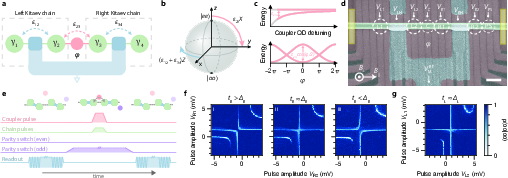
Figure 1: Schematic and device overview, including four Majorana modes, the central coupler QD, Bloch sphere of the qubit, and experimental setup for initialization, manipulation, and readout.
Hamiltonian and Theoretical Structure
Each two-site chain generates a pair of MZMs, so the system supports four zero modes (γ1–γ4) encoding a two-qubit Hilbert space composed of four fermion parity configurations: ∣ee⟩,∣oo⟩ (global even), ∣eo⟩,∣oe⟩ (global odd). Parity conservation constrains the available coherent operations to within either the even or odd manifold.
The effective low-energy Hamiltonian in the even (odd) global parity manifold is:
Heven=(ε12+ε34)Z+ε23cos(φ/2)X
Hodd=(ε12−ε34)Z+ε23cos(φ/2)X
Here, Z and X are logical Pauli operators in the natural computational basis, and each εab represents a two-Majorana coupling; for instance, γ10 is the inter-chain coupling mediated by the central QD, tunable via gate voltages and phase γ11. Notably, when onsite splittings (γ12) vanish, the Rabi oscillation frequencies between parity states are predicted to be identical in both parity sectors—a key signature of topological encoding and Majorana non-locality.
Device Tuning and Initialization
Proper demonstration of Majorana qubit operation requires tuning each chain to its “Majorana sweet spot," where local electron and hole components hybridize for maximal Majorana character, corresponding to matched charge and pairing amplitudes. This regime is identified through pulsed charge-stability diagrams (PCSDs), which map parity mixing features as functions of hybridization gate voltages. The crossings observed in such diagrams serve as operational markers for optimal tuning.
Crucially, the measurements confirm that simultaneous observation of parity-mixing crossings in both chains and both even/odd manifolds is necessary to establish that the device is truly in the regime where both chains house spatially separated MZMs.
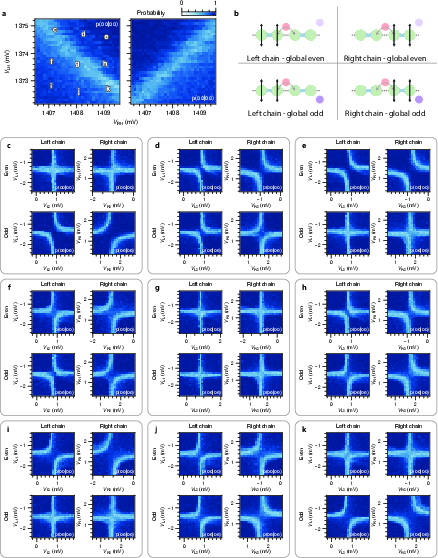
Figure 2: Pulsed charge-stability diagrams across parameter space, showing locations and orientation of parity crossings depending on global parity manifold and chain detuning.
Coherent Parity Oscillations
The central achievement is the resolution of coherent Rabi oscillations between γ13 and γ14 states (even manifold) as well as between γ15 and γ16 (odd manifold), driven by the tunable coupling across the central QD. The oscillation frequency depends on the coupler-dot detuning—specifically, it scales inversely with the energy difference from resonance, consistent with theoretical predictions for cotunneling-mediated inter-chain coupling.
Fit analysis yields Rabi frequencies up to γ17 and decay times γ18 for appropriately chosen parameters, with both contrast and frequency robust to a variety of nonidealities in the device Hamiltonian. Additionally, the experiment verifies the theoretical expectation that oscillation frequencies can be suppressed to near zero by tuning the superconducting phase difference γ19, reflecting the predicted vanishing of γ40 at this phase.
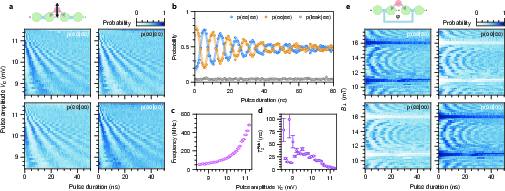
Figure 3: Conditional probabilities showing coherent parity oscillations, frequency scaling with coupler detuning γ41, and oscillation suppression at phase γ42.
Comparative Analysis of Even/Odd Manifolds
By manipulating the parity-switching QD, the study realizes operations in both parity manifolds. Comparative measurements of the coherent dynamics in the even and odd manifolds reinforce that, at the Majorana sweet spot, the Rabi frequencies are matched within experimental uncertainties (γ43, γ44). This parity independence constitutes evidence for the underlying Majorana zero-mode encoding with minimal unwanted overlap of the constituent Majorana wavefunctions.
Deviations from this frequency matching as functions of gate detuning provide a sensitive probe of nonidealities (wavefunction overlap and non-topological couplings) in the system—serving as an important tool for diagnosing how closely the physical device approaches the ideal topological regime.
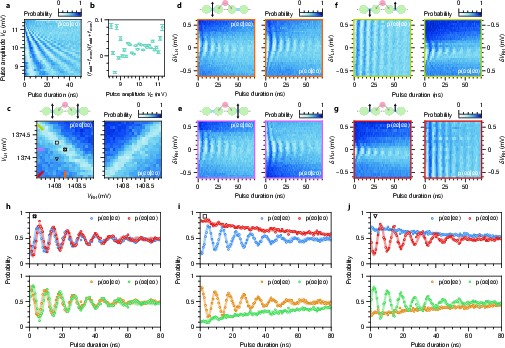
Figure 4: Even/odd manifold parity oscillations, parity-dependent frequency differences, and mapping of oscillation robustness to detuning trajectories.
Robustness and Noise Analysis
The system's partial topological protection is probed by individual and collective detuning of the constituent QDs. Detuning both QDs within a single chain rapidly suppresses coherent oscillations, shifting the qubit away from the protected sweet spot, while detuning only one QD preserves oscillations over a broader voltage interval. These observations match theoretical expectations for the residual sensitivity of poor man's Majoranas (finite-length Kitaev chains) to local perturbations.
Extensive numerical simulations using a full microscopic model with quasistatic charge noise quantitatively capture the experimental decay envelopes, frequency shifts, and parity dependence, confirming that noise on gate voltages and interdot tunnelings are dominant decoherence sources in this regime.
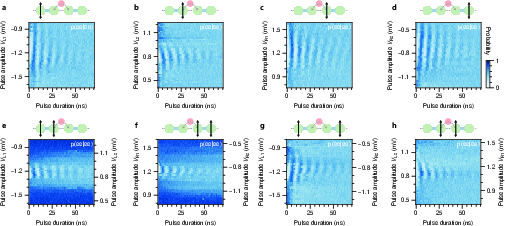
Figure 5: Effect of various QD detunings on parity oscillation visibility and coherence, highlighting regimes of partial protection and rapid decoherence.
Implications and Prospects
The demonstration of coherent control, single-shot readout, and parity oscillations in a split Majorana parity qubit provides a crucial step toward scalable topological quantum computation. Although the topological protection is not fully realized in two-site “poor man's Majorana” chains, the methodology directly extends to longer, more robust Kitaev chains, where qubit splitting susceptibility to local noise is predicted to decrease exponentially with chain length. The architecture is compatible with future fusion and braiding protocols to test non-Abelian statistics—a prerequisite for fault-tolerant quantum logic.
The results also clarify important practical limitations: manipulations that lift qubit degeneracy via local operations are never fully protected by topology, regardless of system size. However, such non-topological operations remain necessary for universal quantum computation (such as magic state preparation/projection).
Rigorous Hamiltonian engineering as demonstrated here—leveraging both advanced materials and high-fidelity time-domain control strategies—lays the foundation for more complex networks where non-Abelian Majorana physics, quantum error correction with topological codes, and scalable readout and coupling schemes can be explored.
Conclusion
This work establishes the feasibility of encoding, initializing, and coherently manipulating a Majorana parity qubit within coupled minimal Kitaev chains, with detailed experimental verification of parity-dependent Hamiltonian structure, coherent dynamics, and noise robustness. The observed equality of even/odd Rabi frequencies at the sweet spot, agreement with theoretical models, and ability to pinpoint qubit detuning via parity oscillations constitute strong evidence of Majorana-based encoding. These results set a robust experimental baseline for scaling Majorana qubits into architectures with greater topological protection and for exploring non-Abelian operations crucial to fault-tolerant quantum computation.