- The paper develops a stochastic control framework that integrates dealer reputation feedback metrics (win ratios, fill rates) into quoting strategies for OTC market making.
- The model employs a high-dimensional HJB equation reduced via adiabatic separation, revealing bistable equilibria and distinct strategic phases.
- Numerical analysis shows that aggressive score management near promotional thresholds enhances future client access and flow dynamics.
Strategic OTC Market Making with Reputation Feedback: An Authoritative Summary
Motivation and Model Architecture
The paper "Strategic OTC market making with reputation feedback" (2607.11328) develops a stochastic control framework for electronic OTC market making where dealer reputation is directly integrated into the quoting strategy. Modern OTC venues—RFQ platforms and streaming liquidity hubs—increasingly employ performance-based flow gates: the intensity and quality of future client requests depends on a dealer's recent execution quality, measured by win ratios and fill rates. This dynamic creates an explicit trade-off: immediate spread capture versus long-term franchise value.
The dealer optimizes across two coupled execution protocols:
- Tier A (RFQ channel): Dealer reputation is encapsulated by a win ratio RA.
- Tier B (Streaming channel): Dealer reputation uses a fill ratio RB, influenced by latency marks and last-look acceptance protocols.
Scores are updated as exponentially-weighted averages, and future request intensities are modulated via logistic gate functions of the scores, GA(RA) and GB(RB). The model yields a high-dimensional HJB equation, which is rendered tractable by employing an adiabatic slow–fast separation: inventory is managed on a fast timescale for fixed scores, with reputation variables RA, RB evolving on a slower timescale dictated by accumulated execution outcomes.
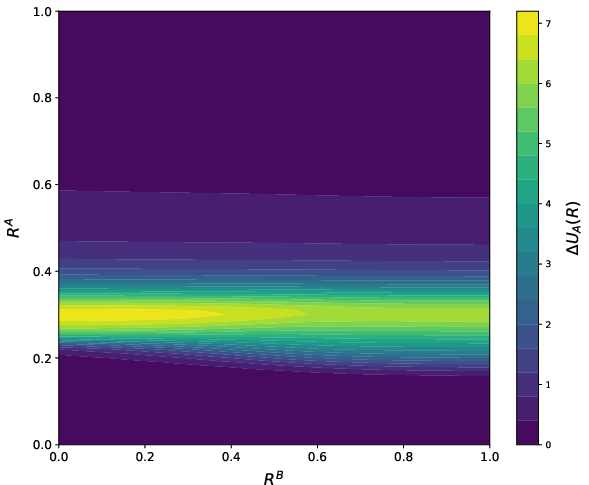
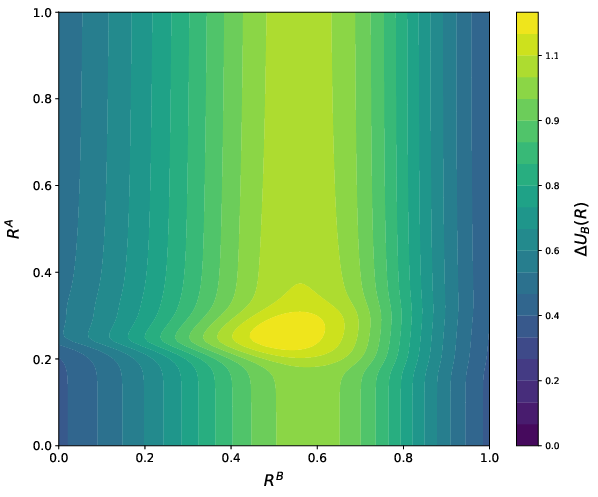
Figure 1: Promotion values ΔUτ(R)=U(R+τ)−U(R−τ) over the two-dimensional score space, indicating state-dependent marginal continuation value of successful execution.
Control Dynamics and Reputation Feedback
Optimal quoting and acceptance strategies are derived via the HJB formalism:
- RFQ Quotes: The dealer optimizes the offset δA∗,s to maximize expected spread, adjusted for the value of a score increment when an RFQ is won, utilizing a sigmoid trade probability model.
- Streaming Quotes and Thresholds: Streaming quotes and last-look rejection thresholds (δB∗,s,ηB∗,s) are jointly optimized; adverse selection is mitigated via a fair protocol, and acceptance probability is shaped by both the quote and threshold.
The marginal value of successful events, ΔUτ(R), exhibits strong state dependence, peaking near promotional thresholds where score gates transition, incentivizing aggressive price improvements to secure future client access.
Numerical Analysis: Policy Surfaces and Equilibria
Numerical implementation employs policy iteration with dampened evaluation over discrete inventory and reputation grids. Key findings include:
- Campaigning Near Gate Thresholds: Dealers sacrifice immediate spread to elevate win/fill ratios when close to the gate midpoints; post-threshold, quoting becomes more defensive and oriented towards franchise monetization.
- Cross-tier Spillovers: Improved streaming scores RB0 bolster RFQ competitiveness through enhanced inventory mixing and future value estimation.
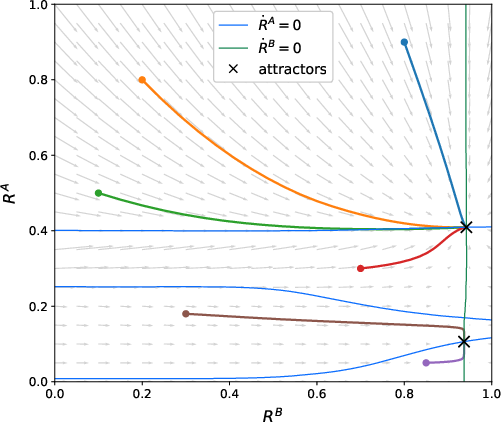
- Multiple Stable Regimes: Score dynamics exhibit bistability—two attracting equilibria: a low-reputation regime (marginal flow) and a high-reputation regime (leadership, increased client access). The transition and recovery sequence across tiers is governed by the geometry of nullclines and reputation feedback strength.
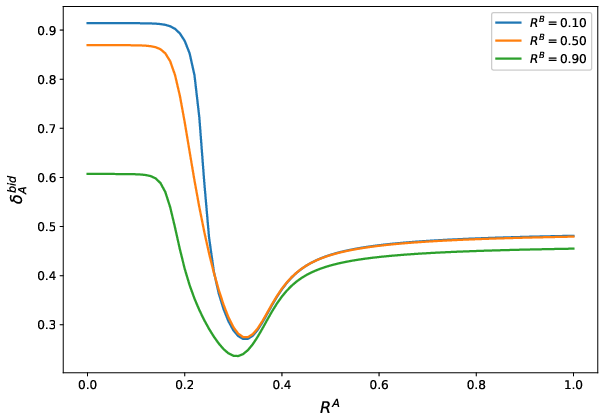
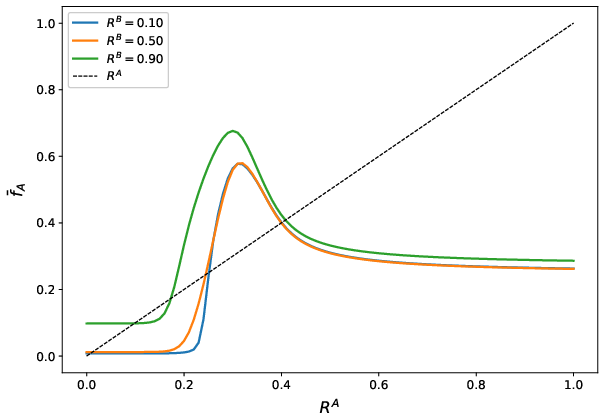
Figure 2: RFQ pricing and inventory-averaged win probability, highlighting fixed-point intersections and demonstrating bistable equilibria accessible via strategic campaigning.
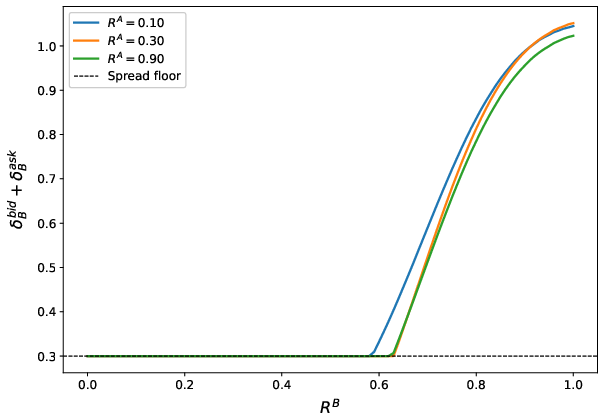
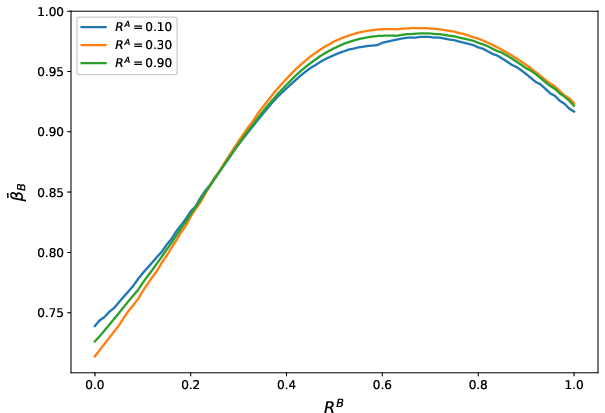
Figure 3: Streaming tier spread and acceptance probability surfaces, revealing adaptive behavior in response to fill ratios and cross-tier influences.
Phase Portrait and Regime Dynamics
The phase portrait of slow reputation variables reveals the global structure of the score dynamics:
Practical Implications and Theoretical Perspectives
This model formalizes the inherent path dependence and regime diversity in OTC market making under performance-based flow allocation. Dealers encounter strategic phases: aggressive campaigning for score recovery, conservative defense near thresholds, and monetization in leadership regimes. The model demonstrates that marginal value is maximized for score increments near gates rather than at high-score states, contradicting non-feedback frameworks.
Key implications:
- Score Management as Portfolio-level Optimization: Optimal strategy demands integrated score management across channels—isolated quote optimization is suboptimal due to coupled inventory and flow dynamics.
- Multiple Stable Flow Regimes: Identical dealers (technology and risk) may persist in low-flow or high-flow states, contingent on initial reputation and execution sequence.
- Cross-tier Effects and Recovery Order: Inventory and continuation value link RFQ and streaming strategies; practical score recovery requires coordinated campaigning and tolerance of flow toxicity.
Theoretical extensions might address multi-dealer competition, endogenous client routing, and adaptive gate evolution, which could further enrich the dynamical landscape and inform large-scale e-trading infrastructure design.
Conclusion
The framework presented rigorously integrates performance-based routing into stochastic OTC market making. Explicit modeling of reputation feedback via win/fill ratios introduces dynamic campaigning, defense, and monetization phases, exposing multiple stable client-flow regimes and path dependency of dealer franchises. Theoretical insights and numerical analysis underline the importance of score management across client channels and provide analytic tools for practical e-trading strategy optimization. Future developments will likely explore multi-agent extensions, adaptive score gates, and learning dynamics for client and platform interactions.