- The paper introduces an MPC framework using an extended SEIR-V model that integrates vaccination, mutation, and super-spreader dynamics to balance public health and economic objectives.
- The paper demonstrates the emergence of the 'Hammer and Dance' strategy through receding-horizon optimization, ensuring hospital capacity is maintained while controlling infection rates.
- The paper provides a robustness analysis showing minimal variability with differing prediction horizons and validates a turnpike property that underpins the controller's asymptotic stability.
Optimal Control of Pandemic Dynamics via Model Predictive Control: Health-Economic Trade-off Analysis
Problem Setting and Model Architecture
The paper develops a rigorous economic Model Predictive Control (MPC) framework grounded on an extended SEIR--V compartmental epidemic model. The SEIR--V model augments the classical structure by incorporating vaccination as a control input, mutation dynamics (original and mutant strains), super-spreaders, and explicit hospital, recovered, and fatality compartments. The state-space representation encompasses nine compartments: susceptible (S), exposed (E), vaccinated (V), infected (original I1 and mutant I2), super-spreaders (P), hospitalized (H), recovered (R), and fatalities (F). Transmission rates are differentiated for infectious classes, and the force of infection is defined as a function of these rates. The model is calibrated to the COVID-19 pandemic dynamics in Italy, specifically during the critical vaccination phase.
The control configuration actuates the system through time-varying social openness (β(t), proxy for transmission and economic activity) and vaccination rate (E0), subject to realistic bounds reflecting policy and logistic constraints. Transmission multipliers for super-spreaders and mutant strains are set at E1, identified via calibration.
The OCP is formulated as a constrained, finite-horizon nonlinear optimization problem. The composite cost function is a weighted sum encoding multiple objectives:
- Economic Cost: Penalizes deviation from maximal openness, based on quadratic distance from the business-as-usual E2.
- Healthcare Capacity Violations: Enforces a steep soft constraint penalty beyond critical ICU capacity (E3).
- Fatality Minimization: Measures daily increments in the cumulative fatality counter.
- Vaccination Effort: Models logistic costs.
- Policy Smoothing: Penalizes abrupt changes in E4 to ensure social adherence.
Model predictive control leverages a receding horizon strategy: at each time step, the OCP is solved using full-state feedback, with only the first control action actuated and the horizon shifted forward, introducing feedback robustness to stochastic disturbances and initial-state uncertainty. The solver employs a single-shooting SQP approach with warm starting.
Numerical Results: Closed-Loop Analysis
The simulation is initialized in a peak-crisis scenario, reflecting real-world conditions with high hospitalization and infection rates. Results are reported for a population with E5 million, using calibrated biological and economic parameters.
The aggressive control policy is implemented with a lexicographic prioritization: economic loss above capacity violation, capacity violation over mortality, and negligible vaccination cost. The controller applies maximum suppression (E6) for the early phase (approximately 45 days) until hospitalizations descend below the E7 deadzone, then gradually reopens (E8), holding vaccination rate at maximum throughout. This suppression-then-reopening sequence, the "Hammer and Dance," is not imposed a priori but emerges from optimal receding-horizon control.
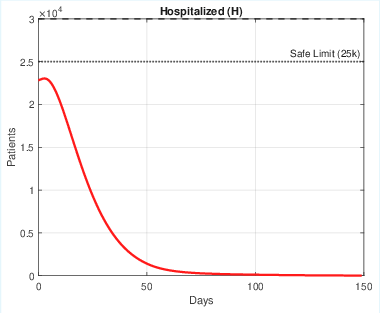
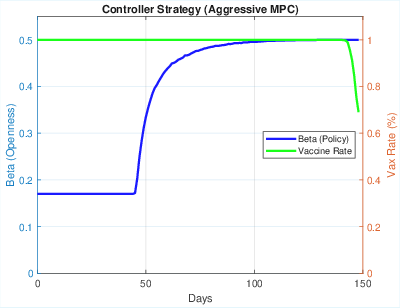
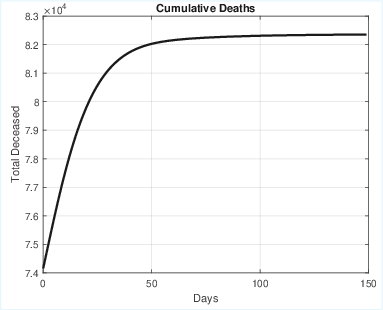
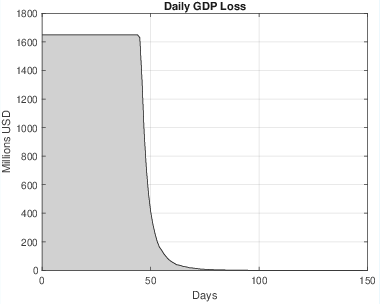
Figure 1: Aggressive Living-with-COVID strategy under closed-loop MPC; hospitalizations are suppressed, social openness held at the lower bound during the “Hammer,” with reopening in the “Dance” phase, fatality plateau, and GDP loss collapse.
Horizon Sensitivity and Robustness
A comprehensive sensitivity analysis reveals the closed-loop controller's robustness to horizon choice. The realized composite cost E9 exhibits minimal variation (<0.15%) across prediction horizons from V0 to V1, with a global minimum at V2 days. Short horizons are modestly sub-optimal due to the exit phenomenon, where the optimizer becomes greedy near terminal time, but this is mitigated in longer horizons that adequately capture the epidemic trajectory and capacity boundaries.
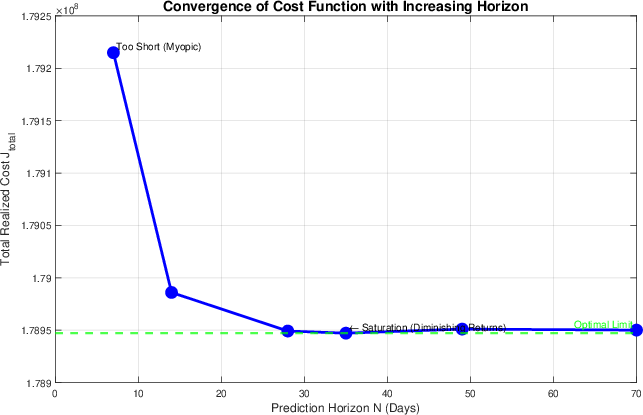
Figure 2: Horizon saturation analysis showing total realized cost as a function of prediction horizon V3, with minimum at V4 days and extremely stable closed-loop performance.
Turnpike Property and Structure of the Optimal Policy
Through open-loop experiments, the paper demonstrates the turnpike property: independently of the initial conditions (low, baseline, high infections), optimal trajectories rapidly converge onto a unique suppression boundary dictated by healthcare constraints, then exit in a terminal reopening arc. The time spent on the turnpike is proportional to the initial infection severity; the suppression turnpike is constraint-induced, shaped by the capacity penalty rather than mere economic cost convexity.
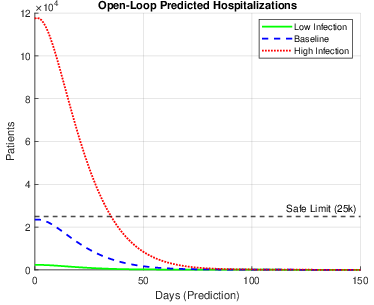
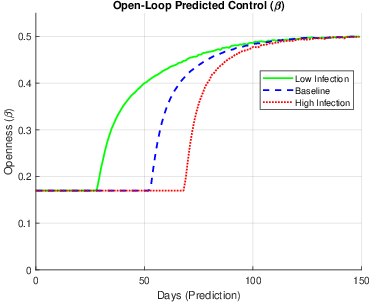
Figure 3: Turnpike property as hospitalizations from diverse initial conditions collapse onto the same optimal boundary path and openness V5 anchors at the suppression bound before adaptive exit.
Analysis across multiple horizon lengths reveals that longer horizons result in more prolonged anchoring to the turnpike before the characteristic exit phenomenon sets in due to the finite-horizon nature of optimization. This structural behavior is essential for practical asymptotic stability, as it proves that receding-horizon economic MPC stabilizes the disease-free equilibrium, which is otherwise open-loop unstable when V6.
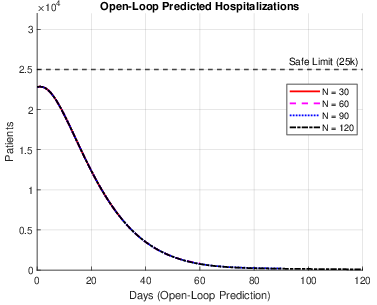
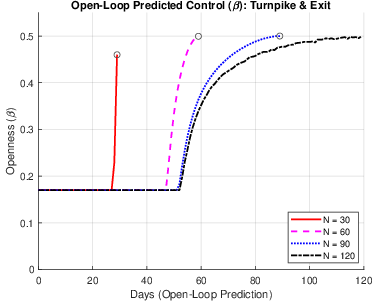
Figure 4: Open-loop turnpike analysis for varying horizons; longer horizons exhibit extended time on the suppression turnpike, while exit (reopening) is delayed and optimized.
Implications and Theoretical Contributions
The study provides a mathematically principled decision-support framework for pandemic policy, moving beyond heuristic or open-loop approaches. The emergence of the Hammer-and-Dance strategy as the mathematical optimum validates the role of feedback, model calibration, and constraint-induced turnpike structure in epidemic control. The practical asymptotic stability is guaranteed for sufficiently long horizons due to the turnpike effect, bypassing the need for intractable terminal constraints in high-dimensional nonlinear models.
The findings have several practical implications:
- Dynamic feedback permits near-optimal policy adaptation, ensuring that critical healthcare capacity is not breached and economic activity is maximized once suppression is achieved.
- Planning horizons must exceed the pathogen’s incubation/generation period to avoid myopic control and enable efficient reopening.
- Structural robustness to horizon and initial-condition perturbations enables practical deployment in uncertain real-world scenarios.
Theoretical implications include the demonstration of constraint-induced turnpike behavior governing the optimal operating point, and the validation of economic MPC stability in realistic epidemic models.
Future Directions
Extension to robust, stochastic, or tube-based MPC frameworks incorporating parametric and measurement uncertainty is proposed, necessitating further validation through Monte Carlo simulation against perturbed plants. Pareto analysis of weightings and multi-objective trade-offs, as well as real-time state-estimation (e.g., via EKF), are technically viable future developments.
Conclusion
The paper establishes that optimal pandemic control can be realized via dynamic, feedback-driven MPC strategies applied to high-fidelity compartmental models. The health-economic trade-off is not static but solvable in real-time through receding-horizon regulation, yielding structural stability anchored by the turnpike property. The resultant policy holds hospitalizations below capacity and implements aggressive suppression followed by measured reopening, achieving minimum societal cost and optimal resource allocation. The framework provides both theoretical insights and practical tools for future epidemic response.