- The paper presents a hybrid optimal control framework that extends classical SIR models with regime switching to optimize intervention timings across multiple phases.
- It employs the Hybrid Minimum Principle to derive phase-specific Hamiltonian conditions and optimal switching schedules using numerical simulations.
- Results demonstrate that coordinated multi-phase interventions, including RTO, WFH, and vaccination strategies, significantly reduce costs and improve epidemic control.
Hybrid Optimal Control of Multi-Phase Epidemiological Systems: Regime-Switching Framework and Analysis
The paper presents a rigorous hybrid optimal control framework for epidemiological compartmental models subject to regime switching. The model extends classical SIR-type structures to incorporate multi-phase interventions, specifically operational switches between return-to-office (RTO), work-from-home (WFH), and a vaccination protocol phase. Each phase is characterized by distinct continuous dynamics, control spaces, and running cost functions, reflecting shifts in both disease transmission mechanisms and public health-socioeconomic trade-offs.
The system is formalized within the hybrid systems framework as a septuple H, capturing discrete modes (Q), phase-dependent state and control spaces, transition maps (both discrete and continuous), and switching manifolds. Regime transitions are governed either autonomously by state threshold criteria (e.g., infection levels crossing thresholds for policy escalation/relaxation), or controlled via intervention decision variables. Nontrivial jump maps account for state and control dimension changes across phase boundaries. This modeling approach allows endogenous optimization of switching times alongside continuous intervention controls, a significant extension over standard optimal control approaches fixed to a single dynamical structure.
Hybrid Minimum Principle and Control Synthesis
Optimal strategies for continuous interventions and switching schedules are characterized via the Hybrid Minimum Principle (HMP), generalizing Pontryagin’s principle to hybrid dynamical systems. For each phase, the family of Hamiltonians Hq(xq,λq,uq,t) incorporates phase-dependent running costs (ℓq) and system dynamics (fq). The optimality conditions yield canonical equations for the state and adjoint processes, with additional boundary and jump conditions dictated by the discrete structure and switching manifolds.
Optimal controls are determined analytically within each phase: quarantine efforts, WFH assignments, and vaccination protocols are each expressed as bounded quadratic minimizers driven by adjoint variables. Input constraints and phase-specific cost weights ensure realistic intervention intensities.
At switching events, Hamiltonian continuity is required, and adjoint boundary conditions are carefully constructed. Autonomous switchings incorporate additional multiplier terms (pi), enforcing optimality with respect to switching manifolds. Controlled switchings require the minimization of the hybrid Hamiltonian with respect to both the continuous input and switching time.
Numerical Simulation and Optimal Strategy Evaluation
Simulations explore the system over a 40-day horizon, beginning with a predominantly susceptible and unvaccinated population. Parameters (transmission, progression, recovery, immunity loss, intervention intensities) are instantiated to represent realistic workplace outbreaks.
The optimal solution specifies switching times [ts1,ts2,ts3]=[13.02,16.39,25.44] days for regime changes. Results demonstrate dynamically coordinated interventions: initial RTO transitions to WFH when infection exceeds Ihigh, with vaccination initiated and subsequently phased out as infections drop below Ilow. State evolution is tracked through the outbreak and recovery, capturing the redistribution of susceptible, exposed, infectious, quarantined, vaccinated, and recovered populations.
(Figure 1)
Figure 1: Optimal evolution of compartmental states, adjoint variables, Hamiltonian, control inputs, and incurred phase-dependent cost across multi-phase regimes.
Perturbation analysis assesses the impact of non-optimal switching schedules. Controlled switching time ts2 is shifted by Q0 day; the resulting solutions violate Hamiltonian continuity at switching events and incur higher total cost. These suboptimal configurations demonstrate both the necessity and sufficiency of HMP-derived optimality conditions for hybrid systems.
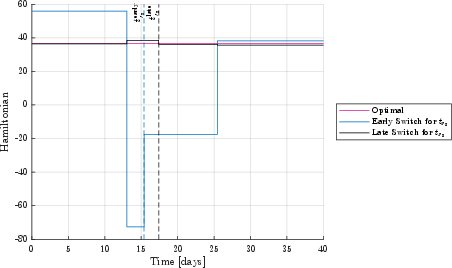
Figure 2: Hamiltonian profiles comparing optimal and perturbed switching times, highlighting discontinuity and suboptimality for off-optimal schedules (Q1 day).
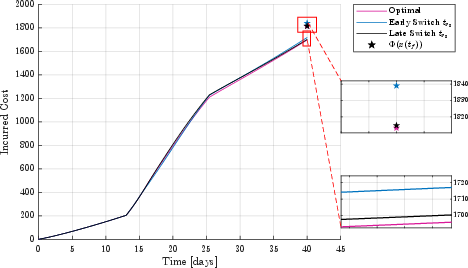
Figure 3: Cost trajectories under optimal vs. perturbed switching policies, with minimum at HMP-compliant schedule and substantial penalties for deviation.
Numerical results substantiate the main claim: hybrid intervention schemes, when optimally coordinated (WFH and vaccination phases with regime switching), significantly outperform single-phase policies in both disease suppression and cost minimization. Strong quantitative evidence is provided, including sharp cost reductions and critical adjoint/Hamiltonian consistency at optimized schedules.
Implications and Future Directions
The theoretical and practical implications of this research are substantial. From a control-theoretic perspective, the hybrid optimal control formulation with regime switching and joint schedule/input co-optimization advances the tractability and expressivity of compartmental epidemic models. The incorporation of nontrivial jump maps and phase-specific structures enables precise modeling of staged public health responses, capturing both operational realism and mathematical rigor.
Practically, the results inform adaptive intervention design: workplace and community policies should be dynamically coordinated, with thresholds for escalation and integrated vaccination protocols. Hybrid frameworks allow policy-makers to optimize not just intervention intensity, but also timing and sequencing, critical for minimizing both epidemiological and socio-economic costs.
Looking forward, the hybrid framework can be extended to heterogeneous systems—networked populations with multiplex interaction structures, stochastic effects, and spatially distributed regimes. Incorporation of graphon limits and mean-field games (as referenced in the paper) will facilitate modeling and control of large-scale, non-uniform populations.
Conclusion
This paper establishes a comprehensive hybrid optimal control strategy for multi-phase epidemiological compartmental models with regime switching. Phase-dependent dynamics and cost structures, coupled with HMP-based optimization, provide both theoretical insight and actionable guidance for public health intervention. Numerical evidence confirms the superiority of coordinated multi-phase policies over isolated interventions. The hybrid paradigm presents a robust foundation for future work in networked, heterogeneous, and data-driven epidemic control settings.
(2605.01559)

