- The paper introduces a lithography-free method for fabricating Te metasurfaces using pulse laser irradiation to spatially pattern the c-axis for reconfigurability.
- Experimental and numerical analyses confirm polarization-dependent beam deflection with designed PB phase gradients, achieving up to 1.4% conversion efficiency.
- The study highlights the potential for dynamic optical applications and suggests that optimizing laser writing protocols could further enhance device performance.
Motivation and Context
The synthesis of reconfigurable metasurfaces is critical for the advancement of lightweight, compact optical devices. Conventional metasurface fabrication relies primarily on intricate lithographic procedures to engineer subwavelength geometries. Such approaches are limited in scalability and functional reconfigurability. Tellurium (Te) offers an alternative due to its pronounced uniaxial optical anisotropy and high refractive index in the near-infrared regime. This paper establishes a lithography-free protocol for metasurface generation via direct, spatially resolved control of the Te c axis through linearly polarized picosecond pulse laser irradiation. The fabricated metasurface beam splitter enables spatially programmable phase manipulation utilizing the Pancharatnam-Berry (PB) phase, allowing dynamic rewrite and reconfiguration of device functionality.
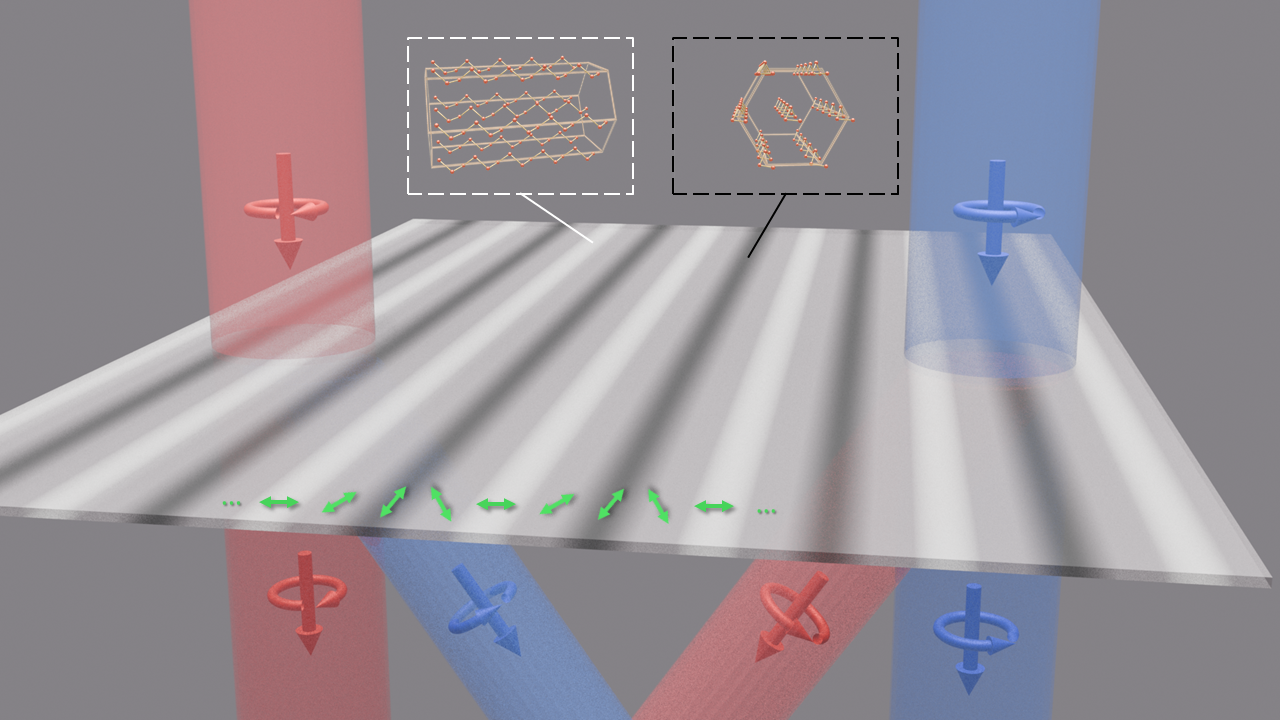
Figure 1: The spatially patterned c axis in Te, induced by pulse laser irradiation, enables PB phase-based polarization-dependent beam splitting.
Theoretical Framework
Beam steering is achieved by imposing a spatially varying PB phase on the cross-circularly polarized component of an incident beam. The local Jones matrix formalism captures the interaction of the incident field with optically anisotropic regions of the Te film, with rotation of the c axis encoding the phase profile. Quantitatively, the PB phase imprinted on the cross-polarized component is ΦPB=∓2θ(x), inducing a deflection of kx=±2π/L for spatial period L of the patterned c axis. The predicted deflection angle is given by sinβ=±λ/L, a result consistent with generalized Snell's law and confirmed via numerical simulation.
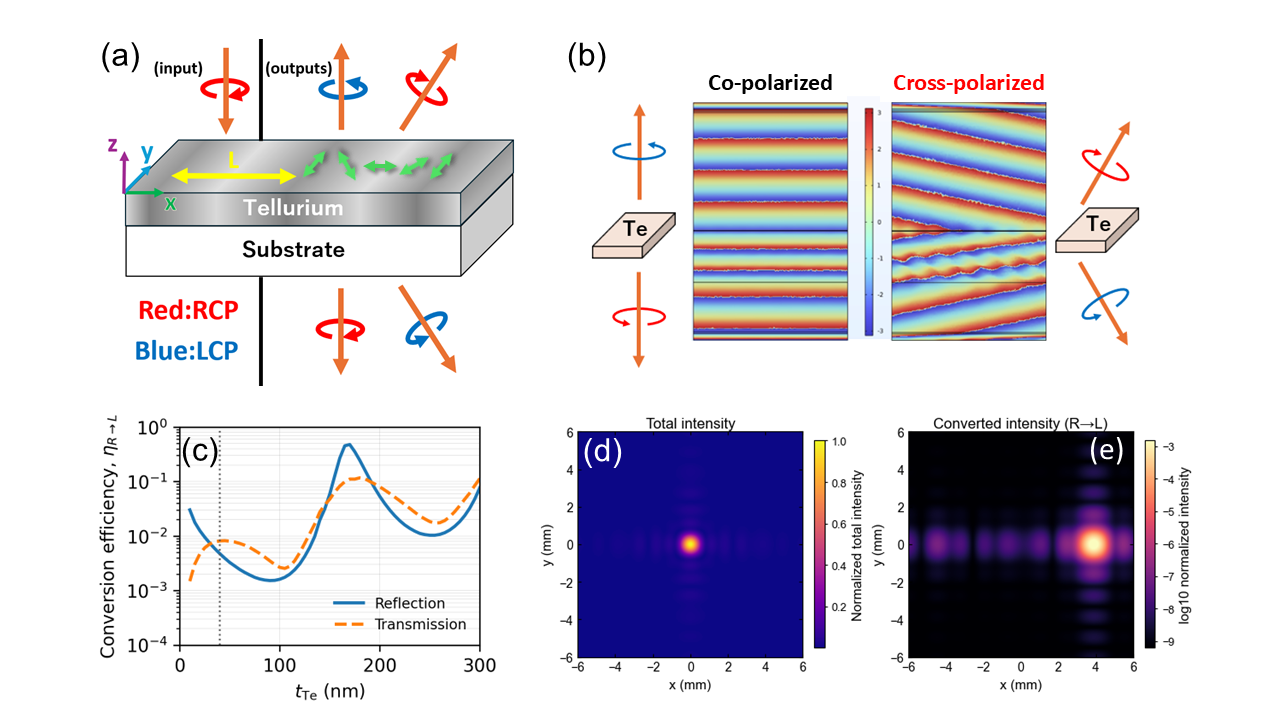
Figure 2: Numerical simulation of a Te metasurface supercell, indicating distinct spatial evolution of the cross-polarized deflected beam under spatially modulated c axis.
Device Fabrication Protocol
Polycrystalline Te films capped with Al2Oc0 are grown via molecular beam epitaxy, with subsequent laser programming of the in-plane c1 axis orientation. The laser parameters—power, scan speed, and polarization—are optimized to produce an array of domains, each with a prescribed c2 axis rotation. Adjacent regions are separated by domain width c3, with a rotation increment c4, forming a supercell of period c5. This stepwise spatial modulation enables digitally encoded phase gradients for beam steering.
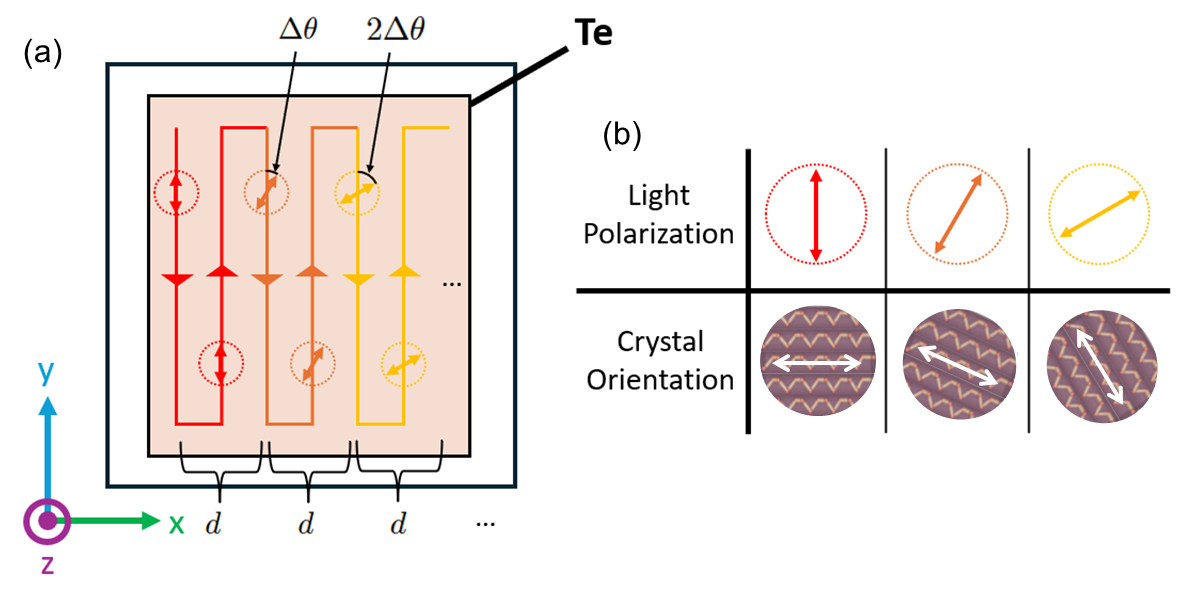
Figure 3: Schematic of the laser writing protocol, demonstrating systematic spatial reorientation of the Te c6 axis across the film.
Experimental Setup and Characterization
The fabricated beam splitter is interrogated with circularly polarized light at c7. Transmitted beam profiles are acquired via an IR camera positioned c8 downstream, with selective exposure accounting for high dynamic range between co- and cross-polarized components. The deflection and efficiency metrics are derived from quantitative image analysis.
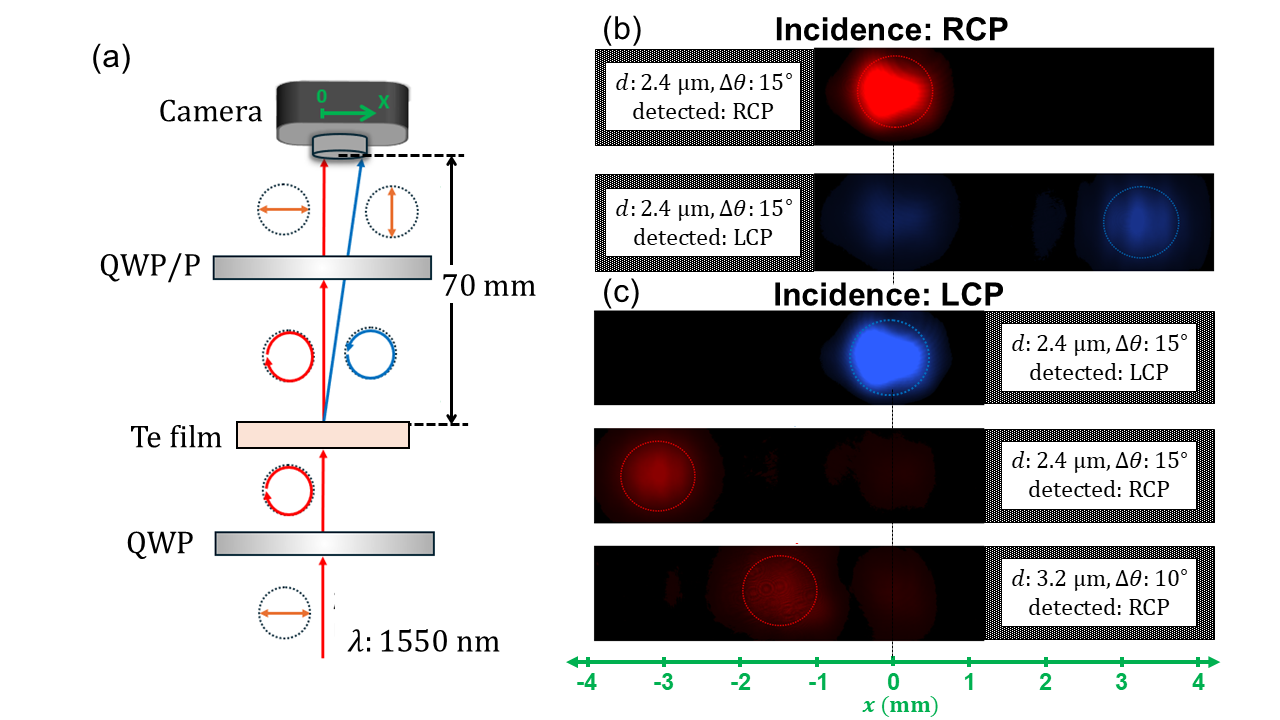
Figure 4: Measured camera images demonstrating spatially resolved cross-polarized beam deflection, with reversal of deflection direction corresponding to incident helicity.
Numerical and Experimental Results
Finite-element simulations (COMSOL) and angular spectrum calculations predict a maximum conversion efficiency c9 for c0 Te films, constrained by achievable control of the c1 axis orientation. Empirically, the measured deflection angles are proportional to the designed phase gradient and exhibit helicity-dependent reversal, corroborating simulation predictions. The conversion efficiency peaks at c2 for optimal laser writing power, with dependence governed by c3, the difference in transmission coefficients along principal axes.
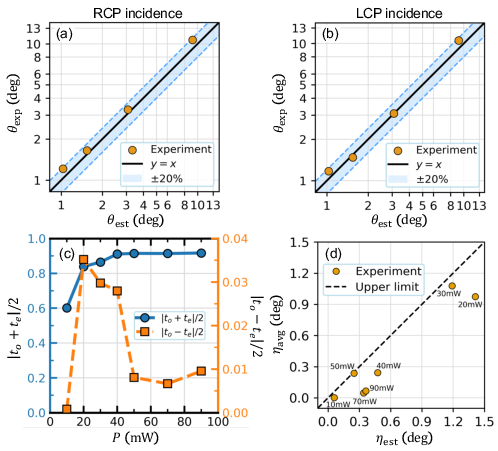
Figure 5: Quantitative comparison of measured and estimated beam deflection angles and conversion efficiencies, highlighting nonidealities and the impact of laser power on polarization conversion.
The polarization-dependent transmittance across irradiated domains is modeled by Jones calculus, enabling extraction of c4 and c5 as functions of writing laser power. The difference c6 peaks at moderate laser power and decays at higher values, corresponding to optimized conversion efficiency. This behavior is attributed to grain orientation and potential residual scattering.
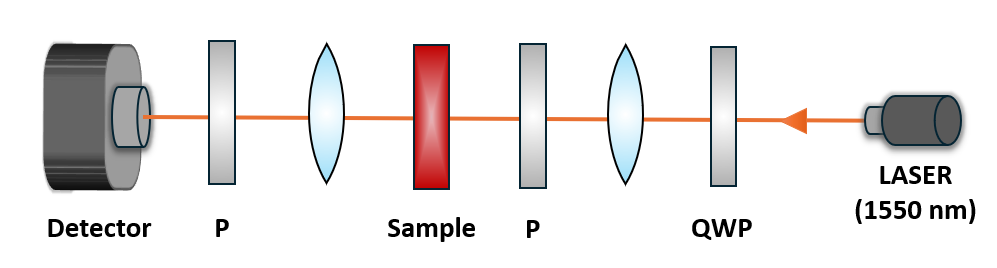
Figure 6: Optical setup for polarimetric determination of transmission coefficients c7 and c8 in laser-written Te domains.
Implications and Outlook
This laser-programmed approach for metasurface fabrication using Te unlocks several practical advantages: lithography-free patterning, rapid reconfigurability, and digital encoding of phase profiles. The direct overwrite capability enables dynamic modification of device functionalities post-fabrication. Current conversion efficiencies are modest and limited primarily by controllable anisotropy in thin films; optimization of writing protocols and extension to thicker films are projected to significantly enhance performance. From a theoretical perspective, this paradigm generalizes metasurface phase manipulation beyond geometry-defined structures to material response-tailored platforms.
Potential future directions include:
- Improving spatial uniformity and control of c9 axis orientation in thick Te films for higher efficiency.
- Integration of this programmable approach with other controllable materials for multifunctional and actively tunable metasurfaces.
- Exploration of higher-order anisotropy patterns for advanced PB phase engineering and multiplexing.
Conclusion
This study demonstrates a functional Te metasurface beam splitter fabricated by direct, pulse laser irradiation for programmable optical anisotropy. Experimental and theoretical analyses reveal precise control of beam deflection angles and moderate conversion efficiencies. The approach circumvents the conventional lithographic constraint, offering a scalable, reconfigurable platform for active flat-optics applications based on laser-driven anisotropy. The results position laser-written Te metasurfaces as a promising vector for future developments in dynamically reconfigurable optics and photonic device engineering.

