Published 12 Jul 2026 in hep-th, cond-mat.stat-mech, and quant-ph | (2607.10921v1)
Abstract: Krylov complexity is a powerful diagnostic of quantum dynamics, with clear connections to other measures of quantum chaos and operator growth. One such measure is the Loschmidt amplitude, defined as the overlap of initially identical states evolved under two slightly different Hamiltonians. Its decay in certain systems is controlled by the classical Lyapunov exponent. Using the algebraic properties of the Krylov complexity operator, we express Krylov complexity as the derivative of a Loschmidt amplitude whose perturbation is parameterized by an angular variable φ. This formulation allows us to define a spectral propagator that encodes the entire complexity distribution, which we characterize for specific types of systems. We study the two-dimensional quantum geometry spanned by time and φ where the original and deformed trajectories reside, demonstrating that Krylov complexity is upper-bounded by its volume. We also express the time derivative of Krylov complexity in terms of a distinct Loschmidt amplitude. Depending on the growth of the Lanczos coefficients, the perturbation term in this amplitude can be truncated. We propose that the strength of this perturbation provides a classification scheme for Krylov complexity dynamics and relate it to the φ-derivative of the spectral propagator. Using this analytical framework, we derive general relations between the time-dependence of the survival amplitude and Krylov space measures.
The paper introduces an operational framework linking Krylov complexity to derivatives of Loschmidt amplitudes under Hamiltonian deformations.
It employs algebraic and geometric methods, including spectral propagators and Fubini-Study metrics, to characterize quantum chaos and operator growth.
Numerical validations across models like DSSYK and RMT confirm robust complexity bounds and demonstrate model-universal behavior.
Krylov Complexity through Loschmidt Amplitude: Operational, Algebraic, and Geometric Perspectives
Introduction and Objectives
The manuscript "Krylov Complexity from Loschmidt Amplitude" (2607.10921) constructs a unifying framework for understanding the dynamics of quantum systems through the lens of Krylov complexity (KC), with an emphasis on its operational connection to Loschmidt amplitudes. The author systematically synthesizes algebraic properties of the Krylov complexity operator, geometrization of the emergent parameter space, and structural insights from the spectral function to establish a comprehensive approach to quantum complexity growth and sensitivity. Notably, the work highlights the explicit representation of KC as derivatives of Loschmidt amplitudes with deformed dynamics, and characterizes the matrix-geometry interplay, linking KC with bounds derived from the Fubini-Study metric.
Krylov Complexity, Operator Growth, and Loschmidt Echoes
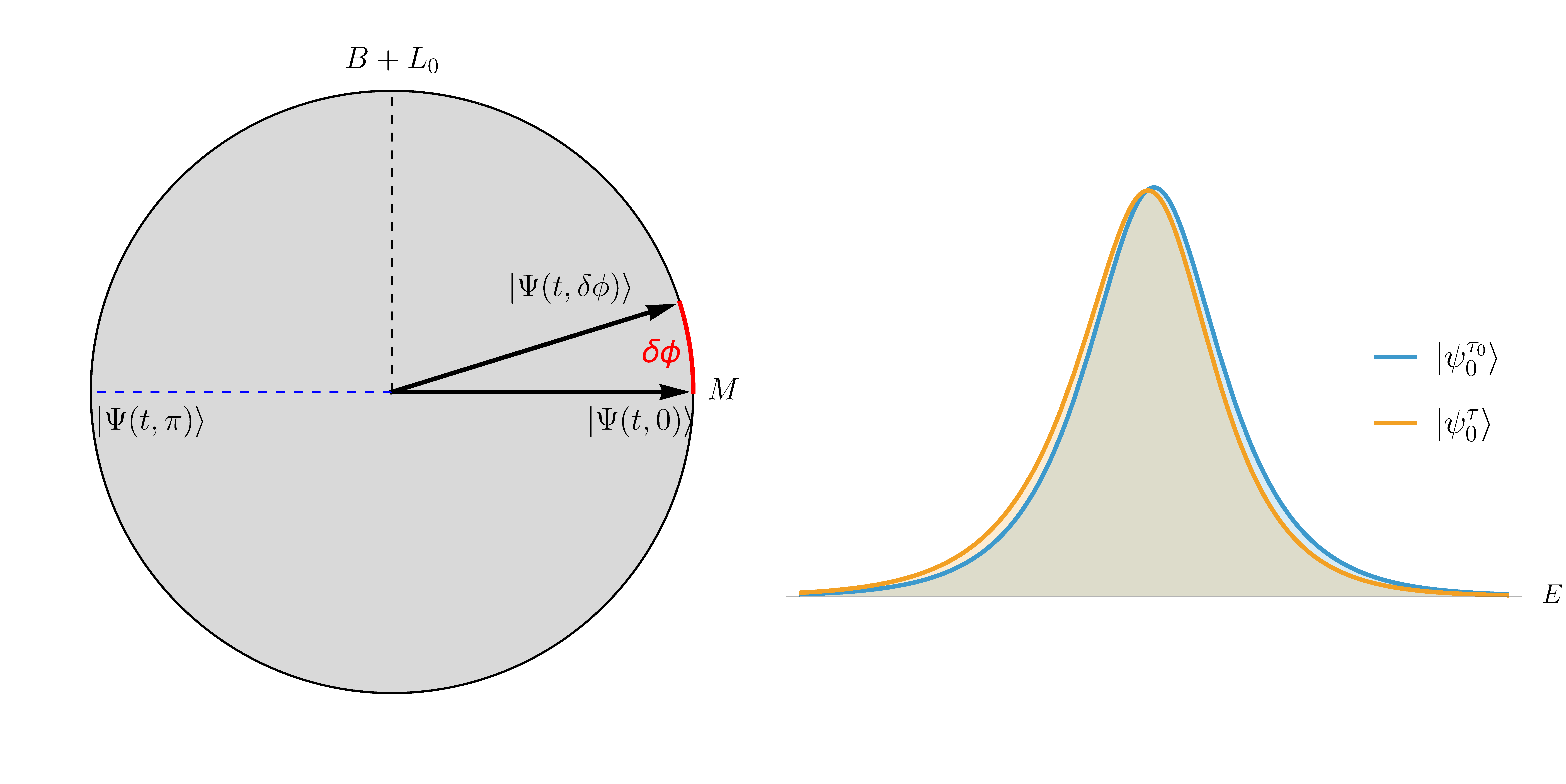
Krylov complexity, defined as the expected position on the Krylov basis chain relative to the initial state, is an extensively utilized diagnostic of operator growth and quantum chaos. The essence of the paper's approach is a mapping of KC to the sensitivity of the quantum evolution under Hamiltonian deformations. Concretely, the author introduces a continuous deformation parameter ϕ, under which the original Hamiltonian is rotated in the Krylov basis:
M(ϕ)=Mcos(ϕ)+Bsin(ϕ)+L0(1−cos(ϕ))
where B=i[n^,M] acts as the conjugate "momentum" operator. The Krylov complexity at time t is then expressed as:
K(t)=−i∂ϕ⟨0eiMte−iM(ϕ)t0⟩ϕ=0
This Loschmidt-type amplitude probes the rate of change in overlap between physical and deformed time-evolution trajectories, establishing KC as a leading-order measure of the system's dynamical sensitivity to perturbations in a specific direction in the Krylov space.
Figure 1: Krylov complexity as the (angular) rate of change of overlap between physical and deformed Hamiltonian trajectories; complexity is geometrically bounded by the volume swept out in the (t, ϕ) manifold.
This framework generalizes the physical interpretation of the Loschmidt echo: the decay of the echo is known to be sensitive to quantum chaos and can encode the system’s Lyapunov exponent. Within the KC formalism, exponential operator growth (and hence signatures of quantum chaos) are captured by the exponential scaling of the Krylov exponent, with direct analogies to Lyapunov growth in classical systems.
Spectral Propagator Formalism and Classification of KC Dynamics
The paper introduces a spectral propagator K(E1,E2,ϕ)—the Poisson kernel built from orthogonal polynomials relative to the system’s spectral function. All complexity moments are encoded as derivatives of this kernel, providing a non-perturbative tool for interpolating between specific models (such as RMT, SYK, and spin chains) and extracting late-time asymptotics or higher moments.
A central result is that the time derivative of KC can be recast as a Loschmidt amplitude with respect to a deformation in Euclidean time τ (i.e., a flow in the initial state under imaginary evolution). The crucial operator
F=i[B,M]
appears as the generator of the spectral (Toda) flow of the Krylov operator. The behavior of the entries of M(ϕ)=Mcos(ϕ)+Bsin(ϕ)+L0(1−cos(ϕ))0—specifically their decay or growth—forms the basis for classifying the type of KC dynamics (ballistic, sub-ballistic, exponential, etc.), and establishes the regimes in which finite-rank truncations yield faithful approximations.
The connection to random matrix theory (RMT) is leveraged to provide explicit analytic formulas for the complexity distribution and bounds, with strong agreement to numerics. For example, with constant Lanczos coefficients (semicircular spectral density), KC moments admit closed-form expressions: M(ϕ)=Mcos(ϕ)+Bsin(ϕ)+L0(1−cos(ϕ))1
for large M(ϕ)=Mcos(ϕ)+Bsin(ϕ)+L0(1−cos(ϕ))2, matching RMT universality.
Geometric Interpretation: The Complexity Manifold
A key insight is the geometrization of the space spanned by evolving quantum states under deformed Hamiltonian trajectories. By defining a family of states M(ϕ)=Mcos(ϕ)+Bsin(ϕ)+L0(1−cos(ϕ))3, the author constructs a two-dimensional manifold (parameterized by M(ϕ)=Mcos(ϕ)+Bsin(ϕ)+L0(1−cos(ϕ))4) equipped with a quantum metric inherited from the Fubini-Study structure. Metric components and Berry curvatures are explicitly related to moments of KC and their derivatives:
M(ϕ)=Mcos(ϕ)+Bsin(ϕ)+L0(1−cos(ϕ))5: variance of the Krylov Hamiltonian,
M(ϕ)=Mcos(ϕ)+Bsin(ϕ)+L0(1−cos(ϕ))6: variance of the KC operator,
M(ϕ)=Mcos(ϕ)+Bsin(ϕ)+L0(1−cos(ϕ))7: the time derivative of KC.
The local volume element of this manifold bounds the KC from above. The precise saturation of this bound is shown to occur when the algebra generated by the dynamical operators closes (complexity algebra scenarios). For subfamilies (e.g., with M(ϕ)=Mcos(ϕ)+Bsin(ϕ)+L0(1−cos(ϕ))8), the scalar curvature and geodesic deviation directly probe the time-evolution of complexity variance, providing a mapping between dynamical chaos and intrinsic manifold curvature.
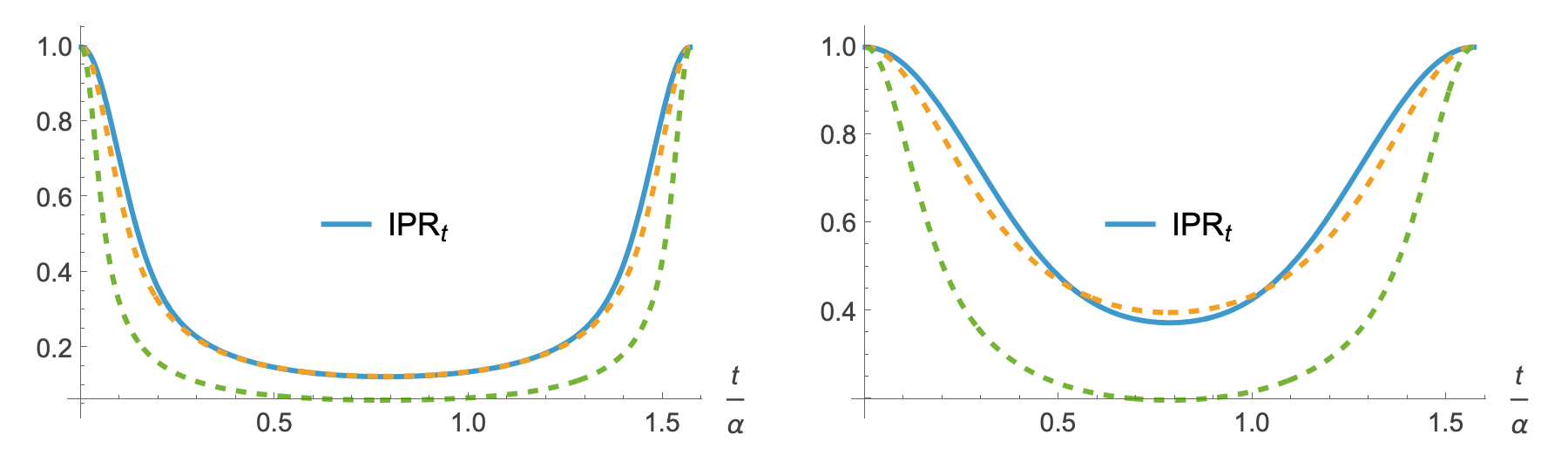
Figure 2: Inverse participation ratio (M(ϕ)=Mcos(ϕ)+Bsin(ϕ)+L0(1−cos(ϕ))9) measured against the variance of the KC distribution, constraining the shape of the probability spread in the Krylov basis.
Furthermore, the author establishes several rigorous and conjectured bounds connecting the decay of the autocorrelation (survival) function B=i[n^,M]0 and the KC variance. The exponential suppression of B=i[n^,M]1 is shown to be generically lower-bounded by the exponential of the KC variance, up to model-dependent prefactors.
Numerical Validation and Model Interpolation
The work provides extensive numerical validation in paradigmatic systems, most notably the double-scaled SYK model, RMT, and non-integrable spin chains. By tuning fundamental parameters (e.g., the "q" parameter in DSSYK), transitions between different KC growth regimes are realized and matched against analytic bounds derived from the operator norm of B=i[n^,M]2 and kernel asymptotics.
Additionally, the framework demonstrates strong structural robustness: even in the presence of stochastic or algebra-breaking perturbations to the Lanczos sequence, the key scaling relations connecting the B=i[n^,M]3 to the variance of KC are retained, reinforcing the universality of the KC–geometry link.
Implications and Future Directions
The algebraic and geometric reinterpretation of KC as a dynamical sensitivity measure, directly tied to Loschmidt amplitudes, enables a refined classification of quantum complexity growth and operator scrambling. The explicit spectral kernel formalism facilitates the derivation of system-agnostic and model-specific upper bounds, robust analytic predictions for late-time complexity statistics, and a rigorous connection between the geometry of state space and the physics of chaos.
Practical implications are substantial: finite-rank truncation schemes provide a computationally tractable and physically motivated approximation to KC in systems with slow operator spreading. The geometric approach opens avenues for formulating complexity measures as operationally accessible quantum geometric quantities, potentially useful for experimental protocols involving Loschmidt echoes or out-of-time-ordered correlators.
On the theoretical front, extensions to unbounded spectra, explicit treatment of more general non-Hermitian or open quantum systems, and connections to holographic duals (where complexity geometry plays a central role) are promising directions. The author’s conjecture that geodesic properties in the complexity manifold may underpin “optimal state preparation protocols” is particularly intriguing.
Conclusion
This study merges the operational definition of Krylov complexity with an explicit geometric structure on the quantum state manifold. By framing KC as the derivative of a Loschmidt amplitude under Hamiltonian (and state) deformations, the work delivers a coherent formalism for analyzing quantum chaos, operator growth, and complexity, establishing both rigorous bounds and model-universal behaviors. The integration of spectral, algebraic, and geometric analytic tools creates a template for future investigations of quantum complexity across condensed matter, quantum information, and holography.