- The paper rigorously applies Krylov complexity to the PWMM under strong mass deformation, deriving explicit analytic expressions for Lanczos coefficients and quadratic early-time growth.
- The analysis compares state and operator complexity, demonstrating universal quadratic scaling across different reductions and highlighting model-dependent effects, especially in the Coulomb potential case.
- The findings establish a robust framework linking complexity, quantum chaos, and holography, paving the way for further investigations into intermediate coupling regimes and holographic duality.
Krylov Complexity in the Plane Wave Matrix Model: Structure, Universality, and Operator Growth
Introduction and Motivation
The investigation of Krylov complexity (KC) has become central in quantum chaos, holography, and black hole physics, providing a systematic framework for characterizing dynamical information spreading in quantum systems. This work rigorously applies the formalism of KC to the BMN Plane Wave Matrix Model (PWMM), focusing on the structural properties of both the Krylov state complexity (KSC) and the Krylov operator complexity (KOC) under strong mass deformation. Through consistent Hamiltonian reductions, the paper establishes explicit analytic results for the Lanczos coefficients and associated complexity growth, highlighting universality, model dependence, and the role of mass deformation in the BMN context.
BMN Matrix Model and Setup
The BMN matrix model is a massive deformation of the BFSS model, arising from a dimensional reduction of N=4 SYM on R×S3 and leading, in the dual gravity description, to a supergravity background with a mass gap parameter μ. The bosonic part of the action is characterized by nontrivial interactions (Myers terms) and mass terms tied to μ, breaking conformality and introducing a parameter regime amenable to systematic analysis in the μ≫1 limit.
Consistent Hamiltonian reductions—particularly the fuzzy sphere models (integrable and pulsating) and Coulomb potential models—yield tractable dynamical systems, supporting explicit construction of Krylov bases and operator chains for both N=3 and N=4 representations.
Krylov State Complexity: Structure and Results
The KSC quantifies the dynamical spread of an initial state in an orthonormal Krylov basis, constructed recursively via the Lanczos procedure. For both the N=3 (Coulomb) and N=4 (integrable fuzzy sphere) reductions, the analysis begins with an initial state localized about potential minima (in large μ), yielding groundstates of coupled harmonic oscillators.
The key structural achievements are:
- Lanczos Coefficient Universality: In all reductions studied, the first several Lanczos coefficients R×S30 scale linearly with R×S31, R×S32, R×S33 at leading order, with dimensionless R×S34 depending on the specific reduction and type of complexity. This holds for both KSC and KOC, but with different constants for each.
- Early-Time Complexity Growth: For strong mass deformation, KSC grows quadratically at early times: R×S35, where R×S36 is an explicitly computed, model-dependent positive coefficient uniquely set by the first few Lanczos coefficients. Corrections due to mass deformation enter universally at quadratic order in both time and mass.
- Coulomb Model Charge Dependence: In the R×S37 Coulomb potential case, the complexity prefactor R×S38 acquires explicit dependence on the conserved Coulomb charge R×S39, leading to a nontrivial structure: complexity growth speed decreases with increasing μ0, and above a critical charge threshold, the complexity expression becomes ill-defined, indicating a breakdown in the oscillator approximation.
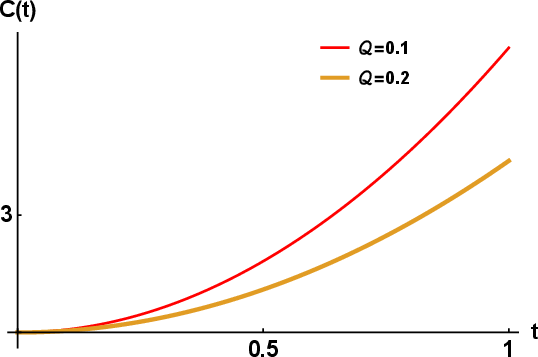
Figure 1: Early-time quadratic growth in complexity as a function of Coulomb charge μ1, illustrating the suppression of complexity spreading for increasing μ2. The plot is for μ3 and various μ4.
Krylov Operator Complexity: Liouvillian Growth and Comparisons
The KOC framework replaces state time evolution with operator dynamics governed by the Liouvillian superoperator. The construction of a Krylov basis in the operator space follows analogous steps, but the Gram-Schmidt orthogonalization ensures vanishing diagonal entries of the Liouvillian.
Principal findings include:
- Linear Mass Dependence of Off-diagonal Lanczos Coefficients: In all cases, μ5 for strong mass deformation, in accord with the operator analog of KSC.
- Early-Time Operator Complexity Dynamics: Operator complexity satisfies the universal scaling μ6, with an explicit, model-dependent μ7. For fuzzy sphere (PFS and IFS) reductions, this coefficient is independent of the Coulomb charge, while for the Coulomb model, μ8 varies non-monotonically with μ9; it first increases then decreases, peaking near a critical charge.
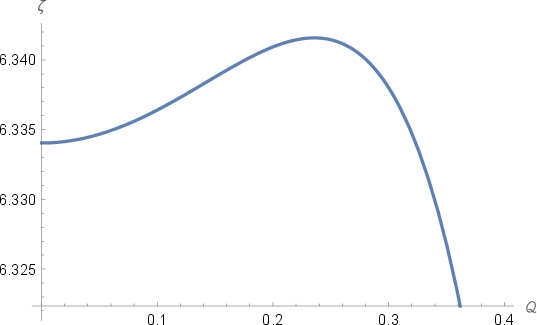
Figure 2: Behavior of the leading order coefficient μ0 controlling complexity growth as a function of the Coulomb charge μ1 in the operator context, showing non-monotonic dependence and a critical threshold.
- Concordance with State Complexity: The model dependence and universality of the scaling confirm the robustness of the KC framework: corrections due to mass deformation systematically coincide in both state and operator settings at quadratic order, demonstrating a form of universality class for the leading complexity growth in large μ2 PWMM reductions.
Implications and Future Directions
The results elucidate structural features of KC in a controlled quantum mechanical truncation of string and M-theory, providing analytic evidence for universality across distinct KC definitions (state vs. operator) and reductions. The linear mass scaling of Lanczos coefficients and universal quadratic early-time growth underpin both the diagnostic reliability and sensitivity of KC as a probe of dynamical complexity and potential chaos.
The explicit model-dependent calculations afford a foundation for multiple further directions:
- Intermediate Coupling Regimes: Extending these analytic calculations away from large μ3 would enable probes of more generic quantum regimes, possibly uncovering crossover phenomena between integrable and chaotic sectors.
- Holographic Duality: The analytic expressions for KC and Lanczos coefficients offer concrete data for comparison with holographic complexity proposals in the dual supergravity (AdS/bubbling geometry), potentially enabling a direct computation of complexity from geometric quantities such as geodesic lengths or two-point functions in the holographic dual [see also related developments in e.g., (Roychowdhury, 10 Jan 2026, Roychowdhury, 18 Apr 2026)].
- Universality Across Models: The universality of quadratic early-time growth and linear mass dependence could be investigated in other matrix model reductions and quantum mechanical systems, exploring the extent to which these features persist as signatures of general information spreading or chaos.
- Numerical and Experimental Tests: The dependence of μ4 on deformation parameters and conserved charges suggests practical, model-agnostic benchmarks for both classical simulation and potential quantum emulation of matrix models.
Conclusion
This work provides a precise analytic characterization of Krylov state and operator complexity in the BMN Plane Wave Matrix Model, under large mass deformation and various consistent reductions. The key findings—scaling laws for Lanczos coefficients, universal quadratic early-time complexity growth, and model-dependent sensitivity to conserved charges—solidify the BMN matrix model's role as a clean quantum laboratory for testing conjectured connections between complexity, chaos, and mass deformation in holography and quantum gravity. The universality between operator and state definitions demonstrated here suggests that KC offers a robust and model-invariant tool for quantifying quantum dynamical complexity.

