- The paper establishes meromorphic continuation and growth bounds for a Selberg-type zeta function formed with modular symbols.
- It applies extended Tauberian methods to derive cancellation estimates for twisted Ramanujan sums and asymptotic error terms of O(X^(1/2+ε)).
- The study confirms statistical independence between classical and modular-symbol-twisted Kloosterman sums, showing no significant correlation as the modulus increases.
Introduction and Motivations
This work focuses on sums of Kloosterman sums that are "twisted" by modular symbols—expressions at the intersection of analytic number theory and the spectral theory of automorphic forms. The authors generalize classical Kloosterman sums by weighting their terms with modular symbols associated to holomorphic cusp forms. Specifically, the sum
S∗(m,n;c)=γ∈Γ∞\Γ0(N)/Γ∞ cγ=c∑⟨f,γ⟩exp(2πi(maγ+ndγ)/cγ)
is examined, where the modular symbol ⟨f,γ⟩ replaces the standard coefficient.
This setting connects to deep conjectures in the theory of automorphic representations and the spectral theory of the Laplacian, notably the 1/4-eigenvalue conjecture for Maass forms and analogues of the Linnik and Selberg conjectures regarding cancellation in sums of Kloosterman sums. The analysis is inherently technical, combining Tauberian theorems, the analytic theory of Selberg-type zeta functions, and perturbative spectral methods.
Main Analytical Tools and Results
The authors extend Tauberian techniques to sums of Kloosterman sums weighted by modular symbols, firstly for the simpler case corresponding to (twisted) Ramanujan sums, then for the genuinely Kloosterman context. They construct and study a modified "Selberg zeta function" Zm,n∗(s) attached to these twisted sums, establishing its meromorphic continuation to Re(s)>1/2. They also bound its growth and analyze its singularities.
Estimate for Twisted Ramanujan Sums
Theorem~\ref{main} (paraphrased) uses Tauberian methods to show that for n=0 and N=p prime,
c<(πX∣n∣)1/2/p∑S∗(n,0;pc)ψc(n,X)=MT+O(X1/2+ϵ)
with explicit main term MT and weights ψc, of order X1+ϵ as ⟨f,γ⟩0.
This result provides a "smoothed sum" version of cancellation for these twisted sums, analogous to classical results on Kloosterman sums but with additional technical complications from infinite poles on the critical line and the non-unit magnitude of modular symbols.
Selberg-type Zeta Function and Analytic Continuation
They define a Dirichlet series
⟨f,γ⟩1
and show, using Sobolev space methods and pseudo-Laplacians à la Phillips-Sarnak/Petridis, that:
- ⟨f,γ⟩2 continues meromorphically to ⟨f,γ⟩3,
- the only possible poles in ⟨f,γ⟩4 are dictated by exceptional Laplacian eigenvalues,
- away from poles, ⟨f,γ⟩5 has controlled polynomial growth in ⟨f,γ⟩6.
This involves an elaborate reduction to a perturbation of Eisenstein series, controlling the analytic properties of Poincaré-type and Niebur series with modular symbol twists.
Asymptotic Statement for Sums
The analogue of Goldfeld-Sarnak's result ([GS]) is obtained: For the average of the twisted Kloosterman sum,
⟨f,γ⟩7
where ⟨f,γ⟩8, ⟨f,γ⟩9 relate to possible exceptional eigenvalues, and Zm,n∗(s)0 is the maximal abscissa of convergence, i.e., the maximal possible growth rate of Zm,n∗(s)1.
Numerical Results, Cancellation, and Non-correlation
A critical aspect is the extensive computational investigation. The authors verify, across varying levels and parameters, that:
- The conjectured Zm,n∗(s)2 cancellation (Linnik–Selberg type) in the twisted sums is broadly observed,
- There is no evidence for correlation between classical and modular-symbol-twisted Kloosterman sums; their joint sign and Pearson correlations trend toward Zm,n∗(s)3 and Zm,n∗(s)4 respectively in the large Zm,n∗(s)5 limit.
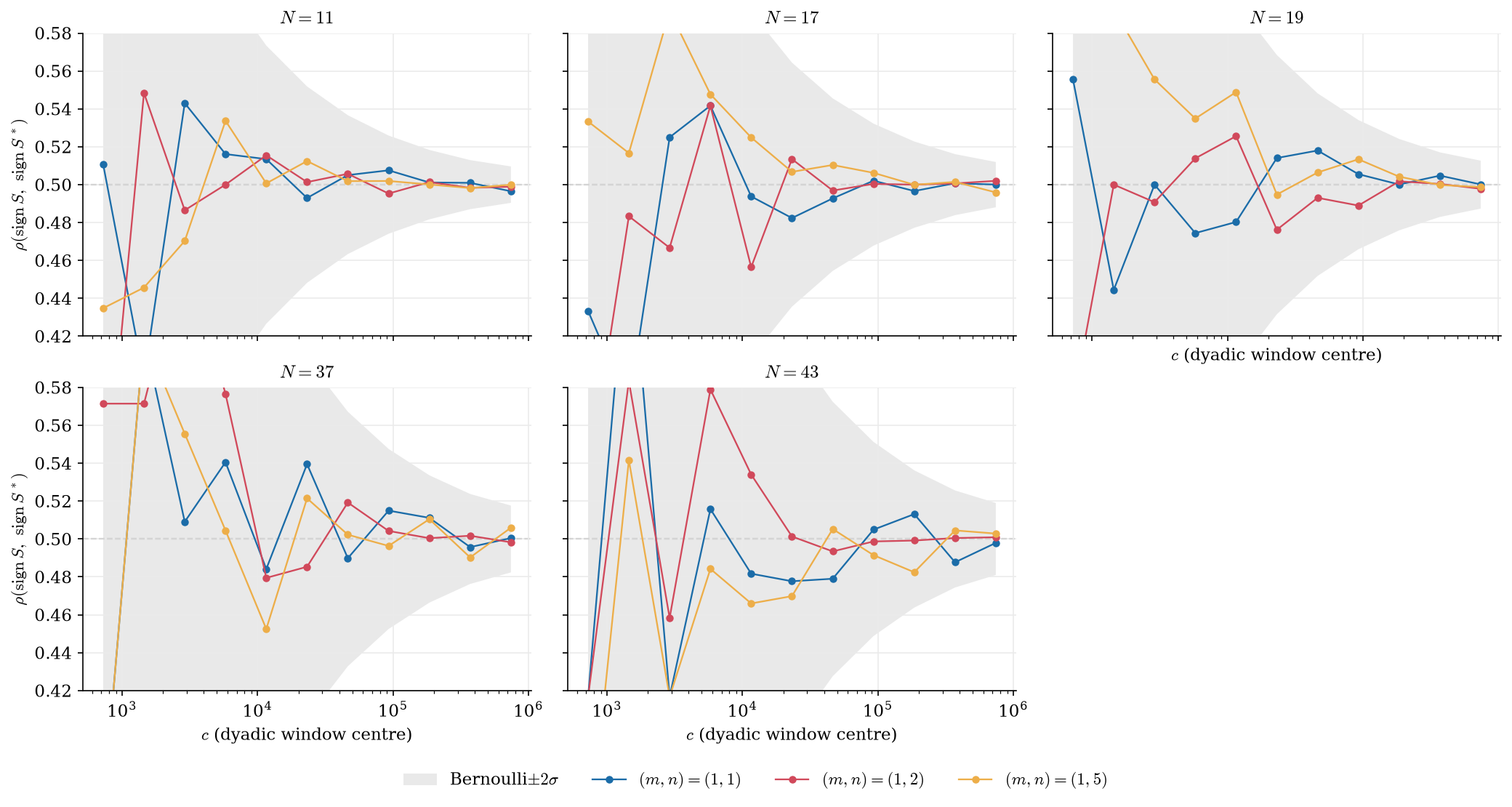
Figure 1: Empirical correlation Zm,n∗(s)6 between signs of Zm,n∗(s)7 and Zm,n∗(s)8, showing no significant correlation as Zm,n∗(s)9 increases.
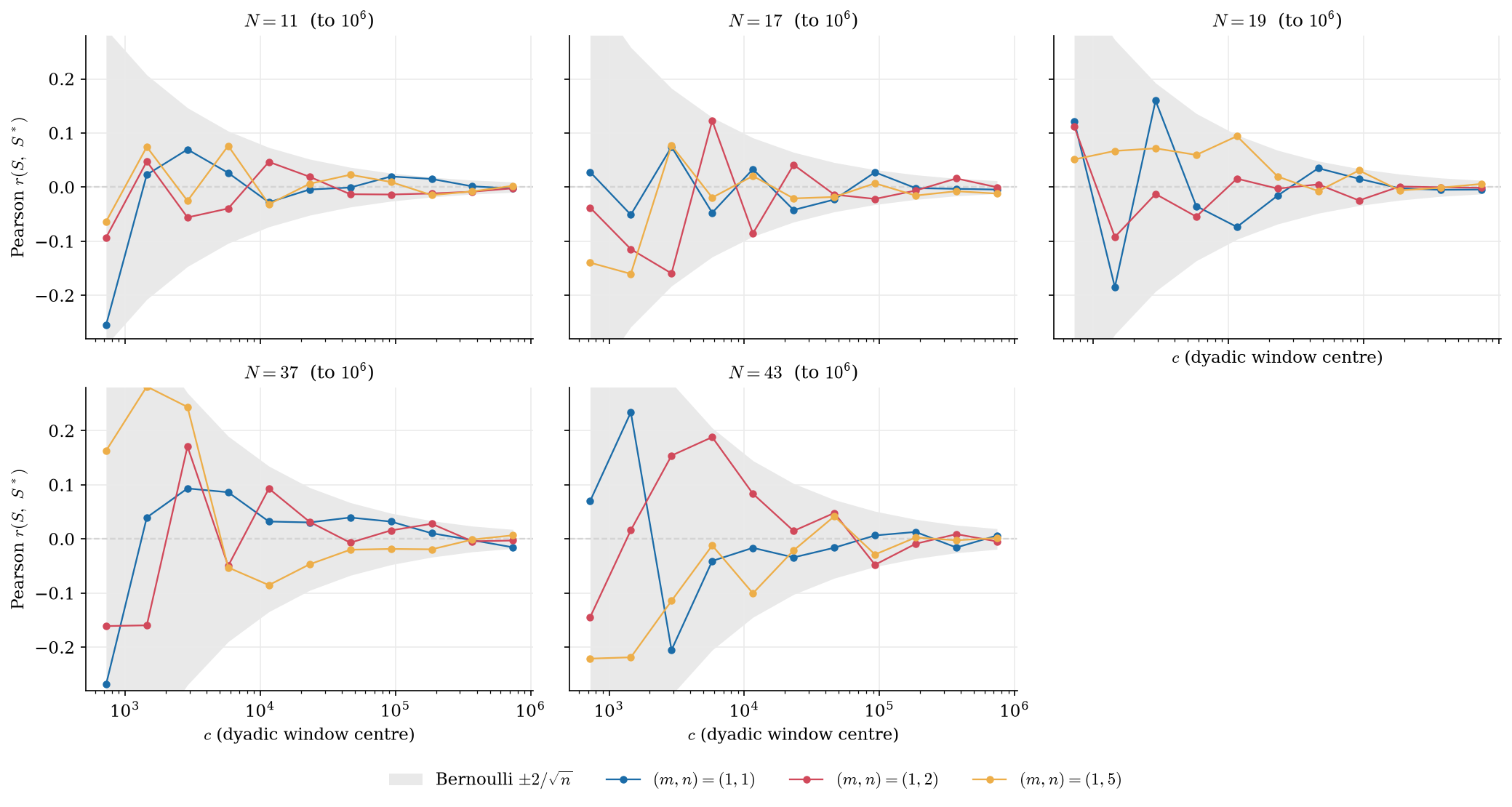
Figure 2: Pearson correlation Re(s)>1/20 between classical and modular-symbol-twisted Kloosterman sums across dyadic windows; rapid decay indicates statistical independence.
This lack of correlation is formalized as Conjecture~\ref{no-correlation}.
Tauberian Theorems and Remainder Term Analysis
With technical computations, the authors analyze the remainder terms in the Tauberian summation for Re(s)>1/21. The experimental fits with the predicted boundary integrals (Eisenstein term) and Maass cusp form contributions demonstrate that:
- The expected order for the error is Re(s)>1/22,
- Any putative exceptional eigenvalue would result in a detectable power saving/worsening, which is not observed.
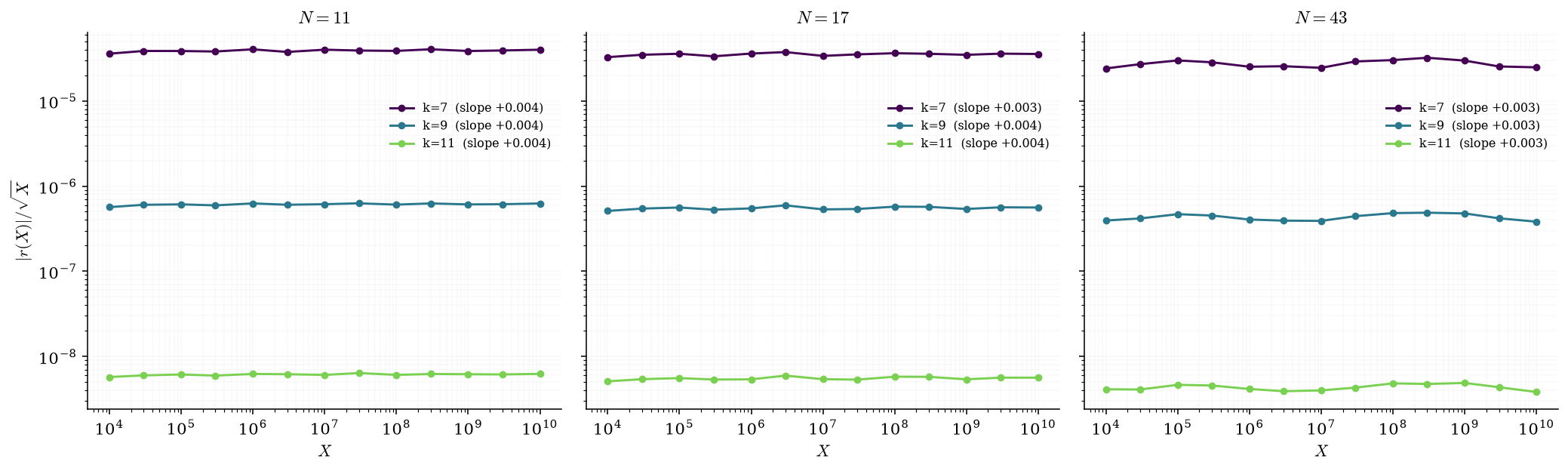
Figure 3: The relative error Re(s)>1/23 in log-log scale for various Re(s)>1/24, Re(s)>1/25, Re(s)>1/26; lines of slope Re(s)>1/27 indicate consistency with predicted theory.
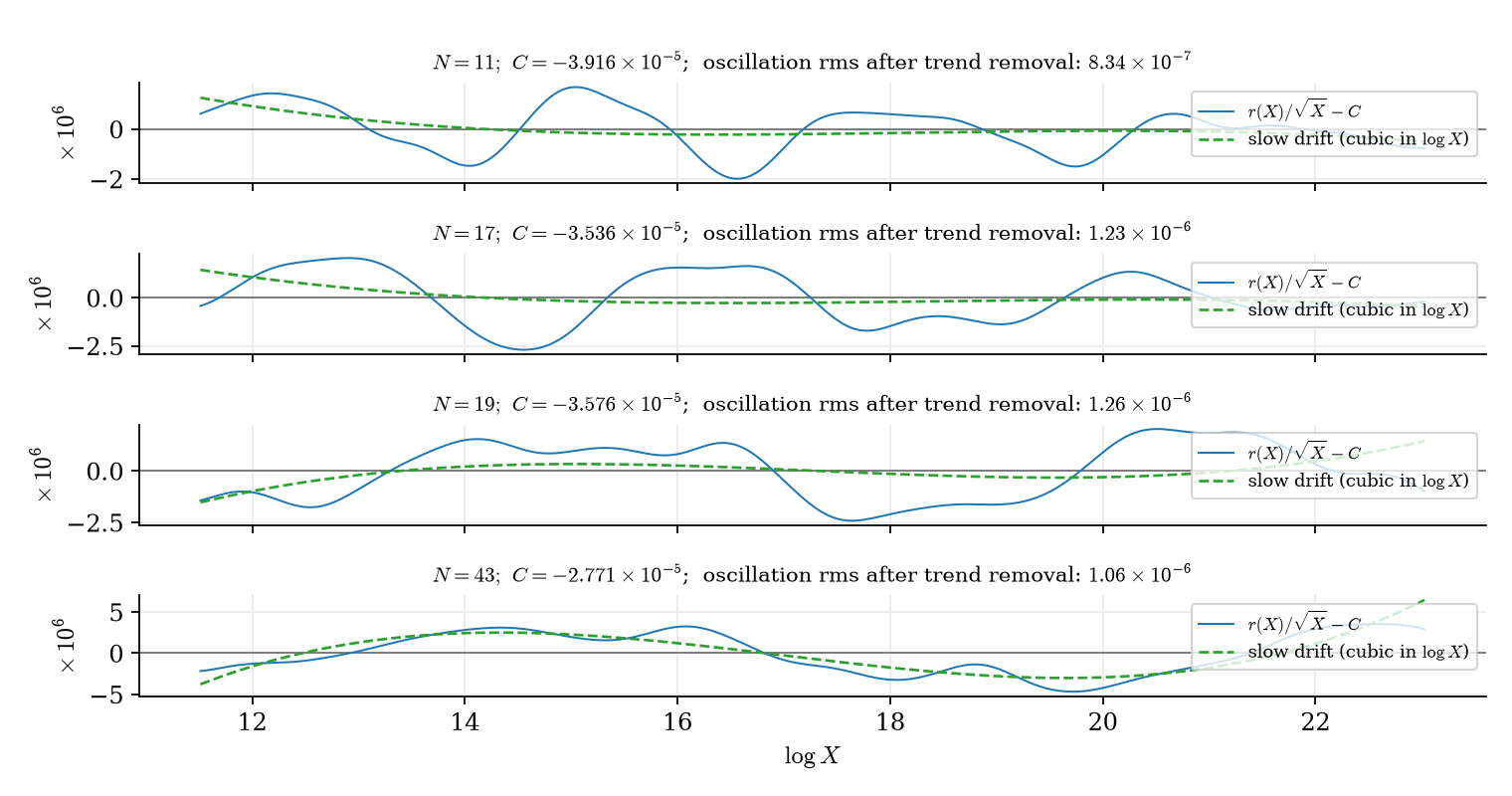
Figure 4: Decomposition of Re(s)>1/28 showing oscillatory (Maass) and monotone (Eisenstein) components.
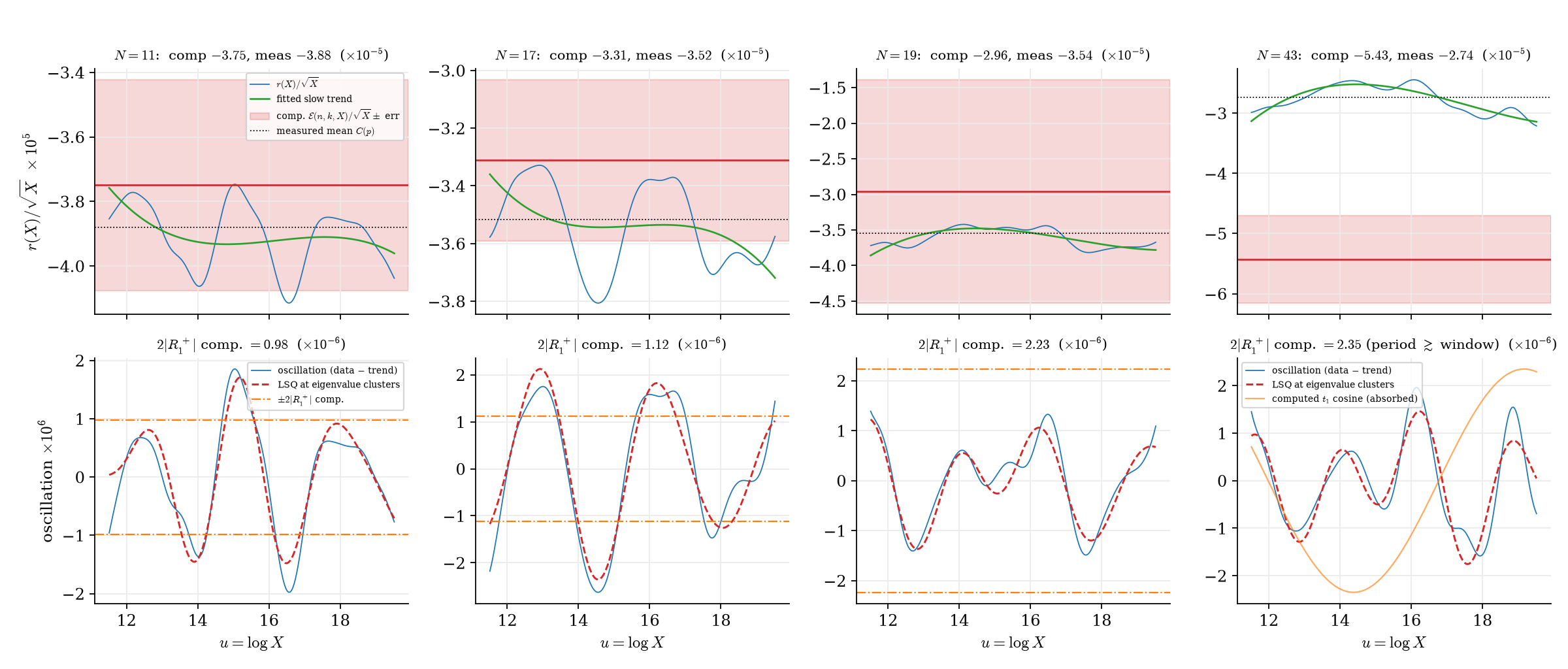
Figure 5: Fine structure of remainder: separation between Eisenstein and Maass layers globally matches analytic predictions.
The explicit connection between the lack of exceptional spectrum and observed cancellation in these sums is made rigorous; conjectures regarding the non-vanishing of the associated residues (cf. Conjecture~\ref{conj-ram-sums}) would, if true, imply the absence of exceptional eigenvalues.
Implications and Future Directions
The analysis offers new Tauberian theorems and analytic techniques for sums incorporating both automorphic and cohomological (modular symbol) weights. The computational results suggest powerful random-matrix–type cancellation in these "higher rank" summation scenarios, mimicking the theoretical predictions of spectral theory in arithmetic.
From a broader perspective, the methods provide a blueprint for analogous studies involving other "twisted" automorphic Dirichlet series, such as those weighted by periods, additive twists, or higher-order modular symbols. The robust toolkit combining analytic continuation, functional equations, and perturbation theory of operators will have further impact on the study of special values of Re(s)>1/29-functions and trace formulae.
Conclusion
This paper provides a comprehensive analytic and experimental study of modular-symbol-weighted Kloosterman sums. Through a combination of Tauberian, spectral, and computational techniques, it:
- Establishes polynomial-type cancellation in averages of these sums,
- Demonstrates the analytic continuation of the associated Selberg-type zeta function,
- Quantitatively relates the asymptotics to the presence of exceptional Laplacian eigenvalues,
- Empirically confirms cancellation and statistical independence from classical Kloosterman sums,
- Suggests a strategy for further exclusion of exceptional spectrum via refined residue analysis.
The results reinforce the rich interplay between spectral theory, analytic number theory, and arithmetic geometry, illuminating open paths for further study in automorphic representation theory and n=00-function theory.
References
- Original preprint: "Sums of Kloosterman sums formed with modular symbols" (2607.10786).
- Classical: [GS] D. Goldfeld and P. Sarnak, "Sums of Kloosterman sums," Invent. Math. 71, 243–250, 1983.

