- The paper demonstrates that LLMs trigger a reversal in solo authorship trends by substituting execution-level work, validated across 300 million works.
- It employs piecewise linear trend analysis and SPECTER2-based semantic embeddings to quantify a significant post-ChatGPT increase in solo paper probabilities.
- Findings reveal field heterogeneity, with computational and labor-substitutable disciplines showing a notable resurgence of solo outputs, challenging traditional credit norms.
Return of the Solo Author: Empirical Evidence for a Generative AI-Induced Reconfiguration of Scientific Collaboration
Introduction
The division of cognitive labor in scientific research has undergone a persistent transition from individual authorship to larger collaborative teams, a trend documented for over a century through increasing average author counts per publication. The integration of generative AI, most notably LLMs, introduces new dynamics to this division of labor. "Return of the solo author: The changing division of labor in science in the age of generative AI" (2607.10780) addresses the core question of whether LLMs amplify team-based production ("acceleration" view) or partially reverse the necessity for human collaboration by substituting for coauthors' execution work ("substitution" view), thus enabling a resurgence in solo authorship.
Methodological Approach
The study utilizes the full OpenAlex corpus (over 300 million works, including 126 million peer-reviewed publications, across 26 disciplines, 1990–2025), systematically dissecting team-size distributions—specifically the behavior of the left tail (solo-authored papers)—before and after the release of ChatGPT (November 2022). The analysis leverages:
- Piecewise linear trend analysis around the ChatGPT release date
- Author-level solo-publication probabilities, adjusting for field, career stage, citation, and productivity
- Conditional hazard modeling of first-time solo publication
- SPECTER2-based semantic analysis on publication content to identify solo-specific topical drift
Main Findings: Reversal of a Longstanding Decline in Solo Authorship
A decades-long, monotonic decline in the share of solo-authored scientific works has either halted or reversed across almost all major fields contemporaneous with the public release of ChatGPT. This is quantified by a significant change in the annual slope (Δβ) of the solo-author share, with robust positive values post-November 2022 in 23 of 26 fields under peer-reviewed publication filters.
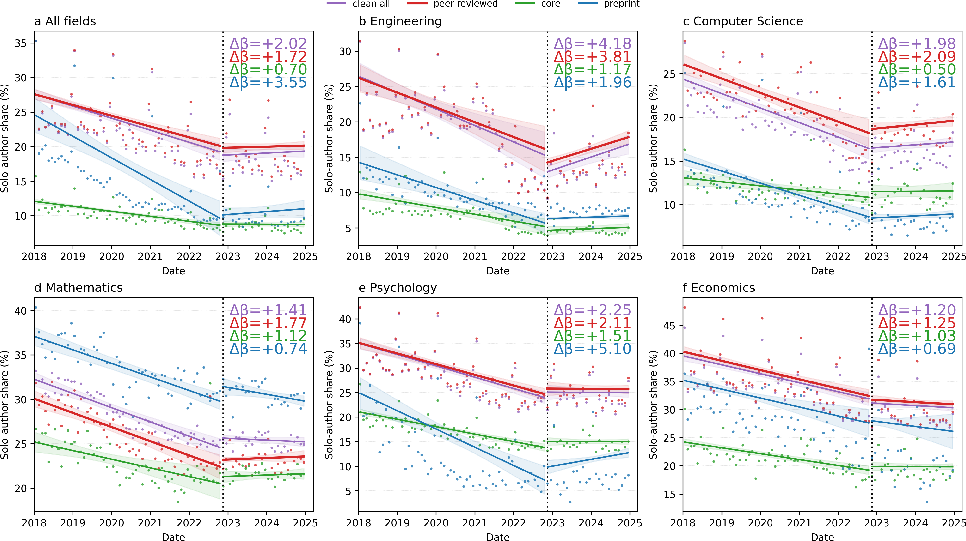
Figure 1: The piecewise-linear break in the monthly solo-author share at ChatGPT's public release, showing a halting or reversal of the pre-existing decline across all fields and focal disciplines.
Key numerical results include:
- In Engineering, the trend-break is +2.5 pp/yr; in Business, Management, and Accounting, +1.9; a tight cluster of Mathematics, Computer Science, Psychology, and Decision Sciences is near +1.7.
- In fields reliant on physical collaboration (Chemistry, Physics, Arts and Humanities), the reversal is absent or statistically insignificant.
- Accompanying this, the decades-long increase in the mean number of authors per paper similarly decelerates or plateaus post-2022.
This discontinuity cannot be accounted for by COVID-era publishing rebounds or venue composition shifts—the effect persists in a balanced panel of continuously indexed journals and is most pronounced in preprints, which have the shortest lag between writing and appearance.
Disentangling Author Composition and Within-Author Change
To resolve whether the increase in solo-authorship is compositional (entry/exit or changing author population) or reflects within-author behavioral change, the analysis employs history-conditioned probability models. It shows that even among researchers with no recent solo publications or never-published-solo antecedents, there is a marked post-2022 increase in the probability of producing solo-authored work; the effect strengthens as conditioning is tightened.
- The trend-break in solo publication probability is positive across all history thresholds and robust to standardization across field, age, citations, and productivity.
- The effect is pronounced among the least prolific authors and is present across all career stages, including among highly senior researchers.
- The result in Engineering is composition-driven rather than within-author (i.e., more new authors, not established authors, are responsible for the field-level effect).
Generative AI as Coauthor Substitute: Empirical Mechanism Analysis
Two primary empirical signatures indicate that LLMs are substituting for human coauthors:
- Who moves to solo authorship? The largest increases are among authors for whom the fixed cost of solo production has previously been high—least-prolific and senior authors. This is consistent with the automation of labor-intensive execution work previously requiring human collaboration.
- What content shifts? SPECTER2-based embeddings and difference-in-differences cohort comparisons show solo-authored output post-2022 is distinctly displaced toward computational topics. This shift is specific—e.g., displacement along the computational axis is +0.040 standard deviations (P=4×10⁻⁸), while review-original, applied-theoretical, and data-rich/scarce axes remain unchanged.
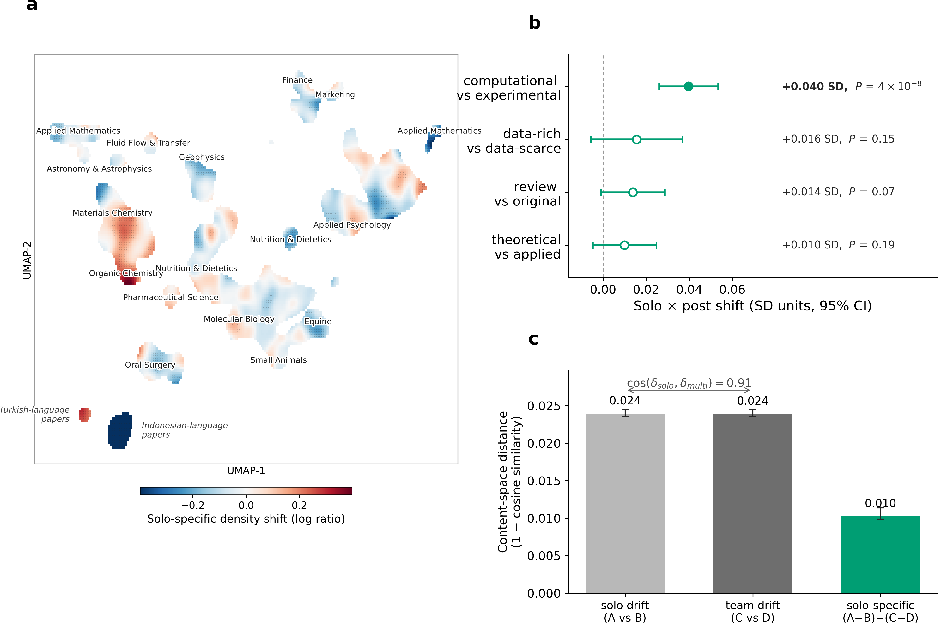
Figure 2: The content distribution of solo-authored publications after 2022, showing a broad, statistically significant drift toward computational work.
At the author level, solo output contracts in content breadth (–0.028, P<10−16; 23% narrower), with no evidence of exploration outside the prior collaborative topic area.
Robustness Checks and Field Heterogeneity
The observed reversal is robust across multiple estimation windows, author history thresholds, and publication filters. Field-level heterogeneity is systematic:
- Strongest effects occur where coauthor labor is most easily substitutable by LLMs (writing, coding, statistical support).
- No reversal is observed in instrument-heavy or physical experiment-oriented fields, corroborating differential substitutability.
- LLM-induced writing (text-level) is pervasive across team sizes and not more prevalent in solo authorship, as shown in external datasets.
Implications for Scientific Labor and Future Research
Reinterpretation of Authorship and Scientific Credit
Solo-authored works, until now, have unambiguously demarcated individual contribution boundaries. LLM substitution severs this link: critical intellectual and execution labor can now be offloaded to entities ineligible for authorship. This challenges traditional credit-assignment frameworks and the utility of authorship as a marker for labor contribution.
Impacts on Training and Collaboration Structure
The contraction of cognitive labor, with senior researchers able to internalize previously collaborative execution work, has immediate implications for early-career training and scientific socialization. The reduction of junior coauthor involvement potentially attenuates in situ training pathways.
Considerations on Output Quality and Publication Inflation
While the study documents higher solo output, it does not assess quality. There is an outstanding risk that the lowered cost of production may inflate solo- and preprint-venue publication rates with LLM-generated manuscripts of uncertain scientific value.
Theoretical and Practical Ramifications
These results indicate that LLMs induce a bifurcation in the scientific division of labor: substitution pressures act on the left tail, while acceleration may still dominate in the distributional upper tail. The empirical measurement of solo-authorship rate and its topical shift thus serves as a leading observable for tracing further waves of cognitive automation in research.
Conclusion
"Return of the solo author" (2607.10780) provides strong, systematic evidence that generative AI—by automating execution-level contributions—enables a partial reversal of the longstanding decline in solo scientific authorship. The effect is heterogeneous and modular, modulated by field-level substitutability of human labor, and is characterized by a marked shift toward computational content. These findings revise the interpretation of authorship and suggest that observable labor relations in science are now bifurcated by automation capacity. The study opens several avenues for future work: quantifying the quality implications of increased solo output, dissecting mechanisms behind compositional effects, and modeling the longer-term consequences for research training and collaboration modalities.

