AI as "Co-founder": GenAI for Entrepreneurship
Abstract: This paper studies whether, how, and for whom generative artificial intelligence (GenAI) facilitates firm creation. Our identification strategy exploits the November 2022 release of ChatGPT as a global shock that lowered start-up costs and leverages variations across geo-coded grids with differential pre-existing AI-specific human capital. Using high-resolution and universal data on Chinese firm registrations by the end of 2024, we find that grids with stronger AI-specific human capital experienced a sharp surge in new firm formation$\unicode{x2013}$driven entirely by small firms, contributing to 6.0% of overall national firm entry. Large-firm entry declines, consistent with a shift toward leaner ventures. New firms are smaller in capital, shareholder number, and founding team size, especially among small firms. The effects are strongest among firms with potential AI applications, weaker financing needs, and among first-time entrepreneurs. Overall, our results highlight that GenAI serves as a pro-competitive force by disproportionately boosting small-firm entry.
Paper Prompts
Sign up for free to create and run prompts on this paper using GPT-5.
Top Community Prompts
Explain it Like I'm 14
Overview
This paper asks a simple, big question: did the rise of generative AI (like ChatGPT) make it easier for people to start new companies? The authors think of GenAI as a “digital co-founder” that helps with tasks like writing, coding, planning, and marketing, so a founder can do more with a smaller team. They study what happened in China after ChatGPT’s launch and look at who benefited most.
Key Questions
To make their big idea concrete, the paper focuses on a few easy-to-understand questions:
- Did new company formation increase after ChatGPT appeared?
- If it did, was the growth mostly among small, low-cost startups or big, well-funded firms?
- Did GenAI change how new firms are built (for example, fewer founders, less capital, smaller teams)?
- Which types of industries and entrepreneurs (first-time vs. experienced) gained the most?
How They Studied It (Methods Explained Simply)
Think of a country-wide map sliced into many small hexagon tiles, like a honeycomb. Each “tile” covers a small area of a city or region. The researchers:
- Collected all new company registrations in China from 2021 to 2024 (over 12.8 million firms).
- Marked each firm’s location onto the honeycomb map (these hexagon tiles are called “H3 grids”).
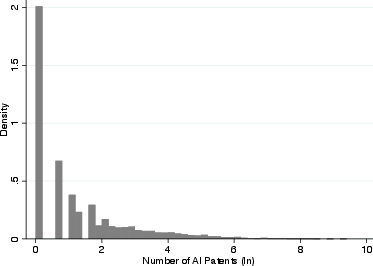
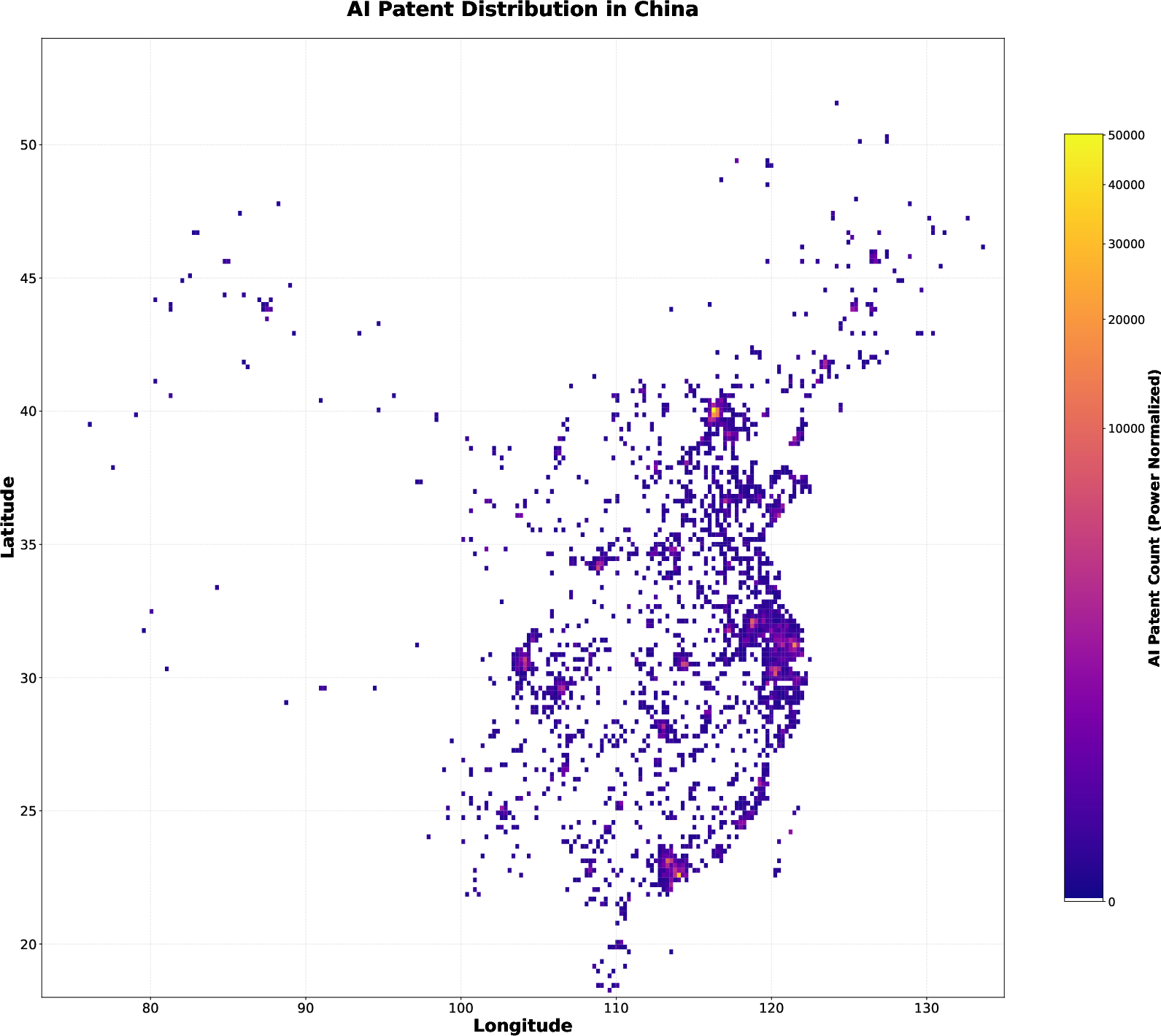
- Measured which tiles had more AI know-how before ChatGPT arrived. To do that, they counted AI-related patents filed from 2010 to 2019 in each tile. More AI patents = more local AI skills and experience (“AI-specific human capital”).
- Treated the November 2022 release of ChatGPT as a global “shock” that suddenly made GenAI tools more visible and accessible.
Then they used a “difference-in-differences” approach, which is like comparing two groups before and after a big event:
- Group A: tiles with strong pre-existing AI know-how (high AI patents).
- Group B: tiles without that AI background.
- Compare how new firm creation changed in Group A vs. Group B after ChatGPT’s launch, while carefully controlling for city-wide factors and seasonal patterns.
To keep the comparison fair, they only compare tiles within the same city and the same time period, so they’re not mixing very different places or moments. They also did extra checks:
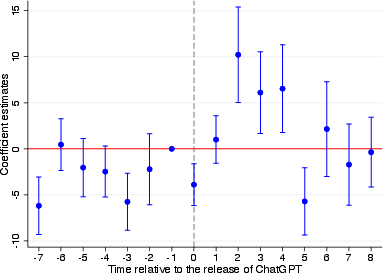
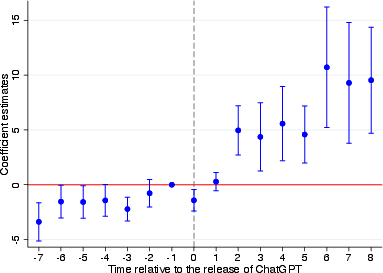
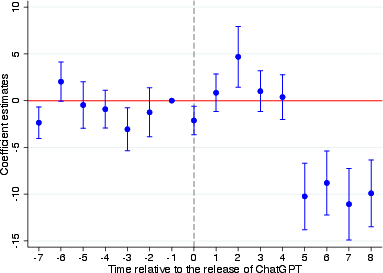
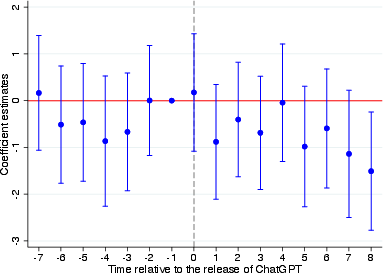
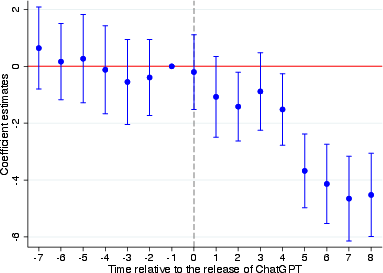
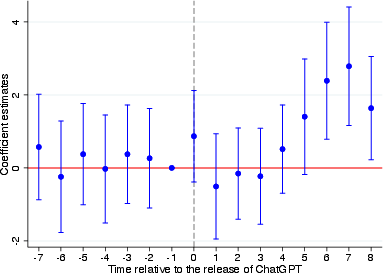
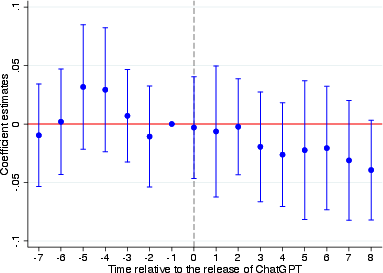
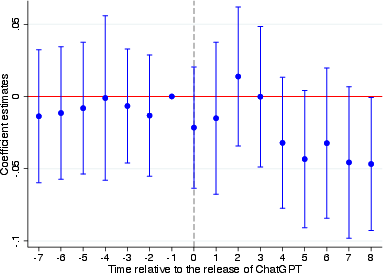
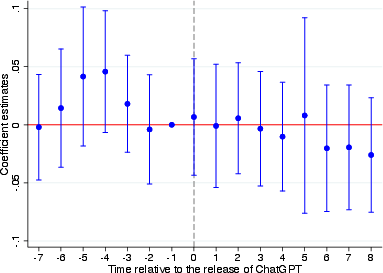
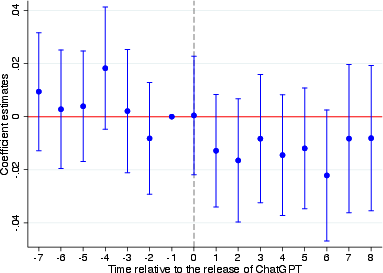
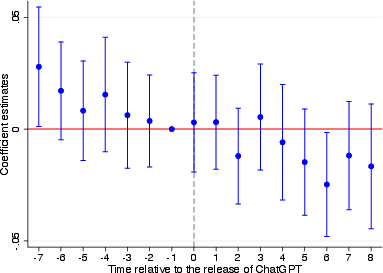
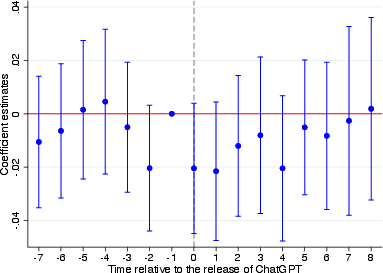
- Event studies: checked that the two groups followed similar trends before ChatGPT, so differences after are more likely due to the AI shock.
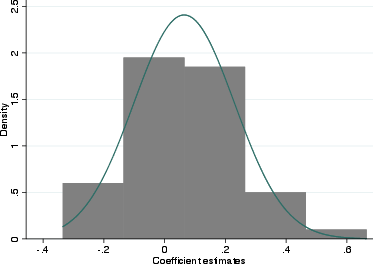
- Placebo tests: replaced AI patents with non-AI patents (general innovation) to see if effects still appear—they mostly disappear, which supports the “AI-specific” story.
- Random labels: shuffled which tiles were “AI-exposed” and re-ran the test many times—the effects vanish, which suggests the real results aren’t a fluke.
Main Findings and Why They Matter
Here are the most important results:
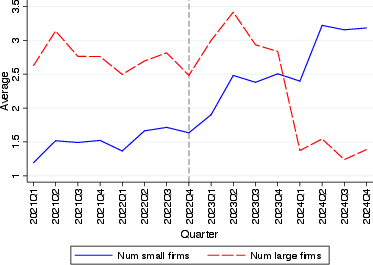
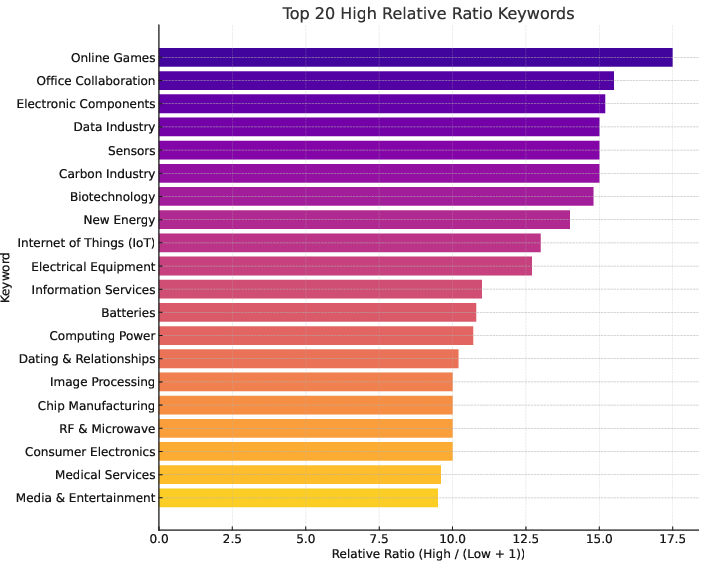
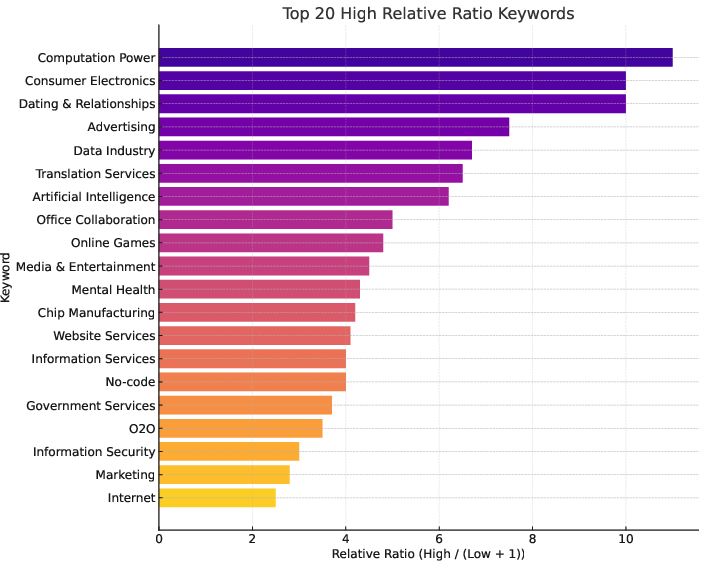
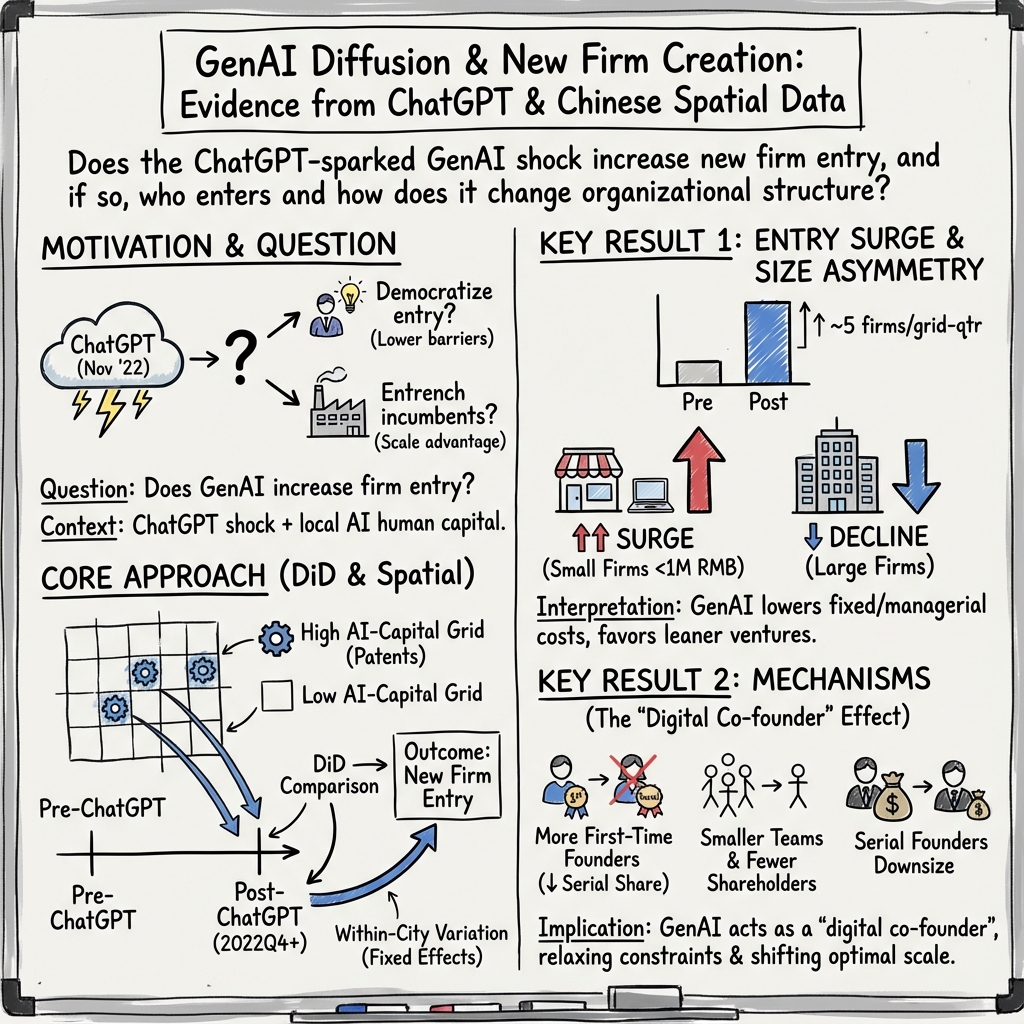
- Big jump in new firms where AI skills were already present: after ChatGPT, tiles with more AI know-how saw a sharp rise in new company registrations. On average, these areas got about five more new firms per tile per quarter than similar areas without AI know-how. Across China, this adds up to roughly 51,000 extra firms per quarter—about 6% of all new firm entries.
- Growth driven by small firms: small, resource-light startups surged; entries by large firms actually fell. This fits the idea that GenAI lowers startup costs so lean teams can do more.
- New firms became “leaner”: they started with less registered capital, fewer shareholders, and smaller founding teams. In other words, GenAI helped founders start with less money and fewer people.
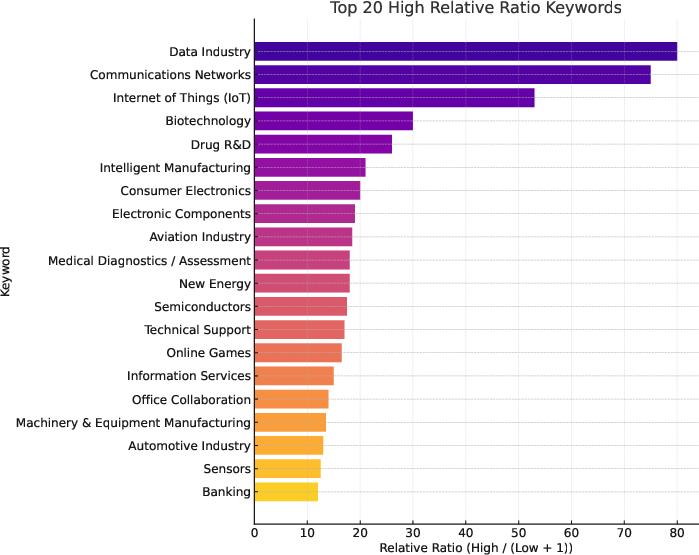
- Strongest effects in AI-friendly, low-capital sectors: retail, online platforms, business services, and other digital/knowledge-heavy areas saw the biggest gains—places where GenAI can directly help with writing, coding, customer service, and marketing. More traditional, capital-heavy industries (like construction and manufacturing) saw slight declines in new entries.
- More first-time entrepreneurs: the share of serial founders (people who had already started a firm in the last three years) fell in AI-intensive areas. This suggests GenAI helped newcomers who lacked prior experience.
- Even experienced founders chose smaller scale: repeat founders launched leaner ventures after ChatGPT, implying GenAI shifts the “optimal” startup size downwards.
Together, these results suggest GenAI acts like a powerful assistant or “co-founder” that:
- Cuts early costs,
- Shrinks team needs,
- Speeds up early product and operations work,
- Opens the door for more people—especially first-time founders—to start companies.
What This Means Going Forward
The study points to a few big takeaways:
- GenAI is a pro-competitive force: by helping small ventures get off the ground, it may reduce market concentration instead of just helping big incumbents.
- Skills matter: areas with stronger AI-specific skills benefited most, showing that human capital (local know-how) is crucial for turning new technologies into real businesses.
- Jobs and innovation: while AI can automate some tasks, new firm creation is a major source of innovation and net job growth. GenAI may help balance concerns about AI replacing jobs by making it easier to create new companies and new roles.
- Policy ideas: to spread these gains, cities and schools could invest in AI training and entrepreneurship support. Making GenAI tools accessible and teaching people how to use them can lower barriers for new founders.
In short, the paper shows that when a general, easy-to-use technology like GenAI arrives, it can change who starts companies, how they’re organized, and how big they need to be—pushing the startup world toward smaller, faster, and more creative teams.
Knowledge Gaps
Knowledge gaps, limitations, and open questions
Below is a single, concrete list of gaps and open issues that remain unresolved and could guide future research:
- Causal identification: disentangle the GenAI “shock” from contemporaneous macro and policy changes in China (e.g., December 2022 COVID policy relaxation, district-level entrepreneurship programs), potentially via triple-differences, staggered treatments, or district-by-time fixed effects.
- Actual GenAI exposure in China: quantify grid-level access and usage of ChatGPT and domestic LLMs (API traffic, enterprise subscriptions, VPN intensity, model release dates), rather than assuming uniform diffusion.
- Proxy validity for AI-specific human capital: validate AI patent counts against alternative measures (AI-skilled labor shares, job postings, resume databases, university AI program graduates, GitHub profiles) and quantify measurement error in AIPatentSBerta classification.
- Spatial measurement error: assess robustness to geocoding inaccuracies in firm and assignee addresses; test alternative spatial resolutions (e.g., H3 r6/r8), adjacency buffers, and population-weighted models.
- Registration vs real activity: distinguish shell/inactive firms from operating businesses using tax filings, invoice issuance, social-insurance rosters, and “active” operating status to ensure entry reflects economic activity.
- Short post-period: evaluate medium- and long-run outcomes (survival, growth, employment, productivity, innovation) of post-ChatGPT cohorts over 3–5+ years to rule out transitory hype effects.
- Entrant quality and AI adoption: measure whether new firms actually use GenAI (website/app text mining, product descriptions, GitHub repos, model API usage) and whether entrants are “AI-native” vs non-adopters.
- Large-firm entry decline: identify mechanisms (substitution toward leaner launches vs macro financing slump or sector-specific cycles) using sectoral controls, credit supply data, and incumbent internal subsidiary formation.
- Local spillovers: test for within-city spatial spillovers from high-AI grids to adjacent low-AI grids using spatial econometrics, buffer zones, and network proximity to AI firms/inventors.
- Sector classification transparency: specify and validate how “AI-downstream” sectors are identified (GB/T or NAICS mapping, text-based classification), and examine sensitivity to alternative taxonomies.
- Financing constraints inference: replace proxies (# of shareholders, registered capital) with direct measures (paid-in capital schedules, bank loans, equity rounds, VC deals) to confirm reduced financing needs.
- Company law and regulatory changes: control for 2023–2025 revisions to China’s Company Law and related capital rules that may affect registered capital and ownership structure independent of GenAI.
- Founding team measurement: verify whether “executives” reflect actual team size by linking to social-insurance registrations or payroll data; test for changes in early hires vs titles.
- Founder heterogeneity: analyze effects by founder demographics (age, gender, education, prior occupation) to assess whether GenAI democratizes entrepreneurship across underrepresented groups.
- Labor-market impacts: quantify net job creation from small-firm entry and potential substitution away from junior white-collar roles using matched employment and hiring data.
- Market structure consequences: measure changes in concentration (HHI, CR4) at product-market or city-industry levels to test pro-competitive implications beyond entry counts.
- Innovation outcomes: track patenting, product releases, and R&D activity of new entrants to determine whether GenAI-enabled startups generate more innovation.
- Awareness vs adoption timing: exploit staggered rollouts of domestic LLMs (ERNIE, Qwen, SparkDesk, Hunyuan, ChatGLM, DeepSeek) to separate awareness shocks from functional tool availability.
- Exposure intensity and thresholds: move beyond a binary HighAI_g>0 to dose–response analyses (continuous AI patent stock, inventor density), instruments (historical AI research centers), and threshold sensitivity.
- Denominator effects: normalize entry by time-varying grid population, business establishment stock, or commercial real-estate availability to avoid conflating density with treatment.
- Firm “churn” and net entry: estimate exit rates and hazard models to assess whether GenAI increases churn vs durable net entry at the grid and sector levels.
- Serial entrepreneur measurement: expand beyond a 3-year look-back and legal representative matching (which may omit founders) by incorporating director/shareholder histories and longer horizons.
- External validity: replicate in other countries or with subnational datasets outside China to test generalizability across institutional environments, regulatory regimes, and capital markets.
- Alternative identification designs: complement DiD with IVs or natural experiments (e.g., broadband outages, API access restrictions, content moderation shocks) that induce exogenous variation in GenAI availability.
- VC and capital supply: test whether entry patterns are driven by changes in venture investment, angel financing, or crowdfunding, and whether effects persist when conditioning on local capital supply shocks.
- Model-level heterogeneity: measure differential effects by access to specific LLMs (quality, cost, latency, multilingual capabilities) to assess whether stronger models amplify entry.
- Incumbent responses: examine incumbent hiring, spinouts, corporate venture creation, and internal startups to understand how GenAI reshapes incumbent–entrant dynamics.
- Welfare and risk: quantify consumer surplus, productivity gains, and potential negatives (fraud, misinformation, low-quality services) associated with the surge in small-firm entry.
- Global linkages and IP: assess whether AI patent intensity captures global tech linkages (co-inventing abroad, cross-border licensing) that affect GenAI absorption independently of local human capital.
Practical Applications
Immediate Applications
The paper’s evidence that GenAI lowers entry costs, shrinks founding teams, and disproportionately boosts small-firm formation (especially in AI-downstream services) enables several deployable applications across sectors and stakeholders.
Industry
- Lean venture building with an “AI co-founder” stack
- Use case: Founders and small teams in digital services, retail/e-commerce, and business services orchestrate LLM tools to handle coding, marketing, customer support, documentation, and basic legal drafting, reducing initial headcount and capital needs.
- Potential tools/workflows: LLM coding assistants; marketing/content generators; customer-support chat agents; contract and company document templates; product research and synthesis agents; China-available LLMs (e.g., ERNIE Bot, Qwen, SparkDesk, Hunyuan, ChatGLM, DeepSeek).
- Sector links: Software, retail/e-commerce, professional/business services, online platforms, media/marketing, education services.
- Assumptions/dependencies: Reliable access to LLMs/APIs; domain data for fine-tuning/prompts; tolerance for model error and human-in-the-loop review; compliance with local data/IP rules.
- VC and accelerator retooling for “tiny teams”
- Use case: Investors rebalance toward smaller check sizes, earlier stages, and solo/duo founders; accelerators design AI-native programs for rapid prototyping and go-to-market in AI-downstream sectors.
- Potential tools/workflows: Geospatial sourcing using AI human capital maps; screening rubrics that weight traction/iteration speed over team size; shared LLM compute credits for cohorts.
- Sector links: Finance (VC/angel), startup support services.
- Assumptions/dependencies: Access to micro-geographic indicators (e.g., AI patent intensity); deal flow in high-exposure grids; legal clarity on revenue-sharing/convertible instruments for micro-financing.
- Micro-geographic site selection and market entry
- Use case: Incubators, co-working operators, and corporate venture builders prioritize H3-level hotspots with pre-existing AI human capital for hubs, events, and pilot launches.
- Potential tools/workflows: “Grid intelligence” dashboards combining AI patenting and firm entry rates to pick locations and tailor programming.
- Sector links: Real estate (co-working), corporate innovation, local ecosystem development.
- Assumptions/dependencies: Access to accurate geocoded patent/firm-registration data; landlord and municipal cooperation.
- SME operational adoption to reduce external financing
- Use case: Existing small businesses deploy GenAI to automate marketing collateral, customer service, catalog/listing management, basic analytics, and cross-border localization to self-finance growth.
- Potential tools/workflows: SOPs for prompt libraries; AI-assisted ad creative and SEO; AI-enabled CRM chat; invoice/email automation.
- Sector links: Retail/e-commerce, hospitality, professional services, education services.
- Assumptions/dependencies: Staff AI literacy; measurable ROI; data governance practices.
- Corporate new-business strategy shift
- Use case: Large firms launch internal “lean spinouts” using AI to test new product lines with minimal staff or partner with AI-native micro-startups (venture client model) rather than building large new divisions.
- Potential tools/workflows: Internal founder-in-residence programs; sandboxed LLM environments; procurement fast lanes for micro-suppliers.
- Sector links: Software, telecom, media, business services, finance.
- Assumptions/dependencies: Compliance, security reviews for LLM use; IP arrangements for spinouts; change management.
Academia
- Method replication and extension using H3 grids
- Use case: Researchers adopt the paper’s high-resolution grid-by-quarter design to study other tech shocks (e.g., domestic LLM releases) and sectors.
- Potential tools/workflows: H3 indexing; AI patent classification models; within-city DiD with grid-by-quarter and city-by-quarter fixed effects.
- Sector links: Economics, management, urban studies, innovation policy.
- Assumptions/dependencies: Access to universal firm registration and patent data; stable classification models.
- Entrepreneurship curricula with GenAI labs
- Use case: Universities embed “AI as co-founder” modules where students build MVPs using LLM tools, emphasizing first-time founders.
- Potential tools/workflows: Course-integrated LLM credits; assignments on AI-augmented customer discovery, prototyping, and go-to-market.
- Assumptions/dependencies: Institutional licenses for LLMs; instructor expertise; ethical/use policies.
Policy
- Targeted support where AI human capital is high
- Use case: Municipalities direct microgrants, compute/API vouchers, and mentorship to H3 grids with strong pre-existing AI exposure to amplify small-firm entry.
- Potential tools/workflows: Grid-level dashboards monitoring small vs. large entry, sector mix, and founder experience; time-bound subsidy windows post-tech shocks.
- Sector links: Economic development, finance.
- Assumptions/dependencies: Administrative capacity for micro-targeting; safeguards against gaming; procurement for LLM credits.
- AI literacy and enablement where exposure is low
- Use case: Workforce programs close gaps in low-AI grids to prevent spatial divergence, focusing on applied use in downstream services.
- Potential tools/workflows: Short bootcamps for SMBs and first-time founders; public access points (libraries, maker spaces) with LLM terminals.
- Assumptions/dependencies: Budget, local partners, and sustained engagement.
- Regulatory facilitation for lean startups
- Use case: Streamlined registration, standardized AI-ready legal templates, and limited-purpose sandboxes for AI-enabled services.
- Potential tools/workflows: Pre-approved document libraries; expedited procedures for micro-enterprises.
- Assumptions/dependencies: Legal harmonization; consumer protection guardrails.
Daily Life
- First-time founder playbooks powered by GenAI
- Use case: Aspiring entrepreneurs use LLMs to draft business plans, customer interviews, landing pages, pitch decks, and basic contracts; launch as solo/duo teams.
- Potential tools/workflows: Interactive AI copilots with localized templates and checklists; “one-week MVP” sprints.
- Assumptions/dependencies: Access to suitable LLMs; mentorship or community feedback to validate outputs.
- Community-based access to GenAI
- Use case: Libraries, community colleges, and maker spaces offer shared access to LLMs and short courses, lowering individual barriers to entry.
- Assumptions/dependencies: Funding; device and bandwidth availability; staff training.
Long-Term Applications
Building on the paper’s causal evidence and mechanisms, several scalable applications emerge that require further development, scaling, or complementary investments.
Industry
- Company-in-a-box platforms (agentic “AI co-founder OS”)
- Use case: Integrated suites that orchestrate legal, finance, engineering, marketing, and support agents for continuous operations of micro-startups.
- Potential tools/workflows: Multi-agent frameworks; vector knowledge bases with firm-specific data; compliance-aware automation.
- Sector links: Software, fintech, legaltech, martech, ops-tech.
- Assumptions/dependencies: Advances in reliability, tool-use, and governance; secure data integration; liability frameworks.
- New financial products for AI-native micro-ventures
- Use case: Revenue-based financing, automated underwriting using operational telemetry (AI-augmented productivity signals), and micro-VC models designed for low-capital, fast-iteration firms.
- Sector links: Finance/fintech.
- Assumptions/dependencies: Access to performance data; privacy-compliant data sharing; regulatory acceptance of alternative underwriting.
- Organizational redesign toward modular firms
- Use case: Corporates adopt a portfolio of lean, AI-assisted micro-business units with shared platforms (compliance, data, brand), enabling rapid market tests.
- Assumptions/dependencies: Platform engineering; incentive alignment; IP and risk management.
Academia
- Longitudinal outcomes of the small-firm surge
- Use case: Track survival, productivity, innovation, job creation, and spillovers of AI-boosted entrants; estimate general-equilibrium effects on incumbents.
- Assumptions/dependencies: Continued access to firm registries, performance, and labor data; robust identification strategies.
- Better measures of AI human capital and diffusion
- Use case: Complement patent-based proxies with skill footprints (education, online profiles, course completions) and firm-level AI adoption metrics.
- Assumptions/dependencies: Data availability, privacy safeguards, validated classification methods.
- Theory integration
- Use case: Embed AI-induced fixed-cost reductions and team-size compression into Schumpeterian and occupational choice models; quantify welfare and policy implications.
- Assumptions/dependencies: Model calibration to micro-data; external validity beyond China.
Policy
- Micro-geography-based entrepreneurship zones
- Use case: Urban planning that recognizes 5 km² heterogeneity, provisioning tailored services (compute, training, sandboxes) at the grid level.
- Assumptions/dependencies: Inter-agency coordination; dynamic reallocation as hotspots shift.
- National AI infrastructure as a public good
- Use case: Shared, regulated access to compute and high-quality domestic LLMs to democratize entry while ensuring safety and compliance.
- Assumptions/dependencies: Sustainable funding; governance to mitigate misuse; interoperability.
- Competition and labor-market policy updates
- Use case: Monitoring concentration as small-firm entry rises; merger policy tuned to protect pro-competitive dynamics; support transitions from displaced entry-level roles into entrepreneurship.
- Assumptions/dependencies: High-frequency entry/exit data; programmatic support for solopreneurs (healthcare, pensions, income smoothing).
- Inclusive capability building to avoid spatial divergence
- Use case: Long-horizon investments in AI education and ecosystem-building in low-exposure grids to prevent persistent gaps identified by the paper’s human-capital mechanism.
- Assumptions/dependencies: Multi-year funding; local institutional partners; outcome tracking.
Daily Life
- Portfolio entrepreneurship as a norm
- Use case: Individuals run sequential or parallel micro-ventures leveraging AI for low-cost experimentation and pivots.
- Assumptions/dependencies: Social safety nets for independent workers; accessible compliance tools; cultural acceptance.
- Lifelong micro-credentialing in AI-enabled entrepreneurship
- Use case: Stackable credentials focused on applied GenAI in marketing, coding, operations, and compliance to maintain employability and venture-readiness.
- Assumptions/dependencies: Credential quality assurance; employer/investor recognition; affordable access.
Cross-cutting assumptions and dependencies
- Generalizability: The paper’s context is China (2021–2024) and uses AI patents as human-capital proxies; replication elsewhere may require adapting exposure measures and accounting for local policy/market conditions.
- Access: Feasibility depends on affordable, reliable access to domestic LLMs/APIs, compute, and developer ecosystems, including language and domain coverage.
- Governance: Data protection, IP, and AI safety/compliance frameworks must evolve to support agentic and automated workflows.
- Human capital: Diffusion hinges on AI literacy; without training, benefits concentrate in already high-exposure grids, as documented by the study.
Glossary
- AIPatentSBerta: A transformer-based model used to classify AI-related patents. "we apply the AIPatentSBerta model, a transformer-based algorithm pretrained on the full corpus of U.S. patent documents and fine-tuned on labeled Chinese AI and non-AI patents, to identify AI-related patents."
- AI-downstream sectors: Industries where AI is applied in core production or services. "AI-downstream sectors that apply AI in core production or service—such as retail, business services, online platforms and other digital-service industries—where GenAI tools can be readily applied"
- AI-specific human capital: Local expertise and skills specific to AI technologies. "leverages variations across geo-coded grids with differential pre-existing AI-specific human capital."
- Assignee addresses: Patent holders’ registered addresses used to geolocate patents. "and aggregate pre-2020 AI patents to the same cells using assignee addresses."
- Balanced panel: A dataset with the same observational units across all time periods. "resulting in a balanced panel of approximately 2{,}658{,}496 observations."
- City-by-quarter fixed effects: Controls that absorb all city-level shocks varying by quarter. "and city-by-quarter fixed effects."
- Clustered standard errors: Standard errors adjusted for intra-cluster correlation. "Standard errors are clustered at the city level."
- Creative destruction: The process where new technologies and firms displace incumbents to drive growth. "entrepreneurship as “creative destruction”"
- Difference-in-differences (DiD): An econometric design comparing changes between treated and control units over time. "Our baseline empirical identification relies on a novel difference-in-differences (DiD) framework"
- Event-study: An analysis of dynamic effects around an event to assess timing and pre-trends. "Event-study estimates show no evidence of differential pre-trends"
- Exogenous shock: An external, unanticipated change unrelated to local conditions. "represents a plausibly exogenous shock"
- Extensive margin of entrepreneurship: The margin concerning the decision to start a firm. "reductions in entry costs expand the extensive margin of entrepreneurship"
- General-purpose technologies: Broad technologies with wide applications that reshape multiple sectors. "in shaping the real economic implications of general-purpose technologies."
- Geo-coded grids: Spatial cells indexed by geographic coordinates for analysis. "leverages variations across geo-coded grids"
- Grid-by-calendar-quarter fixed effects: Controls for grid-specific seasonality and unobservables by calendar quarter. "The specification includes both grid-by-calendar-quarter and city-by-quarter fixed effects."
- Grid-by-quarter panel: Panel data with observations for each grid and quarter. "a novel, nationwide H3 grid-by-quarter panel comprising 166{,}156 spatial cells"
- H3 geospatial indexing system: A hexagonal tiling framework for spatial indexing on Earth. "using the H3 geospatial indexing system"
- H3 resolution 7: A specific H3 cell size (about 5 km2 area) used for analysis. "We use resolution 7"
- Hexagonal H3 grid cell: Individual hex-shaped spatial units in the H3 system. "a hexagonal H3 grid cell—at roughly 5~km spatial resolution—"
- High-dimensional fixed-effect structure: Specifications including many fixed effects to absorb multi-level confounders. "This high-dimensional fixed-effect structure ensures that identification arises solely from within-city, within-quarter variation across neighboring grids"
- Hu Line (Heihe–Tengchong Line): A geographic demarcation dividing China’s developed east from its sparsely populated west. "east of the Hu Line (also known as the Heihe–Tengchong Line)"
- Identification strategy: The approach used to establish causal inference in the study. "Our identification strategy exploits the November 2022 release of ChatGPT as a global shock"
- JEL Classification: Standard codes categorizing economics research topics. "JEL Classification: L26, O33, L53, G30"
- LLMs: Neural models trained to process and generate human language. "LLMs"
- Leaner organizational forms: Smaller teams and simpler structures enabled by technology. "thereby allowing leaner organizational forms."
- Local spillovers: Effects of a treatment spreading to nearby areas, potentially biasing estimates. "Remaining identification concerns, such as local spillovers, differential pretrend, confoundedness, and robustness"
- Matching estimator: A method that pairs treated and control units with similar covariates. "We further use a matching estimator that matches AI-grids with non-AI grids within the same city"
- Minimum viable scale: The smallest efficient size at which a venture can operate. "effectively lowering the minimum viable scale of new ventures"
- Orthogonalize: Remove correlation between variables to isolate variation. "we orthogonalize preâ2019 firm entry with respect to AI patenting at the grid level."
- Parallel pre-trends: The assumption that treated and control units evolve similarly before treatment. "we perform event-study tests for parallel pre-trends"
- Placebo exercises: Tests using fake treatments to check robustness and causality. "We conduct a series of placebo exercises"
- Power-normalized: Rescaled intensities using a power transformation to aid visualization. "with intensity power-normalized to reflect the local concentration of AI activity."
- Pro-competitive force: A factor that increases entry and competition in markets. "GenAI serves as a pro-competitive force"
- Quasi-experimental setting: A context with plausibly exogenous variation akin to an experiment. "creating a natural quasi-experimental setting."
- Registered capital: Declared equity capital at registration used to classify firm size. "we classify a firm as “small” if its registered capital is below RMB~1~million"
- Residualized patent measures: Patent metrics purged of certain correlations for placebo tests. "placebo regressions using non-AI or residualized patent measures"
- Residuals: Error components after fitting a model, used to isolate unexplained variation. "construct residuals that purge the variation associated with AIâspecific human capital."
- Serial entrepreneurs: Founders who have started firms previously. "The share of serial entrepreneurs who have started at least one firm in the previous three years declines"
- Spatial heterogeneity: Variation across locations in characteristics or outcomes. "fine-grained spatial heterogeneity in AI-specific human capital within cities"
- Tessellates: Partition the surface into repeating shapes without gaps. "a hierarchical framework that tessellates the Earth into hexagonal grid cells"
- Time-invariant unobservables: Unmeasured factors that do not change over time. "time-invariant unobservables specific to each grid"
Collections
Sign up for free to add this paper to one or more collections.

