- The paper introduces a governed multi-agent LLM framework that integrates distinct agent roles to generate realistic, context-aware household energy scenarios.
- It employs a multi-stage pipeline combining cultural plausibility with both LLM-generated and physics-based weather data, ensuring rigorous scenario validation.
- Practical evaluations show strong temporal alignment with real meter data while revealing challenges in accurately capturing absolute energy magnitudes.
Context-Aware Household Energy Scenario Generation With Governed LLMs: An Authoritative Overview of WattCouncil
Introduction and Motivation
WattCouncil introduces a new framework for the generation of synthetic household electricity consumption scenarios by coordinating a Council of LLM-based agents. The approach targets the need for high-resolution and context-rich synthetic energy datasets, addressing longstanding barriers of privacy, coverage, and annotation inherent in empirical smart meter data. Unlike conventional approaches that either over-rely on physical simulators or narrowly interpolate from limited datasets, WattCouncil explicitly factors cultural, temporal, behavioral, and environmental constraints into each generated scenario. The framework strives to enable scenario diversity, robust data governance, and practical extensibility for downstream smart-grid analytics.
Governed Multi-Agent LLM Architecture
At its core, WattCouncil operationalizes a strictly governed multi-agent architecture, with each LLM agent fulfilling a fixed functional role in a three-stage pipeline:
- Household Structure and Occupancy Assignments: Generators propose candidate household compositions and routines, with schema-bound JSON output. Auditors validate these for cultural plausibility.
- Weather Profile Generation/Ingestion: Hourly meteorological sequences are either generated by LLMs or injected from a Typical Meteorological Year (TMY) reference dataset. Only physical audit is applied at this stage.
- Energy Consumption Synthesis: Utilizing outputs from preceding stages, the framework produces load profiles with explicit context conditioning. Both cultural and physical audits are enforced on the generated data.
Each proposal is subject to real-time validation by specialized auditor roles, and any deviation from established constraints triggers deterministic intervention: partial regeneration, constrained editing, or complete restart Figure 1.
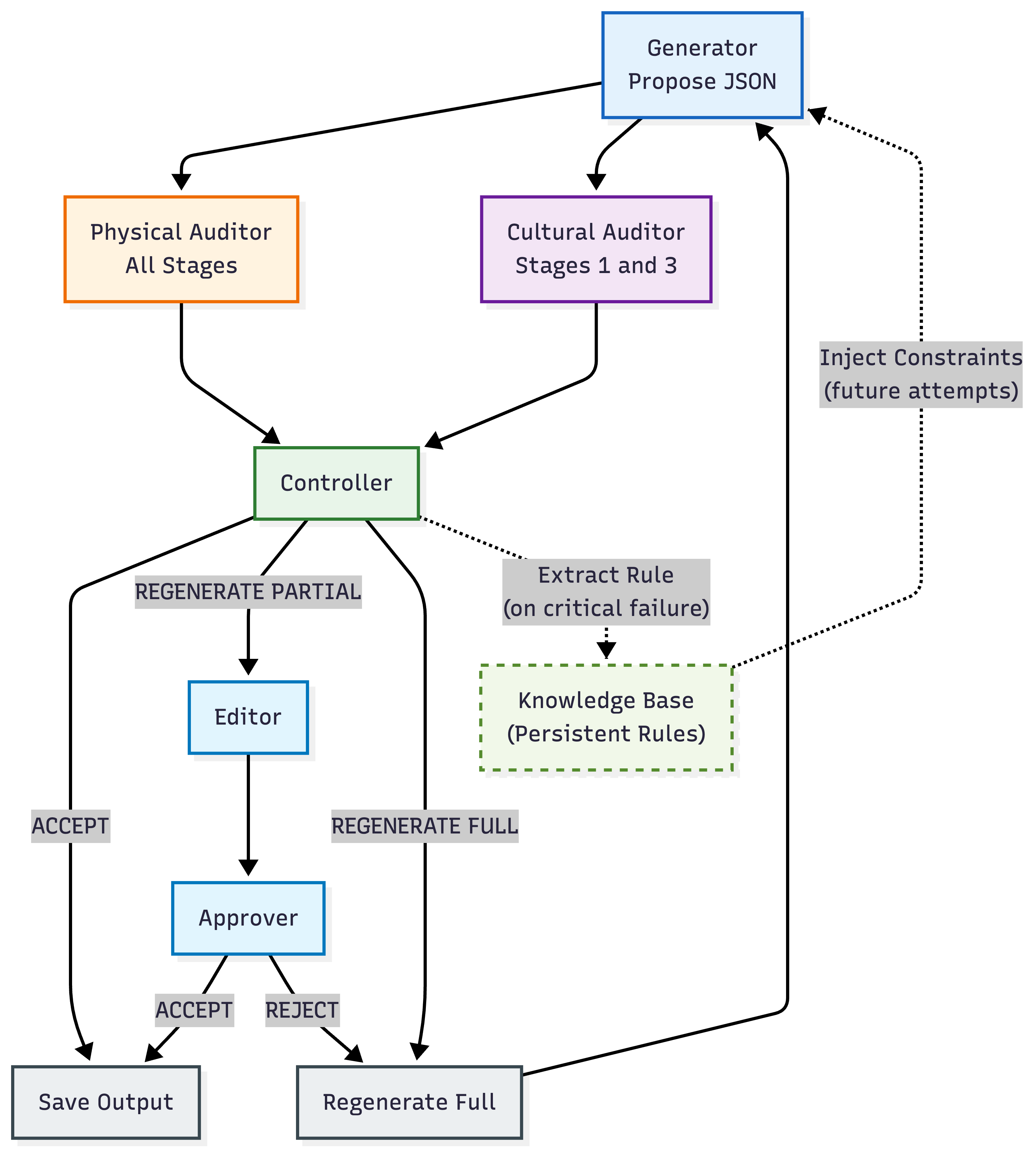
Figure 1: Governance and decision flow mechanism ensuring robust and auditable energy scenario generation via role-specialized LLMs.
This rigor in pipeline governance is designed to deliver reproducibility, explicit error correction, and coherence across generated scenarios. The explicit separation of generative, auditing, editing, and approval roles significantly reduces the likelihood of emergent artifacts that violate physical or cultural constraints, common in more naive generative setups.
Modular Pipeline and Weather Integration
The framework's three-stage pipeline is inherently extensible, allowing key components—particularly weather—to be supplied by external physics-informed sources (e.g., TMY datasets) or by general-purpose LLMs, with convergent downstream interfaces ensuring that ablation and substitution analyses are systematically feasible Figure 2.
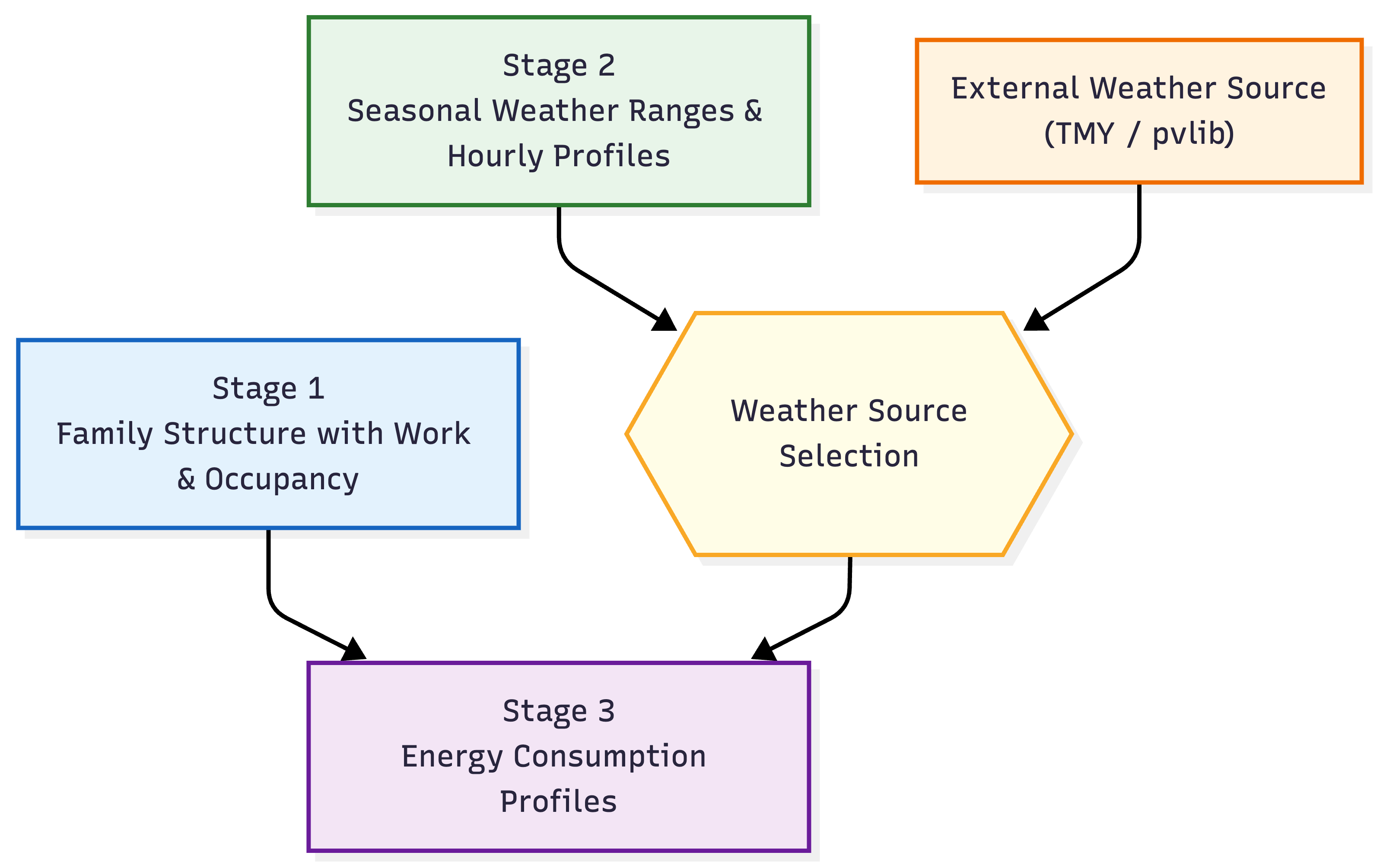
Figure 2: Modular household energy generation pipeline with robust interface definitions allowing selective replacement (notably for weather) without disintegrating pipeline integrity.
Comparison studies reveal that while LLM-generated weather profiles can approximate typical diurnal and seasonal trends, systematic discrepancies persist relative to physics-based references, especially for variables with high temporal structure requirements Figure 3. Pearson correlations between LLM and TMY profiles for temperature, irradiance, and humidity generally exceed 0.7—indicating shape similarity—but less so for variables strongly driven by meteorological extremes.
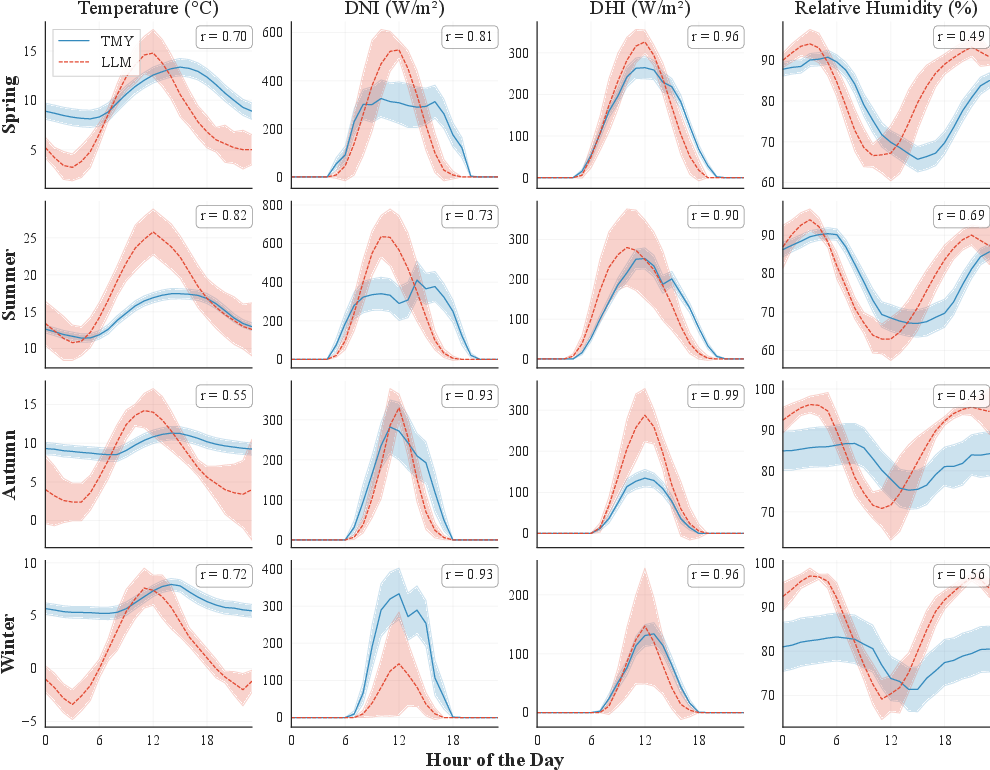
Figure 3: Comparisons of LLM-based vs TMY weather showcase moderately strong alignment in diurnal and seasonal structure, with some loss in physical accuracy for complex variables.
Crucially, the pipeline exhibits resilience to this source uncertainty: household energy consumption profiles remain temporally robust, and demand structure is preserved even as input weather source is switched, with variability limited mainly to confidence-band width rather than mean profile drift Figure 4.
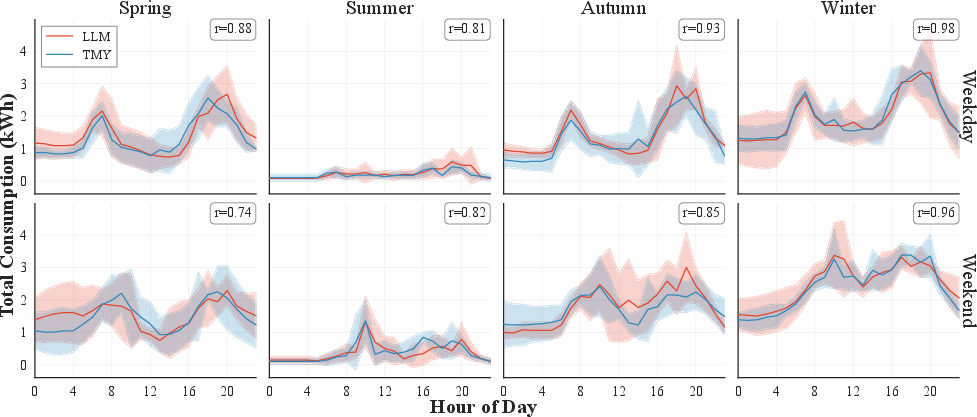
Figure 4: Hourly demand generated under LLM vs TMY weather inputs for fixed households, showing strong correlation and highly aligned load shape across seasons and day types.
Quantitative Evaluation and Contradictory Claims
Synthetic profiles produced by WattCouncil across multiple household types and occupancy regimes were systematically compared against the high-resolution, context-rich CER smart meter dataset. Across all demographic groups and seasons, the generated profiles display significant temporal structure alignment with ground truth (Pearson r typically in the 0.6–0.8 range), sharply matching peak timing and load-shape evolution Figure 5.
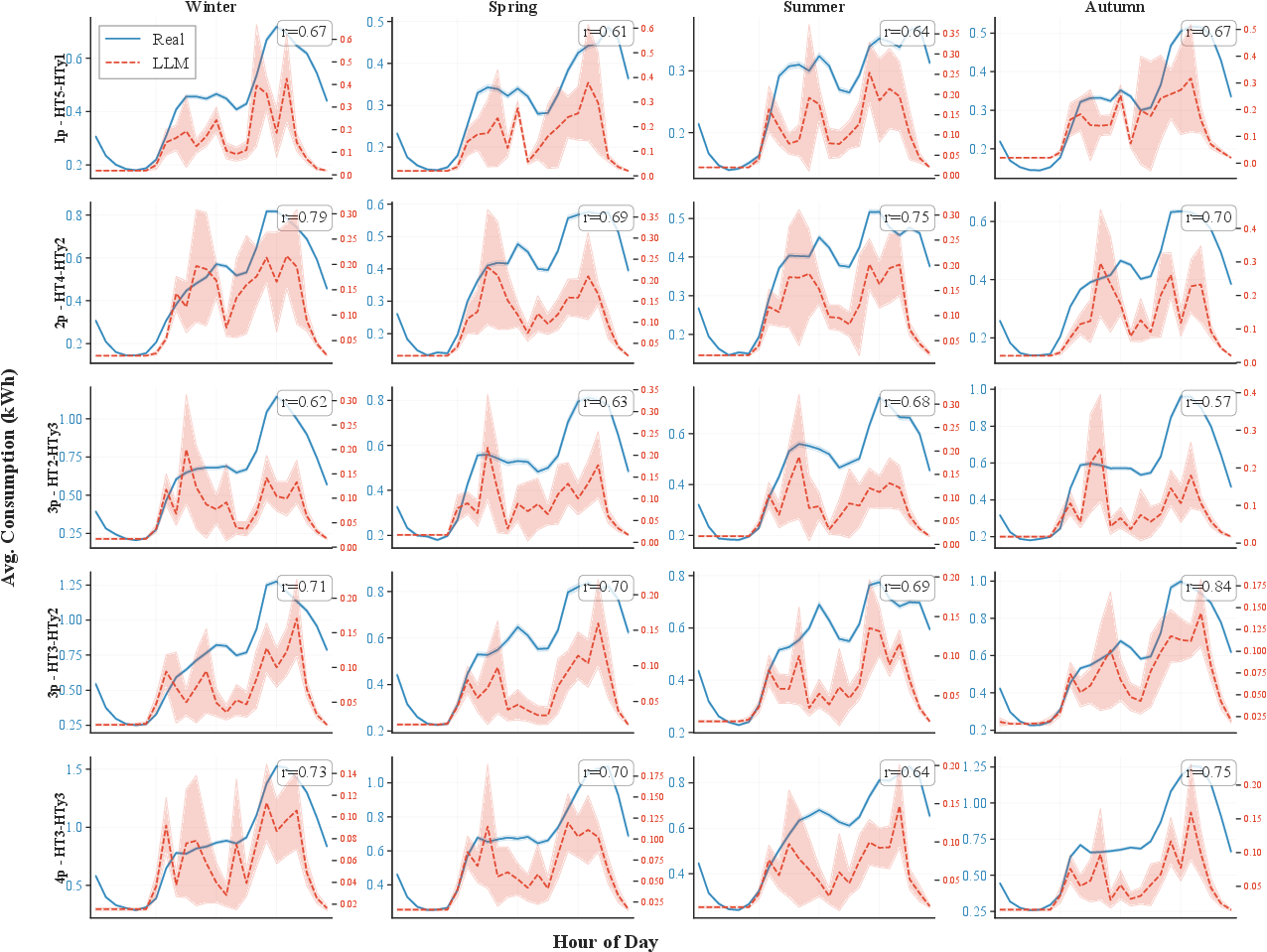
Figure 5: Average seasonal daily load profiles across a range of household compositions validate load shape similarity between WattCouncil's outputs and real CER metered data.
MAE, RMSE, and MAPE statistics expose nontrivial magnitude errors, especially at the absolute energy scale (MAPE often exceeding 70%). The paper asserts that the principal limitations of LLM-based generation lie not in capturing behavioral and temporal variability, but in reliably matching the physical magnitudes of energy usage. This stems from the lack of direct modeling of device efficiency, thermal response, or granular occupancy-appliance coupling—factors crucial for fine-tuned energy realism but challenging to encode purely through language-based generative processes.
Ablation Insights
Systematic ablations demonstrate that LLM-based weather generation, while plausible, introduces physical inconsistencies and is best replaced by deterministic, validated sources for critical analyses. However, the impact on downstream demand profiles is minor (Pearson r∈[0.74,0.98] across all seasons for load shape), underscoring the pipeline's resilience and the centrality of behavioral context over pure weather fidelity for typical demand scenarios.
Practical and Theoretical Implications
Practically, WattCouncil is positioned as a rigorous scenario-generation backbone for data-constrained domains, enabling:
- Flexible benchmarking and privacy-preserving model development for smart-grid applications.
- Systematic scenario generation under precisely specified contextual and temporal regimes.
- Structured governance and reproducibility requisite for high-consequence analytical workflows.
Theoretically, the findings reinforce the importance of physical constraint integration in generative models, advocating for hybrid frameworks that blend LLM reasoning capabilities with domain-specific physics engines or curated meteorological archives. The council-based, role-segregated agent design is validated as a tractable path to enforce multi-constraint coherence in generative pipelines.
The results challenge the notion that LLMs alone can reliably reproduce all aspects of structured time-series data, particularly when physical constraints are nontrivial.
Future Directions
The research points toward embedding physical device and thermal-envelope models into the generative pipeline, migrating from purely context-driven behavior to tightly coupled physical-behavioral hybrid scenarios. Other developments include expansion to diverse geographic regions, enriched socio-demographic conditioning, integration of GCMs or advanced weather simulators, and coupling generated data with downstream optimization/operation frameworks (e.g., demand response, grid resilience analyses). Systematic handling of rare/extreme events remains an open target.
Conclusion
WattCouncil operationalizes a governed multi-agent LLM framework, setting a new baseline for reproducible, context-sensitive synthetic household energy data generation. Empirical evaluation confirms robust alignment of temporal and behavioral patterns with real-world data, though absolute energy magnitude fidelity remains an unsolved challenge—indicating clear directions for augmenting the framework with more granular, physics-aware mechanisms. The modular governance approach provides a template for robust, auditable synthetic data pipelines in other privacy-sensitive, context-rich domains.
All technical claims, results, and figures referenced are substantiated by the arXiv preprint "WattCouncil: Context-Aware Household Energy Scenario Generation With Governed LLMs" (2607.10720).

