- The paper identifies two new excited Σc⁰ resonances at ~2.9 GeV and 3.2 GeV using amplitude analysis of B⁻ → Λc⁺ p̄ π⁻ decays.
- It employs an unbinned likelihood fit on 9 fb⁻¹ of LHCb data to extract precise resonance parameters and resolve overlapping signals.
- The findings clarify the Σc⁰(2800) structure and provide stringent tests for quark model predictions and lattice QCD calculations.
Observation of New Excited Σc0 States in B−→Λc+pπ− Decays
Introduction
The spectroscopy of hadrons containing heavy quarks serves as a critical probe of nonperturbative QCD. In particular, the study of singly charmed baryons, such as those in the Σc0 family, allows for stringent testing of constituent quark models, potential models, and QCD sum-rule predictions. Although several low-lying charmed baryons have been firmly established, the spectrum of excited Σc0 baryons remains incomplete, with only a handful of states confirmed prior to this work. Here, the LHCb Collaboration presents an amplitude analysis of the B−→Λc+pπ− decay channel, leading to the observation of two previously unobserved excited Σc0 resonant structures, in addition to the established Σc0(2455), Σc0(2520), and Σc0(2800).
Experimental Data Selection and Amplitude Analysis
The analysis is based on 9 fb−1 of B−→Λc+pπ−0 collision data collected by the LHCb detector at B−→Λc+pπ−1 7, 8, and 13 TeV. Candidate events are reconstructed with the B−→Λc+pπ−2 identified via its dominant hadronic decay B−→Λc+pπ−3. Advanced particle identification, kinematic, and vertex quality criteria, complemented by BDT-based background suppression, result in a high-purity sample with B−→Λc+pπ−4 B−→Λc+pπ−5 signal events and a background fraction of B−→Λc+pπ−6.
To investigate resonant substructure, an unbinned likelihood fit is performed to the Dalitz distribution of the B−→Λc+pπ−7 final state. The analysis treats the B−→Λc+pπ−8 as stable. To avoid complications from a pronounced B−→Λc+pπ−9 threshold enhancement and the narrow Σc00, regions with Σc01 and Σc02 are excluded or handled separately.
Resonant Structure in the Invariant Mass Distributions
The Σc03 distribution reveals the expected Σc04, Σc05, and Σc06 features, as well as clear excesses indicative of two additional excited Σc07 states at approximately 2.9 and 3.2 GeV/Σc08. The amplitude fit incorporates all known resonant and nonresonant contributions, as well as S-wave and potential P-wave nonresonant amplitudes.
The key projections of the amplitude fit for the relevant two-body mass combinations are illustrated below.
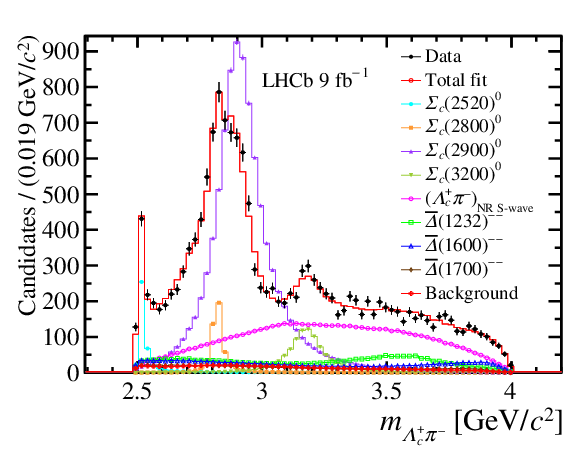
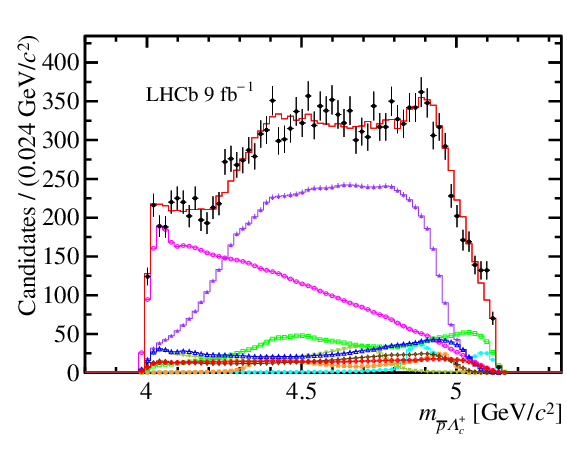
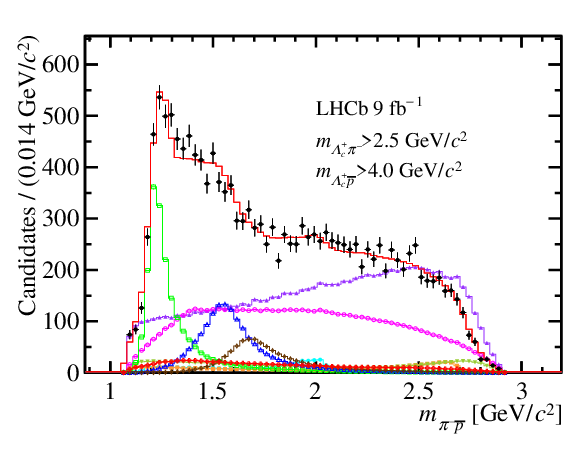
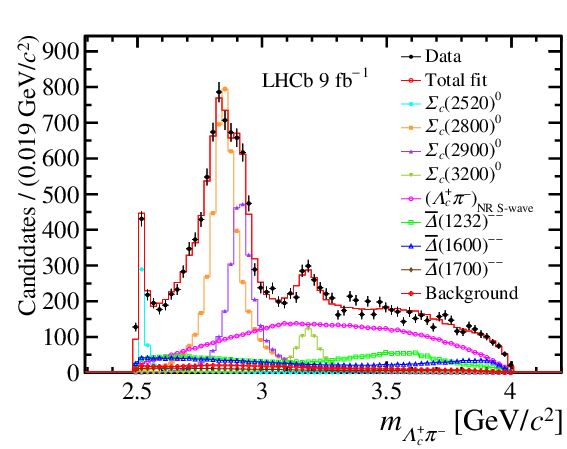
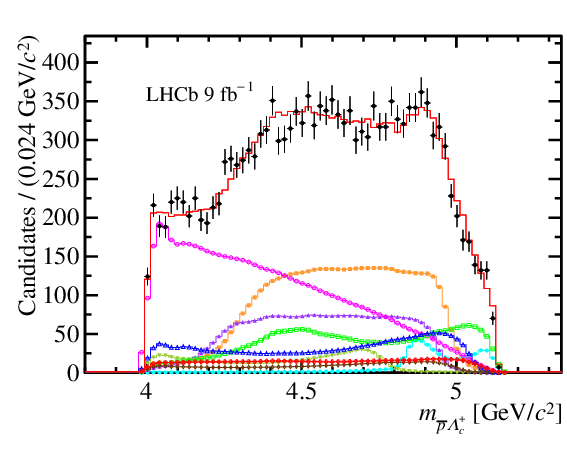
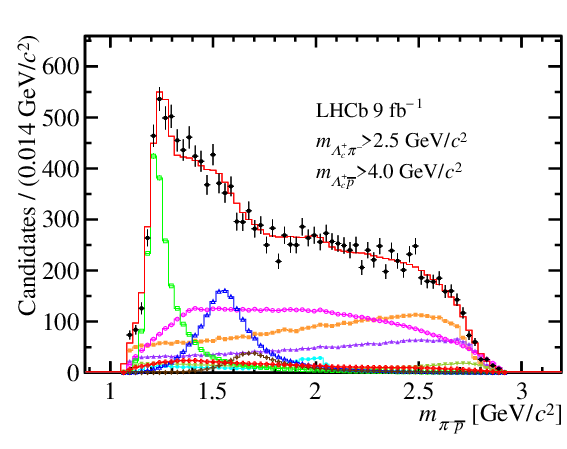
Figure 2: Distributions of (left) Σc09, (middle) Σc00, and (right) Σc01 invariant masses, with the fit result overlaid for both solution groups.
Determination of Resonance Parameters and Ambiguities
The amplitude analysis accommodates interference effects and alternative quantum number assignments for the observed resonances. Multiple local minima are discovered, with two groups (A, B) of near-degenerate solutions distinguished by the preferred spin-parity hypotheses for the states around 2.8 and 2.9 GeV. The masses and widths extracted for the three high-mass Σc02 states differ significantly between these solution groups, particularly for the Σc03 and Σc04, though the Σc05 parameters remain stable. The relative contributions to the Σc06 decay also show sizable variations between solutions, with the Σc07 exhibiting a dominant yield in group A.
Strong statistical evidence supports the necessity of all three high-mass Σc08 amplitudes:
- A two-component model for the 2.8 GeV region (Σc09 and B−→Λc+pπ−0) is favored over a single-resonance hypothesis at B−→Λc+pπ−1 significance (systematics included).
- The B−→Λc+pπ−2 resonance is required at B−→Λc+pπ−3 significance.
The assignment B−→Λc+pπ−4 for the B−→Λc+pπ−5 is overwhelmingly favored, and the B−→Λc+pπ−6 is confirmed as B−→Λc+pπ−7 at B−→Λc+pπ−8.
Systematic Uncertainties
Uncertainties in mass, width, and yield fractions arise from backgrounds, efficiency corrections, model dependence (fixed parameters, alternative S- and P-wave parametrizations, resonance radius, Dalitz acceptance), and the ambiguity in spin-parity assignments. For the B−→Λc+pπ−9, results are stable across both solution groups, while for the Σc00 and Σc01, systematic uncertainties from the solution spread are dominant.
Discussion
The detailed amplitude analysis provides unambiguous evidence for two new excited Σc02 states:
- Σc03 with Σc04 GeV, Σc05 GeV (group A)
- Σc06 with Σc07 GeV, Σc08 GeV
The previously observed Σc09 is disambiguated into two separate resonances, resolving inconsistencies between prior Belle and Babar measurements. The results are compatible with quark-model expectations for higher-lying Σc0(2455)0 excitations, including possible 2S- and 2P-wave assignments. Fit fractions show that the excited Σc0(2455)1 yields exceed or rival those of the ground-state Σc0(2455)2 in some solution scenarios—an unanticipated dynamical feature.
These findings both test and constrain theoretical models of charmed baryon spectroscopy. The observation of high-mass Σc0(2455)3 states in Σc0(2455)4 decays provides a new laboratory for understanding Σc0(2455)5- and Σc0(2455)6-mode excitations, heavy-quark symmetry, and the interplay of strong decay mechanisms.
Theoretical and Practical Implications
This analysis substantially expands the established charmed baryon spectrum, adding two high-mass, broad structures to the excitation pattern of Σc0(2455)7. Precise mass and width measurements sharply constrain relativized quark models and Lattice QCD predictions. The separation of the Σc0(2455)8 into two components sets a precedent for detailed amplitude analyses in other heavy flavor baryon sectors and underscores the need for careful treatment of broad, overlapping resonances in multi-body final states.
Furthermore, the significant fit fractions for the excited Σc0(2455)9 baryons suggest dynamical features of the decay Σc0(2520)0 that are not captured by simple phase-space or naive factorization-based models. These results motivate further theoretical work in the context of heavy-quark effective theory, as well as the exploration of exotic interpretations (e.g., molecular or multiquark components) for the observed states.
Conclusion
The LHCb amplitude analysis of Σc0(2520)1 has resulted in the observation of two new excited Σc0(2520)2 baryons at 2.9 and 3.2 GeV, providing high-precision measurements of their properties and clarifying the resonance structure first observed more than a decade prior. The findings directly impact the interpretation of charmed baryon spectroscopy, serving as benchmarks for nonperturbative QCD calculations and offering new directions for both experimental and theoretical research in heavy flavor baryon physics.