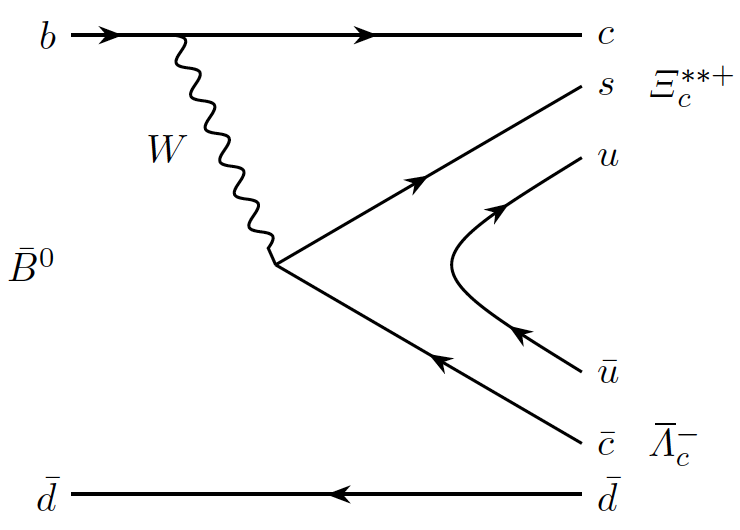
Abstract: The decay B<sup>0</sup>→Λc<sup>+</sup>Λˉc<sup>−</sup>KS<sup>0 is studied at LHCb for the first time using proton-proton collision data recorded by the LHCb experiment at a center-of-mass energy of s=13 TeV, corresponding to an integrated luminosity of 5.4 fb<sup>−1. The branching ratio relative to the decay B<sup>+</sup>→Λc<sup>+</sup>Λˉc<sup>−</sup>K<sup>+ is measured to be </sup>B(B<sup>+</sup>→Λc<sup>+</sup>Λˉc<sup>−</sup>K<sup>+)B(B<sup>0</sup>→Λc<sup>+</sup>Λˉc<sup>−</sup>KS<sup>0)</sup>=0.53±0.05±0.05, where the first uncertainty is statistical and the second is systematic. Evidence is found for contributions from two resonant states, Ξc(2923)<sup>+ and Ξc(2939)<sup>+, in the Λc<sup>+</sup>KS<sup>0 system. The two states show a significance of $3.9σ$ relative to the nonresonant hypothesis. These two Ξc<sup>+ states are consistent with being the isospin partners of the states observed in Λc<sup>+</sup>K<sup>− system.
The paper presents the most precise measurement of the B0 → Λc+ Λ̅c- KS0 branching fraction, establishing its relative suppression versus the B+ decay mode.
It employs multivariate BDT classifiers and extended unbinned maximum-likelihood fits across three invariant-mass dimensions to extract signal yields and suppress background.
The observation of intermediate Ξc+ resonances with a 3.9σ significance confirms their properties and supports isospin symmetry in baryonic B decays.
Study of the B0→Λc+Λˉc−KS0 Decay: Branching Fractions and Resonant Substructure
Motivation and Physics Context
The decay B0→Λc+Λˉc−KS0 constitutes a rare, multibody hadronic process that probes both the electroweak and strong interaction mechanisms underlying heavy flavor decays. This final state, containing two open-charm baryons and a neutral kaon, is sensitive to intermediate baryonic resonances and possible exotic QCD states—issues of contemporary significance for understanding hadron spectroscopy and the interplay between hadronization and weak decay processes. Furthermore, isospin-partner searches, when contrasted with B+→Λc+Λˉc−K+ decays, offer crucial tests of hadronization dynamics and provide an avenue to investigate the spectrum and isospin structure of Ξc baryons, particularly their excited, narrow states near $2.9$ GeV.
Experimental Methodology
The analysis is performed using pp collision data at s=13~TeV corresponding to 5.4fb−1, recorded by the LHCb detector. The Λc+ and Λˉc− are reconstructed in their dominant B0→Λc+Λˉc−KS00 final states, and the B0→Λc+Λˉc−KS01 via B0→Λc+Λˉc−KS02 pairs, with optimization for both long- and downstream-track topologies. Multivariate BDT classifiers, trained on simulation and high-sideband data, are used to suppress combinatorial backgrounds. Extended unbinned maximum-likelihood fits to three invariant-mass dimensions (B0→Λc+Λˉc−KS03 candidate, each B0→Λc+Λˉc−KS04 candidate) distinguish signal from nonresonant and partially reconstructed or misidentified backgrounds.
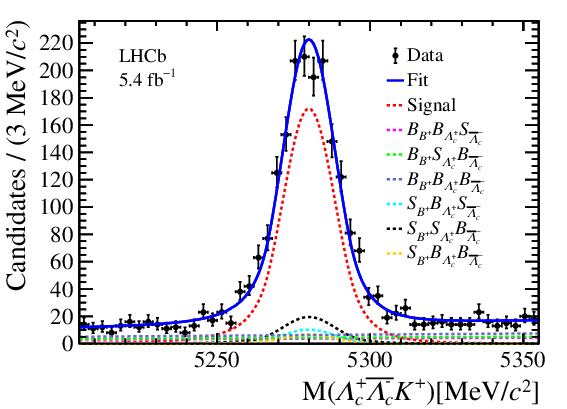
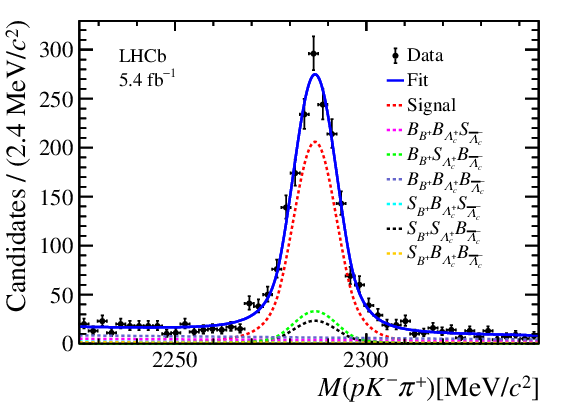
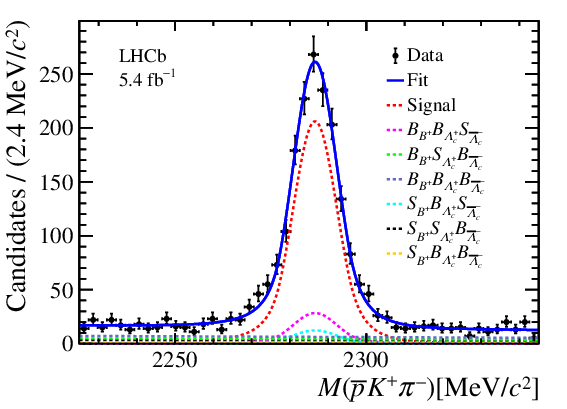
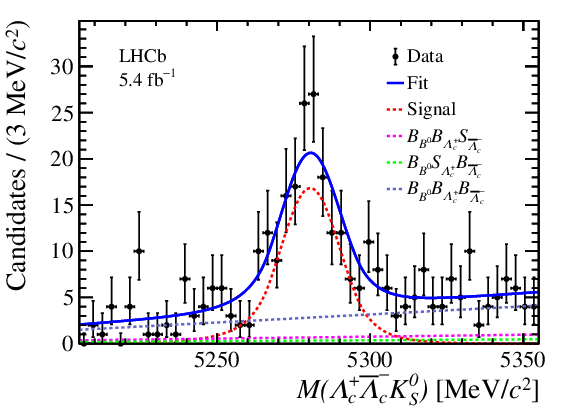
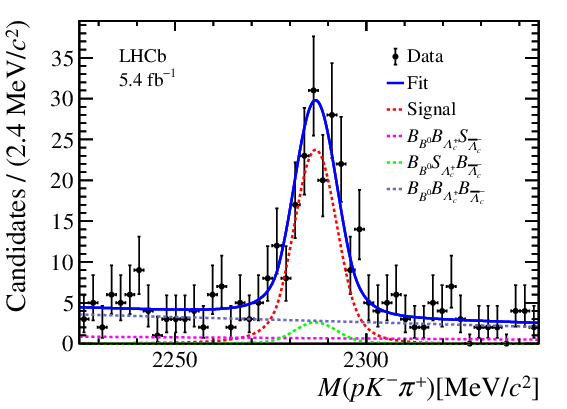
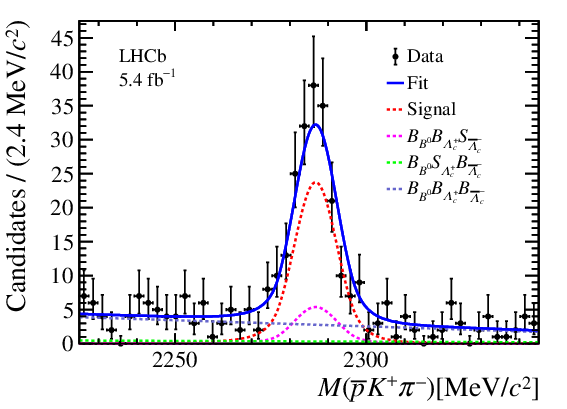
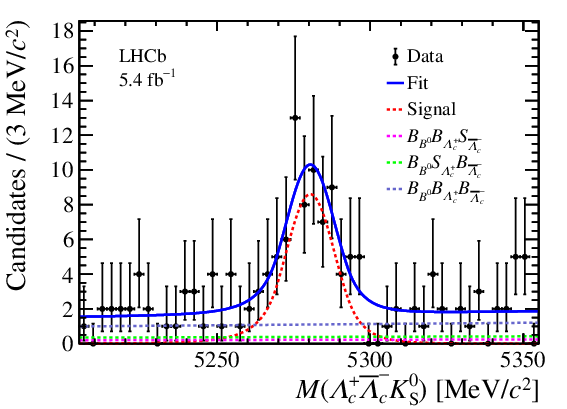
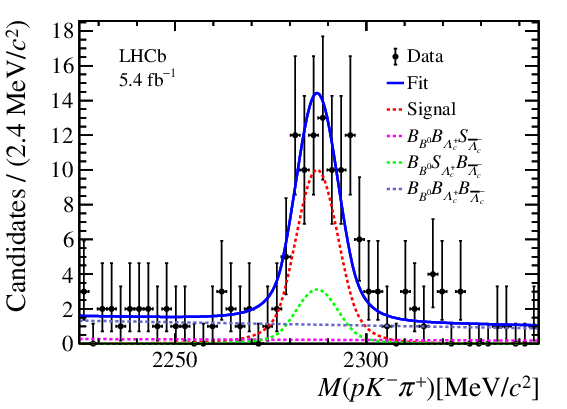
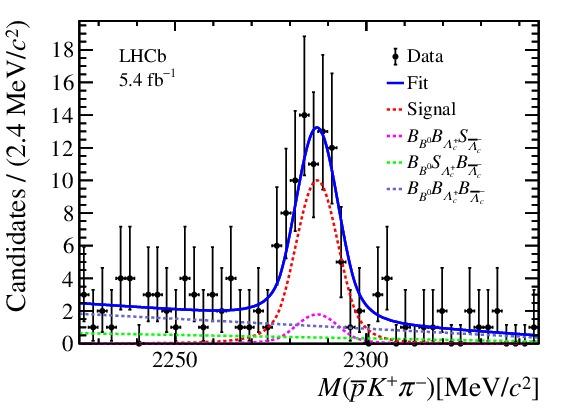
Figure 1: Fit projections for signal and control decay channels, with separate tracking categories for B0→Λc+Λˉc−KS05, isolating the B0→Λc+Λˉc−KS06-candidate and hyperon-mass peaks relevant for yield extraction.
Signal yields are determined independently for each reconstruction category and control channel, with simulation-driven corrections for acceptance, reconstruction, and PID efficiencies.
Branching Fraction Measurement
The relative branching fraction to the normalization mode B0→Λc+Λˉc−KS07 is measured as
B0→Λc+Λˉc−KS08
where the uncertainties are statistical and systematic, respectively. Combining with the world average for the B0→Λc+Λˉc−KS09 normalization mode yields
B+→Λc+Λˉc−K+0
with the final uncertainty due to the reference branching fraction. This constitutes the most precise determination for this channel to date and establishes the relative suppression of B+→Λc+Λˉc−K+1 compared to B+→Λc+Λˉc−K+2 in these final states, consistent with expectations from isospin symmetry and hadronization.
Intermediate Resonant Structure
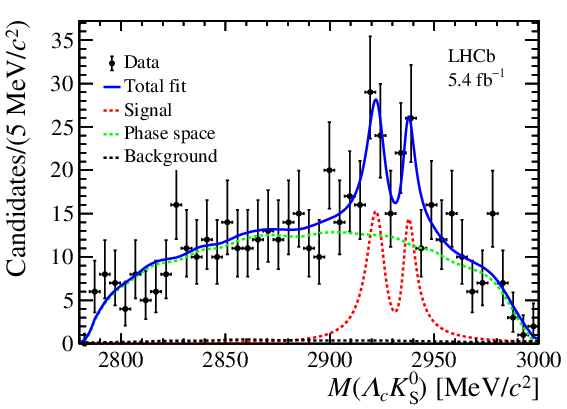
A key focus is the B+→Λc+Λˉc−K+3 (and B+→Λc+Λˉc−K+4) invariant mass spectrum, as possible contributions from excited B+→Λc+Λˉc−K+5 baryons are theoretically anticipated—specifically, B+→Λc+Λˉc−K+6 and B+→Λc+Λˉc−K+7. The analysis implements tight selection on the reconstructed masses and performs an unbinned fit including coherent resonant amplitude modeling (relativistic Breit-Wigner shapes after detector smearing), phase-space, and background components. The parameters for the two B+→Λc+Λˉc−K+8 resonances are left free in the fit, tested for systematic robustness under a variety of model variations (spin-parity, orbital configuration, effective strong radii, interference effects).
Figure 2: Invariant mass fit of the B+→Λc+Λˉc−K+9 system showing clear structures consistent with the Ξc0 and Ξc1 states.
The extracted yields for the sum of the two resonances correspond to a Ξc2 significance over nonresonant background. The measured masses and widths,
Ξc3 MeV, Ξc4 MeV;
Ξc5 MeV, Ξc6 MeV,
are consistent with isospin partners previously observed in the charged kaon decay channel as well as with prompt production measurements. This concordance strengthens the postulate that these structures belong to Ξc7 baryon excitations.
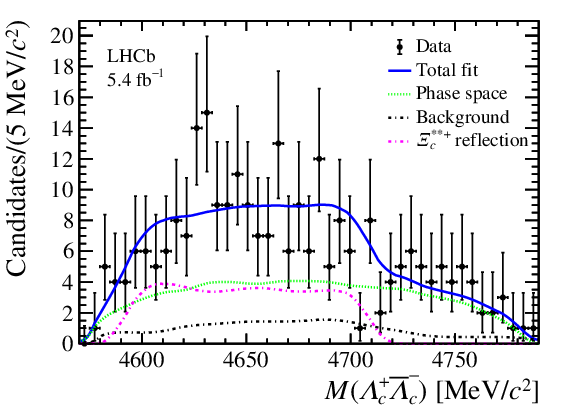
No statistically significant structure is observed in the Ξc8 mass distribution.
Figure 3: Ξc9 mass spectrum, showing no evidence of exotic near-threshold charmonium or baryonium states at current level of precision.
Theoretical and Phenomenological Implications
The measurement establishes a robust, high-significance observation of the $2.9$0 decay, mapping the isospin landscape against earlier charged $2.9$1 measurements. The observation of the two $2.9$2 resonances in the $2.9$3 channel, with yields and masses in strong agreement with results for the $2.9$4 states in $2.9$5, provides powerful evidence for the isospin doublet interpretation of these baryons. The null observation for $2.9$6 threshold enhancements further constrains models for exotic baryonium and possible multi-quark dynamics in $2.9$7 decays.
These results sharpen the assignment of $2.9$8 quantum numbers for the excited $2.9$9 states, solidify the role of intermediate baryonic resonances in multibody pp0 decays, and offer an anchor point for future amplitude analyses of the pp1 Dalitz plot.
Outlook and Future Developments
The demonstrated ability to disentangle resonant from nonresonant contributions in high-multiplicity baryonic pp2 decays emphasizes LHCb's reach in heavy-flavor baryon spectroscopy, especially in channels unexplored at pp3 factories. These methods can be extended to explore further rare decay modes—including possible pentaquark or tetraquark contributions—and polarization observables, and will benefit from the increasing datasets foreseen in future LHC runs. Detailed amplitude analyses leveraging full angular correlations will become feasible, enabling more precise quantum number assignments and more sophisticated tests of QCD-inspired models of hadronization and exotic spectroscopy.
Conclusion
This study delivers the most accurate measurement to date of the pp4 branching fraction and provides strong evidence for intermediate pp5 resonances in the pp6 spectrum. The results not only confirm isospin symmetry in the pp7 spectrum but also define stringent constraints on explanations for threshold enhancements and exotic hadronic states in heavy-flavor decays, underpinning ongoing efforts to understand QCD dynamics in baryonic pp8 decays (2604.15040).
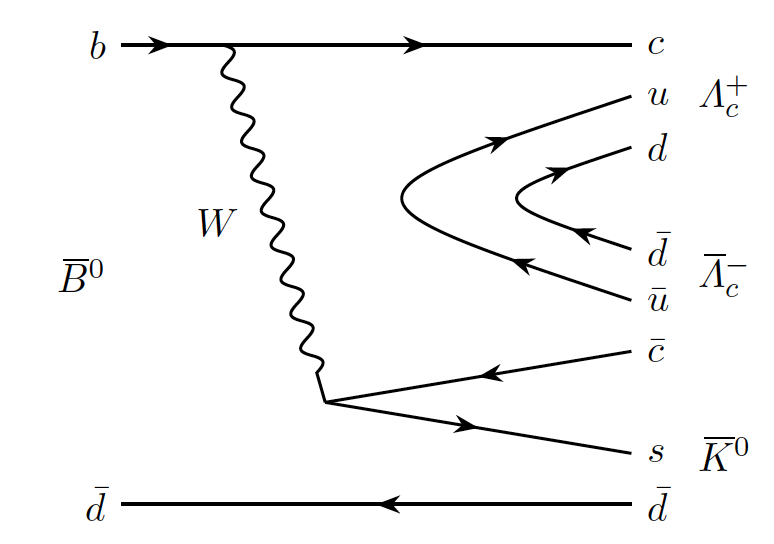
Figure 4: Feynman diagrams illustrating (left) nonresonant and (right) resonant mechanisms contributing to pp9 decay.