- The paper shows that implicit CoT methods yield superior patent claims, with human evaluations improving by up to +5.9 points in logical structure.
- It introduces a structured three-phase prompting approach—feature extraction, logical grouping, and language formalization—that mimics expert legal drafting workflows.
- It finds that explicit CoT creates a verbalization bottleneck, degrading output quality by losing critical technical and legal details.
The Verbalization Bottleneck in Chain-of-Thought Prompting for Patent Claim Generation
Introduction
Patent claim generation presents complex algorithmic and linguistic challenges, demanding precise, hierarchical, and legally rigorous text production grounded in technical documentation. While Chain-of-Thought (CoT) prompting has demonstrated efficacy in enhancing the systematic reasoning capabilities of LLMs across various tasks, its utility in highly detail-preserving generation domains such as legal drafting has been contested. This work provides a systematic study of CoT prompting for automated patent claim generation, critically analyzing the interplay between reasoning externalization and output fidelity, with a focus on the "verbalization bottleneck" that emerges in this domain.
The study formalizes the task as generating high-quality claims C from a technical description D via an LLM guided by an instruction I: C=G(I,D). Given the intricacy of patent claims—requiring nuanced extraction, hierarchical structuring, and legalized linguistic formalization—the authors introduce a structured, domain-specific zero-shot CoT paradigm comprising three sequential phases: feature extraction, logical grouping, and language formalization. This approach mirrors professional patent drafting protocols.
Three prompting methods are investigated:
- Plain Prompt: The model directly produces final claims with no explicit reasoning scaffold.
- Implicit CoT: The model is instructed to reason step by step internally but outputs only the final claims.
- Explicit CoT: The intermediate reasoning steps are explicitly verbalized as text prior to claim generation.
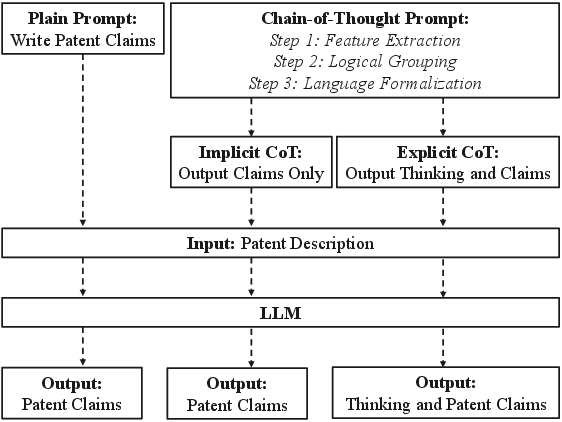
Figure 1: Overview of the CoT prompting methods. Implicit CoT and Explicit CoT share the same three-step process (Feature Extraction → Logical Grouping → Language Formalization); they differ in whether intermediate reasoning is externalized as text.
Empirical Evaluation and Core Results
Experiments conducted on the EPD and HUPD-DCG datasets with models including Llama-3.1 (8B, 70B), Mixtral-8×7B, Mistral-7B, and GPT-4o, are evaluated using both automated metrics (PatClaimEval; LLM-as-a-judge) and expert human annotation.
Key findings include:
- Implicit CoT consistently yields superior claim quality over both plain prompting and explicit CoT.
- On GPT-4o, implicit CoT provides a substantial and stable mean improvement in human evaluations, notably +5.2 points overall and +5.9 in logical structure.
- Automated metrics corroborate human findings: PatClaimEval and LLM-as-a-judge scores also improve under implicit CoT.
- Explicit CoT reliably degrades performance, with average human rating drops (e.g., −2.2 on GPT-4o), and even more pronounced regression on smaller models.
These results are robust across datasets, architectures, and evaluation methodologies, emphasizing a fundamental distinction between implicit and explicit reasoning approaches in detail-critical tasks.
Diagnosis of the Verbalization Bottleneck
The observed degradation from explicit CoT is traced to a "verbalization bottleneck": the process of externalizing complex internal model states into linear, lossy textual reasoning steps. This bottleneck manifests via three mechanisms:
- Abstraction of Critical Detail: Intermediate reasoning externalizes abstracted, high-level concepts, systematically omitting essential technical features, numeric constraints, and element relationships that underpin legal enforceability.
- Disruption of Internalized Generation Patterns: LLMs pretrained on legal corpora develop strong priors for claim drafting conventions. Interposing explicit reasoning interrupts these priors, leading to less coherent, less formal, or legally misaligned output structures.
- Error Propagation Across Steps: Any omission or misclassification in the reasoning phase irreversibly pollutes subsequent claim generation, since generation is conditioned purely on the intermediate text, not the original input. Human analysis reveals nontrivial drop-off at each stage (e.g., 62–72% precision in feature extraction with further declines in grouping and final synthesis).
Detailed human and comparative analyses substantiate these mechanisms and illustrate that explicit CoT often omits or abstracts legally salient information (e.g., "blind holes" or "non-smooth textures"), leading to inferior claim fidelity.
Theoretical and Practical Implications
This work demonstrates that, contrary to prevailing trends in reasoning-oriented prompting, verbalized CoT can be detrimental in structured legal text generation. The findings challenge the uniform adoption of explicit CoT protocols and underscore the necessity of evaluating the effects of reasoning visibility in domain-sensitive tasks. The verbalization bottleneck is a significant obstacle whenever the task objective is to maximize detail preservation, compositional fidelity, and adherence to rigid formal constraints.
Pragmatically, the superiority of implicit CoT in patent drafting suggests that, for legal-gen tasks, silent planning (with invisible intermediate computation) capitalizes more effectively on LLMs' internal chain-of-thought while avoiding lossy intermediate text serialization. This principle is also hypothesized to extend to other contractive drafting domains, such as regulatory filings, where specific wording, hierarchical dependencies, and exception handling are paramount.
Perspectives and Future Directions
These findings call for domain- and task-adapted prompting policies in legal NLP. Future research should generalize the verbalization bottleneck framework to a broader set of legal, regulatory, and rights-document generation tasks, investigate systematic interventions (e.g., reinforcement learning for internal CoT scaffolds), and extend analysis to settings involving supervised fine-tuning, agents, or multimodal grounding. More granular ablation studies (as provided in the appendix) reveal that the logical grouping phase is particularly critical, with the feature extraction step being less essential and possibly redundant in expert models.
Moreover, the observation that making chain-of-thought visible may decrease output fidelity introduces new theoretical questions regarding the representations LLMs use during "thought" and their interaction with explicit textualization.
Conclusion
This paper rigorously demonstrates that, for the domain of patent claim generation, implicit CoT surpasses explicit CoT—contrary to trends in arithmetic or symbolic reasoning—and that externalized reasoning can constitute a substantive information bottleneck. These conclusions provide actionable guidance for legal NLP system design and open new lines of inquiry into context-sensitive prompting and model introspection, informing both the deployment and further development of LLM-based legal drafting systems.
(2607.10480)

