- The paper introduces analytic and numerical frameworks to compute Krylov complexity in systems with time-dependent Hamiltonians using Floquet theory and Magnus expansion.
- The paper details a piecewise Magnus approach that segments time evolution to ensure convergence and accurately capture nonadiabatic effects.
- The paper provides concrete benchmarks in two-level and quadratic systems, demonstrating error control and practical utility in quantum dynamics.
Krylov Complexity for Time-Dependent Hamiltonians: Frameworks and Computation
Overview and Motivation
The manuscript "Krylov Complexity for Time-Dependent Hamiltonians" (2607.10454) systematically develops practical methodologies for analyzing Krylov and spread complexity in quantum systems subject to time-dependent Hamiltonians. Krylov complexity, a bottom-up quantum complexity metric, measures how an initially simple state or operator explores Hilbert space under evolution. While its computation for time-independent generators is well-established, time-dependent dynamics pose significant complications due to non-commuting instantaneous Hamiltonians. The paper rigorously addresses these complications, providing analytic and algorithmic tools based on Floquet theory, Magnus expansion (both global and piecewise), and explicit benchmarks in two-level and quadratic systems.
Periodically Driven Systems and Floquet Theory
The authors provide a detailed review of periodically driven quantum systems, governed by H(t) with H(t+T)=H(t). Floquet theory recasts such dynamics in terms of a stroboscopic effective Floquet Hamiltonian HF, defined via the one-period evolution operator U(T,0)=e−iHFT. Krylov complexity at integer multiples of the period is then calculable as in time-independent cases, though intra-period micromotion can contribute substantial complexity outside stroboscopic points.
The computation of HF is rarely available in closed form except for basic cases. The authors highlight the necessity of perturbative and numerical approaches—particularly the Floquet–Magnus expansion—for obtaining HF when explicit analytic forms are inaccessible. This formalism delivers systematic corrections in the high-frequency regime, where the driving period is short relative to internal timescales.
Magnus Expansion and Convergence Analysis
The Magnus expansion is used to approximate the time-evolution operator for general H(t):
U(t,0)=Te−i∫0tH(s)ds≈eΩ(m)(t),Ω(m)(t)=k=1∑mΩk(t),
with higher-order terms capturing nested commutators. The authors present rigorous convergence criteria, emphasizing that Magnus truncations are only reliable when ∫0t∥H(s)∥ds<π [Moan2008Convergence; Apel2025Magnus]. Numerical truncation error bounds are detailed and empirically illustrated for the linearly polarized drive:
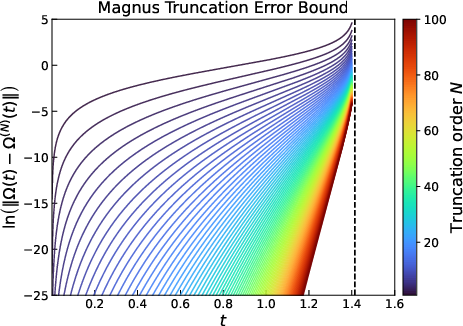
Figure 1: Magnus truncation error bound for the time-dependent Hamiltonian Hlin(t) as a function of time and truncation order.
These results delineate the practical regime where global Magnus expansion is applicable; outside this region, errors escalate rapidly, necessitating alternative approaches.
Two-Level Systems: Analytical Case Studies
The paper applies its framework to driven two-level systems, both analytically and numerically:
- Circularly Polarized Drive: Transformation to a rotating frame produces an effective static Hamiltonian. The complexity profile is analytically derived, exhibiting Rabi oscillations whose amplitude and frequency depend on drive parameters and detuning.
- Linearly Polarized Drive: In the near-resonant regime, the rotating-wave approximation (RWA) leads to the same effective Hamiltonian as the circular case. For strong driving/high frequency, the Floquet–Magnus expansion is employed. The authors derive the effective Hamiltonian up to second order, with explicit expressions involving Bessel and Struve functions, capturing commutator-induced transitions even for initially eigenstates.
Piecewise Magnus Expansion
For genuinely time-dependent systems beyond periodic driving and where global Magnus expansion fails or loses accuracy, the piecewise Magnus method is introduced. Time is partitioned into subintervals to ensure local Magnus convergence; effective Hamiltonians are computed per segment and sequentially composed. This approach is systematically benchmarked on quadratic oscillators:
Sudden Quench Benchmark
A harmonic oscillator undergoing a frequency quench from H(t+T)=H(t)0 to H(t+T)=H(t)1 is solved exactly, as the generator post-quench is static and commutators vanish. Krylov complexity is derived analytically:
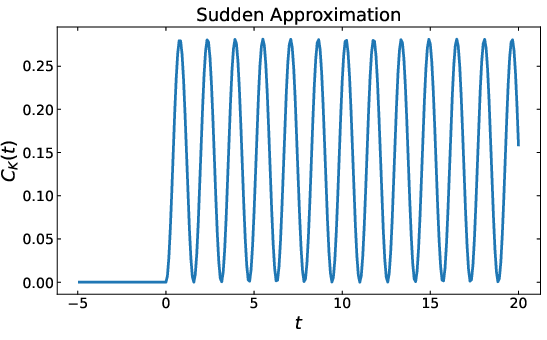
Figure 2: Krylov complexity for an almost sudden quench with parameters H(t+T)=H(t)2, H(t+T)=H(t)3, H(t+T)=H(t)4.
Soft Quench and Adiabatic Limit
For a smooth finite-time quench, the piecewise Magnus algorithm is applied. Krylov complexity is numerically computed across various ramp regimes:
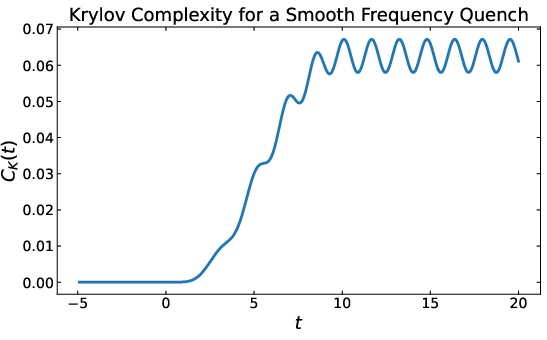
Figure 3: Krylov complexity for a soft quench with parameters H(t+T)=H(t)5, H(t+T)=H(t)6, and H(t+T)=H(t)7.
In the slow ramp (adiabatic) limit, complexity approaches a constant value, demonstrating minimal nonadiabatic excitation:
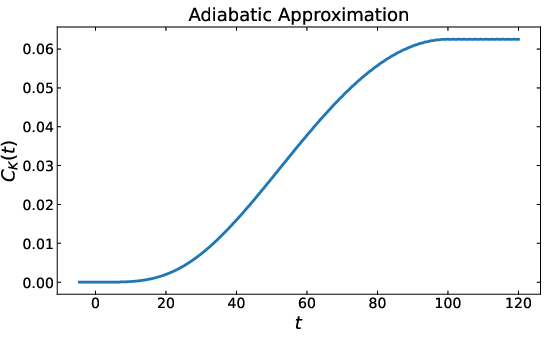
Figure 4: Krylov complexity for a very slow soft quench with parameters H(t+T)=H(t)8, H(t+T)=H(t)9, and HF0.
These results confirm the validity and flexibility of the piecewise Magnus expansion as an analytic and numerical framework.
Numerical Results and Strong Claims
The paper features robust quantitative evaluation of Magnus truncation errors, demonstrating exponential decay within convergence bounds and rapid divergence outside. The piecewise Magnus method exhibits precise agreement with analytic results (in the sudden quench limit) and physical expectations (in adiabatic ramps), substantiating its reliability for a wide class of non-periodic, time-dependent Hamiltonians.
Theoretical Implications and Relations to Prior Work
The piece contextualizes its contributions within recent advances on Krylov complexity in time-dependent settings:
- Floquet Krylov Space Universality: Mapping stroboscopic Floquet evolution to non-interacting one-dimensional models, suggesting universal features independent of spatial dimension or Hilbert space [Yeh:2023fek].
- Arnoldi and Lanczos Chains: Operator dynamics mapped onto chain models with varying hopping structure [Yates2021StrongModesKrylov, Nizami2023KrylovFloquet].
- Extended Hilbert Space Approaches: Auxiliary time parameters allow Krylov construction for time-dependent generators [Takahashi:2024hex].
- Diabatic Magnus Expansion: Universal growth and scaling (Kibble–Zurek) in complexity when crossing quantum phase transitions [Grabarits2025].
The paper’s Magnus-based tools, especially the piecewise protocol, complement these frameworks and suggest further generalizations such as operator complexity and parameter-dependent generators.
Practical Implications and Future Directions
From a computational and practical standpoint, the methods demonstrate strong applicability for:
- Modeling complexity growth in Floquet-engineered quantum platforms.
- Assessing adiabaticity and nonadiabatic excitation across ramps.
- Characterizing complexity dynamics in quantum information tasks involving time-dependent control.
Potential future work includes extension to operator complexity, non-quadratic many-body Hamiltonians, and exploring generalized Krylov complexity [FarajiAstaneh:2025thi] where generator dependencies transcend pure time evolution.
Conclusion
The manuscript provides a rigorous analytic framework and practical algorithm suite for computing Krylov complexity in quantum systems subject to general time-dependent Hamiltonians. By integrating Floquet theory, Magnus and Floquet–Magnus expansions, and a piecewise approximation technique, it delivers controlled quantitative results across both periodic and non-periodic regimes—including detailed error bounds and explicit computation for prototypical cases. The theoretical and numerical results position the piecewise Magnus approach as a robust tool for future studies on quantum complexity in dynamically driven systems.

