- The paper establishes that thermal damping of quantum oscillations in flat bands is governed by quantum geometry rather than by band dispersion.
- It uses a minimal two-band model to analytically derive the Landau level spectrum and reveal a field-dependent effective mass linked to the quantum metric.
- Numerical simulations confirm that the enhanced, field-dependent effective mass is a direct signature of nontrivial quantum geometric effects in topological bands.
Lifshitz–Kosevich Analysis of Anomalous Landau Levels and Quantum Oscillation Damping in Topological Flat Bands
Introduction and Problem Overview
Quantum oscillations in metals, typically described by the Lifshitz–Kosevich (LK) formalism, reflect oscillatory magneto-thermodynamic responses sourced from Landau quantization of cyclotron orbits near the Fermi surface. In dispersive bands, thermal damping of these oscillations is governed by the band mass at the Fermi energy. For a perfectly flat band, however, vanishing group velocity would naively yield an infinite cyclotron mass, leading to the LK prediction of complete thermal suppression of quantum oscillations. Recent experimental advances with moiré materials and topological flat bands challenge this expectation, as these bands can support anomalous Landau level (LL) manifolds with finite-field energy spacing generated by quantum geometry rather than by single-particle dispersion.
This work rigorously develops an LK description of quantum oscillations for such anomalous LLs in topological flat bands, focusing on implications of quantum geometry in the thermal damping process. The paper employs a minimal two-band model that supports a perfectly flat Chern band (Chern number ±1) with nontrivial quantum metric structure, analytically derives the LL spectrum in the presence of a perpendicular magnetic field, and investigates the resultant thermodynamic quantum oscillations for both normal (dispersive) and anomalous (flat-band) LLs.
Model Construction and Quantum Geometry
The minimal Hamiltonian features coupled flat and dispersive fermion components. Tuning the parameters such that the band separation matches the hybridization energy enforces perfect flatness of the lower band. The wavefunctions of this flat band exhibit nontrivial quantum geometric tensor and Berry curvature distributions, quantifiable via the quantum metric's trace and related to the square of the hybridization strength divided by the gap squared:
trgα(k)=(ak2+c2/a)22c2
for band curvature a, hybridization c, and relative momentum k.
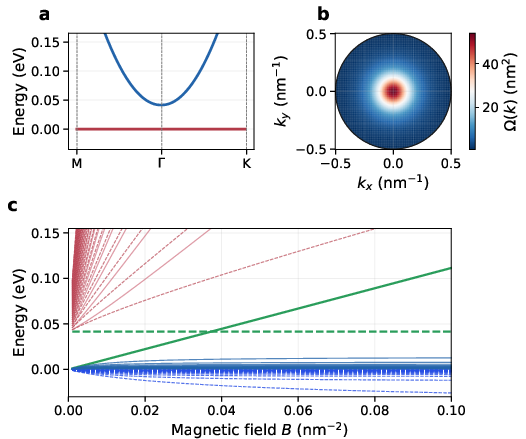
Figure 1: (a) Ideal flat band (red) and dispersive band (blue) along M–Γ–K. (b) Spin-up flat-band Berry curvature; (c) LL spectrum—normal, anomalous, and zeroth LLs by color—with a=1.115 eV⋅nm2, c=0.215 eV⋅nm, trgα(k)=(ak2+c2/a)22c20.
In the presence of a perpendicular field, ladder operators enable an analytic solution of the LL spectrum for both spin sectors. The spectrum reveals (i) dispersive branches with near-standard LL structure and (ii) anomalous LL branches sourced from the perfectly flat band, which at finite field spread across a finite energy window due to quantum geometry effects. Berry curvature is localized in momentum space and yields a quantized Chern index for each spin sector.
Lifshitz–Kosevich Theory for Anomalous Landau Levels
The authors generalize the LK formalism for systems where the LL gaps do not originate from dispersion but from quantum geometry. They derive that the thermal damping factor trgα(k)=(ak2+c2/a)22c21 for the trgα(k)=(ak2+c2/a)22c22th harmonic, instead of being governed by a cyclotron energy determined by curvature, is controlled by the local LL spacing at the Fermi level:
trgα(k)=(ak2+c2/a)22c23
where trgα(k)=(ak2+c2/a)22c24 is evaluated at the Fermi energy for LL branch trgα(k)=(ak2+c2/a)22c25. This key replacement forms the backbone for extracting quantum geometric information from oscillation phenomena.
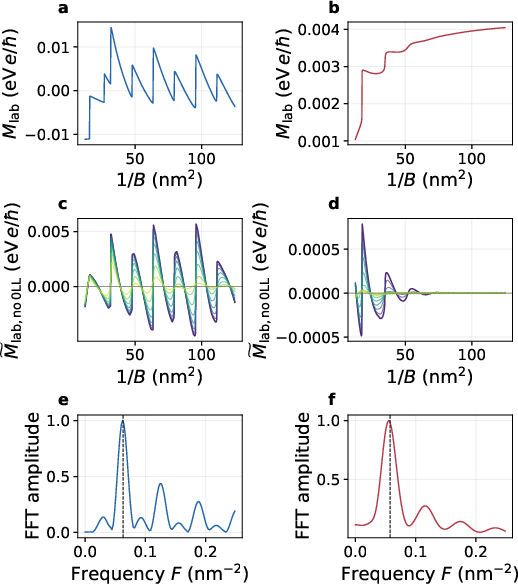
Figure 2: Fixed-density magnetization oscillations: (a) Normal LL (electron regime), (b) Anomalous LL (flat-band/hole regime), (c,d) Oscillatory magnetization after background subtraction, (e,f) Corresponding FFT spectra confirming trgα(k)=(ak2+c2/a)22c26.
Numerical simulations of the background-subtracted magnetization, at fixed carrier density and variable temperature, reveal robust, strongly damped oscillations for anomalous LLs, while normal LLs display much slower damping. The oscillation frequency remains dictated solely by LL degeneracy, highlighting its independence from the band dispersion—a point validated by Fourier analysis.
Field and Quantum-Geometry Dependence of Effective Mass
The quadratic trgα(k)=(ak2+c2/a)22c27-dependence of LL splitting for anomalous branches imparts a distinctive, monotonic increase of the extracted LK "effective mass" trgα(k)=(ak2+c2/a)22c28 with decreasing magnetic field, in stark contrast to the field-independent normal-band effective mass. Critically, the effective mass for anomalous LLs is determined by the quantum metric and field strength:
trgα(k)=(ak2+c2/a)22c29
where a0 is the quantum metric's trace at the semiclassical a1 corresponding to the Fermi density.
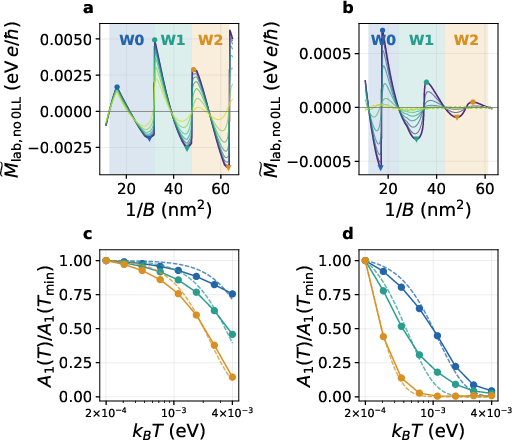
Figure 3: Local window analysis for thermal damping: (a) Magnetization oscillations for normal LLs, (b) For anomalous LLs, (c,d) Normalized a2 harmonic amplitudes, colored by magnetic field window, compared with LK fits.
The study finds effective masses in the anomalous LL regime to be an order of magnitude larger than normal LLs and strongly dependent on a3. The data across several field windows and densities verify this monotonic scaling and the link to quantum geometry.
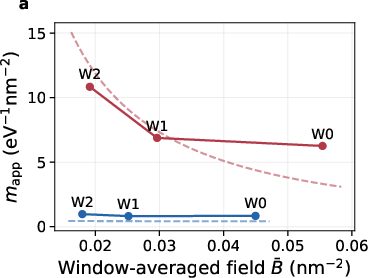
Figure 4: Apparent effective mass extracted from thermal damping versus window-averaged magnetic field: blue for normal LLs, red for anomalous LLs; dashed curves show analytical trends.
Experimental and Theoretical Implications
Mechanistic Insights
- Persistence of Quantum Oscillations: Quantum oscillations persist for topological flat bands within the LK framework owing to the quantum-geometric origin of LL spacing, not band curvature.
- Thermal Damping as Quantum Metric Probe: The anomalous LL quantum oscillation thermal damping encodes direct information about the flat band's quantum metric. Thus, fits to the temperature dependence of oscillation amplitudes yield the local quantum metric magnitude.
- Distinguishability: The field-dependent, enhanced effective mass acts as a qualitative and quantitative signature distinguishing flat-band oscillations from their dispersive counterparts.
Experimental Relevance and Future Directions
Recent moiré superlattice devices and tunable topological flat bands observed in twisted bilayer graphene, MoTea4, and related systems present ideal platforms for these predictions. Thermal broadening measurements of magnetization quantum oscillations in such systems can, in principle, extract the quantum metric, providing a route to probe quantum geometry in a bulk experiment. This capability is likely to enable direct experimental mapping of band quantum metric and Berry curvature distributions, impacting the study of flat-band correlated states, fractional Chern insulators, and quantum Hall ferromagnetism.
From a theoretical perspective, the connection between quantum geometry and thermodynamic measurements demonstrates that, even in the absence of dispersion, quantum geometry serves as the dominant energy scale for field-induced thermodynamics, suggesting avenues for future exploration in flat-band superconductivity and quantum Hall-like phenomena without traditional Fermi surfaces.
Conclusion
This work advances the theoretical understanding of quantum oscillations in topological flat bands by constructing a precise LK formalism for anomalous LLs, validating that quantum oscillation thermal damping reflects quantum geometric information rather than band dispersion. The extracted effective mass scaling provides an experimental observable for the quantum metric, establishing a paradigmatic link between band geometry and quantum magneto-thermodynamics in flat-band materials. This approach paves the way for thermodynamic probes of quantum geometry in moiré and topological band systems, with potential to impact both fundamental and applied condensed matter research.
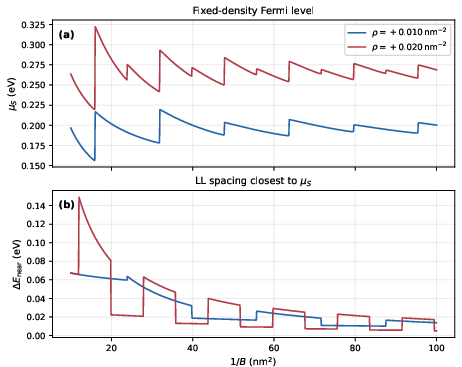
Figure 5: Comparison of windowed chemical potentials and near-Fermi LL splittings for two electron densities, revealing the proximity to spin-split or spin-degenerate LL regimes.