- The paper demonstrates that quantum Sondheimer oscillations directly map Landau level energies, offering a robust tool for probing band topology.
- It employs a minimal model of 2D layers with interlayer tunneling to detail how boundary effects and damping factors influence oscillatory conductivity.
- The study differentiates quantum SO from SdH and classical oscillations, outlining experimental strategies for accurate topological measurements.
Quantum Sondheimer Oscillations as a Direct Probe of Band Topology in Thin Films
Introduction and Theoretical Framework
This work presents a comprehensive quantum theory of Sondheimer oscillations (SO) in thin films under strong transverse magnetic fields, situating these oscillations as a direct and robust probe of band topology and Landau level (LL) spectra. Unlike the canonical Shubnikov–de Haas (SdH) effect—where topological information emerges only as a phase shift in $1/B$-periodic oscillations—the quantum SO regime reveals that topological corrections fundamentally alter the SO frequency itself. This provides unique experimental advantages, notably immunity to the ambiguities associated with phase determination and dephasing effects inherent to SdH measurements.
The analysis is developed using a general model for a stack of L two-dimensional (2D) layers coupled by interlayer tunneling t, each described by a quasi-2D electronic Hamiltonian Hlayer. Focusing on a minimal model parameterized by λ, the authors interpolate between trivial and nontrivial quadratic band touchings—a scenario realized in AB-stacked bilayer graphene and topologically trivial semiconductors—capturing a tunable Berry phase and distinct Landau level structures.
Quantum Theory of Sondheimer Oscillations
The central result is a fully quantum mechanical calculation of the oscillatory conductivity kernel σ~xx in the slab geometry, accounting for the quantization of transverse momentum and the formation of discrete subbands for each LL index n. Through Poisson resummation techniques, the quantum analogue of Sondheimer oscillations is extracted—not via classical commensurability conditions but from the quantum energy spectrum En,k=En−tcos(πk/L), where k labels the quantized momenta along the confined direction. Explicitly, the oscillatory part of the conductivity is shown to be governed by
σ~xx(μ)=−πlB2e2(πtL)2aL1n∑2Im(ei2πkn⋆Kn),
with the L0 determined by the spectrum L1; thus, the oscillation frequencies reflect the underlying LL energies.
Topological Fingerprints in Quantum SO
A striking discovery is that SO frequencies reveal the full Landau spectrum, imprinting topological properties as distinct, field-dependent frequencies. For topologically trivial bands (L2), the fundamental quantum SO frequency is L3, whereas for nontrivial bands (L4), it is L5, with additional peaks at L6. This direct mapping between the quantum SO frequency spectrum and LL energies constitutes the core of the work’s claim that quantum SO serve as a spectroscopic tool for band topology.
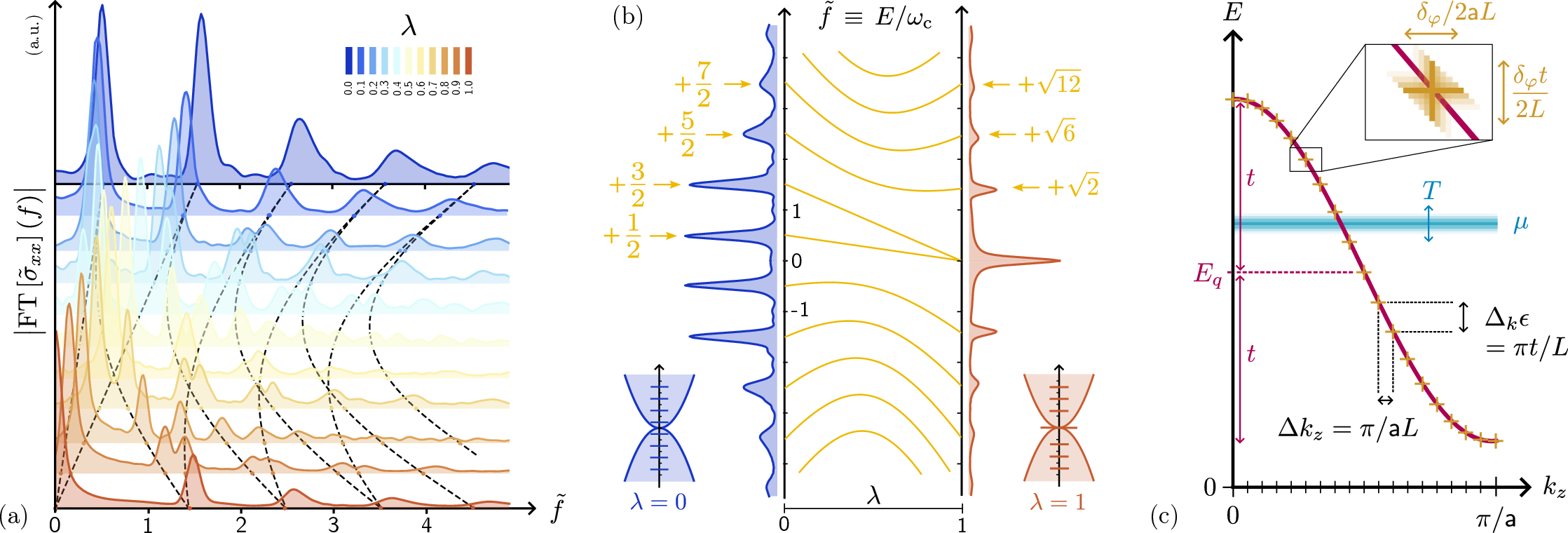
Figure 1: Fourier spectrum of quantum SO at L7 for different L8, showing clear one-to-one correspondence between LL energies (black dashed) and SO peaks for each topological configuration.
This figure visibly demonstrates that the quantum SO frequencies (peaks in the Fourier amplitude) shift and multiply as the topological parameter L9 is tuned, allowing extraction of the complete LL spectrum through transport measurements.
Damping Mechanisms and Surface Effects
Analytical and numerical investigations reveal the dependence of SO amplitude on disorder (Dingle factor), temperature (Lifshitz-Kosevich-like damping), and surface roughness (manifesting as additional exponential damping). Notably, unlike SdH oscillations, the thermal and disorder-induced damping of SO depend on slab-specific quantities (t0) rather than LL separation (t1), reflecting the geometric origin of quantization in the finite slab. Surface roughness enters via randomization of the boundary scattering phase, leading to an extra broadening factor absent in the specular limit.
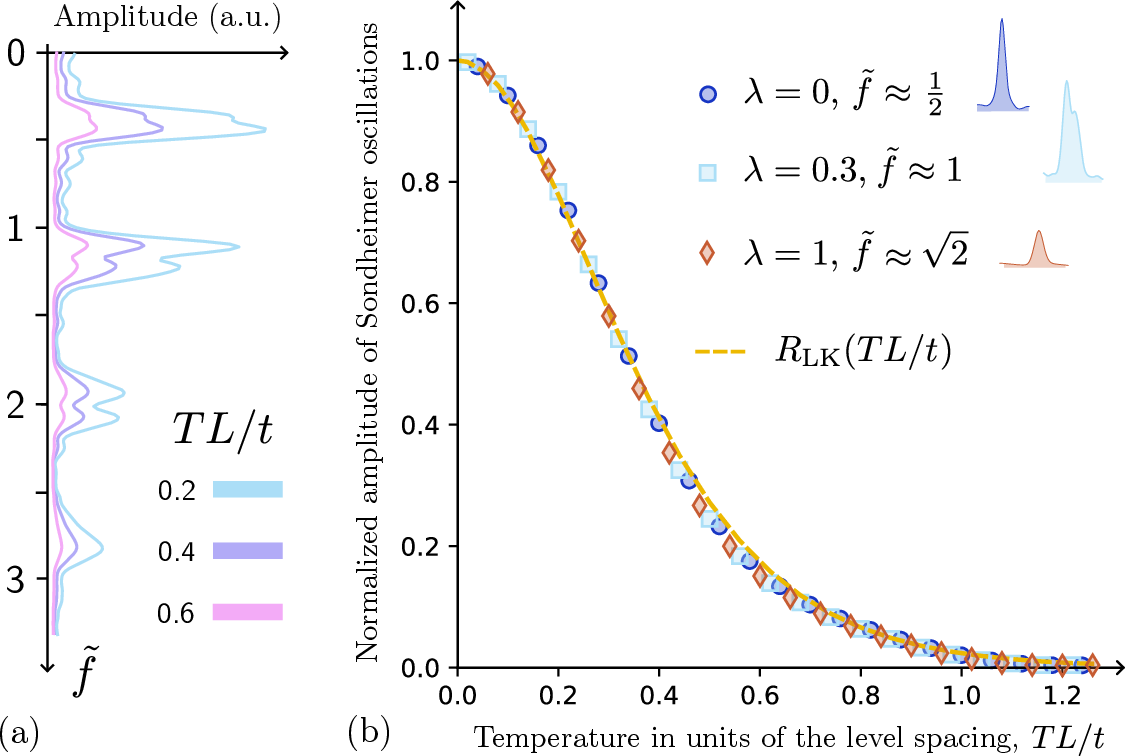
Figure 2: Fourier spectrum of quantum SO at t2 for varying temperatures t3, illustrating the predicted universal thermal damping dependence of SO amplitude.
Experimental Implications and Comparison With Other Oscillatory Phenomena
The theory is immediately relevant for recent high-field measurements in graphite thin films, where quantum SO with only two LLs have been observed. The authors argue that such observations are not classical size effects but genuine quantum SO, showing the correct field dependence and frequency signatures predicted by the quantum theory. A key experimental hallmark is that, in the quantum regime, multiple SO frequencies corresponding to individual LLs may be visible—distinct from the single-frequency signature of classical SO or the t4-periodicity of SdH oscillations.
Practical distinctions between classical SO, SdH, and quantum SO are further highlighted:
- Classical SO: Single-frequency, semiclassical commensurability, suppressed by specular boundary conditions, occurs at low t5.
- SdH: t6-periodic, phase encodes topology, multiple frequencies for multiband systems, robust to boundary.
- Quantum SO: Multiple t7-periodic frequencies directly map to LL energies—allowing direct experimental access to topological band structure, prominent at high fields, and sensitive to surface roughness.
Theoretical and Practical Consequences, and Future Directions
Quantum SO open a new avenue for the identification and measurement of band topology in mesoscale devices using transport, as they circumvent the phase ambiguities and limit-extrapolation issues of conventional magneto-oscillations. Their sensitivity to both the Landau spectrum and boundary roughness, combined with the ability to operate in the quantum limit (few LL regime), positions them as a unique tool for interrogating 2D/topological materials—including semiconducting heterostructures and transition metal dichalcogenides with strong spin-orbit coupling.
On the theoretical side, several open questions emerge:
- The crossover from quantum to classical SO as t8 increases.
- The interplay of surface disorder and quantum coherence, requiring unbiased lattice numerics.
- Generalizations to thin films of 3D topological materials (e.g., Weyl semimetals).
- Prospects for observing SO-like quantum oscillations in Fermi-surface-free or fractionalized systems, given the decoupling from Fermi-surface quantization.
Conclusion
This work establishes quantum Sondheimer oscillations as a direct, quantitative probe of Landau quantization and band topology in thin films under strong magnetic fields. The frequency content of quantum SO spectra encodes the full underlying LL structure, enabling experimental access to topological information in a manner not susceptible to the limitations inherent in conventional SdH analysis. The theoretical framework, broadly applicable to layered materials, motivates both refined experimental investigations and theoretical analyses of topological quantum oscillations and their damping mechanisms in mesoscale and quantum-coherent devices.