From local weight selection to Zeno slowdown in an open Su-Schrieffer-Heeger chain with a single local loss
Published 11 Jul 2026 in quant-ph | (2607.10218v1)
Abstract: We study a quadratic open SSH chain with a single-site loss and show that the many-body fermionic Lindblad problem admits an exact reduction to a finite non-Hermitian one-body matrix with a rank-one imaginary impurity. Its rapidities generate the complete Liouvillian spectrum and reveal three mechanisms governing the slowest relaxation. At weak loss, decay is selected by the clean local spectral weight at the lossy site, yielding the generic law Δ<em>L∼γN<sup>−3 and, in the topological regime, exponentially smaller edge-controlled gaps. At intermediate loss, a centered bulk-loss geometry reaches an exact exceptional point on the real-γ axis. Symmetry-related rapidity pairs coalesce simultaneously, including the pair at the lower rapidity edge. Exact real-space dynamics at this lower-edge exceptional point exhibits a polynomially enhanced exponential tail, whereas a matched high-energy control with the same parity-even one-body decay edge but no lower-edge defectiveness remains nearly exponential. At strong loss, one ultrafast defect mode separates from an active slow sector governed by a cut-chain Zeno problem, giving Δ</em>L∼γ<sup>−1 up to a geometry-dependent prefactor. The full finite fermionic Liouvillian spectrum, including its operator-parity sectors and subset-sum structure, is statistics-specific. By contrast, the elementary one-body decay spectrum and the three associated mechanisms are governed by a finite-dimensional linear drift matrix, so their spectral and dynamical signatures can also be accessed in bosonic and classical-wave platforms engineered to realize the same effective matrix. These results establish how topology, defect geometry, and local dissipation jointly organize long-time relaxation in an open dimerized lattice.
The paper presents an analytic reduction of the Liouvillian gap dynamics in an open SSH chain subject to a single-site loss.
It identifies three distinct regimes—weak-loss selection, exceptional point reorganization, and Zeno-projected relaxation—with specific scaling laws.
The findings offer actionable insights for experimental platforms such as ultracold atoms, superconducting circuits, and photonic arrays.
Exact Liouvillian Gap Dynamics and Regime Transitions in the Open SSH Chain with a Local Loss
Introduction and Model Structure
The work rigorously investigates the relaxation dynamics of an open Su-Schrieffer-Heeger (SSH) chain subject to a single-site bulk loss, focusing on the finite-size, non-interacting fermionic Lindblad problem (2607.10218). By leveraging third quantization, the many-body Lindbladian dynamics are reduced to a finite-dimensional one-body non-Hermitian spectral problem with a rank-one imaginary impurity. This spectral reduction enables exact analytics and numerics for the full Liouvillian spectrum and, crucially, allows for direct tracking of the lowest nonzero decay rate—the Liouvillian gap—across all physical loss regimes.
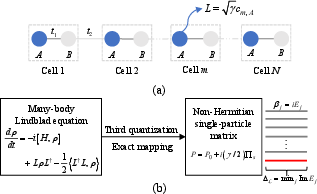
The system comprises N SSH unit cells with alternating intracell (t1) and intercell (t2) hoppings, under open boundary conditions. Dissipation enters via a single local jump operator L=γcm,A at bulk A site m (with physical loss rate γ), mapping the many-body Lindblad master equation to a complex symmetric one-body problem for the rapidity matrix P=h+i(γ/2)Πs.
The central technical advance is an analytic reduction: the Liouvillian spectrum is generated as fermionic subset sums over the eigenvalues (rapidities) of P and its chiral symmetric counterpart (Figure 1).
Figure 1: Two-panel summary of the quantum simulation architecture (a dimerized SSH chain with dissipation) and the exact spectral reduction to non-Hermitian rapidity blocks.
Spectral Regimes and Analytical Results
Weak-Loss Regime: Local Weight Selection and Size Scaling
For small γ, the system's relaxation is dictated by the coupling of clean system eigenmodes to the lossy site. The shift in rapidity is linear in γ and determined by the local spectral weight at the defect site:
t10
where t11 is the eigenmode weight at the dissipative site. In the trivial phase, the Liouvillian gap scales as t12. In the topological regime, with a boundary-localized loss, the gap is exponentially small, controlled by the exponentially weak overlap of the edge mode with the lossy site.
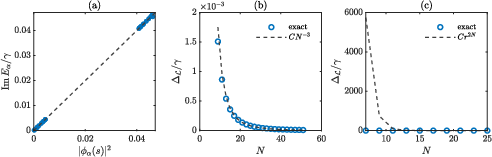
Figure 2: Weak-loss regime diagnostics showing local spectral weight control of decay (a), t13 scaling for bulk losses (b), and exponential scaling for topological edge-mode protection (c).
These results explicitly demonstrate that bulk dynamics, symmetry, and topology control the selection of decay channels and parametric sensitivity of system relaxation.
Intermediate-Loss Regime: Exceptional Points, Defectiveness, and Dynamical Signatures
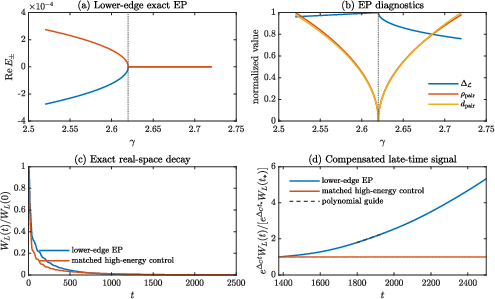
For intermediate values of t14, perturbation theory fails, and rapidity "reorganizations" occur. For balanced, centered-loss geometry, the system reaches an exact second-order exceptional point (EP) on the real-t15 axis, where symmetry-related rapidity pairs (including the lower-edge gap-defining pair) coalesce, and the rapidity matrix becomes defective. This spectral singularity is analytically tied to the local Green function and is only realized if local spectral weights are exactly balanced.
Figure 3: Intermediate-loss regime (a-b) reveals an exact lower-edge EP via vanishing pairwise phase rigidity and spectral distance, and (c-d) demonstrates the pronounced slow dynamical tail and polynomially enhanced prefactor for window occupations when the EP controls the decay edge.
Crucially, time-domain dynamics at the EP exhibit a non-trivial polynomially enhanced late-time tail—a signature of Liouvillian defectiveness not present for similarly slow (but non-defective) high-energy control pairs. The late-time occupation in observables carries an algebraic prefactor rather than a simple exponential decay, aligning with the underlying Jordan block structure.
Strong-Loss (Zeno) Regime: Subspace Projection and Gap Inversion
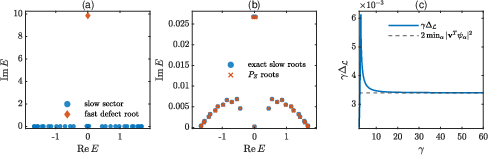
For t16, the system enters a dissipative quantum Zeno regime. One isolated rapidity branch becomes ultrafast (decaying at rate t17), associated with strong localization on the lossy site. The remainder of the spectrum is dominated by slow modes supported on the two disconnected segments of the chain: the dissipative site acts as a cut, and slow relaxation arises from virtual processes suppressed as t18, where t19 characterizes intersite hopping.
Figure 4: Strong-loss (Zeno) regime. Panel (a) shows clear separation of the ultrafast defect root; (b) confirms the slow sector matches the effective cut-chain Zeno matrix; (c) demonstrates the predicted t20 scaling for the Liouvillian gap.
The slow Liouvillian gap thus scales as t21 with a geometry- and boundary condition-dependent prefactor. This regime realizes dissipative Zeno physics: the monitored site is adiabatically eliminated, but the chain is not globally frozen.
Disorder Robustness
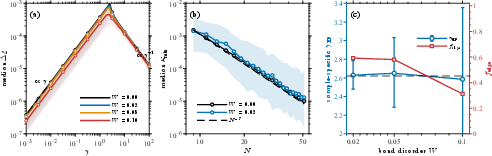
A disorder analysis (Appendix and Figure 5) reveals that:
The weak-loss t22 and strong-loss t23 scalings are robust under moderate chiral-symmetry-preserving bond disorder.
The placement and lower-edge dominance of intermediate-regime EPs become sample- and geometry-dependent; while EPs persist, their control of the minimal gap is not universal.
Figure 5: Robustness against bond disorder—t24 and t25 scaling persist, while EP positions broaden and lower-edge dominance declines with stronger disorder.
Implications and Generalizations
The paper's results precisely separate which spectral and dynamical mechanisms are universal to non-interacting Lindblad problems and linear non-Hermitian matrices, and which are strictly fermionic. The rapidity reduction and all three spectral regimes (weak-loss selection, EP reorganization, Zeno projection) are governed by the one-body drift matrix and appear in both fermionic, bosonic, and classical-wave settings with identical local dissipation topology. However, full Liouvillian subset-sum structure and operator-parity sectorization are strictly fermionic phenomena.
These results have direct implications for experimental quantum simulation platforms, ranging from ultracold atoms to superconducting and photonic arrays, as well as for classical wave networks realizing effective non-Hermitian Hamiltonians.
Conclusion
This work provides a comprehensive analytic framework for the structure, organization, and robustness of the Liouvillian gap and slow relaxation in open SSH chains with local dissipation. By exact reduction to a single-particle non-Hermitian impurity problem, it elucidates three spectral regimes—local-weight selection, exceptional-point reorganization, and Zeno-projected relaxation—each with distinct scaling laws, spectral/dynamical fingerprints, and disorder sensitivity. These theoretical findings serve as a benchmark for experimental probes of open-system topology, non-Hermitian spectral transitions, and dissipative quantum Zeno phenomena.
“Emergent Mind helps me see which AI papers have caught fire online.”
Philip
Creator, AI Explained on YouTube
Sign up for free to explore the frontiers of research
Discover trending papers, chat with arXiv, and track the latest research shaping the future of science and technology.Discover trending papers, chat with arXiv, and more.