Exact spectrum and anomalous relaxation in the open disorder-free Sachdev-Ye-Kitaev system
Published 6 Jun 2026 in cond-mat.str-el, cond-mat.stat-mech, hep-th, and quant-ph | (2606.08079v1)
Abstract: We study a disorder-free variant of the Sachdev-Ye-Kitaev (SYK) model with dissipation within the Gorini-Kossakowski-Sudarshan-Lindblad formalism. By utilizing the integrability of the clean SYK model, we derive an exact solution in a spectrum-resolved form, i.e., the eigenvalues and corresponding projection superoperators of the Liouvillian for arbitrary system size N. We determine the scaling of the gap that governs the long-time decay of the two-point correlation functions. Importantly, the gap does not vanish in the dissipationless limit when the thermodynamic limit is taken first, despite the integrability of the model. This phenomenon, known as anomalous relaxation, suggests a possible connection with chaotic dynamics and quantum Ruelle-Pollicott resonances. We also find several spectral features, such as transitions in the Liouvillian spectrum from complex to real eigenvalues with increasing dissipation strength, as well as the convergence of the dissipative form factor to the spectral form factor in the dissipationless limit. These findings indicate that the present model offers a useful platform for exploring nontrivial open dynamics of many-body quantum systems.
The paper establishes that the open, disorder-free SYK model exhibits finite Liouvillian gaps reflecting anomalous relaxation.
It employs an analytic solution of the GKSL master equation, leveraging integrability and operator growth in a clean four-body Majorana Hamiltonian.
The study reveals that noncommutative thermodynamic and dissipationless limits yield robust relaxation dynamics even in integrable systems.
Exact Spectrum and Anomalous Relaxation in the Open Disorder-Free SYK Model
The paper "Exact spectrum and anomalous relaxation in the open disorder-free Sachdev-Ye-Kitaev system" (2606.08079) investigates the interplay between integrability, dissipation, and operator relaxation in a non-random variant of the SYK model, employing analytic methods that yield a complete spectral resolution of the associated Gorini-Kossakowski-Sudarshan-Lindblad (GKSL) quantum master equation. This study elucidates the profound emergence of anomalous relaxation—characterized by a nonvanishing Liouvillian gap in the thermodynamic, dissipationless limit—within an integrable, disorder-free context, extending the paradigm of quantum chaotic relaxation into new theoretical territory.
Model and Analytic Solution Construction
The considered Hamiltonian is the clean (uniform coupling) SYK model with four-body Majorana terms:
H4=−1≤i<j<k<l≤N∑γiγjγkγl
with Hermitian Majorana fermions {γi,γj}=2δij. This system is integrable for arbitrary N and does not, in the closed limit, exhibit conventional quantum chaos. The dissipative dynamics are governed by a GKSL equation with jump operators Lj=Γγj:
ρ˙=L[ρ]=−[H4,ρ]+j=1∑N(LjρLj†−21{Lj†Lj,ρ})
The analytic solution exploits the integrability and symmetry structure of the model. By mapping the problem to a basis of complex fermions diagonalizing the two-body Hamiltonian H2, and leveraging commutation properties and superoperator structure, the authors explicitly derive the full Liouvillian spectrum and provide explicit forms for the projection superoperators. This yields spectral decompositions valid for arbitrary system size N, explicitly tracking the evolution of density operators.
Liouvillian Spectrum Structure and Exceptional Points
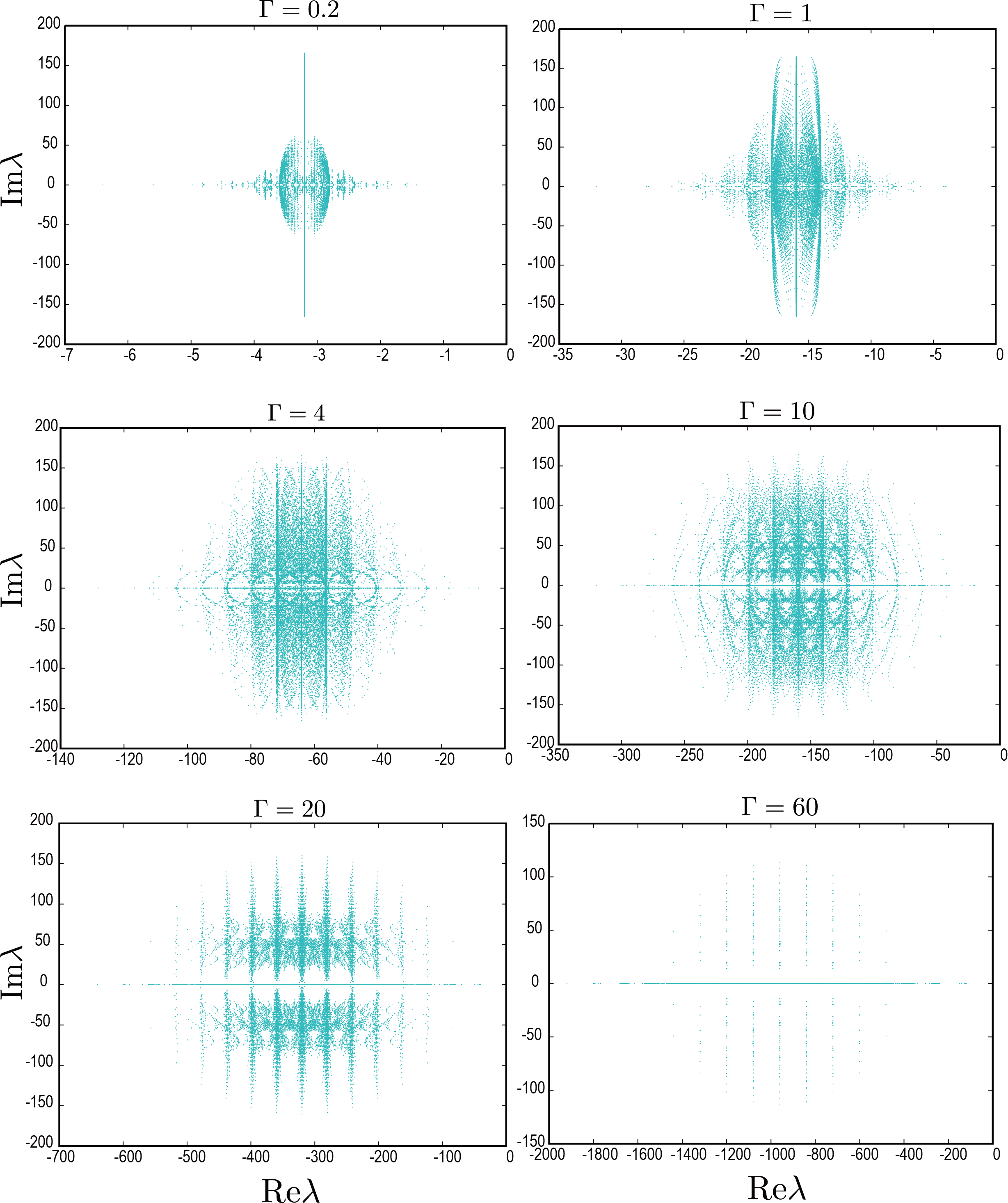
A striking feature of the spectrum is the transition from complex to real eigenvalues as Γ increases, signaling the appearance of non-Hermitian "exceptional points" in parameter space—a hallmark of many dissipative or open quantum systems.
Figure 1: Eigenvalues of the Liouvillian L for N=16 at various {γi,γj}=2δij0; increasing dissipation causes the spectrum to transition from complex (oscillatory) to real (purely relaxational) bands.
At small {γi,γj}=2δij1, the eigenvalues cluster along lines with constant real parts, inherited from the symmetric structure and integrability of {γi,γj}=2δij2. As dissipation is strengthened, the spectrum collapses onto the real axis, and the system's relaxation dynamics shift from underdamped to overdamped. The spectral gap—the real part of the eigenvalue with the smallest magnitude—ultimately dictates the asymptotic decay rate for typical two-point functions.
Dissipative Form Factor and Dynamical Regimes
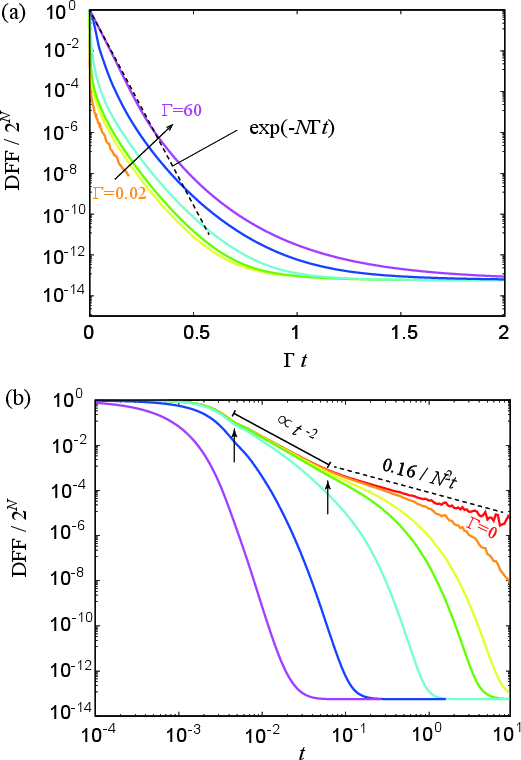
The dissipative form factor (DFF), given by {γi,γj}=2δij3, generalizes the spectral form factor (SFF) of closed models to open quantum dynamics. Calculations up to large {γi,γj}=2δij4 demonstrate regime structure in how the DFF approaches the SFF as {γi,γj}=2δij5, with different scaling behaviors in time manifesting for various {γi,γj}=2δij6 and {γi,γj}=2δij7.
Figure 2: DFF at {γi,γj}=2δij8 for multiple {γi,γj}=2δij9 values, showing (a) exponential decay at large N0, with DFF converging to the SFF at N1 as N2, (b) crossover among constant, N3, and N4 scaling regimes seen in the dissipationless case.
The form factor decays exponentially at early times for strong dissipation, consistent with N5. In contrast, the weak dissipation regime allows the DFF to closely track the SFF at various time scales, with step-wise convergence that depends on both N6 and the underlying operator growth in the system—a feature that is different than in disordered SYK models with dissipation.
Anomalous Relaxation and Liouvillian Gap Scaling
A central result is the analytic demonstration that, when the thermodynamic limit is taken before the dissipationless limit, the Liouvillian gap—determining relaxation rate—remains finite. In contrast, if the order of limits is reversed, the gap closes, consistent with unitary, integrable dynamics. This noncommutativity is captured explicitly:
N7
This anomalous relaxation, usually associated with quantum chaotic models and non-Hermitian Ruelle-Pollicott resonances, is here shown analytically in a nonchaotic, disorder-free, integrable system—revealing that rapid operator growth, not spectral chaos per se, can underpin robust relaxation dynamics.
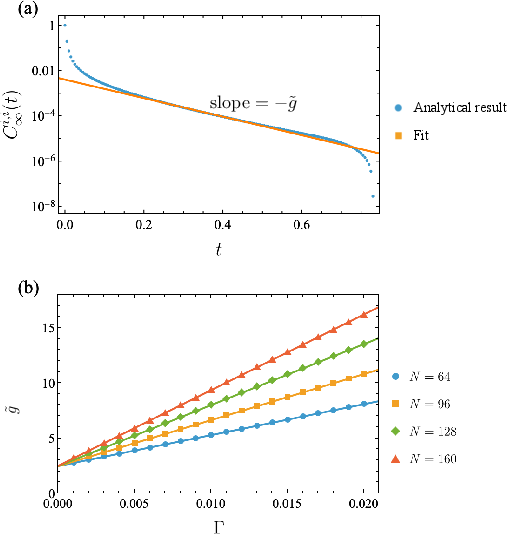
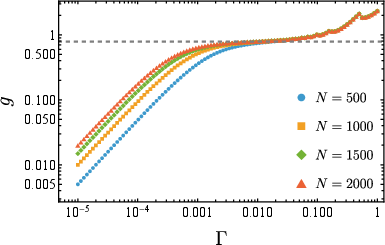
Figure 3: (a) Steady-state autocorrelation for N8 and N9 shows single-exponential decay; (b) Fitted decay rate Lj=Γγj0 as a function of Lj=Γγj1 for various Lj=Γγj2 is consistent with a nonzero lower bound in the thermodynamic limit as Lj=Γγj3.
Figure 4: Analytic computation of the asymptotic decay rate Lj=Γγj4 versus Lj=Γγj5 at Lj=Γγj6, illustrating the approach to the finite gap value.
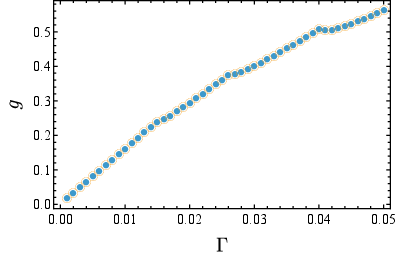
Figure 5: Asymptotic decay rate Lj=Γγj7 versus Lj=Γγj8 for Lj=Γγj9, with the thermodynamic limit yielding ρ˙=L[ρ]=−[H4,ρ]+j=1∑N(LjρLj†−21{Lj†Lj,ρ})0 at ρ˙=L[ρ]=−[H4,ρ]+j=1∑N(LjρLj†−21{Lj†Lj,ρ})1.
Implications and Outlook
This work provides the first full analytic resolution of dissipative dynamics in an integrable, disorder-free SYK model, establishing that the anomalous persistence of relaxation—long linked to quantum chaos—can emerge from the structure and operator growth dynamics of highly symmetric, nonrandom systems. The noncommutativity of limits and the explicit spectral resolution offer a template for understanding open dynamics far beyond random matrix or strongly chaotic models.
Practically, these results suggest new ways to engineer robust relaxation and information scrambling in synthetic quantum matter by tuning dissipation rather than randomness or chaos. The exceptional-point structure, and the closed-form analytic framework developed here, allow systematic exploration of the interplay between integrability, open system effects, and quantum many-body relaxation. Extending these methods to more general classes of nonrandom, interacting systems—including supersymmetric and higher ρ˙=L[ρ]=−[H4,ρ]+j=1∑N(LjρLj†−21{Lj†Lj,ρ})2-body variants—in open environments, is a promising direction for future research.
Conclusion
The analytic solution of the open, clean SYK model's Liouvillian spectrum demonstrates that anomalous relaxation is not exclusive to disordered or chaotic systems but can appear in integrable environments displaying rapid operator growth. These findings deepen the theoretical foundations of open quantum dynamics and illuminate the fundamental mechanisms behind dissipative relaxation in many-body settings. The techniques and structures uncovered in this study provide a foundation for an expanded understanding of nontrivial collective behavior in both theoretical and experimental open quantum systems.
“Emergent Mind helps me see which AI papers have caught fire online.”
Philip
Creator, AI Explained on YouTube
Sign up for free to explore the frontiers of research
Discover trending papers, chat with arXiv, and track the latest research shaping the future of science and technology.Discover trending papers, chat with arXiv, and more.