- The paper demonstrates that TraCE-ST robustly reconstructs causal trajectories for extreme events by combining event-conditioned estimation and ensemble uncertainty quantification.
- It employs Elastic-Net regularized regression and probabilistic sampling to outperform methods like PCMCI and DYNOTEARS in speed, spurious link suppression, and recovery accuracy.
- Applications to Tropical Storm Debby, Mount Pinatubo, and the PNW heatwave illustrate its effectiveness in identifying and quantifying multi-variable, event-specific causal drivers.
Tracing the Space-Time Causal Origins of Earth System Extremes: An Expert Perspective on TraCE-ST
Introduction and Theoretical Context
The identification of causal mechanisms underlying extreme events in complex Earth system dynamics is a foundational challenge for both physical understanding and predictive modeling. Current paradigms in causal discovery—including Granger causality, PCMCI, DYNOTEARS, and Koopman-based models—have extended inference of directed graphical models to high-dimensional multivariate time series, but remain fundamentally limited in undersampled regimes, high-dimensionality, and in capturing event-specific, multi-step causal chains characteristic of geophysical extremes. The "Tracer of Causal Evolutions in Space and Time" (TraCE-ST) framework responds to this gap by providing probabilistic, event-conditioned causal pathway tracing in spatiotemporal gridded multivariate data, moving beyond purely statistical association toward mechanistically interpretable, retrospective process attribution (2607.10033).
Methodological Developments: The TraCE-ST Framework
TraCE-ST operationalizes event-conditioned causal trajectory inference by recursively propagating backwards in time from a target event (the "child") through a series of local, single-lag causal graphs estimated via the M-CaStLe method. At each trajectory step, TraCE-ST selects among clusters of significant causal parents using both deterministic and stochastic sampling proportional to inferred causal strength (e.g., regression coefficients or conditional dependence metrics), as illustrated in an idealized multivariate grid system.
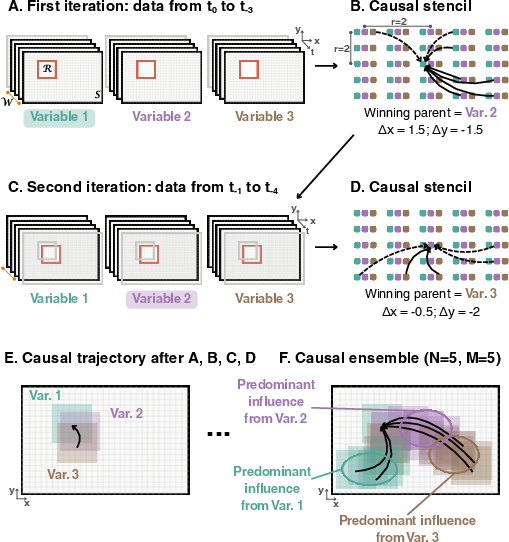
Figure 1: TraCE-ST framework: Local causal estimation and recursive backward propagation in an idealized multivariate gridded system.
Hyperparameters controlling stencil size, region of analysis, clustering, and core causal discovery engine are treated as tunable, with problem-driven selection and extensive sensitivity analysis. This design enables both the recovery of coherent physical propagation pathways and quantification of ensemble-level uncertainty in the relative contributions of competing drivers.
Validation in Controlled Synthetic Systems
TraCE-ST's performance is rigorously tested against synthetic benchmarks designed to reflect common geophysical causal motifs. In a two-variable system—one causally self-propagating, the other merely correlated—TraCE-ST robustly reconstructs prescribed perturbation trajectories, correctly avoiding spurious causal attribution to non-driving variables for appropriate hyperparameter regimes and discovery algorithms.
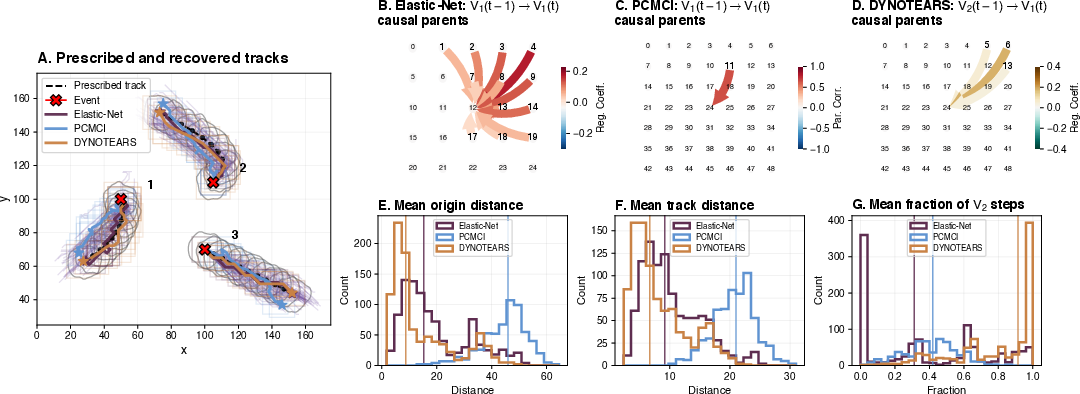
Figure 2: Trajectory reconstruction accuracy in a two-variable synthetic system with spurious correlation.
In a three-variable synthetic system with prescribed mixtures (via a tunable αmix) of independent drivers converging to produce a target, the probabilistic ensemble-wise formulation of TraCE-ST accurately estimates the fractional causal contributions, maintaining near-linear recovery of ground-truth mixing weights across ensemble members.
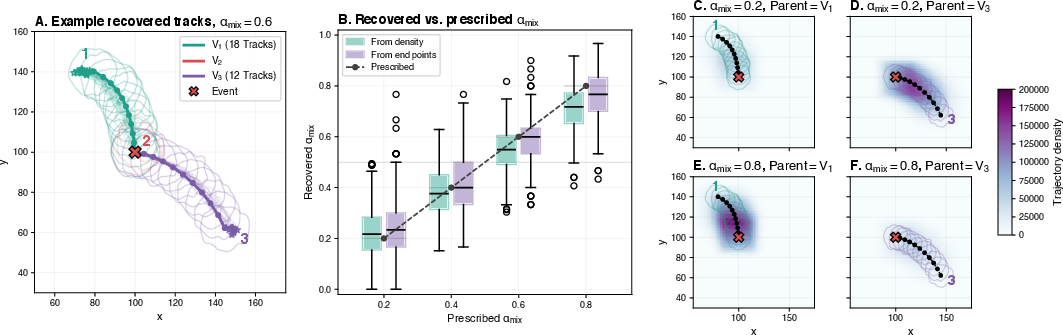
Figure 3: Mixed-driver synthetic: Prescribed versus recovered causal mixtures and spatial dispersion of accepted pathway ensembles.
Algorithmic comparison demonstrates the efficiency and stability of the Elastic-Net regularized regression core, outperforming PCMCI and DYNOTEARS in speed, spurious link suppression, and recovery accuracy in these high-dimensional, limited-sample contexts.
Real-World Applications and Scientific Findings
Tropical Storm Debby (2006)
Applying TraCE-ST to precipitation, brightness temperature, and mid-level vorticity, backward-causal trajectories initialized in Debby's late tropical storm stage map closely onto the observed synoptic track and, further upstream, onto the genesis region over West Africa. Integrated ensemble pathway density uniquely identifies orographically enhanced vorticity genesis over the Hoggar Mountains and dry-wet vortex merger regions, providing formal, quantitative confirmation of previously hypothesized precursors and highlighting less-emphasized orographic contributions.
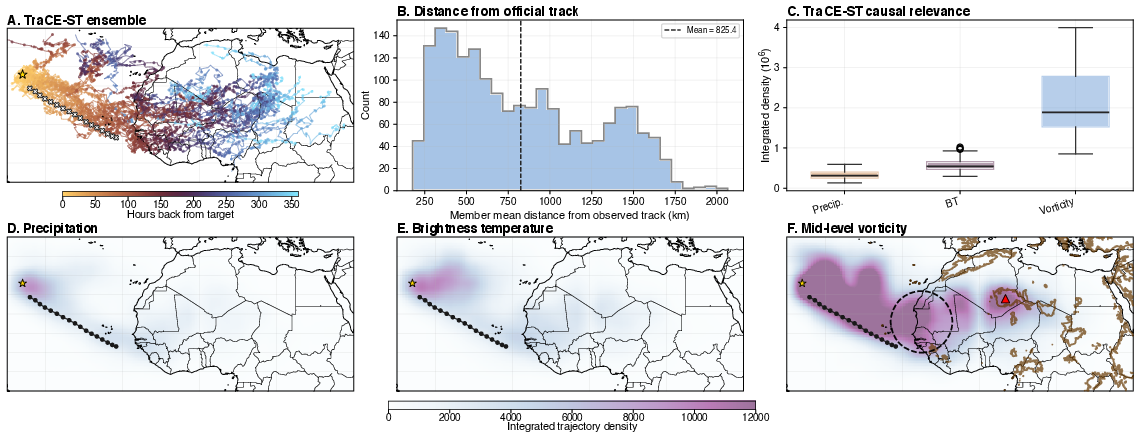
Figure 4: TraCE-ST ensembles reconstructing Debby's track and highlighting causal density over vorticity source regions.
Mount Pinatubo Eruption (1991)
TraCE-ST, using simulated SO2, H2SO4, SO4 burden, and aerosol optical depth fields, recovers the canonical gas-to-aerosol transport pathway with backward ensemble convergence centered on the eruption site. Critically, the frequency quantification across ensemble members correctly prioritizes SO2 burden as the dominant precursor over long time lags and reproduces the expected cross-variable causal ordering despite significant under-resolution of rapid intermediate chemistry (i.e., H2SO4 production), indicating robustness to temporal aggregation in physical processes.
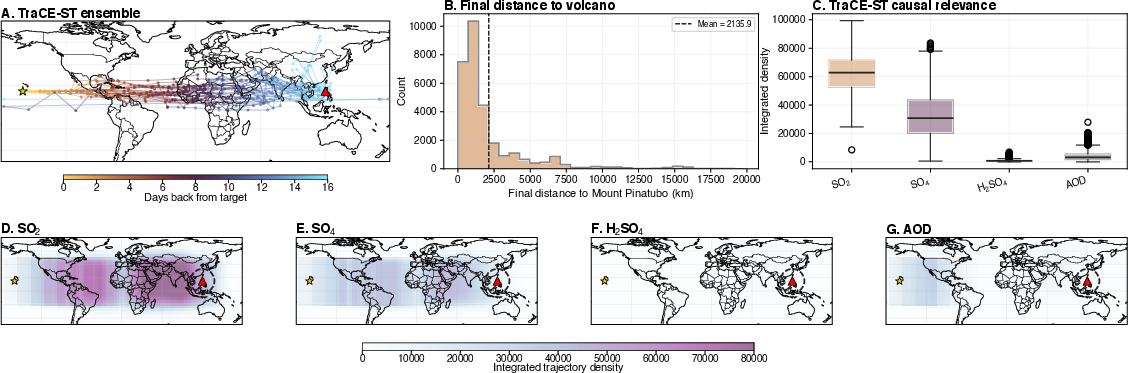
Figure 5: Probabilistic causal trajectory ensembles for the Pinatubo case, with variable-specific density localization and cross-variable attribution.
2021 Pacific Northwest Heatwave
For the PNW 2021 extreme heatwave, TraCE-ST—applied to multiple reanalysis fields (Z500, Z10, OLR, TCWV, LHF, SHF)—yields multivariate, time-stratified causal attributions. Near-event times are dominated by Z500 (ridge amplification) and TCWV (moisture transport), while at longer lags, ensemble densities highlight the roles of diabatic tropical Pacific OLR anomalies and, notably, ocean-atmosphere fluxes over the Gulf of Alaska, reinforcing emerging theoretical emphasis on remote and surface-forced contributions. Notably, inferred stratospheric links (Z10) are weak, providing quantitative, ensemble-based evidence to clarify the mechanistic hierarchy among proposed drivers.
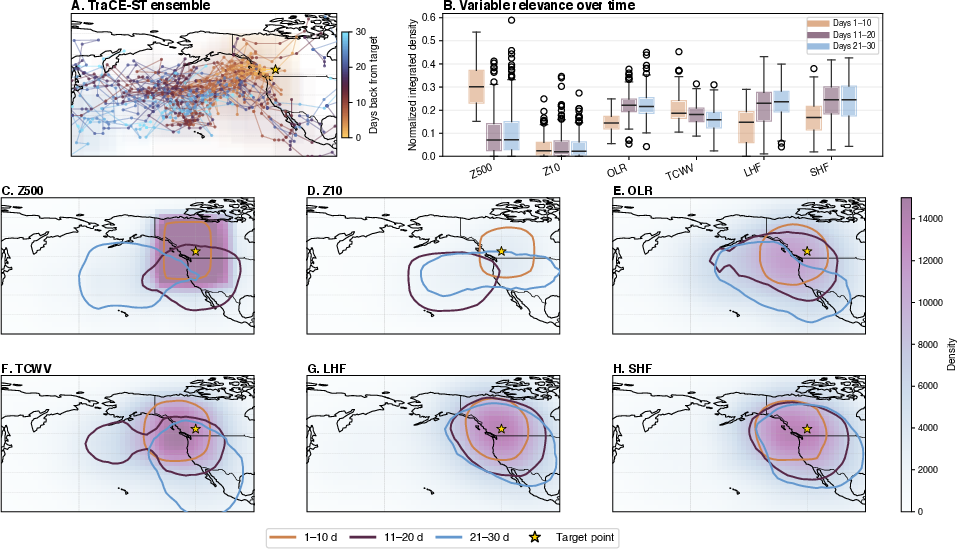
Figure 6: Multi-variable causal densitometry and lead-time stratification for PNW 2021, highlighting evolution and competition among surface and upper-level drivers.
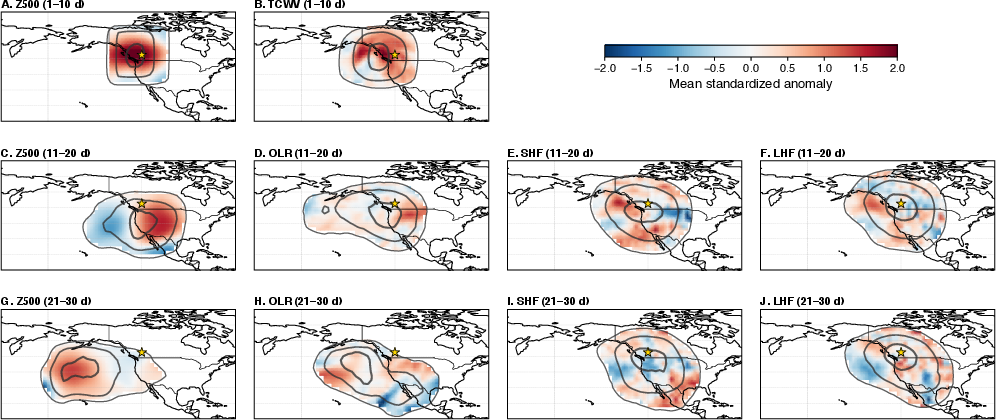
Figure 7: Lead-time-stratified anomaly patterns corresponding to highest-causal-density regions along inferred trajectories for the PNW event.
Practical and Theoretical Implications
TraCE-ST extends the capacity of data-driven causal discovery in Earth system science by enabling event-conditioned, multi-step, and multi-variable pathway reconstruction directly in high-dimensional, sample-limited gridded data. Unlike traditional local or stationary graph recovery, this approach produces physically interpretable ensembles of potential origins for any event, with explicit quantification of relative driver contributions and pathway uncertainty. The ensemble methodology allows distinguishing robust mechanistic attributions from route-specific ambiguity, thus complementing and constraining both correlation-based diagnostics and expensive numerical perturbation experiments.
This event-centric, probabilistic causal tracing approach is poised to substantially improve both hypothesis generation and model evaluation for rare or compound extremes—settings in which synthetic counterfactuals are infeasible and numerical ensemble experiments are prohibitively expensive. Especially relevant is its use in model intercomparison, targeted event attribution, and sensitivity analysis—making it valuable for the forecast verification, process understanding, and ensemble-based discovery communities.
Future Directions
Anticipated developments include integrating adaptive temporal windowing, non-rectangular analysis regions, and expanding to multi-lag and multiscale causal inference, further aligning the framework with complex, filamentary, or nonlocal dynamical regimes. A primary methodological avenue is tighter linkage with fast, scalable causal discovery algorithms that retain statistical power in the undersampled, high-dimensional regime endemic to geosciences.
There is strong potential for applications to AI-based hybrid Earth system models and composite event catalog analysis, leveraging the interpretability and computational efficiency of TraCE-ST for both operational and fundamental research—e.g., rapid intensification diagnostics, compound event attribution, and mechanistic model benchmarking.
Conclusion
TraCE-ST provides a structurally and computationally efficient paradigm for event-conditioned, probabilistic causal process tracing in Earth system science. By bridging local directed graph estimation and Lagrangian-type pathway tracing, it enables rigorous, interpretable attribution of observed extremes to multi-step, multivariate, and spatially distributed drivers, with uncertainty quantification and ensemble methodology central to its design. Results from synthetic and real-world validations demonstrate the method's fidelity, versatility, and practical value, suggesting a significant advance in the formal study of extreme event genesis, attribution, and model validation (2607.10033).