Religion and Artificial Intelligence as Distributed Meaning Systems: A Naturalistic Conceptual Model
Abstract: This paper develops a naturalistic account of religion and artificial intelligence as structurally similar distributed meaning systems. I argue that both emerge from the same underlying cognitive architecture: socially extended processes that offload interpretation, norm-guidance, and world-model construction into external symbolic environments. Drawing on work in distributed cognition, cultural evolution, and philosophy of mind, the paper proposes a conceptual model showing how meaning is generated, stabilised, and transmitted through recursive interactions between agents and their informational ecologies. Religion is analysed not as a set of beliefs but as a cognitive-ecological system that scaffolds coordination, normativity, and shared interpretation. Contemporary AI systems are shown to instantiate analogous functions, operating as high-bandwidth, algorithmically mediated environments that shape reasoning, attention, and social meaning-making. The model explains how both systems create epistemic compression, reduce cognitive load, and generate shared frameworks that guide behaviour. It also clarifies the conditions under which AI systems can become culturally entrenched meaning authorities. The contribution is conceptual: a unified framework for understanding religion and AI as parallel forms of distributed cognitive machinery. This reframing opens new pathways for analysing artificial agents not as isolated tools but as components in evolving socio-cognitive ecologies.
Paper Prompts
Sign up for free to create and run prompts on this paper using GPT-5.
Top Community Prompts
Explain it Like I'm 14
What is this paper about?
This paper says that religion and modern AI work in surprisingly similar ways as “distributed meaning systems.” That’s a fancy way of saying both help groups of people make sense of the world by spreading thinking and decision-making across many people, tools, and symbols outside any one person’s head.
Imagine a big shared toolkit made of stories, rules, rituals, apps, feeds, and recommendations. Both religion and AI act like that toolkit: they guide attention, set expectations for behavior, and give people shared ways to understand what’s going on.
What questions does it ask?
The authors ask simple but important questions:
- Can we understand religion and AI using the same natural, science-based ideas about how minds and cultures work?
- In what ways do religion and AI do similar jobs for society, like organizing behavior and creating shared meanings?
- When and how might AI systems become trusted “meaning authorities” that people rely on to interpret the world?
How did the authors approach it?
This is a “conceptual” paper, not a lab experiment. That means the authors build a clear model using ideas from several fields and explain how those ideas fit together.
They draw on:
- Distributed cognition: the idea that thinking isn’t just in our brains; it’s spread across people, tools, and environments. Example: a sports team or a ship’s crew “thinks” together using checklists, instruments, and shared routines.
- Cultural evolution: practices and beliefs change over time as groups copy, test, and keep what works, even if no single person fully understands why it works.
- Social meaning and institutions: things like laws, money, and nations exist because many people agree on them. That shared agreement gives them power in real life.
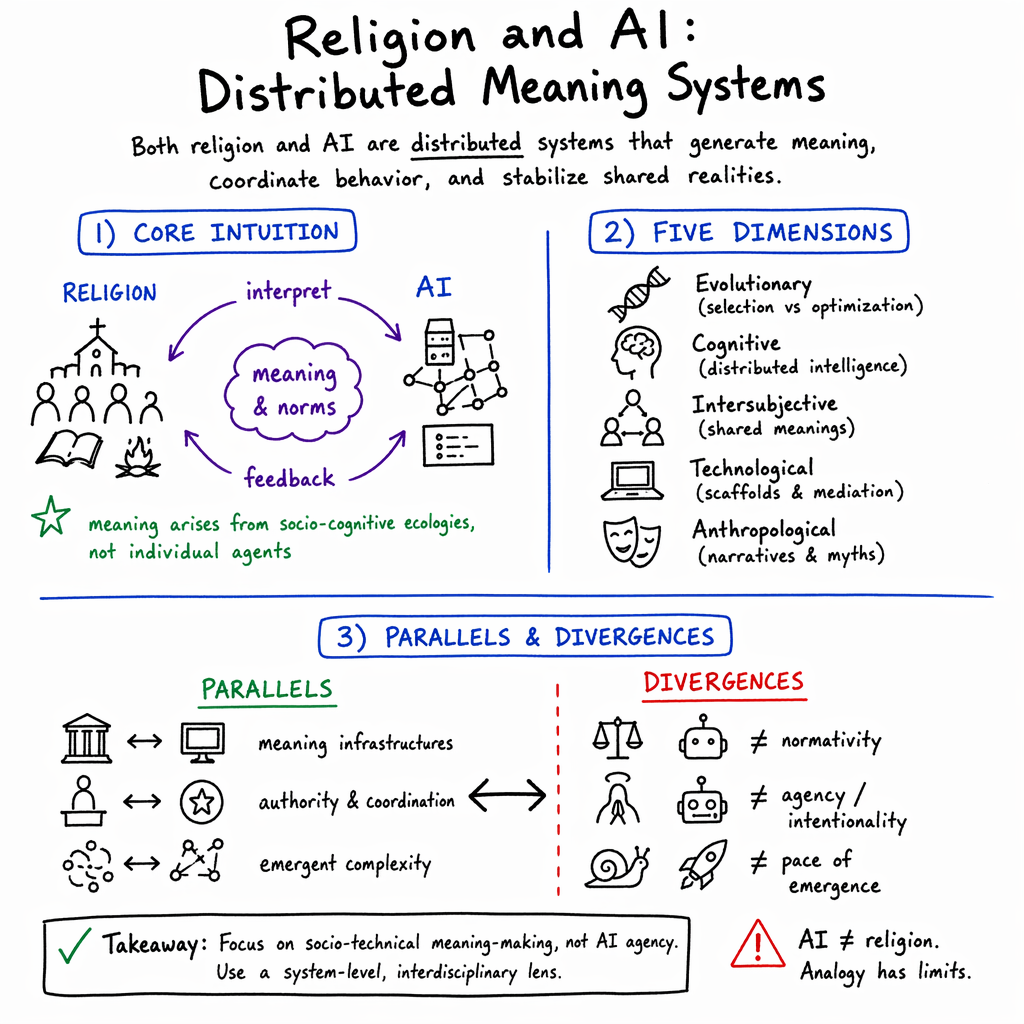
Using those ideas, the authors propose a five-part framework for both religion and AI:
- Evolutionary: how they change and stabilize over time
- Cognitive: how they spread thinking across people and tools
- Intersubjective: how they create shared, agreed-upon meanings
- Technological: the physical and organizational stuff that keeps them going (buildings, books, servers, data, interfaces)
- Anthropological: the stories and myths people tell about them
They then compare religion and AI across these five parts to spot similarities and differences.
What did they find?
The main findings are about parallels and limits.
Similarities:
- Both are distributed systems. No single person holds all the meaning or rules. In religion, the “mind” is spread across texts, rituals, leaders, and communities. In AI, behavior comes from large networks trained on tons of data—no single piece “knows” the whole.
- Both evolve. Religions change across generations; AI models are refined by training and feedback. In both cases, smart behavior can emerge without anyone fully understanding how every part works.
- Both generate shared meaning. Religions offer stories and moral frameworks. AI systems produce summaries, labels, recommendations, and explanations that people use to make sense of things.
- Both reduce mental effort. The paper calls this “epistemic compression,” which you can think of as a smart “short version” of a huge, complicated world: simple rules, trusted sources, and quick cues that help people decide and coordinate.
Important differences:
- Built-in values vs. borrowed values. Religion is “normatively saturated”: it comes with thick, shared values and moral expectations. AI is “normatively thin”: its outputs only gain moral weight when people and institutions choose to treat them as important.
- Agency and intention. Religions often attribute agency (to gods or institutions). AI systems don’t have intentions or beliefs; they’re statistical pattern-makers. If they seem intentional, that’s our human habit of reading minds into machines.
- Authority sources. Religious authority grows from tradition and community practices. AI authority often comes from perceived objectivity, performance metrics, and the prestige of computation—sometimes called “algorithmic authority.”
- Speed and visibility. Religious change tends to be slow and explicit. AI change can be fast and hidden in interfaces and updates.
- How coordination happens. Religions coordinate behavior through explicit norms and rituals. AI coordinates through nudges and rankings embedded in apps and platforms.
Why this matters:
- AI can become a “meaning infrastructure,” like a modern layer that shapes how we see the world, similar to how religious systems have long done. That influence grows when people widely accept AI outputs as trustworthy or authoritative.
Why is this important?
- It gives us a clearer, less mystical way to think about both religion and AI. Instead of asking “Is AI a person?” or “Is religion just beliefs?”, it shows how both function as systems that help societies think and act together.
- It warns against two mistakes:
- Anthropomorphism: treating AI like a person with beliefs and intentions.
- Reductionism: treating religion as just superstition or treating AI as just code. Both are bigger, system-level phenomena.
- It suggests better questions for the future. Instead of focusing only on whether AI is conscious, we should ask how AI is shaping attention, choices, norms, and shared meanings—because that’s how it will influence society.
Key terms in everyday language
- Distributed meaning system: A shared toolkit of stories, rules, tools, and habits that helps many people understand things in the same way.
- Intersubjective reality: Something that’s real because many people agree it’s real (like money or a nation).
- Cognitive scaffolding: Supports that make thinking easier—like calculators, maps, checklists, or step-by-step rituals.
- Epistemic compression: Turning complex information into simpler, usable summaries so people can decide faster.
- Algorithmic authority: When people trust a computer system’s output because it seems objective or advanced, not because the system “understands.”
Bottom line
The paper argues that religion and AI are not the same thing, but they play similar roles as big, shared systems that help people interpret the world and move in sync. Religion brings deep, value-rich traditions; AI brings fast, data-driven suggestions. Understanding both as distributed meaning systems helps us see how they guide behavior, earn trust, and shape society—and helps us make smarter choices about how we build, use, and govern AI.
Knowledge Gaps
Knowledge gaps, limitations, and open questions
The paper is a conceptual reframing and leaves multiple empirical, methodological, and theoretical questions open. The following list outlines concrete gaps that future research can address:
- Operationalization gap: No precise, measurable definitions are offered for key constructs (e.g., “distributed meaning system,” “epistemic compression,” “algorithmic authority,” “normative thickness/thinness,” “meaning infrastructure”). Specify operational metrics and observable indicators for each.
- Measurement of epistemic compression: The claim that religion and AI reduce cognitive load and compress epistemic complexity is not quantified. Design behavioral and cognitive experiments to measure load reduction, interpretive convergence, and decision latency under AI- or religion-mediated conditions.
- Causal mechanisms and feedback loops: The “recursive interactions” between agents and informational ecologies are described but not modeled. Map and test concrete feedback loops (e.g., user adoption → institutional reliance → training data shifts → model updates → authority consolidation).
- Boundary conditions for AI becoming a meaning authority: The paper asserts conditions can be clarified but does not specify them. Identify necessary/sufficient conditions (e.g., performance reliability, institutional endorsement, interface friction, perceived neutrality, regulatory mandates, media narratives) and test them experimentally or via field studies.
- Predictive, testable hypotheses: The unified model lacks falsifiable predictions. Derive and preregister hypotheses (e.g., transparency reduces perceived algorithmic authority only above a competence threshold) and evaluate with controlled studies.
- Typology of meaning-shaping AI: AI is treated generically. Develop a typology distinguishing recommender systems, LLMs, search engines, agents, and decision-support tools by bandwidth, personalization, persistence, and normativity effects; test differential impacts on meaning-making.
- Diversity within religion: Religious traditions are treated at a high level of abstraction. Analyze variation across denominations, ritual intensity, textual vs oral traditions, and institutional centralization to test which structures most strongly shape distributed meaning.
- Cross-cultural and linguistic variation: The model does not address how cultural context and language (including low-resource languages and oral cultures) mediate AI’s meaning effects or interact with religious systems. Conduct comparative, cross-cultural studies.
- Co-evolution dynamics: The pace differences between religious and AI emergence are noted but not modeled. Build formal or agent-based models of co-evolution (lock-in, tipping points, path dependence, institutional isomorphism) and test with longitudinal data.
- Competing meaning systems: Interactions among religion, AI, law, markets, and science are acknowledged but not analyzed. Study conflict, substitution, and complementarity among multiple concurrent meaning infrastructures.
- Norm translation: How “normatively thin” AI outputs become “normatively thick” through social uptake is not specified. Trace processes (institutional adoption, pedagogical embedding, ritualization) through ethnography and institutional case studies.
- Power and political economy: The roles of platform governance, corporate incentives, data ownership, and regulatory environments in shaping AI’s meaning authority are underdeveloped. Integrate political economy analyses and governance case studies.
- Epistemic justice and inclusion: The framework does not assess whose meanings are amplified/suppressed. Evaluate distributive and recognition harms (e.g., category imposition, cultural erasure) and develop equity-sensitive metrics and audits.
- Emotional and embodied dimensions: Religion’s affect, ritual embodiment, and sacralization are central but lack AI analogs in the model. Investigate whether and how interfaces, habit loops, and immersive media instantiate functionally similar affective scaffolds.
- Contestability and pluralism: Criteria and mechanisms to preserve interpretive pluralism under AI mediation are not provided. Develop design patterns (e.g., contrastive explanations, option diversity, “interpretive dissent” prompts) and evaluate their efficacy.
- Governance levers and interventions: The paper offers no concrete policy or design interventions. Specify and test levers (audits, transparency regimes, provenance, value pluralism objectives, user agency tools) and their trade-offs.
- Responsibility and accountability in distributed systems: The model does not resolve attribution of responsibility when meaning effects are emergent. Propose frameworks for distributed accountability spanning developers, deployers, institutions, and users.
- Distinguishing reflection from shaping: It remains unclear when AI outputs merely reflect existing meanings versus actively reshape them. Employ causal inference (natural experiments, instrumental variables) to disentangle reflection from intervention.
- Data lifecycle effects: How data sourcing, filtering, RLHF, and continual learning alter meaning ecologies is not addressed. Study how updates propagate into public discourse and institutional practices over time.
- Robustness and failure modes: The model does not analyze breakdowns (hallucinations, bias spikes, distribution shifts) and their social consequences (trust shocks, “crises of authority”). Develop diagnostics and trust-repair protocols.
- Domain-specific implications: No sectoral analysis is provided. Conduct comparative studies in law, education, health, finance, and religion-mediated communities to map domain-specific meaning dynamics and risks.
- Methods toolkit: Methodological guidance is high-level. Specify mixed-method designs (ethnography, lab/field experiments, network analysis, log-data audits, discourse analysis, longitudinal panels) tailored to each model dimension.
- Formalization: There is no mathematical or computational formal model. Develop graph- or dynamical-systems models of distributed meaning, simulate authority formation, and validate against empirical traces (citations, sharing cascades, policy adoptions).
- Evaluation metrics for “meaning effects”: Propose concrete indicators (interpretive convergence/divergence indices, norm adoption rates, authority reliance scores, contestability measures, pluralism indices) and public benchmarks.
- Human–AI hybrid agency: The paper brackets agency but does not analyze hybrid cognitive assemblies (teams using AI, chain-of-agents workflows). Study how coordination and authority emerge in human–AI ensembles.
- Adversarial dynamics and manipulation: The framework omits coordinated influence operations, prompt injection, and propaganda that exploit meaning infrastructures. Develop threat models and resilience metrics.
- Temporal granularity and memory: Differences in persistence and memory (scripture/canon vs retrievable model states and logs) are not explored. Examine how archival practices shape authority and revision norms.
- Interaction with religious practice: Potential AI-mediated ritualization (AI-guided prayer, sermon generation, liturgical planning) is mentioned implicitly but not studied. Map adoption patterns, legitimacy debates, and institutional responses.
- Public perception and anthropomorphism: While cautions are noted, the paper lacks instruments to measure projections of agency/divinity onto AI. Create validated scales and interventions to reduce misattribution.
- Conflict and reconciliation mechanisms: The model does not specify how clashes between AI outputs and religious norms are negotiated (e.g., blasphemy controversies). Analyze dispute resolution pathways and design de-escalation tools.
- Reference completeness and evidence base: Some citations are incomplete and the argument largely synthesizes secondary theory. Expand the evidence base with empirical studies and resolve bibliographic gaps (e.g., full Jasanoff & Kim reference).
Practical Applications
Immediate Applications
Below are deployable applications that translate the paper’s conceptual model—AI and religion as distributed meaning systems—into concrete practices, products, and policies.
- Meaning Impact Assessments (MIA) for AI deployments
- Sectors: software platforms, healthcare, finance, education; public policy
- What: Pre- and post-deployment checklists and dashboards that assess how a system compresses meaning, shapes user interpretations, and creates de facto “algorithmic authority”
- Tools/workflows: MIA templates (akin to DPIA/AIRMF), “epistemic compression risk” scores, reliance telemetry, authority-uptake surveys, incident postmortems focused on interpretive harms
- Assumptions/dependencies: Requires instrumentation for user behavior and consented analytics; relies on emerging metrics; organizational capacity to act on findings
- Algorithmic authority disclosures in UX
- Sectors: software platforms, healthcare decision support, fintech advisory, education tech
- What: Clear UI signals when outputs are advisory vs. authoritative; provenance, confidence, and “contested/alternative views” indicators
- Tools/workflows: UI labels, “Why this answer?” evidence panels, multi-view toggles, escalation-to-human pathways in high-stakes contexts
- Assumptions/dependencies: Product design bandwidth; regulatory guidance on disclosure; retrieval and provenance pipelines
- Pluralized output modes to mitigate single-source authority
- Sectors: education, media, enterprise knowledge systems
- What: Default presentation of multiple interpretive frames (e.g., legal, ethical, cultural, scientific) rather than one canonical answer
- Tools/workflows: Multi-perspective generation with cited sources; user-selectable frameworks; side-by-side comparison widgets
- Assumptions/dependencies: Diverse, well-attributed corpora; evaluation methods for pluralism quality; UX space for comparative views
- “MeaningOps” as a governance function
- Sectors: technology, healthcare, finance, government IT
- What: Cross-functional teams (policy, UX, ML, legal, social science) that manage interpretive risks, monitor “meaning drift,” and align outputs with institutional norms
- Tools/workflows: Pre-launch review boards, socio-technical risk registers, interpretive A/B tests, drift monitors, red-teaming for normative edge cases
- Assumptions/dependencies: Resourcing and executive sponsorship; access to qualitative and quantitative user data; clear escalation criteria
- Guardrails against epistemic compression
- Sectors: search, productivity suites, assistants
- What: Features that surface uncertainty, alternate explanations, and underlying evidence to counter overconfident, normatively thin outputs
- Tools/workflows: Uncertainty bands, counterfactual prompts (“Show a competing interpretation”), evidence expansion panels
- Assumptions/dependencies: Reliable retrieval augmentation; calibration of uncertainty communication to avoid user overload
- Cultural coverage audits for training and fine-tuning
- Sectors: AI development, content platforms
- What: Audits that assess whether datasets and RLHF processes reflect diverse cultural and normative contexts
- Tools/workflows: Coverage taxonomies, sampling dashboards, cultural representativeness reports, community advisory panels
- Assumptions/dependencies: Access to dataset metadata; ethical engagement with communities; privacy and IP constraints
- AI meaning-making literacy programs
- Sectors: K-12, higher education, workforce training, libraries
- What: Curricula that teach distributed cognition, algorithmic authority, and interpretive pluralism
- Tools/workflows: Micro-courses, classroom simulations (e.g., “multiple frames” exercises), public-service modules
- Assumptions/dependencies: Curriculum adoption; teacher training; alignment with digital literacy standards
- Community co-design in values-rich domains
- Sectors: civic tech, NGOs, religious and cultural organizations
- What: Participatory design to define boundaries (e.g., non-substitution for spiritual or communal authority) and acceptable use
- Tools/workflows: Co-design workshops, harm-mapping, consent protocols, culturally informed “do-not-answer” lists
- Assumptions/dependencies: Trust-building and time; IRB/ethics oversight in research settings
- Institutional language and style guides to avoid anthropomorphism
- Sectors: government, enterprises, media
- What: Policy templates that frame AI as socio-technical meaning infrastructure rather than agentive entities
- Tools/workflows: Style guides, policy addenda, review checkpoints in documentation and marketing
- Assumptions/dependencies: Communications alignment; leadership endorsement
- Meaning drift monitoring
- Sectors: platforms, enterprise AI
- What: Ongoing measurement of how users’ interpretations and reliance patterns change over time
- Tools/workflows: Longitudinal surveys, behavioral telemetry (with consent), cohort studies of authority uptake, alerting for shifts in high-stakes use
- Assumptions/dependencies: Privacy-preserving analytics; stable instrumentation; interdisciplinary analysis capacity
- Normatively thick escalation triggers
- Sectors: healthcare consent, legal aid tools, financial advice
- What: Automatic routing to qualified humans when prompts touch normatively saturated issues (rights, duties, moral judgments)
- Tools/workflows: Topic classifiers tied to escalation policies; expert queues; auditable logs
- Assumptions/dependencies: Accurate topic/risk classification; staffing and SLAs; false-positive management
- Socio-technical context documentation (“Social Context Cards”)
- Sectors: AI research and product
- What: Extend Model/Data Cards with a map of intended users, institutional settings, interpretive risks, and governance mechanisms
- Tools/workflows: New documentation templates; pre-launch sign-off gates
- Assumptions/dependencies: Team adoption; integration into existing compliance workflows
Long-Term Applications
These applications require further research, standardization, scaling, or regulatory development before broad deployment.
- Standards for “meaning infrastructure” (e.g., ISO-style)
- Sectors: standards bodies, regulators, industry consortia
- What: Norms for disclosure, pluralization, provenance, and oversight when AI systems shape shared meaning
- Tools/workflows: Technical and process standards; certification schemes; conformity assessments
- Assumptions/dependencies: Cross-sector consensus; measurable compliance criteria; global harmonization
- Meaning influence metrics and audits
- Sectors: academia, regulators, platforms
- What: Quantitative and qualitative measures of interpretive influence (e.g., authority uptake, diversity of frames, reliance elasticity)
- Tools/workflows: Network analyses, causal inference on behavior changes, ethnographic audits, standardized survey instruments
- Assumptions/dependencies: Data access and privacy safeguards; validated methodologies; independent auditors
- Pluralistic recommender systems optimizing for interpretive diversity
- Sectors: social media, news, streaming, search
- What: Objective functions and UX that promote exposure to multiple credible frames over narrow engagement maximization
- Tools/workflows: Diversity-aware ranking, user-controllable perspective sliders, exposure caps/quotas, transparency APIs
- Assumptions/dependencies: Business model shifts; robust quality and credibility signals; user acceptance
- Normative overlay layers for domain- and community-specific constraints
- Sectors: healthcare, education, enterprises, public sector
- What: Modular policy engines that mediate model outputs with community or institutional norms (e.g., age-appropriate pedagogy, clinical ethics)
- Tools/workflows: Policy-as-code, constraint-aware decoding, rule-backed red-teaming, conflict-resolution protocols
- Assumptions/dependencies: Formalization of norms; governance for competing norms; verification and monitoring
- Cognitive-ecological sandboxes for system-level testing
- Sectors: regulators, research labs, policy think tanks
- What: Agent-based and field-experiment testbeds to simulate population-level effects of AI-mediated meaning and authority
- Tools/workflows: Synthetic societies, controlled rollouts, pre-registration and IRB-managed studies
- Assumptions/dependencies: Validated models linking micro to macro effects; ethical oversight; funding
- Meaning provenance and signing protocols (beyond content origin)
- Sectors: media, search, enterprise knowledge management
- What: Cryptographic tagging of interpretive frames, sources, and transformation steps attached to outputs
- Tools/workflows: Extensions of C2PA-like standards to include “frame signatures,” chain-of-interpretation logs
- Assumptions/dependencies: Interoperable standards; ecosystem adoption; performance overhead constraints
- Cross-system coordination mechanisms between religious/cultural institutions and platforms
- Sectors: faith communities, tech platforms, civil society
- What: APIs and councils for flagging contested topics, co-creating guidance, and defining non-substitution zones
- Tools/workflows: Advisory boards, topic registries, friction-insertion for sensitive queries, context modules linking to community resources
- Assumptions/dependencies: Trust and representative participation; clear governance charters; safeguards against censorship
- Regulatory regimes for de facto algorithmic authority
- Sectors: government, high-stakes industries
- What: Legal thresholds where systems that shape decisions/interpretations must meet oversight, licensing, or audit obligations
- Tools/workflows: Risk-tiering frameworks, auditability requirements, user disclosure mandates, sanctions for non-compliance
- Assumptions/dependencies: Statutory clarity on “meaning-shaping” risk; regulatory capacity; international coordination
- Civics-for-AI curricula reframing citizenship in a mediated meaning ecology
- Sectors: K-12, higher education, adult education
- What: Programs that teach critical interpretation, pluralism, and governance of socio-technical meaning systems
- Tools/workflows: Revised civics standards, teacher training, assessment rubrics for interpretive competence
- Assumptions/dependencies: Curriculum governance buy-in; longitudinal assessment methods; teacher workforce development
- Ethnographic rapid-response units for cultural entrenchment monitoring
- Sectors: academia–industry partnerships, public-interest research
- What: Embedded teams that study how AI systems become “meaning authorities” in specific communities and feed insights back to governance
- Tools/workflows: Rapid ethnographies, community panels, real-time reporting to MeaningOps and policy teams
- Assumptions/dependencies: Sustained funding; data-sharing agreements; ethical frameworks for community engagement
- AI-assisted hermeneutic tools for comparative interpretation
- Sectors: humanities, theology, museums, education
- What: Systems that juxtapose interpretations across traditions, periods, and cultures, explicitly labeling frames and sources
- Tools/workflows: Corpus alignment, interactive commentary graphs, educator overlays
- Assumptions/dependencies: High-quality digitized corpora; rights management; scholarly validation mechanisms
- Market and procurement incentives for meaning-safe design
- Sectors: public procurement, enterprise buyers
- What: RFP requirements that privilege pluralization, provenance, drift monitoring, and escalation in vendor systems
- Tools/workflows: Procurement checklists aligned with meaning standards; vendor attestation and audits
- Assumptions/dependencies: Standardized criteria; auditor ecosystem; willingness to pay for safer designs
These applications rely on the paper’s core insights: treat AI not as an agent but as meaning infrastructure; manage authority formation and interpretive effects at the system level; and design for pluralism, provenance, and governance across socio-technical contexts. Feasibility hinges on organizational will, standardization, availability of culturally diverse data, ethical oversight, and compatible business and regulatory incentives.
Glossary
- algorithmic authority: The conferral of trust and decision power to computational systems because of their algorithmic nature rather than human intention. "This aligns with analyses of algorithmic authority, where trust is conferred on systems because of their computational form rather than their intentional states (Mittelstadt et al., 2016)"
- algorithmically mediated environments: Contexts shaped by algorithms that filter, prioritise, or generate information, influencing cognition and behaviour. "operating as high-bandwidth, algorithmically mediated environments that shape reasoning, attention, and social meaning-making."
- anthropomorphism: Attributing human traits like agency or intention to non-human systems, such as AI. "Avoiding anthropomorphism: Since neither system requires agency, intention, or comprehension to generate meaningful outputs."
- cognitive ecology: The study of how cognition is shaped by interactions among minds, tools, and environments. "Keywords: Distributed cognition, Cognitive ecology, Distributed meaning systems, Meaning-making processes, Artificial intelligence, Religion as cognitive scaffolding"
- cognitive scaffolding: External supports (e.g., rituals, tools, texts) that structure and extend human cognition. "Keywords: Distributed cognition, Cognitive ecology, Distributed meaning systems, Meaning-making processes, Artificial intelligence, Religion as cognitive scaffolding"
- cognitive-ecological system: A system in which cognitive processes are distributed across individuals and their environmental supports. "Religion is analysed not as a set of beliefs but as a cognitive-ecological system that scaffolds coordination, normativity, and shared interpretation."
- coalitional signalling: Behaviours or cues that communicate group membership and commitment to enhance cooperation. "Hyperactive agency detection, minimally counterintuitive concepts, and coalitional signalling are not religious modules but ordinary features of human cognition..."
- collective intelligence: Group-level problem solving and adaptation arising from the aggregation and coordination of many individuals. "Religion is therefore a dynamic, historically contingent system of collective intelligence."
- cultural evolution: The process by which cultural traits change over time via social learning, variation, and selection. "Drawing on work in distributed cognition, cultural evolution, and philosophy of mind..."
- cumulative cultural selection: The iterative retention and refinement of cultural practices across generations due to their functional success. "Henrich's work on cultural evolution deepens this naturalistic picture by showing how religious systems emerge through cumulative cultural selection (Henrich, 2015)."
- distributed cognition: A framework viewing cognitive processes as spread across individuals, artifacts, and social structures. "This aligns with broader accounts of distributed cognition, where functional organisation emerges from the coordinated activity of multiple components..."
- distributed intelligence: Intelligence emerging from interactions within large-scale systems without a central controlling agent. "Agüera y Arcas argues that contemporary machine-learning systems exhibit forms of distributed intelligence..."
- distributed meaning systems: Networks of people, practices, and artifacts that collectively generate and regulate shared meaning. "This paper develops a naturalistic account of religion and artificial intelligence as structurally similar distributed meaning systems."
- epistemic authority: The capacity of an agent or system to be accepted as a credible source of knowledge or interpretation. "Both religion and AI generate forms of epistemic authority."
- epistemic compression: Reduction of complex information into simpler, shared representations that ease understanding and coordination. "The model explains how both systems create epistemic compression, reduce cognitive load, and generate shared frameworks that guide behaviour."
- external symbolic environments: External media or artifacts (texts, architectures, interfaces) that store and structure symbolic information used in cognition. "offload interpretation, norm-guidance, and world-model construction into external symbolic environments."
- feedback-driven improvement: Performance enhancement through iterative cycles of evaluation and adjustment based on outcomes. "Modern AI capabilities arise from recursive optimisation, scaling, and feedback-driven improvement rather than from explicit symbolic reasoning..."
- hyperactive agency detection: A bias to infer agency behind events, often cited in cognitive accounts of religion. "Hyperactive agency detection, minimally counterintuitive concepts, and coalitional signalling..."
- imagined orders: Shared narratives or constructs that organize social reality despite lacking physical instantiation. "This is consistent with accounts of intersubjective meaning and imagined orders (Harari, 2014; Searle, 1995)."
- informational ecologies: Interconnected environments of information sources, tools, and practices within which cognition unfolds. "through recursive interactions between agents and their informational ecologies."
- institutional facts: Socially constructed facts that exist due to collective acceptance and rules (e.g., money, laws). "social ontology, which analyses how shared symbolic structures generate institutional facts and normative expectations (Searle, 1995)."
- intersubjective meaning structures: Shared frameworks of interpretation embedded in collective practices and institutions. "the integration of AI into intersubjective meaning structures"
- intersubjective realities: Entities that exist within shared belief systems and collective practices rather than in purely physical or individual mental realms. "Harari's notion of intersubjective realities provides a complementary lens on religion as a meaning-making system (Harari, 2014)."
- meaning infrastructure: Systems and tools that generate, distribute, and stabilise shared interpretations in society. "AI as meaning infrastructure: It reframes AI not as an autonomous agent but as a meaning infrastructure..."
- meaning-making architectures: Structures and processes that support the construction of shared significance and interpretation. "Religion is one of the most enduring of these meaning-making architectures."
- meaning-shaping infrastructures: Technological or institutional systems that influence how meaning is produced and circulated. "Harari argues that contemporary AI systems are becoming powerful meaning-shaping infrastructures..."
- minimally counterintuitive concepts: Ideas that slightly violate expectations, enhancing memorability and transmission. "Hyperactive agency detection, minimally counterintuitive concepts, and coalitional signalling..."
- moralising gods: Supernatural agents believed to enforce moral norms, facilitating large-scale cooperation. "Costly rituals, moralising gods, and doctrinal systems stabilise cooperation..."
- normatively saturated: Richly infused with moral meanings and obligations. "religion is normatively saturated, whereas AI is normatively dependent."
- normatively thin: Carrying little intrinsic moral content, relying on external contexts for normative force. "AI-mediated meaning is statistically derived and normatively thin."
- pattern-completion mechanisms: Systems that produce outputs by completing patterns learned from data rather than by explicit symbolic reasoning. "Instead, they operate as pattern-completion mechanisms whose outputs reflect statistical regularities..."
- philosophy of mind: The field studying the nature of mental phenomena, consciousness, and cognition. "Drawing on work in distributed cognition, cultural evolution, and philosophy of mind..."
- recursive optimisation: Iterative improvement where outputs inform further rounds of training or adjustment. "Modern AI capabilities arise from recursive optimisation, scaling, and feedback-driven improvement..."
- social ontology: The study of how social entities and facts are constituted and maintained through collective practices. "This view aligns with social ontology, which analyses how shared symbolic structures generate institutional facts and normative expectations (Searle, 1995)."
- sociotechnical imaginaries: Collectively held visions of social futures shaped by and shaping technological development. "These narratives ... intersect with broader sociotechnical imaginaries, which shape how societies envision technological futures..."
- technological infrastructures: Foundational technical systems and networks that support information processing and social functions. "analyses of information systems, which emphasise how technological infrastructures shape meaning and social reality (Floridi, 2014)."
- technological mediation: The way technologies shape human perception, interpretation, and action. "This dimension aligns with broader analyses of technological mediation, which emphasise how technologies shape human perception, interpretation, and action (Verbeek, 2011)."
- world-model construction: Building internal or external representations that structure understanding and prediction about the world. "offload interpretation, norm-guidance, and world-model construction into external symbolic environments."
- socio-cognitive ecologies: Interacting social and cognitive environments within which meaning and behaviour co-evolve. "artificial agents not as isolated tools but as components in evolving socio-cognitive ecologies."
Collections
Sign up for free to add this paper to one or more collections.