- The paper introduces SEAMLiS, which integrates gatekeeper-based attitude and CBF-based positional filters to ensure safe decentralized multi-robot exploration.
- It rigorously analyzes safety gaps from limited sensor FoV and finite-range perception, proving recursive feasibility under defined sensing conditions.
- Empirical evaluations in simulation, high-fidelity emulation, and hardware tests show SEAMLiS eliminates collisions while maintaining efficient exploration.
SEAMLiS: Visibility-Aware Safety for Perception-Limited Multi-Robot Exploration
Introduction
Decentralized multi-robot exploration is central to scalable autonomous mapping in unknown environments but poses unique safety challenges when robots operate with finite-range, limited field-of-view (FoV) perception. Standard exploration stacks treat unknown space as free and prioritize information gain, often divorcing sensor heading from motion direction. Under limited sensing, such strategies introduce a fundamental risk: a robot may move toward a hidden obstacle that is revealed only when the available stopping distance is insufficient for avoidance. This paper rigorously analyzes this safety gap and proposes Safe Exploration for Autonomous Multi-Robot Systems Under Limited Sensing (SEAMLiS), a modular execution-layer framework that certifies provable safety via perception-aware attitude and positional filtering.
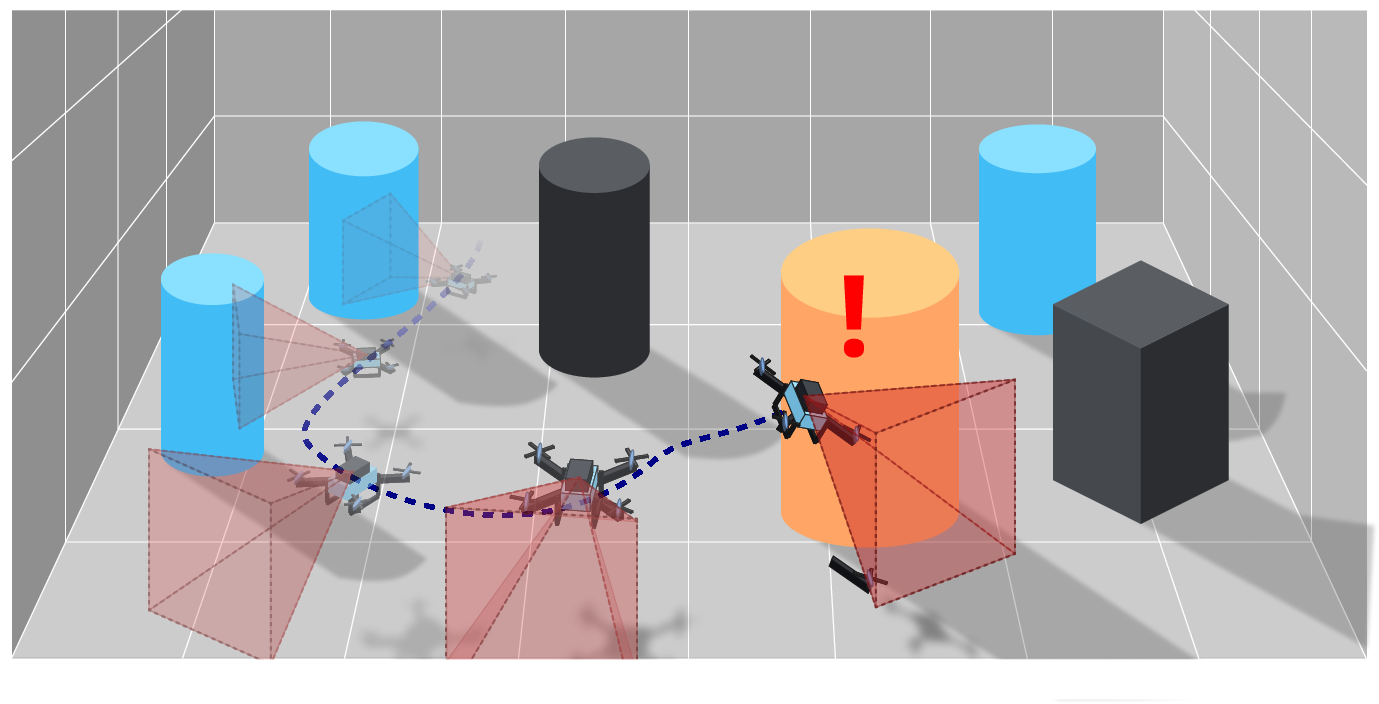
Figure 1: This schematic illustrates a perception-limited safety failure, where information-seeking sensor control leads the robot into collision with an unseen obstacle.
Decentralized Exploration under Limited Sensing
Problem Structure and Failure Modes
The robot dynamics are modeled as double-integrators in position and single-integrators in yaw, reflecting holonomic or quadrotor-like platforms with decoupled heading. Each robot receives goals from decentralized assignment modules and computes local paths, typically treating unknown space optimistically. The core safety issue arises when the yaw control aims for maximal information gain, which can rotate the sensor away from the velocity vector; as a result, the robot may not detect obstacles in time for feasible avoidance.
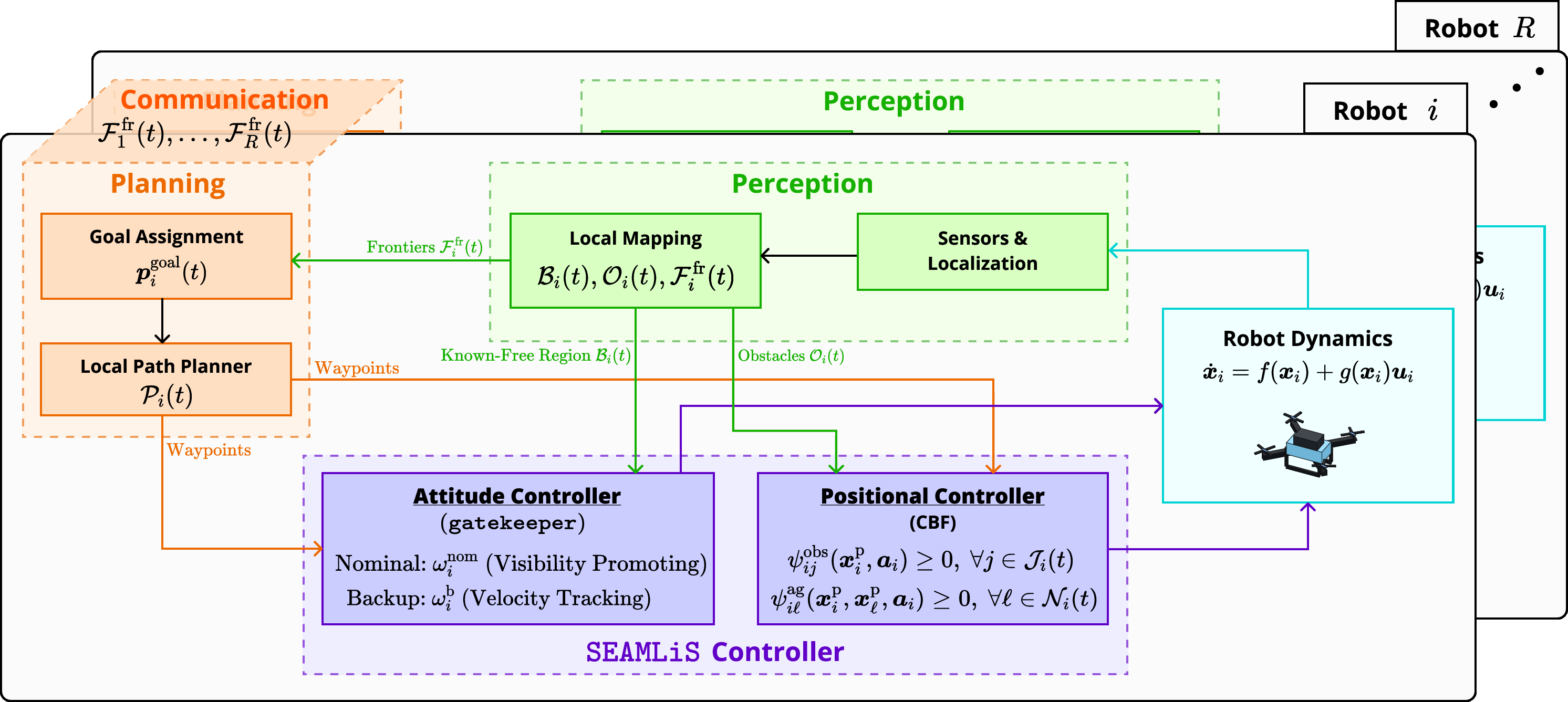
Figure 2: The SEAMLiS layer integrates with existing decentralized exploration stacks, providing downstream perception-aware safety regardless of upstream assignments or planners.
These failures are particularly acute in decentralized settings, where robots do not share full occupancy maps due to communication constraints. Thus, a robot might be assigned a path toward a region that, in its local map, is unknown, and traverse trajectories where hidden obstacles are not perceived until actuation limits preclude avoidance.
SEAMLiS Framework: Perception-Aware Safety Filters
SEAMLiS is designed to be agnostic to the choice of goal allocator or local planner. At the execution layer, it augments the basic stack with two principled safety filters:
- Gatekeeper-Based Attitude Filter: This component monitors whether the boundary between the known-free and unknown regions (the “critical point”) will be visible with the sensor’s FoV and reacting if the predicted margin is insufficient.
- CBF-Based Positional Filter: This controller enforces high-order Control Barrier Function (HOCBF) constraints to avoid all mapped obstacles and other robots, including dynamically detected ones.
Visibility Margin and Gatekeeper Execution
The visibility margin is computed based on the measured path distance to the critical point, the actuation-braking distance, and the time to rotate the sensor toward critical boundary points. If the future yaw plan cannot guarantee that obstacles will be detected before reaching the braking margin, the gatekeeper switches from a nominal visibility-driven yaw control to a velocity-tracking policy, ensuring that the sensor is always aligned with the direction of motion when required for safety.
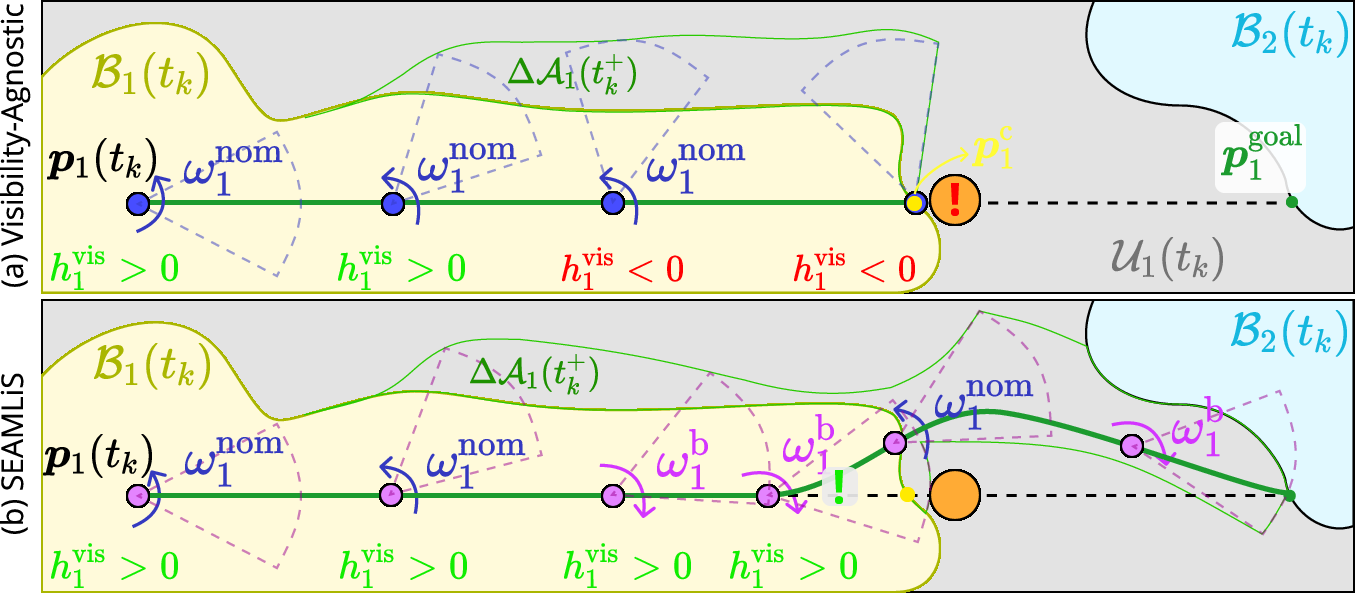
Figure 3: SEAMLiS governs sensor heading so that the border between known and unknown regions is kept visible, switching to motion-aligned backup control when visibility of the critical boundary is compromised.
Theoretical Guarantees
A key contribution is the formal proof of recursive feasibility. If the sensing range exceeds the sum of the robot's safety radius and maximum braking distance, the attitude safety filter can always guarantee sufficient look-ahead for the positional CBF filter to find a collision-free avoidance maneuver, even for previously unknown obstacles, independently of the upstream goal or path planner. Collision avoidance among robots is jointly ensured via distributed, pairwise high-order CBF constraints, with responsibilities split across robots based on current communication.
Empirical Evaluation
Simulation Benchmarks
The efficacy of SEAMLiS is demonstrated in large-scale simulation across 1-3 robot teams, with both classical frontier allocation and a decentralized CoScan-inspired mechanism. Across 100 randomized trials per configuration, SEAMLiS eliminates all collisions with initially unknown obstacles and achieves coverage rates and exploration times comparable to aggressive, less-safe baselines.
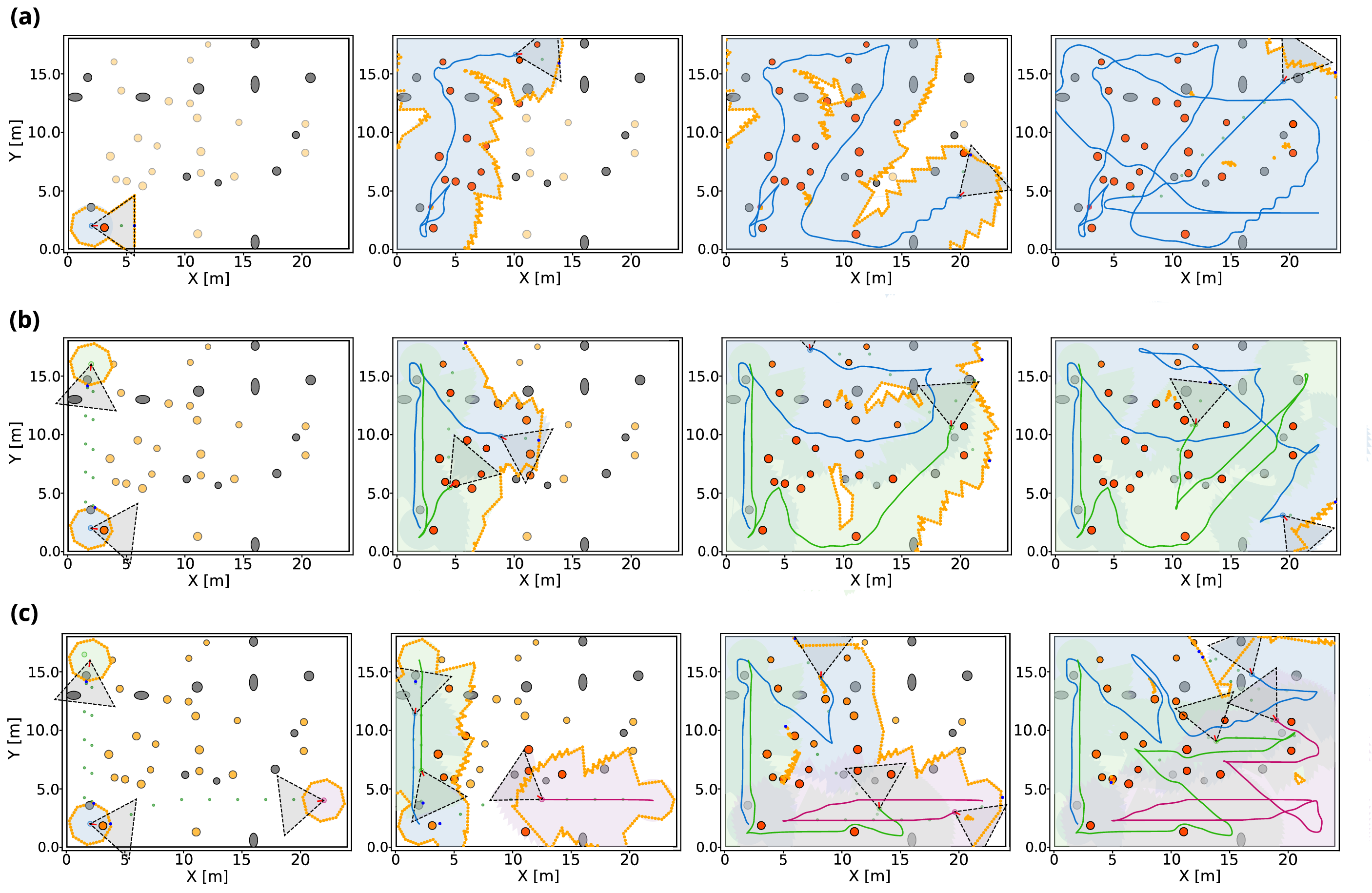
Figure 4: Visualization of single, double, and triple robot explorations, showing how SEAMLiS dynamically adapts sensor heading for safety while maintaining efficient exploration and coverage.
Qualitative analysis demonstrates that without the SEAMLiS filter, both constant yaw-rate and pure information gain-oriented yaw control regularly permit fatal collisions due to late obstacle detection.
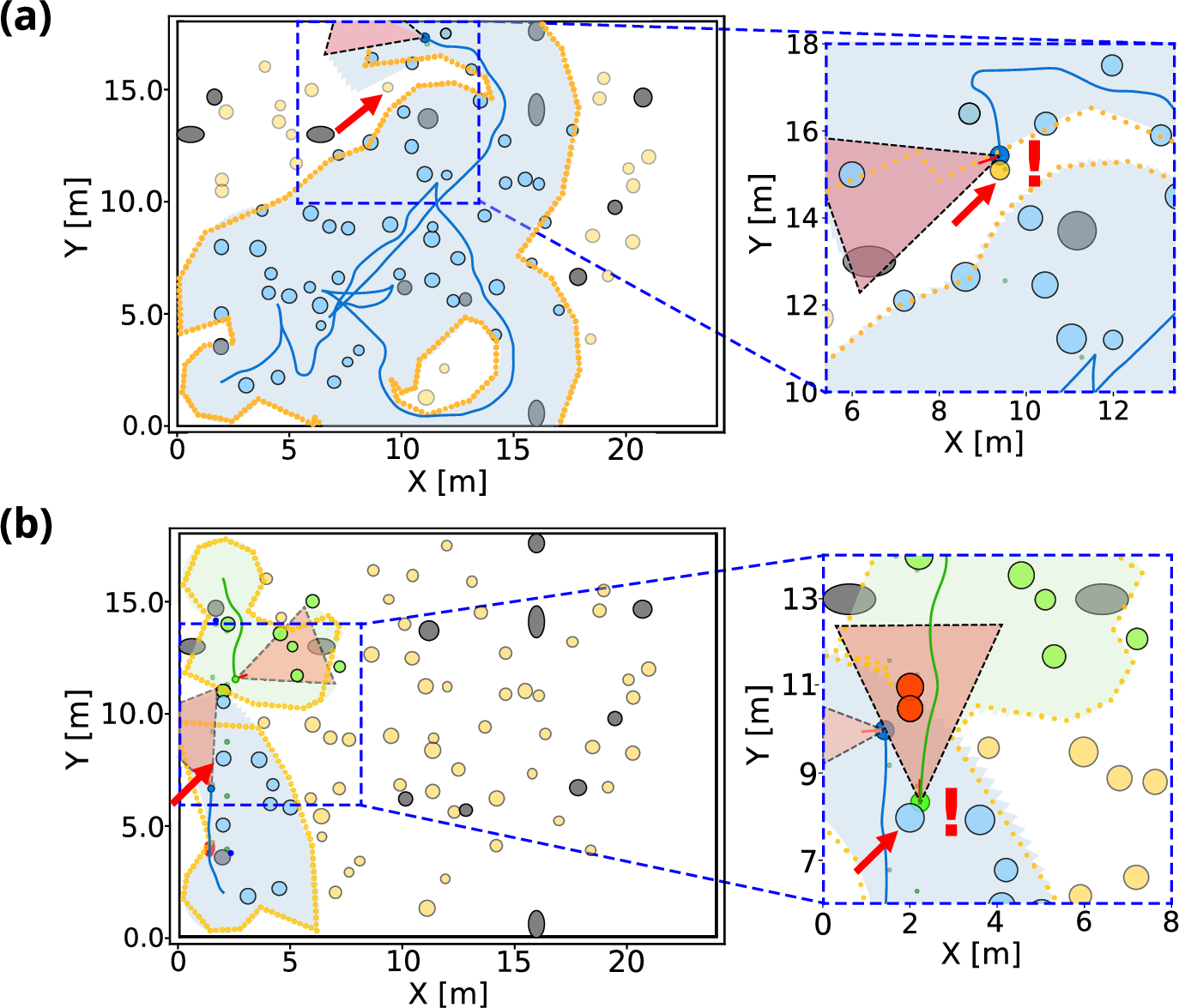
Figure 5: Baseline failures: the absence of visibility-aware filtering leads to repeated collisions with hidden obstacles in decentralized settings.
Direct inspection of the evolution of the visibility margin in representative rollouts illustrates that SEAMLiS actively intervenes to keep the margin nonnegative, as opposed to alternative policies which allow repeated violation of visibility constraints, correlating with collisions.
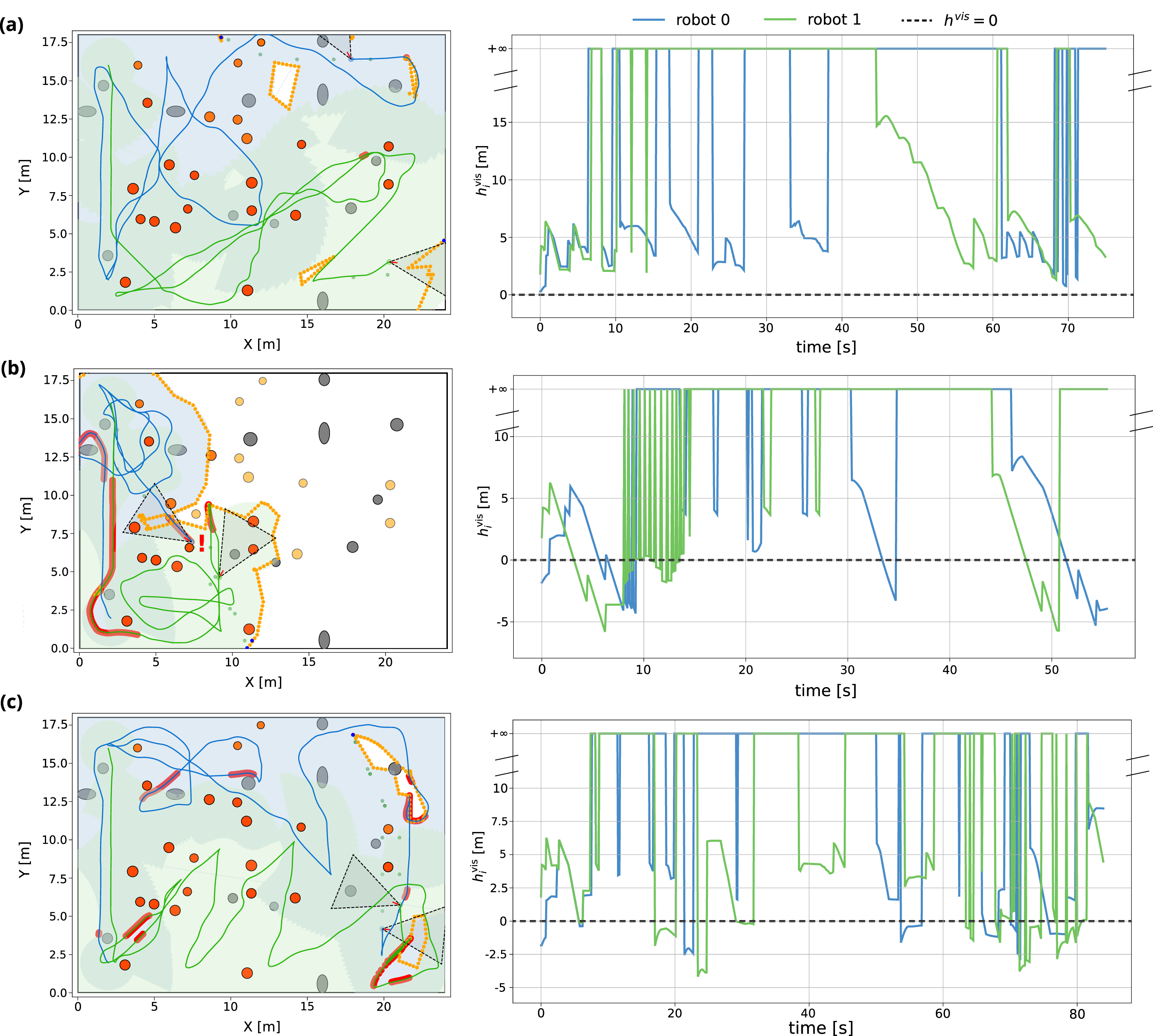
Figure 6: The visibility margin hivis under SEAMLiS remains nonnegative, avoiding safety-critical events that induce collisions in baseline policies.
High-Fidelity Simulation
In Isaac Sim, SEAMLiS is validated in physically plausible environments. Here, only teams utilizing SEAMLiS consistently avoid late-detection collisions with previously unknown obstacles, despite decentralized map sharing.
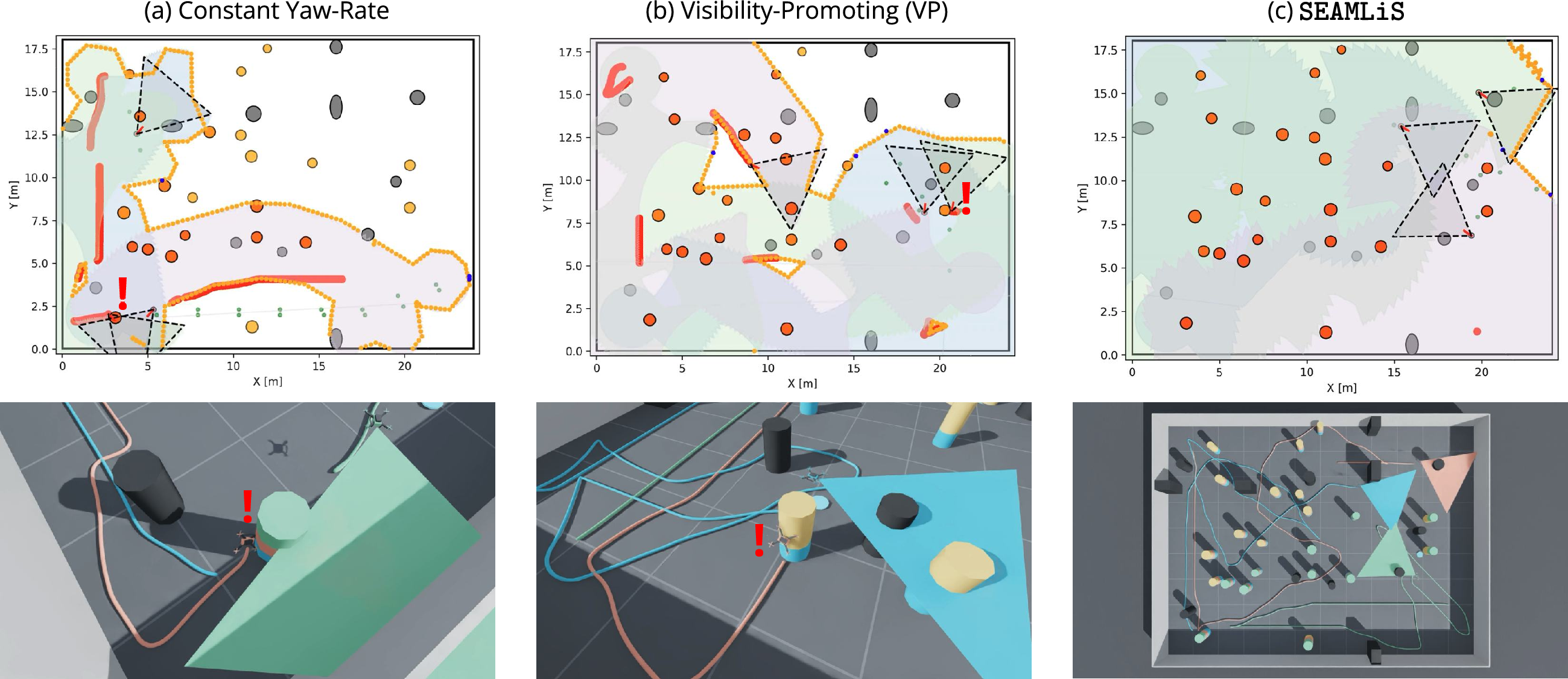
Figure 7: In Isaac Sim, SEAMLiS uniquely maintains collision-free exploration, in contrast to constant yaw or pure visibility-promoting strategies.
Hardware Validation
Experiments with Crazyflie quadrotors reinforce simulation findings. Under constant yaw-rate, robots collide with initially unknown obstacles even though others have already detected them, since maps are not shared. With SEAMLiS, each robot maintains sufficient visibility to avoid such collisions, thereby demonstrating the practical impact of perception-limited failures and the effectiveness of execution-layer filtering.
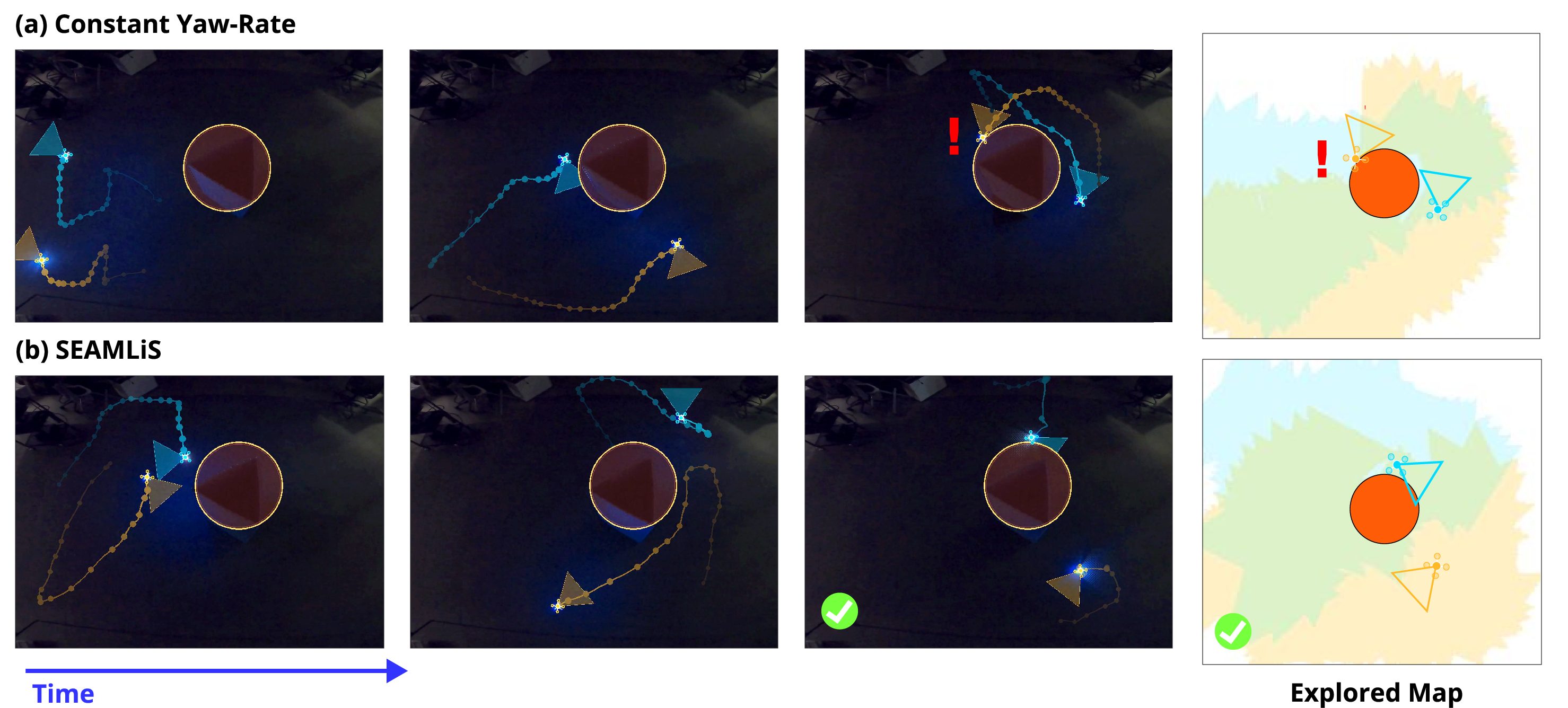
Figure 8: Hardware results: With SEAMLiS, both robots avoid a previously unknown obstacle, while the constant yaw-rate baseline induces a collision due to late detection.
Implications and Future Directions
SEAMLiS exposes and closes a significant safety gap in decentralized exploration under limited perception—namely, that recursively feasible collision avoidance cannot be ensured by standard efficiency-driven exploration stacks if the FoV and actuation dynamics are not explicitly considered. The framework's modularity allows integration with any allocation or planning method, making it compatible with frontier, optimization-based, and learned exploration policies.
The theoretical conditions (bounded dynamics, sufficient sensing range, certified feasibility of the attitude filter, and local information sharing only for neighboring robots) characterize a robust sufficient regime for safe decentralized operation. Practical limitations relate to conservative parameter margins and scalability of CBF-QP solving in large teams/environments.
Extensions include generalization to partially observed, dynamically changing environments, integration with semantic mapping, and deployment on heterogeneous teams with asynchronous update rates and communication losses. Incorporating learned predictors for friction or sensor failure modes, and joint design of upstream planners that are inherently perception-aware, would also be promising directions.
Conclusion
The SEAMLiS framework provides a principled, modular, execution-layer approach that fills the perception-limited safety gap in decentralized multi-robot exploration. By fusing backup-based attitude control with high-order CBF-based positional filtering, SEAMLiS guarantees collision avoidance with previously unknown obstacles, independent of the choice of exploration strategy, while maintaining competitive efficiency. Simulation, high-fidelity emulation, and physical hardware validation collectively demonstrate its scalability and reliability, laying a foundation for robust deployment of perception-limited autotomy in multi-robot systems.