- The paper introduces an occupation-measure and Frank-Wolfe framework that lifts heterogeneous mean-field control to a population-level optimization problem.
- It leverages convexity via matrix-valued interaction kernels to decouple multi-population dynamics into independent optimal control subproblems.
- The framework demonstrates scalable convergence and robust performance in applications such as UAV coordination and 3D search-and-rescue missions.
Occupation-Measure and Frank-Wolfe Algorithms for Heterogeneous Mean-Field Control
The paper "An Occupation-Measure and Frank-Wolfe Framework for Heterogeneous Mean-Field Control" (2607.09907) systematically addresses the challenging problem of mean-field control (MFC) in systems composed of multiple, interacting, heterogeneous populations. Heterogeneous MFCs introduce complexities beyond the homogeneous setting due to differences among populations in dynamics, control constraints, and interaction patterns—complicating both theoretical analysis and scalable computation.
The authors leverage the occupation-measure perspective, building on classical measure-theoretic optimal control formulations, and propose a relaxation that lifts finite-agent heterogeneous MFC to population-level optimization over suitable measure pairs. The occupation-measure (OM) approach facilitates problem decomposition and supports scalable optimization algorithms by virtue of its linear dynamical constraints.
Key innovations include a convexity condition for the heterogeneously coupled system, expressible via a positive-semidefinite matrix-valued kernel over interaction terms, and a Frank-Wolfe (FW) method whose linear minimization step decomposes into independent optimal control problems for each population. This architecture enables parallel algorithms and circumvents a priori discretization, while preserving the population structure intrinsic to MFC.
Mathematical Framework and Algorithmic Approach
Occupation-Measure Lifting for Heterogeneous Populations
For M interacting populations, each population a is assigned distinct dynamics fa, control constraints Ua, and initial state distribution ρ0a. Agentwise state-control trajectories are encoded as empirical occupation measures, which are then averaged over each population, yielding running and terminal occupation-measure pairs (μa,νa).
The global control objective includes population-specific running and terminal costs and both intra- and inter-population interaction terms, formulated as
J(μ1,ν1,…,μM,νM)=a=1∑M[∫ℓadμa+∫Ψadνa]+p=1∑Mq=1∑MκpqIpq(μp,μq)
where Ipq captures (possibly asymmetric) interaction kernels Wpq and weights κpq.
The feasibility set a0 for each population is determined by linear weak Liouville constraints, and the infinite-dimensional global feasible set is a1.
Convexity and Decomposition via Matrix-Valued Interaction Kernels
Convexity of the population-level OM-MFC objective is asserted if the matrix-valued interaction kernel
a2
is positive semidefinite in the sense of continuous positive-definiteness over all finite linear combinations. This extends the classical scalar-kernel convexity condition for homogeneous MFC: the interaction structure across populations now governs convexity, not a scalar quantity.
Frank-Wolfe Algorithm in Measure Space
The FW method avoids explicit projection in infinite-dimensional measure spaces and instead iteratively forms convex combinations of current iterates and population-wise solutions to linearized optimal control problems. At each iteration, cross-population coupling is "frozen" into the running cost function, decoupling the linear minimization across populations.
Formally, the key step reduces to solving, for each population a3,
a4
where a5 aggregates running costs and fixed interaction terms based on the measures at iteration a6. Each subproblem further reduces to aggregating measures over deterministic trajectories, allowing tractable composition of iterates from classical optimal control solutions.
The FW approach maintains convex combinations of dynamically feasible trajectories, ensuring practical implementability and interpretability, while ordinal interaction structure and heterogeneity are preserved throughout optimization.
Numerical Results and Empirical Validation
Three principal scenarios validate the proposed framework:
Symmetric, Asymmetric, and Non-Convex UAV Coordination
In a planar two-population UAV crossing experiment, under single-integrator dynamics and varying Gaussian interaction kernels, the method exhibits distinctive population-level behaviors:
- Scenario 1 (Convex Symmetric): Populations split optimally and reconverge symmetrically around an obstacle, marked by well-separated crossing and efficient target arrival.
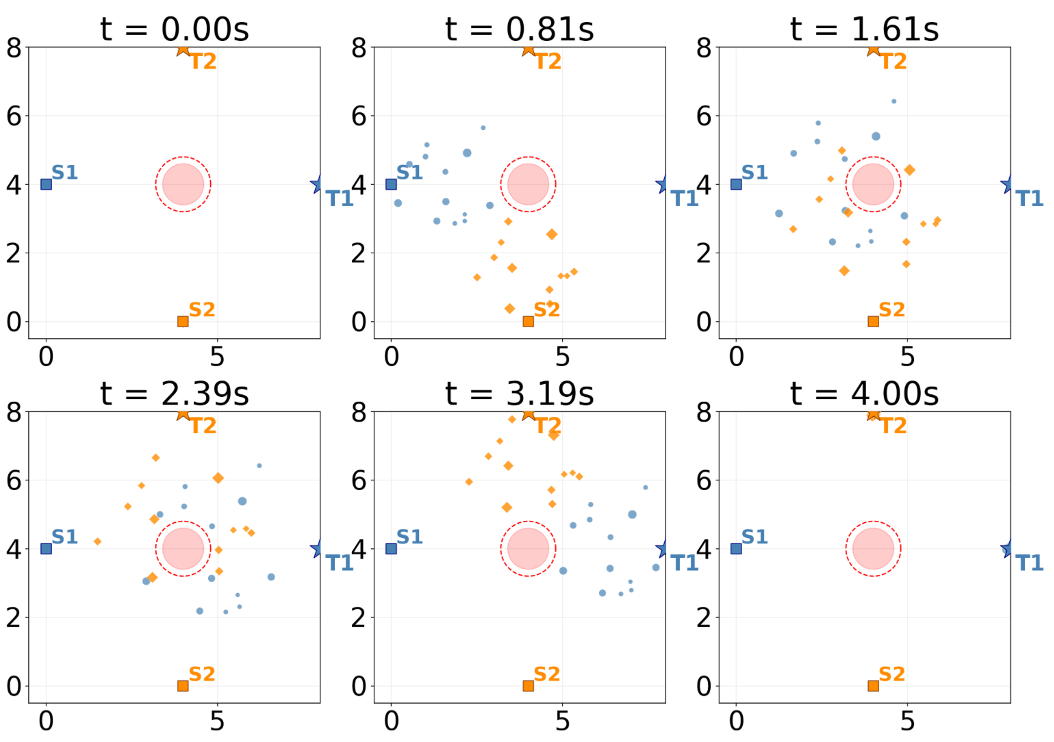
Figure 1: Symmetric two-population crossing—snapshots show balanced detours and reconvergence around intersection.
- Scenario 2 (Convex Asymmetric): Asymmetric weights enforce that one population yields, taking longer paths and exhibiting greater dispersion, consistent with the asymmetric interaction kernel's design.
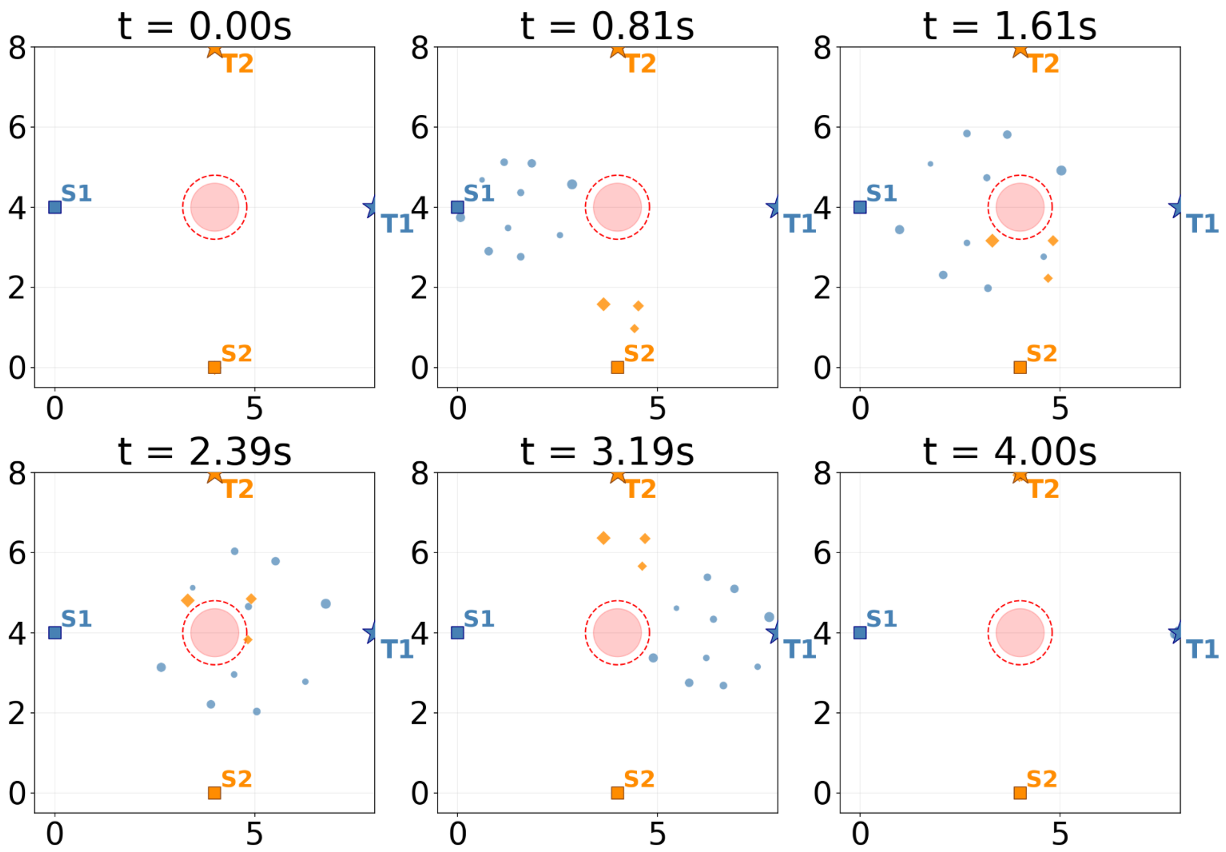
Figure 2: Asymmetric regime—population 1 (blue) yields and takes wider detours, while population 2 (orange) follows more direct paths.
- Scenario 3 (Non-Convex): With convexity violated, population distribution becomes more dispersed; nevertheless, the FW method continues to produce agents that avoid obstacles and reach their targets, though with less structured detours.
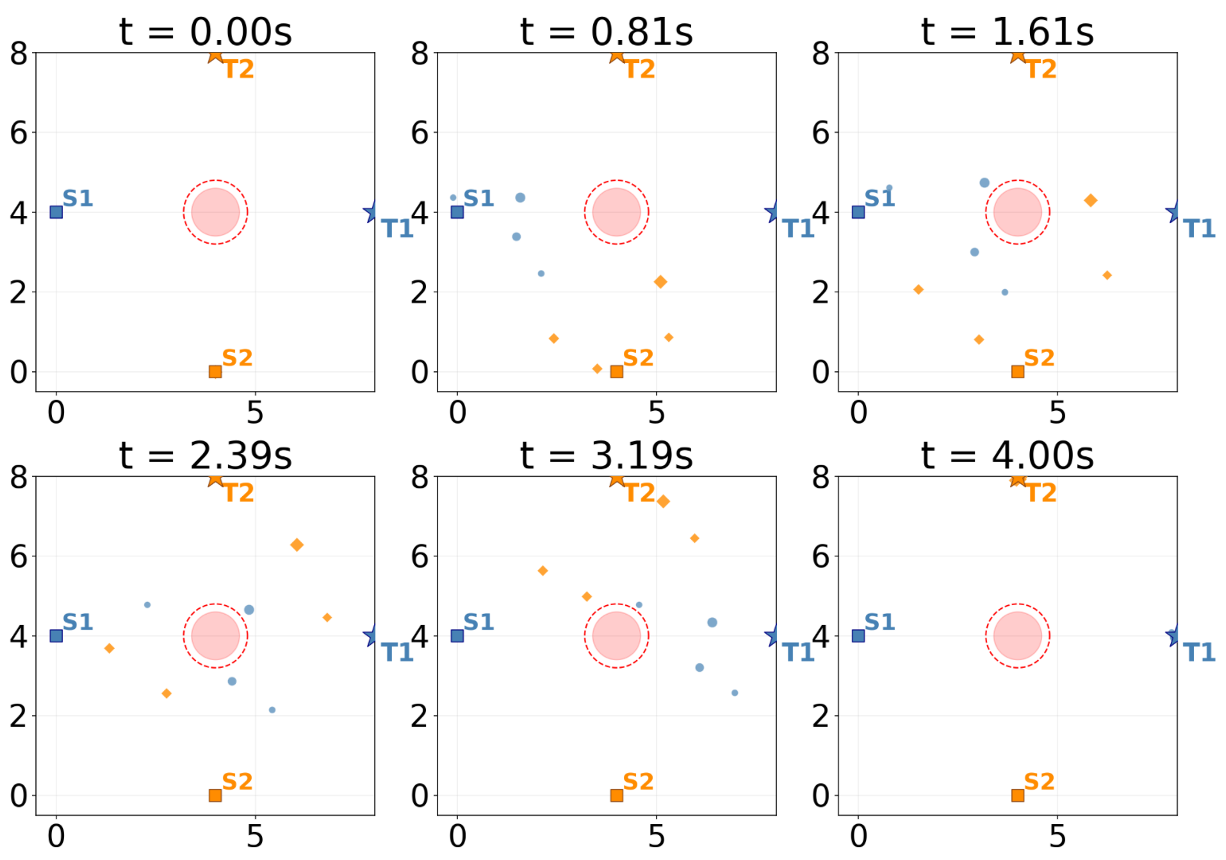
Figure 3: Non-convex interaction—populations exhibit increased dispersal and less organized crossing.
The objective value a7 decreases monotonically across Frank-Wolfe iterations, even in the non-convex regime, illustrating empirical convergence:
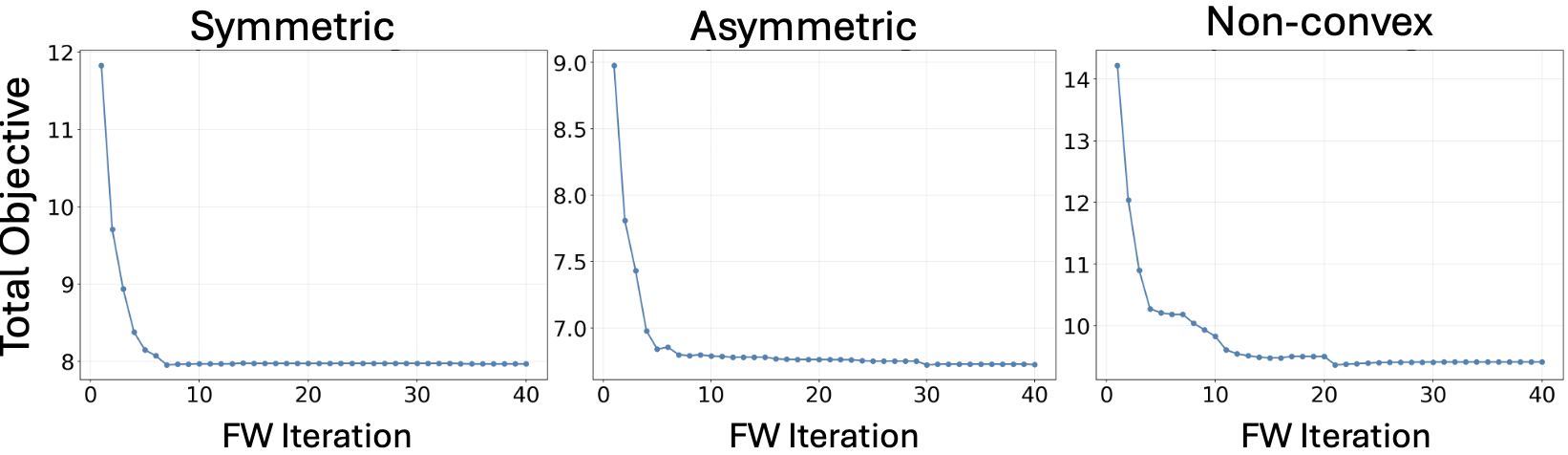
Figure 4: FW convergence of the objective value a8 across all three interaction regimes.
Directional, Heterogeneous Coordination in 3D Search-and-Rescue
The method extends seamlessly to a three-dimensional, obstacle-rich scenario with directional, population-asymmetric interaction kernels. Here, the primary constraint is that a "search" population must remain ahead of a "rescue" population along a mission-aligned axis. The algorithm enforces this ordering as designed, with populations efficiently avoiding obstacles and preserving the hierarchical structure imposed by the interaction kernels.
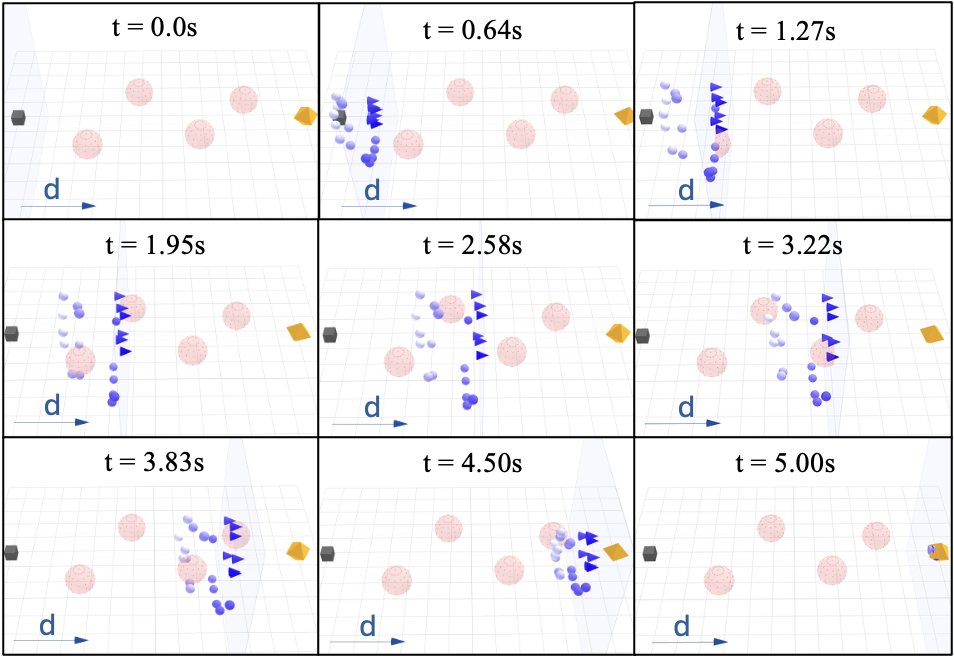
Figure 5: 3D search-and-rescue coordination—trajectories and population distributions respect mission hierarchy and obstacle avoidance.
The objective again exhibits monotonic decrease over FW iterations despite the complexity introduced by the directional kernels:
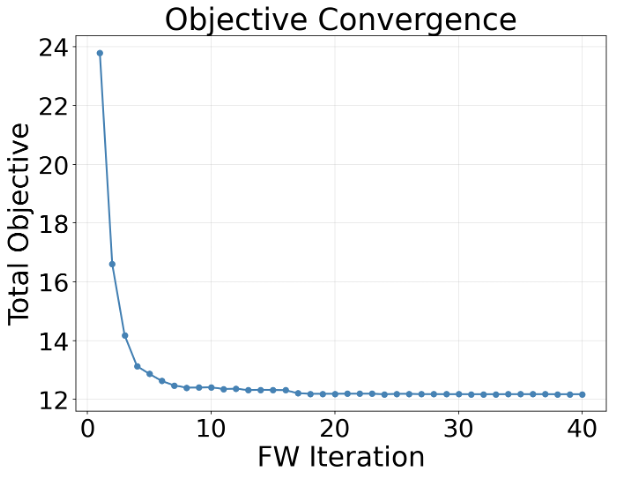
Figure 6: Convergence of objective a9 in the 3D scenario with directional, population-asymmetric coupling.
Across all cases, each FW iteration is computationally dominated by parallelizable deterministic optimal control subproblems, enabling scalability and extensibility.
Implications and Outlook
The occupation-measure and FW-based heterogeneous MFC framework provides a rigorous and tractable means to address coupled, multi-population optimal control problems without requiring a priori discretization or Monte Carlo sampling of agentwise strategies. The method's decomposition property is particularly salient: it enables parallel scalability while preserving the essential structure of mean-field interactions and heterogeneity.
The convexity assertions explicitly link system-theoretic coupling to algorithmic tractability, and the empirical viability of the FW procedure extends—even when these conditions are violated—indicates promising practical robustness. The occupation-measure approach further clarifies connections between population-level PDE relaxations, classical optimal control, and measure-theoretic optimization in high-dimensional settings relevant to real-world robotic, network, and swarm applications.
Anticipated directions for future work include non-convex convergence theory for infinite-dimensional FW in measure spaces, integration with learning-based MFC paradigms, and extensions to more general classes of interaction structures, such as those involving state and control-dependent graphons, stochastic dynamics, or time-varying kernels.
Conclusion
The paper delivers a technically principled and effectively implemented occupation-measure plus Frank-Wolfe architecture for heterogeneous mean-field control, supported by both theoretical insight and detailed numerical evidence. The decomposition property and scalable structure advance the computational capabilities available for structured multi-population optimal control problems—enabling representation of complex interactions, handling high-dimensional continuous-time systems, and supporting robust empirical performance even outside strict convexity regimes. These contributions set the stage for practical high-level coordination within multi-agent systems and provide a rigorous template for further advances in structured population-level control.

