- The paper provides a rigorous decomposition of the 21-cm power spectrum into BAO and VAO components using analytic inverse sine transform techniques.
- It shows that BAO and VAO oscillatory features exhibit non-monotonic redshift and scale evolution, impacting cosmic expansion measurements.
- Forecasts for SKA indicate that isolating these components enables percent-level corrections essential for unbiased H(z) estimation.
21-cm Acoustic Oscillations at Cosmic Dawn: Decomposition, Evolution, and Implications
Introduction
This work introduces the first rigorous decomposition of 21-cm power spectrum acoustic features at cosmic dawn into baryon acoustic oscillations (BAOs) and velocity-induced acoustic oscillations (VAOs), leveraging the analytic {\tt Zeus21} framework. The study establishes that the interplay of density (δ) and baryon–cold dark matter (CDM) streaming velocity (η) fields imprints two distinct, non-identical oscillatory structures on the 21-cm signal from the intergalactic medium (IGM). Detailed analysis shows that these components are not only offset in phase, but also vary non-monotonically in relative amplitude over redshift and scale, leading to a composite "acoustic ruler" at high redshift.
This segmentation is crucial for interpreting 21-cm probes of cosmic expansion and galaxy formation, as ignoring these subtleties can bias cosmological parameter inference—specifically, producing a ∼2% error in H(z). The paper provides robust forecasts for the detectability and separability of BAO and VAO features with instruments like SKA, and delivers a clear prescription to correct for their phase offset and amplitude evolution.
Decomposition and Temporal Evolution of 21-cm Acoustic Features
The core advance is a formal decomposition of the dimensionless 21-cm power spectrum Δ212(k,z) into a smooth baseline and oscillatory "wiggle" templates that capture BAO and VAO structure. This is achieved by baseline removal via inverse sine transform techniques, separately for Pm(k) (mattered density) and Pη(k) (velocity field), and subsequent analytic propagation into T21 fluctuations.
The analysis reveals that BAO and VAO features are not phase-aligned: the BAO features are consistently shifted relative to VAO, with the maximum offset increasing for higher-order peaks. At z∼14, VAOs dominate the spectrum at low k (large scales), but their amplitude rapidly decays with increasing η0. BAOs only overtake VAOs at higher-order peaks. At η1, corresponding to the Lyman-η2/X-ray heating transition, VAO features nearly vanish and the signal becomes BAO-dominated.
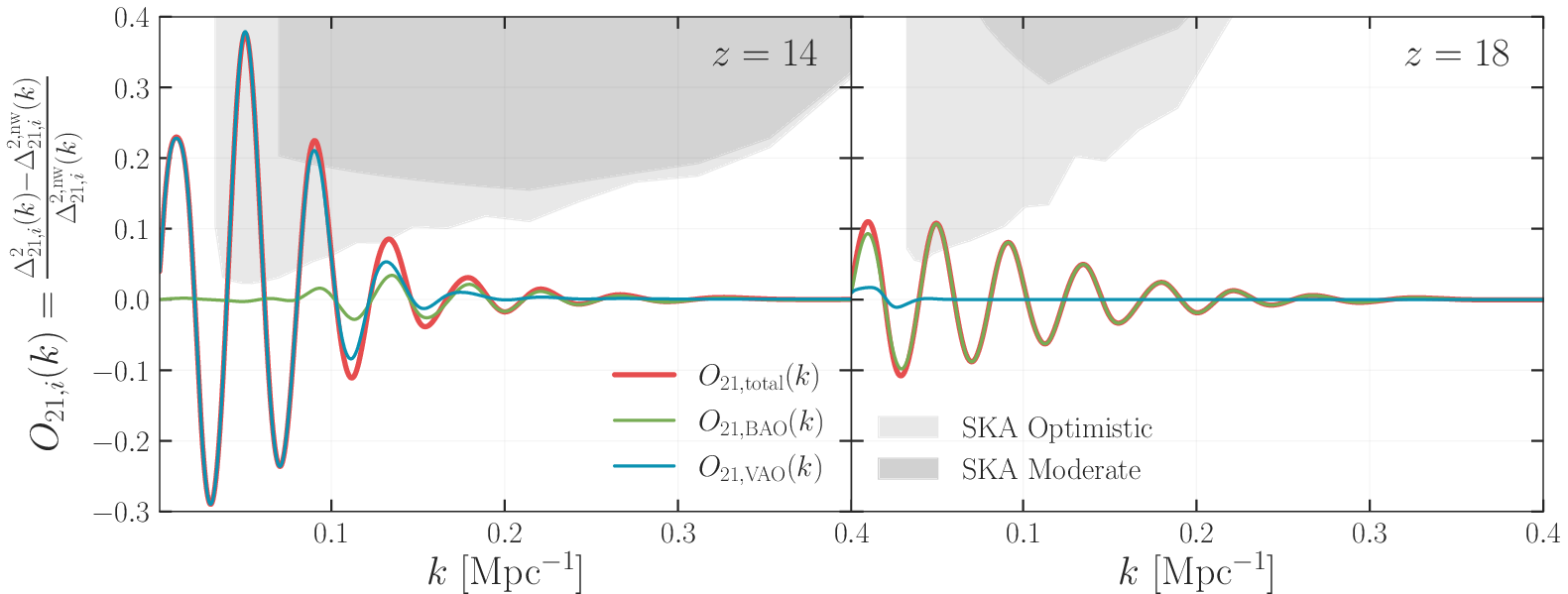
Figure 1: The normalized “wiggle”-only portion of η3 at two redshifts, split into its BAO, VAO, and total components, showing their nontrivial competition in amplitude and phase.
The non-monotonic evolution of BAO and VAO amplitudes with η4 is a direct consequence of radiative feedback-driven suppression of star formation in low-mass halos (for VAO) and the scaling of astrophysical coupling and heating terms. VAOs are absent at the transition redshift (η5), while BAOs persist to lower η6. This nontrivial redshift evolution precludes modeling 21-cm acoustic features as a simple scaled copy of low-η7 BAOs.
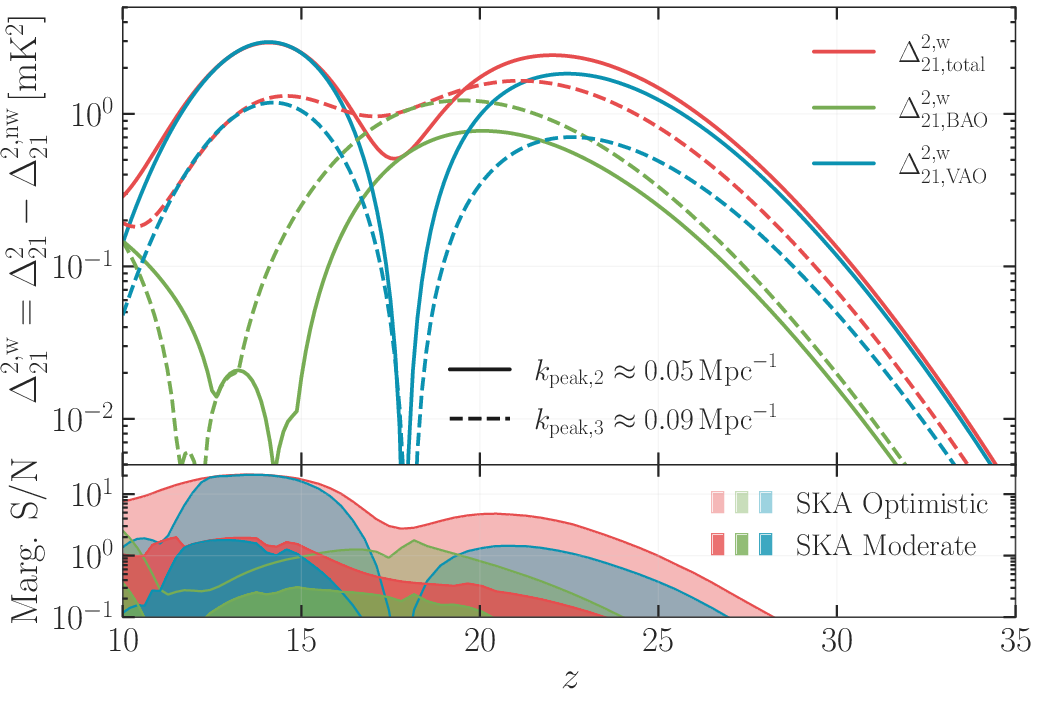
Figure 2: Amplitudes of the second and third acoustic peaks for the 21-cm spectrum and its BAO/VAO components, over redshift; the lower panel shows the marginalized SNR for detection with SKA under optimistic and moderate foreground scenarios.
Detectability and Separability with Upcoming Interferometers
The study provides comprehensive detectability forecasts for both the total wiggle power and individual BAO/VAO components using SKA, incorporating foreground removal strategies spanning the "optimistic" to "moderate" regimes. In moderate scenarios, SKA can achieve η8 detection of total acoustic structure in the η9 window; optimistic scenarios allow significant detection across ∼2%0. Detection is maximal when BAO and VAO features sum coherently—however, separability of individual components is possible primarily in the high SNR regime and via exploitation of their distinct phase structure.
The information matrix analysis demonstrates that VAOs, while more pronounced at early times, are only robustly detected in a narrow redshift window barring optimal foreground removal. Importantly, the joint detection of both BAO and VAO boosts the total SNR of the acoustic feature significantly.
Phase Structure and Implications for Cosmological Inference
Phase misalignment between BAO and VAO components has direct implications for cosmological parameter estimation. The authors measure this phase difference by undamping the oscillatory templates ∼2%1 with fitted envelope functions, yielding undamped sinusoids ∼2%2 with scale-dependent phase ∼2%3.
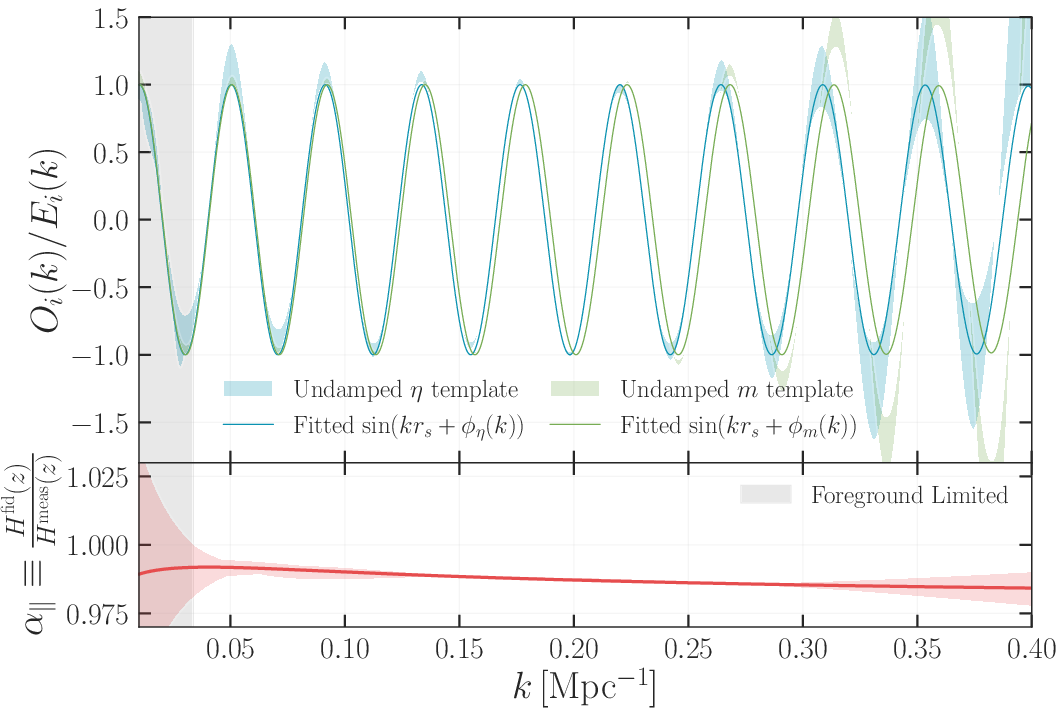
Figure 3: (Top) Undamped oscillatory components of ∼2%4 and ∼2%5, with envelope fit uncertainties; (Bottom) Alcock-Paczynski parameter error from treating VAO-only signal as BAO, showing ∼2%6 ∼2%7 bias.
Neglecting velocity fluctuations or assuming BAO-only (or VAO-only) acoustic structure produces a scale-dependent bias in the Alcock-Paczyński parameter ∼2%8 and, correspondingly, erroneous ∼2%9 constraints by up to H(z)0 across observable H(z)1-modes—already significant at the level of next-generation survey precision.
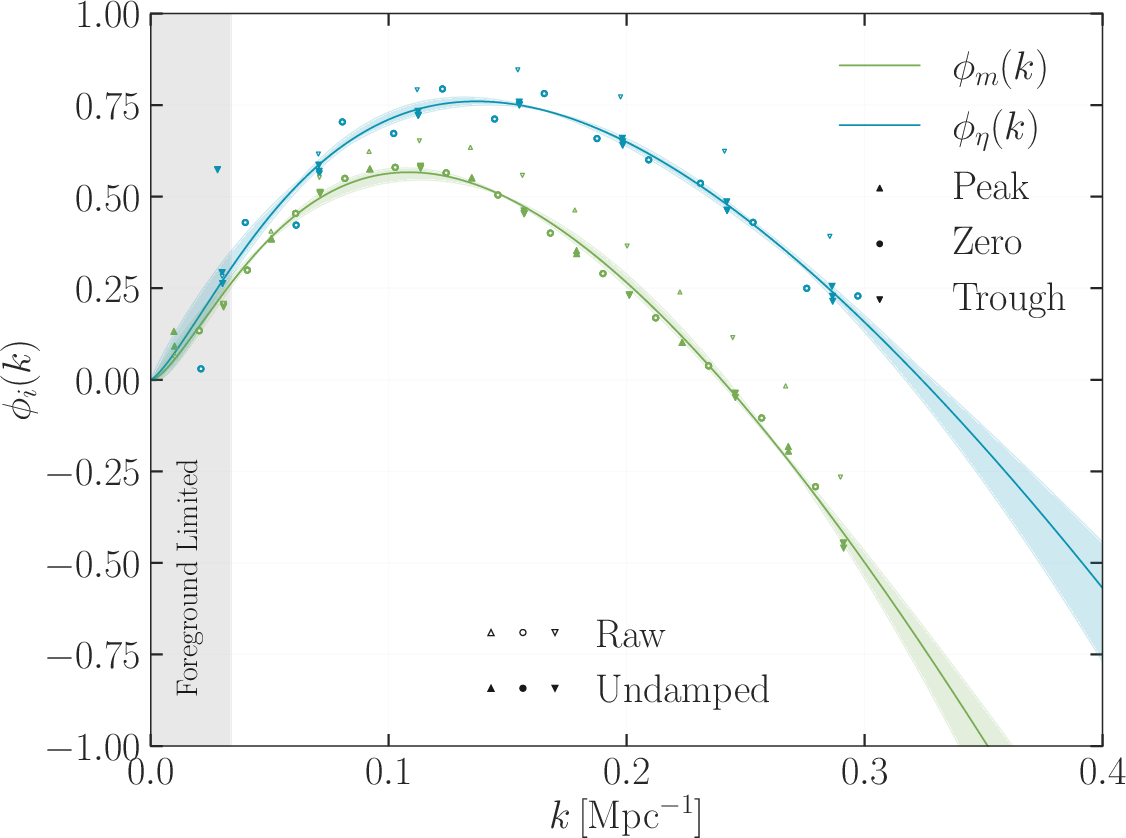
Figure 4: Scale-dependent phase offsets for wiggles in H(z)2 and H(z)3, quantifying phase errors under varying baseline/envelope choices.
Astrophysical and Cosmological Implications
The results firmly establish that joint BAO and VAO modeling is mandatory for robust inference of both astrophysical (Pop II/III SFE, radiative feedback) and cosmological (expansion rate, early structure growth) parameters from cosmic dawn 21-cm data. The amplitude, scale dependence, and evolution of BAO/VAO features are shown to carry distinctive information on both standard cosmology (e.g., baryon fraction, power spectrum shape) and new physics (non-standard DM models, light relics), as well as on the feedback-regulated star formation efficiency and timings of population transitions.
The analysis exposes pitfalls in naive 21-cm standard ruler applications that ignore VAO contributions. The forecasts provided establish concrete detection thresholds for SKA and similar facilities and offer strategies for component separation based on phase, amplitude, and redshift evolution.
Conclusion
This work represents a significant advance in 21-cm cosmology, providing a unified analytic framework for the decomposition, detection, and interpretation of acoustic features at cosmic dawn. The finding that the 21-cm signal encodes two physically distinct and partially dephased standard rulers—BAOs and VAOs—redefines how the cosmic expansion and early galaxy formation will be constrained by upcoming experiments. The robust, percent-level corrections for the phase offset between BAO and VAO templates are essential for unbiased cosmic expansion measurements at high redshift.
Future directions include joint astrophysical-cosmological inference from extended models, higher-order corrections to the phase templates, and leveraging next-generation survey data to separately constrain the fundamental physical processes imprinted on the early universe (2607.09846).