Constraining Lyman-Werner Feedback from Velocity Acoustic Oscillations in the Cosmic Dawn 21 cm Signal
Published 31 Mar 2026 in astro-ph.CO | (2603.29947v1)
Abstract: During Cosmic Dawn, Pop III stars could be formed in minihalos through molecular hydrogen (H$_2$) cooling. The minimum halo mass required for H$_2$ cooling is highly sensitive to Lyman-Werner (LW) radiation, which dissociates H$_2$ and regulates star formation. However, the efficiency of LW feedback remains poorly constrained due to the lack of direct observations of Pop III stars. The dark matter-baryon relative streaming velocity suppresses star formation in low-mass halos and imprints characteristic Velocity Acoustic Oscillation (VAO) features in the 21 cm power spectrum. These features are particularly sensitive to the cooling threshold mass: if LW feedback raises the minimum halo mass above the streaming-sensitive regime, the VAO signal is strongly suppressed. This makes the VAO wiggles a promising indirect probe of LW feedback during Cosmic Dawn. We investigate the feasibility of constraining LW feedback parameters using semi-numerical 21 cm lightcone simulations. We compute the multi-frequency angular power spectrum (MAPS) to isolate the VAO features and train a Convolutional Neural Network (CNN) to infer the LW feedback efficiency and the baseline cooling threshold. We find that in the absence of instrumental noise, the LW feedback efficiency can be accurately recovered from the VAO features. However, for the SKA-low AA* configuration, meaningful constraints require integration times exceeding $104$ hours under optimistic foreground assumptions. Nonetheless, our results demonstrate that VAO features provide a physically robust and potentially powerful probe of LW feedback at Cosmic Dawn.
The paper demonstrates that VAO features in the 21 cm signal can indirectly constrain LW feedback efficiency impacting the cooling thresholds for Pop III star formation.
It employs a modified 21cmFAST simulation and CNN-based inference to extract cooling parameter values while addressing challenges like cosmic variance and instrumental noise.
The study highlights that robust VAO detection requires long integration times and advanced foreground mitigation to reliably probe early galaxy formation.
Constraining Lyman-Werner Feedback via VAO Features in the Cosmic Dawn 21 cm Signal
Background and Motivation
The formation of Population III (Pop III) stars during the Cosmic Dawn epoch is critically regulated by molecular hydrogen (H2) cooling in minihalos. Lyman-Werner (LW) radiation efficiently dissociates H2, generating a feedback mechanism that suppresses star formation in low-mass halos and raises the minimum mass threshold required for cooling. Although this feedback profoundly impacts early galaxy formation, its efficiency remains poorly constrained due to the lack of direct observations of Pop III stars.
A distinct opportunity arises from the interplay between dark matter–baryon streaming velocities and the formation of Pop III stars. The relative velocity suppresses gas accretion in minihalos, imprinting velocity acoustic oscillation (VAO) features in the large-scale 21 cm power spectrum. VAO wiggles are highly sensitive to the cooling threshold mass; a sufficiently strong LW feedback erases the VAO signature. Thus, measuring the VAO features in the 21 cm signal provides an indirect probe of LW feedback and the cooling physics regulating the first stars.
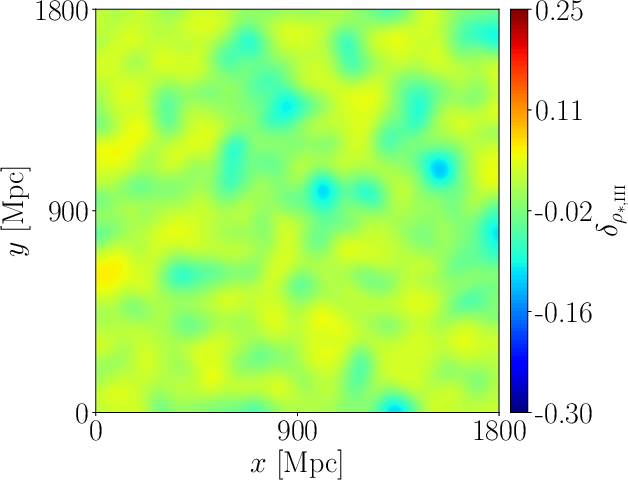
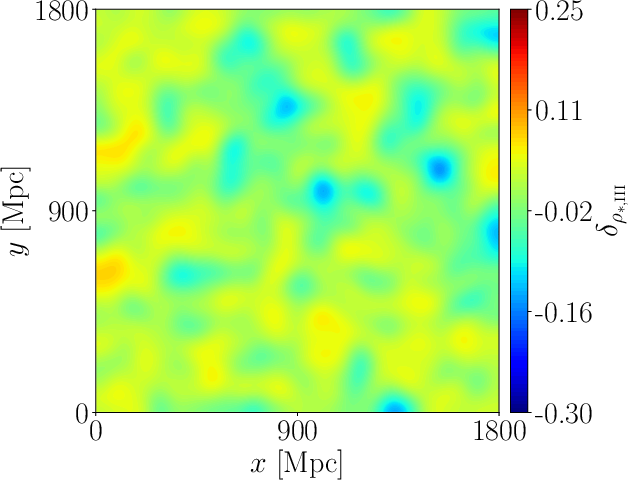
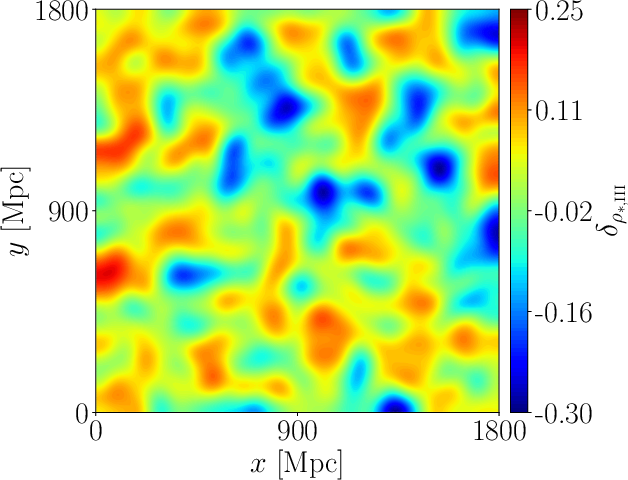
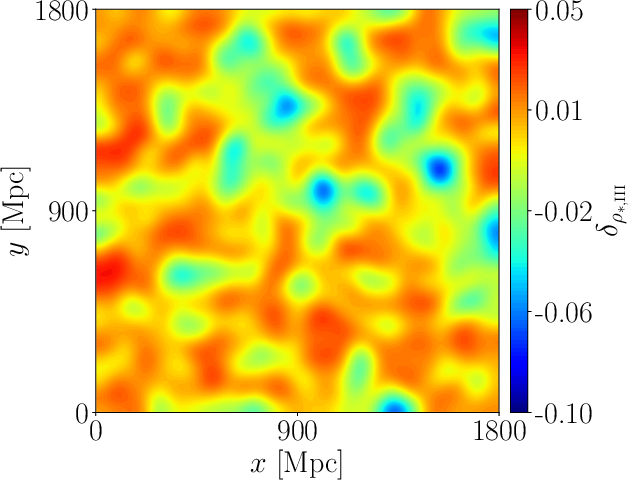
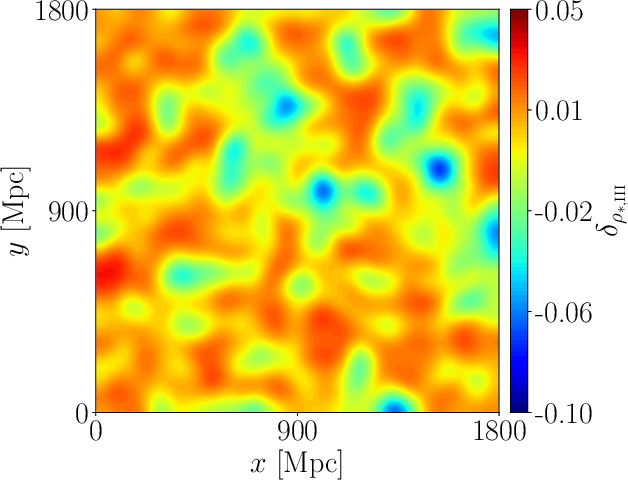
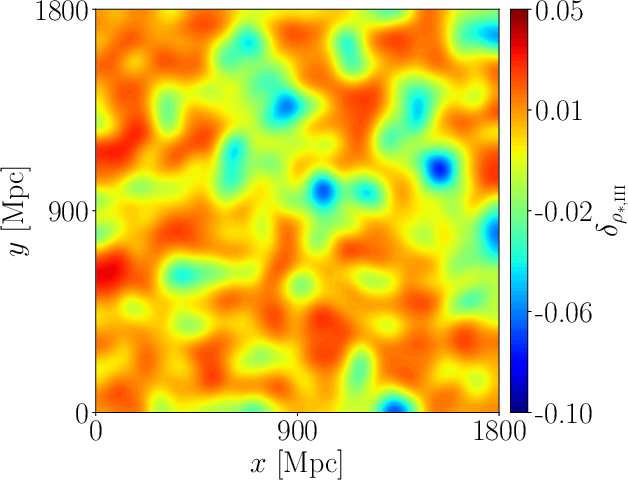
Figure 1: The relative density contrast of the Pop III stars mass field, δρ∗,III, highlighting LW feedback-modulated structure at z=26 and z=20.
Physical Modeling and Simulation Framework
The authors employ a modified semi-numerical simulation pipeline based on 21cmFAST, augmented to compute evolving density and streaming velocity fields, Pop III star formation, and the spatially resolved LW radiation self-consistently. The critical mass threshold for H2 cooling is parameterized as:
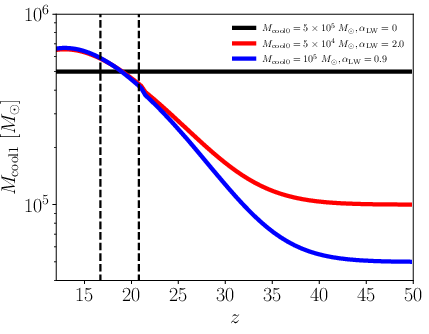
Mcool1=Mcool0[1+αLW(4πJLW)0.47]
where Mcool0 is the baseline cooling threshold and αLW the LW feedback efficiency. This mass threshold is further modulated by the local streaming velocity, following a quadratic addition in the circular velocity space, yielding a refined spatially and temporally variant critical mass Mcool2(r,z).
The simulations generate full 21 cm lightcone realizations, constructing frequency-resolved 2D angular slices (multi-frequency angular power spectrum, MAPS) suitable for the analysis of VAO features in the rapidly evolving Cosmic Dawn regime. Lightcone construction accounts for cosmic variance via randomized translations, rotations, and multiple realizations.
Figure 2: The redshift evolution of the cooling threshold mass 20 under varying LW feedback—degeneracies arise where similar cooling histories yield overlapping VAO-active intervals.
VAO Extraction and Machine Learning Inference
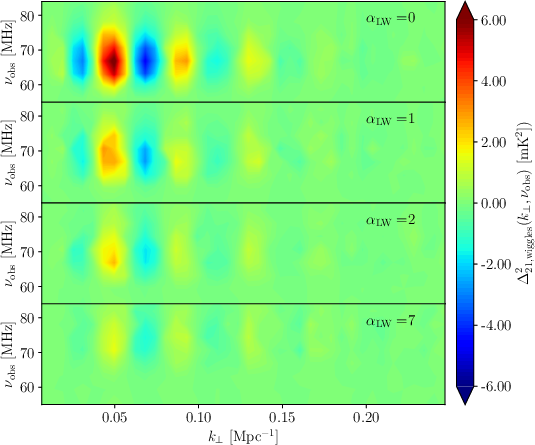
VAO features are quantified by subtracting a polynomial-fitted smooth component from the angular power spectrum, yielding net wiggles at percent-level amplitudes. The authors observe that the spatial and frequency evolution of VAO wiggles depends on both 21 and 22: increasing 23 systematically suppresses VAO amplitude, shifting the frequency window of detectability.
Figure 3: VAO features for fixed 24 and variable 25 demonstrate monotonic suppression with increasing feedback efficiency.
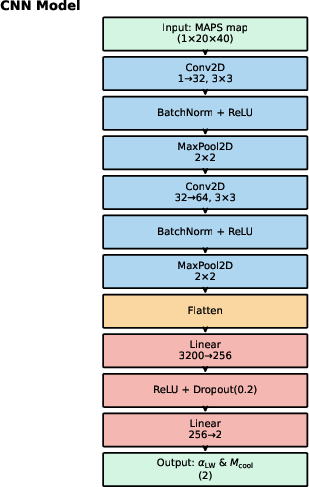
To infer cooling parameters from the MAPS morphology, a convolutional neural network (CNN) architecture is designed with two convolutional and two fully connected layers. The CNN is trained on thousands of simulation-derived MAPS samples covering a wide parameter range. The approach circumvents explicit likelihood construction, leveraging the nonlinear relations between VAO features and underlying physical parameters and robustly handling cosmic and instrumental variance.
Figure 4: CNN structure diagram—highlighting the convolutional layers, flattening, and fully connected layers utilized for parameter regression.
Numerical Results and Parameter Constraints
Three main cases are analyzed:
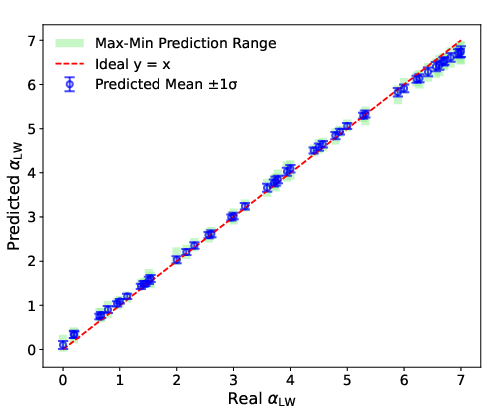
Case A: 26 inference, fixed 27. The network achieves high accuracy (28), with minimal loss and robust recovery even in the presence of significant cosmic variance across realizations.
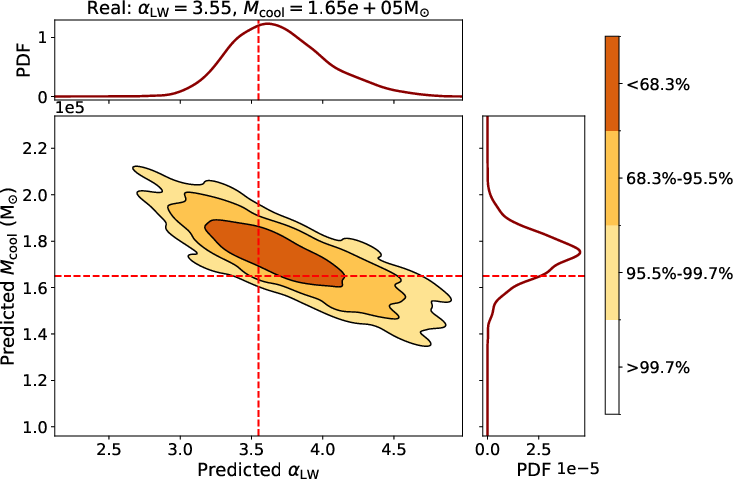
Case B: Joint inference of 29 and δρ∗,III0. Degeneracies emerge along curves of similar cooling history, but recovery remains strong (δρ∗,III1 for both parameters).
Case C: Inclusion of SKA-low AA* instrumental noise (10δρ∗,III2 hr integration). Recovery of δρ∗,III3 performance drops (δρ∗,III4), and δρ∗,III5 is not reliably constrained. Signal-to-noise and foreground contamination sharply limit sensitivity, with VAO features visible only in optimistic scenarios for low δρ∗,III6.
Notably, VAO morphology reflects cooling history in the VAO-active redshift window (δρ∗,III7–δρ∗,III8); parameter degeneracies stem from combinations generating similar cooling mass evolution, not instantaneous values.
Figure 5: CNN-recovered δρ∗,III9 versus true values in Case A demonstrates nearly perfect regression and quantifies cosmic variance.
Figure 6: Joint probability density distribution for predicted z=260 and z=261—degeneracy follows curves of constant effective cooling history.
Observational and Methodological Considerations
Foreground mitigation and large-scale mode removal are critical; VAO features reside on the largest angular scales, those most affected by wedge contamination. Even aggressive mode excision leaves some residual signal, but full wedge removal erases the VAO, highlighting the necessity of advanced cleaning protocols.
Instrumental noise and integration time requirements are challenging (%%%%322033%%%% hours), but not prohibitive. CNN-based inference outperforms Fisher matrix constraints, extracting higher-order morphological structure beyond simple summary statistics.
MAPS estimators are preferred over spherically averaged 3D power spectra due to lightcone evolution and frequency drift. The choice of polynomial degree for smooth component subtraction has minor impact relative to cosmic variance.
Implications and Future Directions
The results establish VAO wiggles as a physically robust, astrophysics-sensitive diagnostic of LW feedback during Cosmic Dawn. They provide a quantitative method for constraining the cooling mass history required for Pop III star formation—a fundamental input for galaxy formation models. Absence of VAO features would indicate highly efficient LW feedback or alternative suppression mechanisms.
Practically, successful recovery is contingent on next-generation instrument sensitivity, foreground mitigation advancements, and large integration times. Theoretically, the method can be extended to incorporate more detailed cooling parameterizations and multi-dimensional feedback models. Application of Bayesian neural networks or likelihood-free inference frameworks (e.g., density estimation likelihood-free inference) will likely increase reliability and enable full posterior characterization.
Machine learning emulators will be central for scaling inference to larger parameter spaces and incorporating systematics (see, e.g., [diaoMultifidelityEmulatorLargescale2025]). Synergies with forthcoming high-redshift observations (e.g., JWST, SKA) will further sharpen astrophysical constraints.
Conclusion
This work demonstrates that Velocity Acoustic Oscillation features in the Cosmic Dawn 21 cm signal, modulated by LW feedback and streaming velocities, encode key information about the cooling threshold for primordial star formation. Semi-numerical MAPS simulations, combined with deep CNN inference, offer a powerful indirect probe of LW feedback efficiency. Observationally, constraints are limited by foregrounds and instrumental noise, but the methodology provides a foundational framework for interpreting future 21 cm data and advancing our understanding of early galaxy formation physics.