- The paper demonstrates that eccentricity modulation acts as a diagnostic tool to break phase degeneracy between dark matter halos and accretion disks in EMRI waveforms.
- The study employs a numerical kludge model that incorporates modified metric profiles and gas dynamics to simulate environmental effects.
- Results show that even slight eccentricity drastically reduces distinguishability time, emphasizing the need for prolonged LISA observations.
Eccentricity-Modulated Phase Degeneracy and Environmental Distinguishability in EMRIs
Introduction
This work addresses the challenge of distinguishing environmental effects—specifically, those induced by dark matter (DM) halos and accretion disks—on the gravitational waveforms from extreme mass-ratio inspirals (EMRIs) in the LISA band. EMRIs, consisting of a stellar-mass compact object inspiraling into a massive/supermassive black hole, accumulate O(105–106) GW cycles. Even subtle perturbations due to ambient matter can imprint measurable dephasing in the waveform phase evolution. Importantly, DM and disk effects exhibit partial phase degeneracy, complicating their disentanglement in future GW data. This study systematically quantifies the eccentricity-modulated phase response and establishes diagnostics for distinguishing between DM and disk-induced phase evolutions using a consistent numerical kludge waveform framework.
The gravitational waveforms are constructed using the numerical kludge method, which combines fully relativistic geodesic motion in an effective spherically symmetric spacetime with a leading-order quadrupole mapping to gravitational radiation. Environmental effects are incorporated as follows:
- Dark Matter Halo: The metric is modified according to either the Navarro–Frenk–White (NFW) or Beta profile, yielding an explicit f(r) for the background geometry. Dissipative forces (dynamical friction and Bondi–Hoyle–Lyttleton accretion) are included, directly affecting the orbital energy and angular momentum loss rates.
- Accretion Disk: The environment is modeled as a thin, α-disk. Disk properties (surface density and aspect ratio) follow established power-law scaling relations. The binary's dynamical evolution is affected via gas-driven torque, migration, and eccentricity/inclination damping prescriptions, parameterized for both subsonic and supersonic regimes according to the Mach number.
Orbital elements—including semi-latus rectum p and eccentricity e—evolve due to the combined influence of GW emission, dynamical friction, accretion, and disk torque. The waveform is synthesized for benchmark EMRI parameters, enabling a direct comparison of environmental imprints.
Eccentricity Dependence of Environmental Dephasing
Analyzing the time evolution of the GW phase, the study introduces the normalized eccentricity response, Senv(e0), as a sensitivity metric for the accumulated environmental dephasing relative to the circular case:
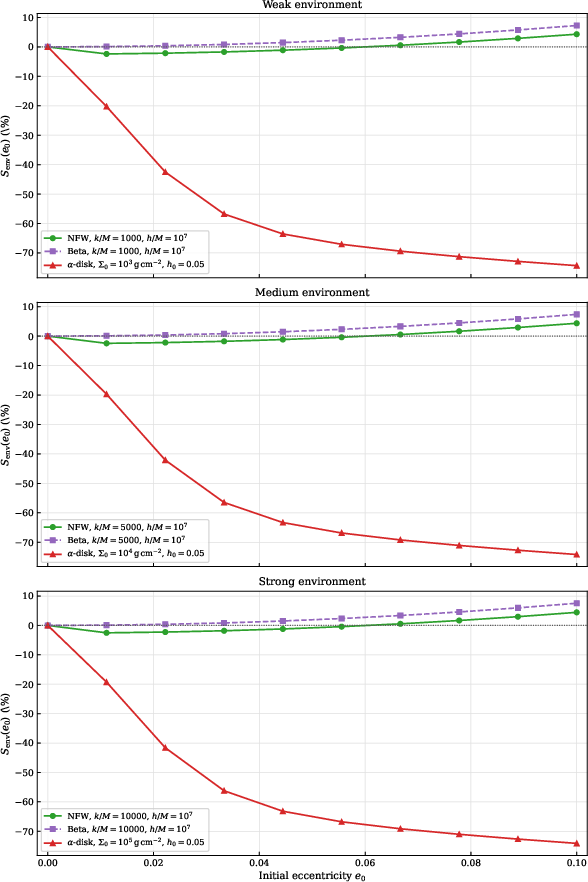
Figure 1: Normalized eccentricity response Senv(e0) for NFW, Beta, and α-disk models under varying environmental strengths, as a function of initial eccentricity e0.
The key findings are:
- DM halos (NFW/Beta): 106)0 exhibits weak dependence on 106)1 across 106)2, with only minor enhancement at high 106)3 for Beta halos. The phase response is robust to both density profile choice and halo strength.
- Accretion disk (106)4-disk): 106)5 is strongly negative and rapidly decreasing with increasing 106)6, reflecting significant suppression of disk-induced dephasing at modest eccentricities. This suppression is robust across a wide range of disk strengths.
This differential eccentricity dependence constitutes a primary diagnostic for discriminating disk versus DM phase effects in observed EMRI waveforms.
Time to Distinguishability and its Eccentricity Dependence
To address degeneracy in accumulated phase, the distinguishability time 106)7 is defined as the earliest integration time where the phase difference between DM and disk waveforms exceeds 106)8 rad. This threshold is operationally relevant for phase-resolved GW analysis.
The results demonstrate:
- Circular orbits (f(r)1): The required f(r)2 is maximal, i.e., the time to break phase degeneracy is longest.
- Slightly eccentric orbits (f(r)3): f(r)4 drops sharply—more than a factor of two reduction—even for small nonzero eccentricity, then plateaus for higher f(r)5.
- Parameter robustness: The f(r)6 feature is insensitive to halo profile, varying only with overall environmental strength.
Thus, observations of even mildly eccentric EMRIs drastically reduce the duration required to distinguish between DM and disk-induced phase evolution.
Residual SNR and LISA Detectability Analysis
To connect phase diagnostics to observability, the residual signal-to-noise ratio, f(r)7, between DM and disk waveforms is evaluated using the LISA instrument noise power spectral density. Detectability is tied to f(r)8.
The findings are as follows:
- Residual SNR α2 for all cases: Even for weak environments and one-year observations, the waveform difference is detectable.
- Dominant effect of observation time: Longer α3 linearly amplifies α4, independent of environment type or eccentricity, highlighting the criticality of long-duration LISA observation.
- Eccentricity effects: Variability of α5 with α6 is secondary, only becoming appreciable in strong environmental regimes and short observation times.
DM–disk distinguishability is therefore fundamentally limited by SNR acquisition via observation time, but eccentricity provides a diagnostic lever that can sharpen separation at fixed α7.
Implications and Future Directions
Practical Implications
The results confirm that for EMRIs observed in the LISA band, disk-induced dephasing is highly sensitive to eccentricity, whereas DM-induced effects persist for both circular and eccentric inspirals. This has direct impact for astrophysical inference: if a significant eccentricity-dependence is observed in waveform phase residuals, a disk origin is favored. Conversely, robustness to α8 points toward a DM-dominated environment. For parameter estimation pipelines, joint fitting of environmental parameters and α9 is thus essential.
Theoretical Perspectives
The clear difference in p0-modulation arises from the distinct spatial and kinematic configuration of disk (planar, dissipative, strong p1-dependence) versus halo (quasi-isotropic, weakly-interacting, monotonic p2-profile) environments. Future efforts may generalize these results to non-spherical (triaxial) halos, inclined or warped disks, and include more complex baryonic feedback.
Prospects for Space-Based Detectors
Given that observation time is the principal determinant for SNR-limited distinguishability, extended LISA operation will directly translate to greater discriminating power for environmental effects. Eccentricity will serve as an auxiliary discriminant, especially valuable for sources with intermediate or poorly constrained p3. Leveraging joint EMRI–AGN observations or cross-correlation with electromagnetic accretion disk tracers can further inform environmental modeling.
Conclusion
This study rigorously demonstrates that eccentricity serves as an auxiliary but robust diagnostic for distinguishing dark matter halo and accretion disk environmental effects in EMRI waveforms. The accretion disk signature exhibits strong suppression with increasing eccentricity, while the dark matter-induced dephasing remains comparatively insensitive. The observation duration is, however, the primary limiter of DM–disk distinguishability in the LISA regime. These findings motivate future waveform modeling and parameter inference strategies that prioritize accurate eccentricity characterization, long-duration observation, and thorough consideration of environmental effect degeneracies for precision gravitational wave astrophysics.