- The paper demonstrates a scalable protocol using the PPT criterion and overlapping state tomography to detect two-spin entanglement in quantum phase transitions.
- Results reveal strong nearest-neighbor entanglement in TFIM and XXZ models, with error mitigation aligning noisy quantum hardware data with MPS benchmarks.
- The study highlights the localized nature of two-qubit entanglement at criticality, paving the way for extended analysis of multipartite and topological entanglement.
Probing Two-Spin Entanglement at Quantum Criticality on a Quantum Processor
Introduction and Motivation
The paper "Probing two-spin entanglement at quantum criticality on a quantum processor" (2607.08967) investigates the detection and characterization of bipartite entanglement in strongly-correlated quantum many-body systems at quantum criticality, leveraging near-term quantum hardware. The work critically addresses the limitations of entanglement entropy (EE) as an experimentally accessible metric on noisy quantum processors, particularly in mixed-state regimes commonly encountered due to decoherence and imperfect gates. Instead, the authors employ the Positive Partial Transpose (PPT) criterion—along with overlapping state tomography (QOT)—as an entanglement witness suitable for both pure and mixed states. This methodological choice enables scalable, hardware-efficient mapping of subsystem entanglement across quantum phase transitions in archetypal 1D spin chains such as the transverse-field Ising model (TFIM) and the XXZ chain.
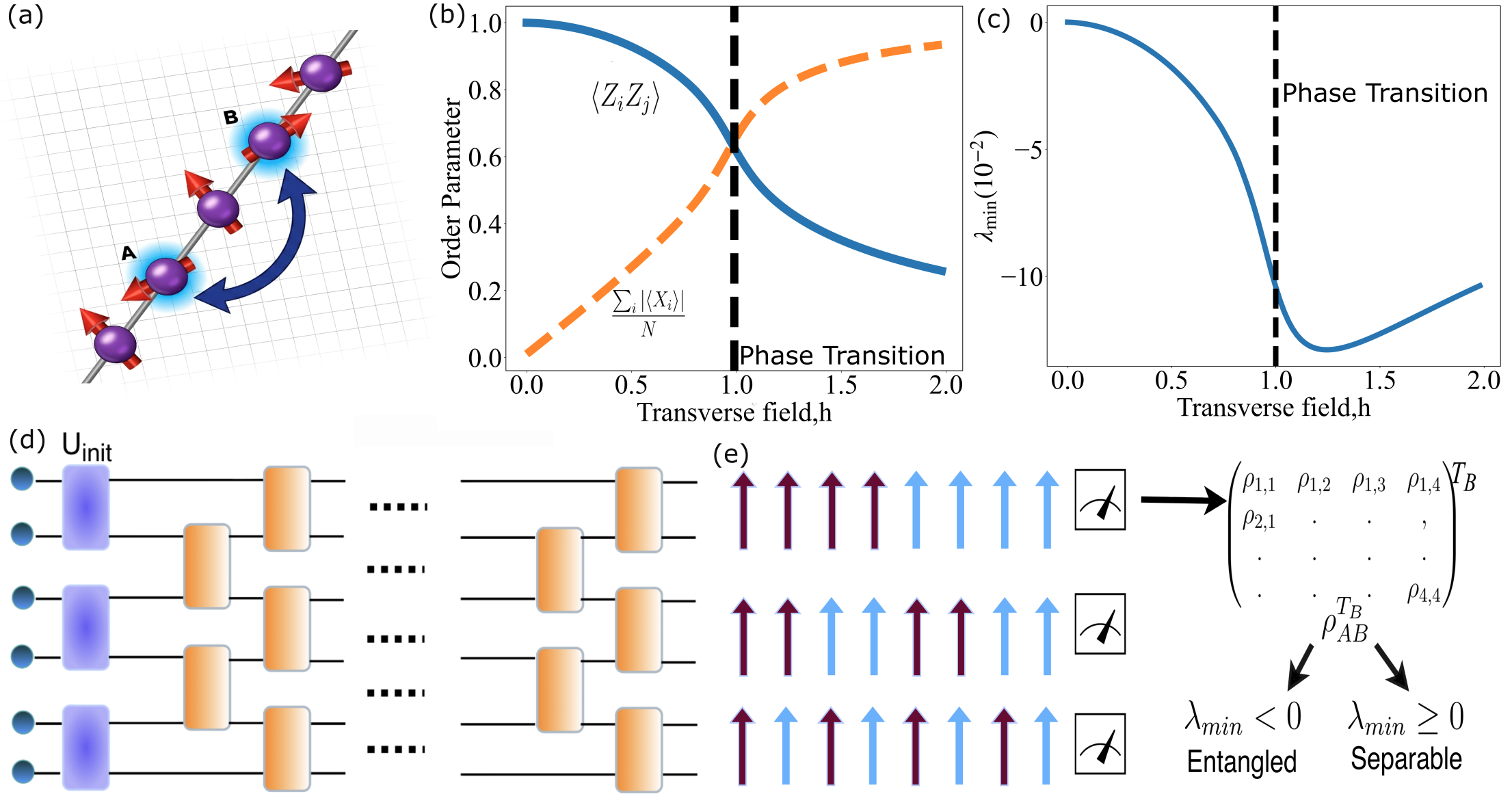
Figure 1: Schematic of the protocol, including spin-chain models, phase transitions, PPT witness maximization at quantum criticality, variational state preparation on quantum hardware, and the overlapping state tomography strategy.
The PPT Criterion and Overlapping Tomography
Fundamentally, the PPT criterion diagnoses entanglement in two-qubit reduced density matrices, regardless of whether the global system state is pure or mixed. For a spin pair with reduced state ρAB, a negative minimal eigenvalue of the partial transpose (λmin<0) certifies entanglement with both necessity and sufficiency in 2×2 and 2×3 Hilbert spaces.
The experimental protocol reconstructs all two-qubit reduced density matrices of a prepared many-body state by measurement in multiple local Pauli bases—a logarithmic number of measurement settings per QOT [Cotler, Wilczek 2020]. The reconstructed ρAB are then subject to the PPT test to assign pairwise entanglement structure as a function of Hamiltonian parameters, system size, and hardware noise.
The target systems are benchmark Hamiltonians in condensed matter:
H^TFIM=−Ji=1∑N−1σizσi+1z+hi=1∑Nσix
H^XXZ=−Ji=1∑N(σixσi+1x+σiyσi+1y)+Δi=1∑Nσizσi+1z
For both models, variational, physics-inspired brick-wall circuits adiabatically connect simple valence bond states to the interacting system ground states. The ansatz fidelity is maximized layerwise, and the circuits are transpiled for execution on IBM’s 156-qubit superconducting hardware with periodic qubit layouts.
Experimental Results and Error Mitigation
The key experimental contribution is a detailed comparison of hardware-derived entanglement signatures with Matrix Product State (MPS) numerical ground states, including robust error mitigation:
- Raw Results: Quantum hardware captures strong nearest-neighbor entanglement at and near criticality, but with loss of next-nearest and longer-range entanglement due to noise-induced separability, especially evident in the XXZ chain.
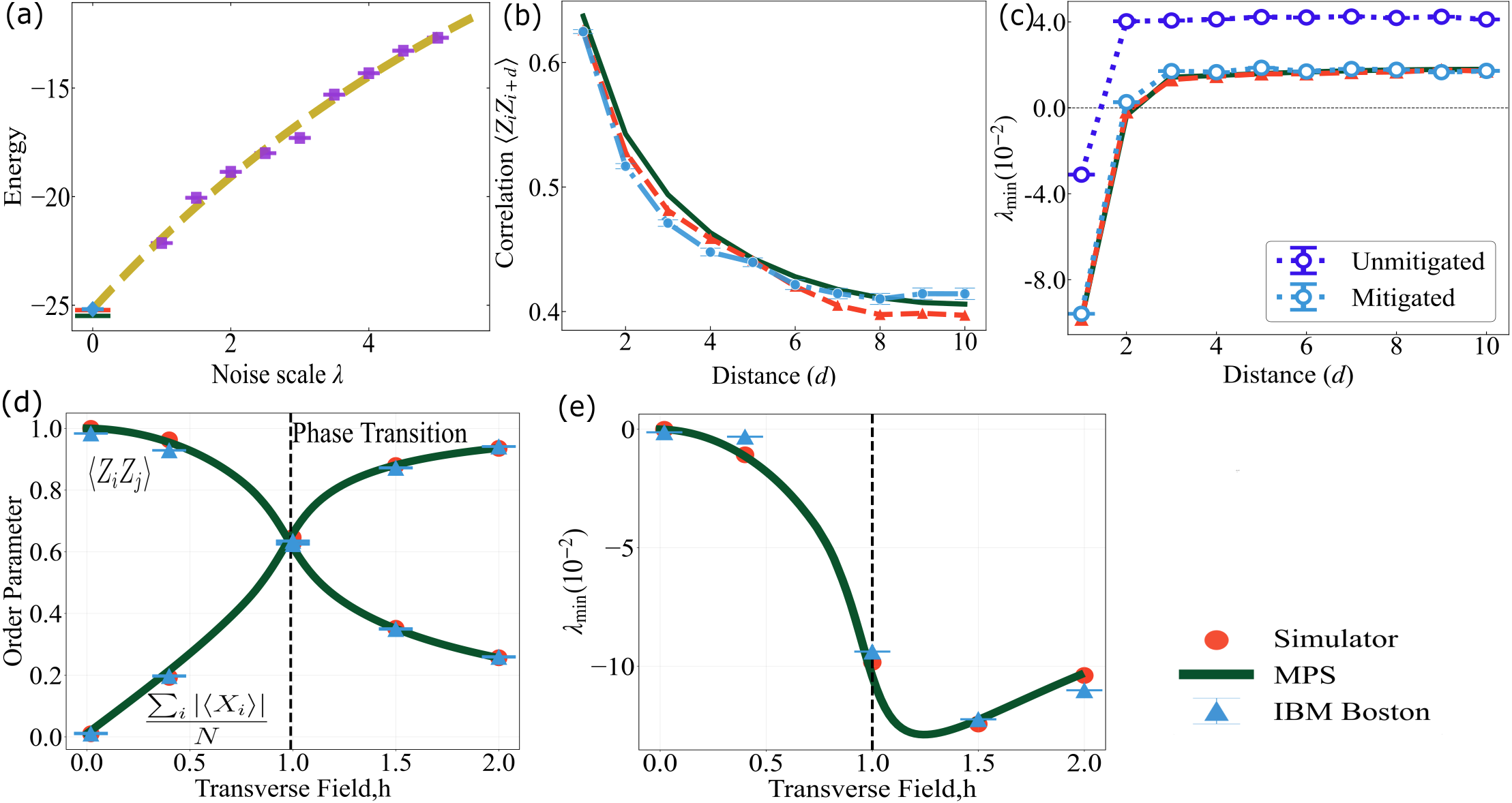
Figure 2: Zero-noise extrapolated energy and power-law decay of correlations in the TFIM. Hardware mimics MPS benchmarks with high fidelity post-mitigation; λmin reveals nearest-neighbor entanglement only at and around criticality.
- Error Mitigation: Readout errors are mitigated via matrix-free methods, and gate errors are attenuated by robust zero-noise extrapolation (ZNE) protocols involving circuit folding strategies and local error modeling. After mitigation, hardware PPT spectra align quantitatively with numerical MPS entanglement maps, reliably recovering pairwise entanglement structure for chains up to N=20.
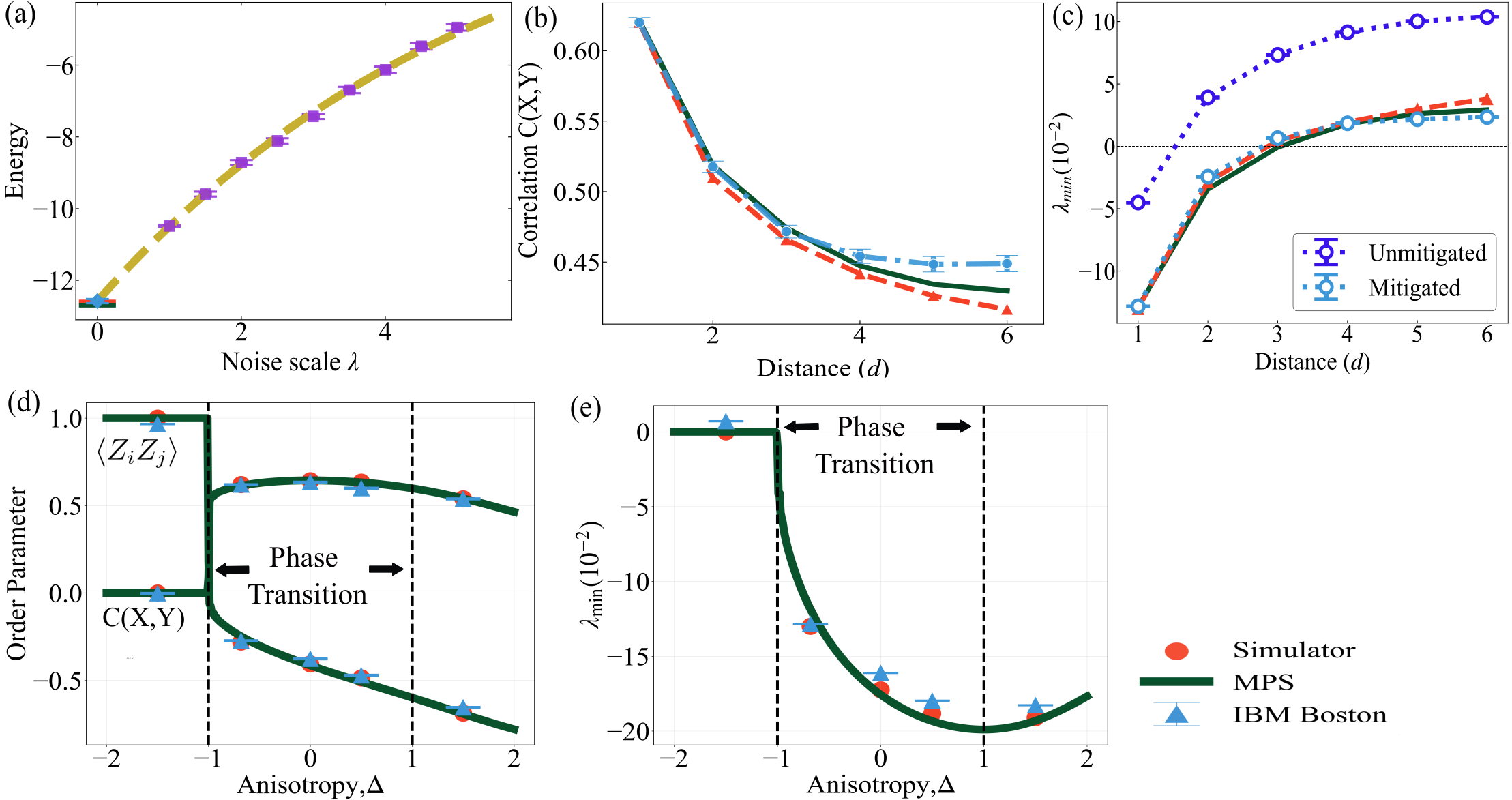
Figure 3: Analogous quantum simulation results for the XXZ model. Two-spin entanglement robustly detected for both nearest and next-nearest neighbors in the gapless phase, consistent with MPS data after mitigation.
- Universality: Across both models, the PPT witness exhibits a pronounced dip (more negative λmin) precisely at the phase transition, marking the locus of maximum two-spin entanglement in the space of control parameters.
Physical Interpretation and Entanglement Structure
The PPT analysis demonstrates that while quantum critical points are associated with divergent correlation length and area-law violations in EE, two-qubit entanglement does not necessarily extend beyond next-nearest neighbors, even in idealized ground states. Hence, observed long-range correlations at criticality are predominantly classical, with genuine quantum entanglement manifesting dominantly in local (adjacent) spin pairs. Notably, for the TFIM, two-spin entanglement at criticality is strictly short-ranged, while the XXZ model admits next-nearest neighbor entanglement in the gapless regime.
The implications are twofold:
- The PPT witness offers a practical metric for benchmarking and diagnosing quantum hardware operation in simulating highly entangled states at the frontier of classical tractability.
- The absence of multi-site entanglement in two-site reductions motivates generalization to multipartite witnesses to probe the full hierarchy of many-body entanglement—essential for identifying exotic phases and verifying quantum computational advantage.
Theoretical and Practical Implications
This research underscores several points relevant for quantum simulation, condensed matter, and the development of quantum information tools:
- Hardware Validation: The PPT witness, accessible via QOT, sets a standard for evaluating entangling capacity and noise performance of quantum processors on nontrivial correlated states—not merely via global fidelities, but through subsystems’ entanglement structure.
- Scalability: By relying on local tomography and two-qubit reductions, the method is compatible with the scaling properties of advanced, high-qubit-count devices, where ancilla and mid-circuit measurement overhead for full state tomography is prohibitive.
- Model Independence: The protocol is model-agnostic, usable for thermal states, mixed states, and a variety of Hamiltonians—enabling broad application in benchmarking and validation across distinct physical platforms.
- Limitations and Future Directions: The methods’ inability to capture multipartite or topological entanglement structures in minimal reductions points directly to the importance of developing scalable λmin<00-site tomography and PPT-based (or alternative) higher-body witnesses, especially targeting phases inaccessible to two-site analysis, e.g., quantum spin liquids and symmetry-protected topological phases.
Conclusion
The integration of PPT entanglement detection with scalable overlapping tomography and robust variational state preparation on quantum hardware provides a practical, quantitative framework for characterizing and benchmarking two-qubit entanglement at quantum criticality. The workflow bridges conceptual advances in quantum information with pragmatic demands of hardware evaluation. The results emphasize that while two-spin entanglement is localized even at criticality, the approach sets the groundwork for extension to multipartite entanglement detection and cross-platform benchmarking, vital for the verification and validation of emerging quantum technologies as they scale in both qubit number and circuit complexity.
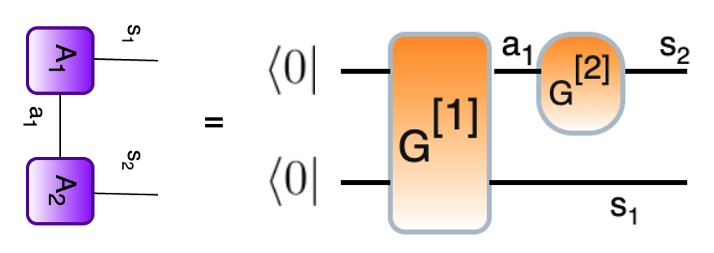
Figure 4: Exact quantum circuit representation of a two-qubit MPS, providing the primitive for scalable variational ground-state preparation.
Future research should generalize these methodologies to systematically characterize multipartite and topological entanglement, as well as dynamical and non-equilibrium states, across diverse quantum architectures. This would facilitate comprehensive reliability benchmarks and deepen our understanding of entanglement phenomena in quantum critical and strongly-correlated systems.