- The paper presents a novel MERA implementation on a trapped-ion quantum computer that efficiently probes entanglement scaling across a quantum phase transition.
- It employs holographic tomography and hardware-native Mølmer-Sørensen gates to achieve logarithmic circuit depth and measurement resources.
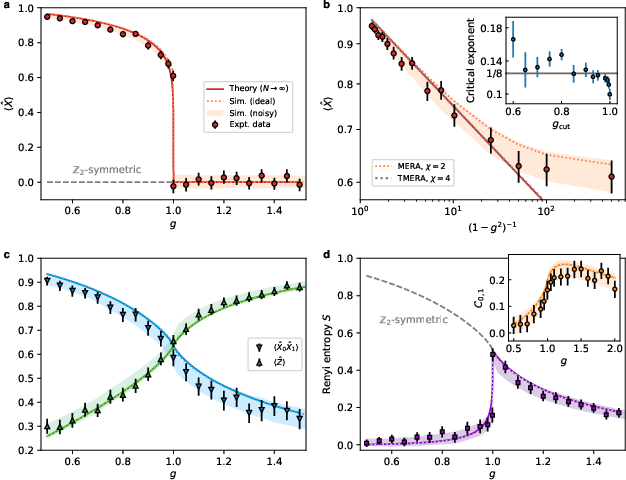
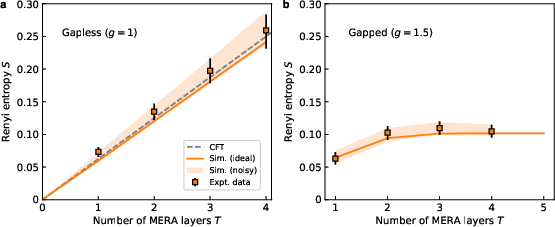
- Benchmarking on the 1D transverse-field Ising model reveals both area-law and log-law entanglement scaling, with accurate critical exponent extraction and robust error modeling.
Probing Entanglement Scaling and Criticality with MERA on a Trapped-Ion Quantum Computer
Introduction
The paper "Probing Entanglement Scaling Across a Quantum Phase Transition on a Quantum Computer" (2412.18602) presents a comprehensive demonstration of entanglement scaling and critical phenomena in quantum many-body systems using the multiscale entanglement renormalization ansatz (MERA) realized on a trapped-ion digital quantum computer. The primary focus is the measurement and characterization of entanglement across a quantum phase transition, overcoming the significant challenges imposed by finite-size effects, measurement costs, and state preparation complexities inherent in both classical and quantum simulation approaches.
Methodology: MERA Implementation and Holographic Tomography
The authors address three major obstacles in simulating quantum criticality on quantum hardware: limited qubit counts, exponential measurement costs for subsystem entanglement, and poor variational trainability in deep quantum circuits. Leveraging the MERA tensor network, which hierarchically organizes entanglement across multiple scales, the study achieves efficient quantum circuit constructions whose depth and measurement overhead scale only logarithmically with system size and correlation length.
The MERA circuits are deployed on a fully-connected linear chain of up to 15 171Yb+ ions. Local observables and reduced density matrices for arbitrary subsystems are obtained by executing circuits within the corresponding causal cone of the MERA, allowing for selective subsystem tomography ("holographic tomography") that circumvents full state reconstruction (Figure 1).
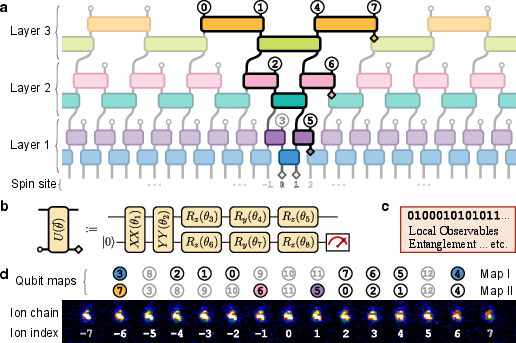
Figure 1: MERA construction, causal cone structure, and measurement protocol on a trapped-ion chain enabling scalable access to subsystem entanglement.
Gate compilation strategies incorporate hardware-native Mølmer-Sørensen XX(θ) gates and symmetry-tailored constructions, minimizing error accumulation while implementing all circuit elements necessary for MERA layers and isometries (Figure 2).
Experimental Results
Benchmarking the Quantum Phase Transition
The method is benchmarked on the 1D transverse-field Ising model (TFIM), a paradigmatic critical system exhibiting a quantum phase transition from an ordered ferromagnetic to a disordered paramagnetic phase. The demonstration includes:
Entanglement Entropy Scaling
A central achievement is the direct measurement of entanglement entropy scaling laws across the quantum phase transition:
Entanglement Spectrum and Gap
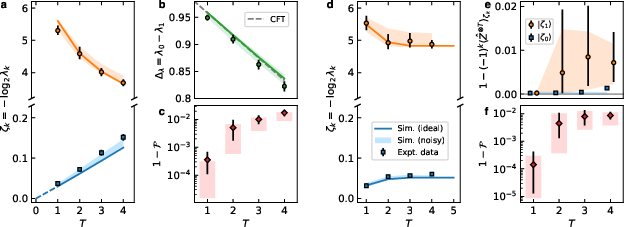
The study further investigates the entanglement spectrum (the eigenvalues of the reduced density matrix viewed as the spectrum of an effective "entanglement Hamiltonian"):
Implications and Outlook
This work demonstrates that MERA circuits, realized on digital quantum computers with all-to-all connectivity, offer a scalable approach to probing both local and global entanglement properties in strongly-correlated quantum systems, including the direct observation of log-law entanglement scaling—a hallmark of criticality.
Key practical implications include:
- MERA quantum circuits readily scale to system sizes and effective subsystem sizes beyond reach for classical simulation methods.
- Critical properties (universal scaling exponents, entanglement laws, entanglement spectra) can be quantitatively extracted with modest hardware resources, due to the logarithmic scaling of required qubits and gates.
Theoretical implications are:
- MERA circuits provide a bridge between renormalization group concepts and quantum computation, enabling direct access to entanglement structure across scales.
- The causal cone structure enables efficient and hardware-compatible measurement, suppressing the exponential explosion of tomography costs in generic circuits.
Future prospects involve extending these MERA-based protocols to higher-dimensional systems, frustrated magnets, and fermionic models. For 2D and larger bond dimensions (χ), classical contraction costs become prohibitive; however, quantum implementations with logarithmic scaling in system size and bond dimension become especially advantageous. Additionally, MERA-prepared states provide rigorous groundwork for nonequilibrium and Floquet protocols, for which entanglement growth generically leads to classical intractability.
Hybrid methods—e.g., Trotterized MERA, entanglement Hamiltonian tomography, and randomized measurements—are poised to further enhance the practicality of these techniques as quantum hardware scales in both gate fidelity and qubit number.
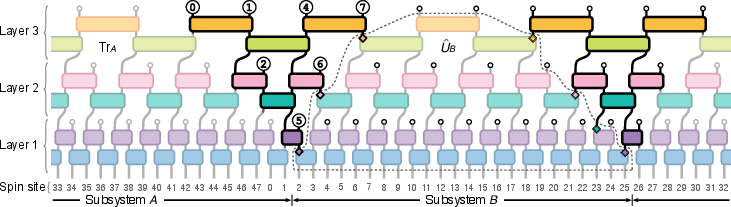
Figure 6: Holographic subsystem tomography, showing reduced experimental requirements for efficient entanglement spectrum extraction in MERA.
Conclusion
The paper establishes that implementing MERA on a trapped-ion quantum computer enables the observation and quantitative characterization of quantum criticality and its associated entanglement scaling laws. The combination of efficient circuit structure, robust error modeling, and holographic measurement demonstrates clear advantages for studying universal properties of strongly correlated quantum systems and advances the frontier for quantum simulation of condensed-matter phenomena on programmable quantum hardware.