- The paper introduces a unified framework that uses a relaxation coefficient to trade off between speed and task capability in token generation.
- It benchmarks constrained, fuzzy, and contrastive decoding methods, revealing practical performance trade-offs and resource limitations.
- Experimental results show that robust drafters are essential, as weaker models can degrade performance and incur additional evaluation overhead.
Introduction and Motivation
Autoregressive LLMs underpin state-of-the-art language modeling but are fundamentally limited by sequential token generation, which leads to undesirable latency in practical applications. Speculative decoding addresses this by introducing a low-cost auxiliary drafter that rapidly proposes token spans, which are then parallel-verified by the primary LLM (verifier), accelerating generation without sacrificing the sampled distribution.
Strict speculative decoding preserves the original distribution through rejection/resampling mechanics, providing lossless speed-up. Recent research proposes “relaxed” speculative decoding methods that deliberately deviate from the verifier distribution to unlock further speed-ups, enable controlled capability-speed trade-offs, or even enhance task capability. This paper systematically investigates a wide array of training-free, per-token relaxed speculative decoding techniques, benchmarking them in contemporary settings and distilling actionable takeaways and empirical findings.
The paper establishes a unified framework for relaxed speculative decoding: strictly, tokens proposed by the drafter q are either accepted or rejected by the verifier p according to the acceptance ratio p/q, with residual resampling ensuring output from p. Relaxed variants replace p with a relaxed target distribution π, parameterized by the relaxation coefficient α. Relaxation can be applied to rejection, residual, and bonus sampling steps, introducing diverse narratives and trade-off behaviors.
Key algorithmic types include:
- Constrained Acceptance (CACTUS/mentored-dec): Explicitly maximizes acceptance probability while constraining divergence (usually KL) from p; enables tight control of deviation, providing predictable capability-speed trade-offs.
- Fuzzy Acceptance (r-fuzzy/spec-casc-opt/ensemble): Draft acceptance based on similarity/divergence criteria between q and p; interpolates between strict spec-dec and unrestricted drafter output, facilitating tunable trade-offs.
- Contrastive (spec-cont-dec): Uses the drafter-verifier pairing in a contrastive fashion, deliberately pushing the output distribution away from p0 to improve task capability; may sacrifice generative speed.
(Table summarizing taxonomy omitted as per instruction; full details in paper.)
Modeling Speed-up and Practical Deployment Constraints
The token-throughput speed-up achievable via speculative decoding is a nontrivial function of drafter cost (p1), average accepted span (p2), and draft length (p3):
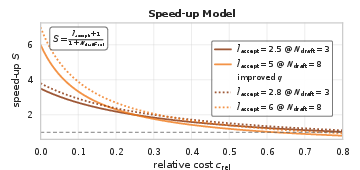
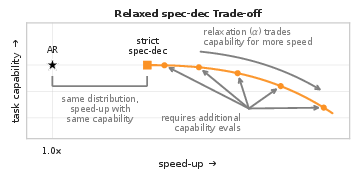
Figure 1: The speed-up model shows how p4, p5, and p6 interact, affecting achievable speed-up and optimal settings.
Relaxed methods—by accepting more tokens from p7—can further increase p8 and speed-up, but at the potential cost of task capability, necessitating empirical evaluation and calibration of p9. The paper highlights the critical deployment caveat: if an application is capability-constrained, strict spec-dec requires no additional evaluation, while relaxation incurs potentially prohibitive evaluation overhead.
Resource and infrastructure bottlenecks (e.g., memory, kernel launch overhead, batch scheduling) can limit real-world speed-ups; practitioners should consider these alongside the proxy model when optimizing deployments.
Experimental Evaluation: Methodology and Findings
The paper conducts broad empirical benchmarking across modern LLMs (Qwen3.5 MTP, Qwen3 0.6B, Qwen3 8B, Llama3), evaluating relaxed spec-dec variants on AIME24, GPQA, and LCB—contemporary reasoning and coding benchmarks. Metrics include both token-throughput and generation-length-adjusted speed-up (p/q0), as well as task capability.
Key results include:
- Draft Length vs. Relaxation: Optimizing p/q1 under strict spec-dec yields speed-up gains comparable to relaxation, but with zero additional capability evaluation cost. The best p/q2 is highly sensitive to p/q3, implying that relaxation-induced speed-ups often plateau or diminish for suboptimal draft lengths.
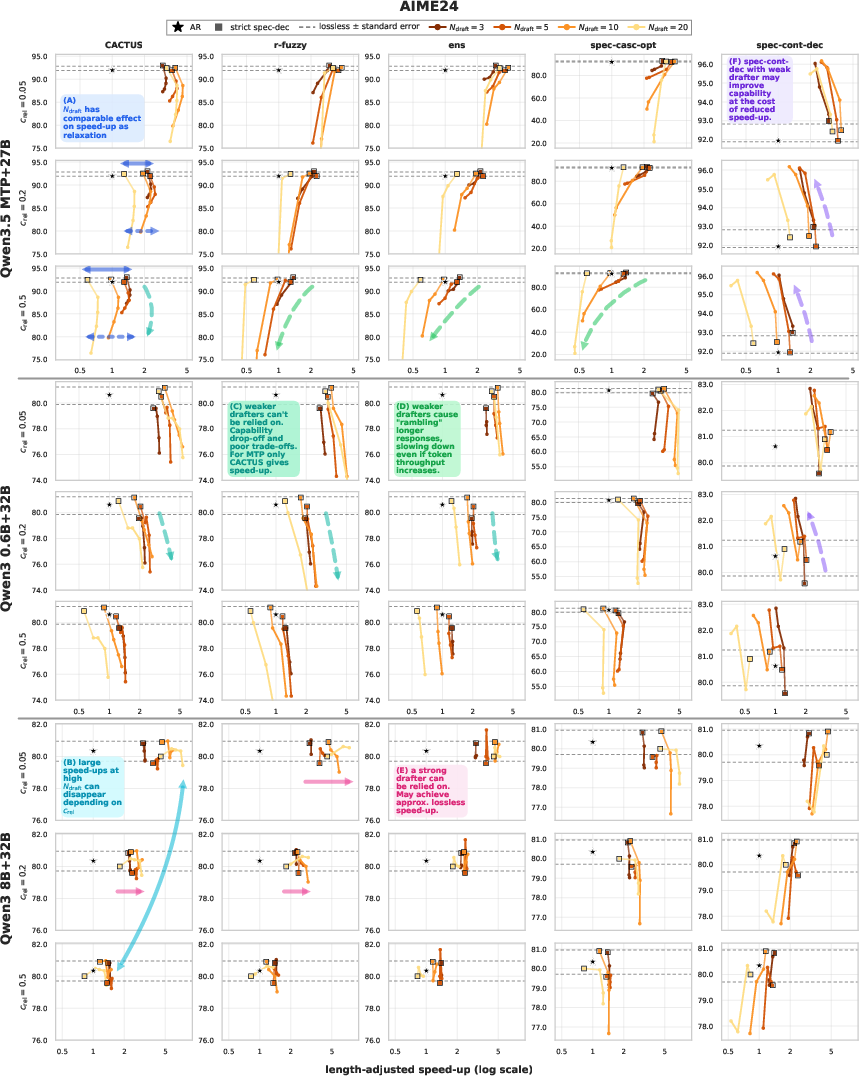
Figure 2: Capability-speed trade-offs highlight the comparable impact of draft length and relaxation parameter, and the necessity of calibrating p/q4 to specific p/q5.
- Drafter Language Modeling Quality: Relaxed methods relying on p/q6 for generation (ensemble/fuzzy/cascade) are only viable when p/q7 is a robust LLM. Weak or MTP drafters, while efficient for strict spec-dec, degrade capability under relaxed rejection, often yielding longer, less coherent outputs (rambling), and, in some regimes, actual slowdowns.
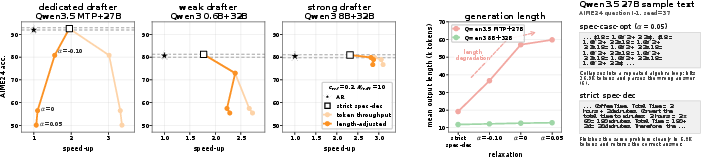
Figure 3: For weak drafters, relaxed methods exacerbate rambling and generation pathologies, lengthening responses and reducing speed-up.
- Constrained Methods Are Robust: CACTUS and mentored-dec maintain capability-speed trade-offs even with weak drafters, as their relaxation is tightly bound to p/q8 and does not simply trust p/q9. Thus, they are practically viable even in mainstream MTP-only serving scenarios.
- Contrastive Decoding Can Trade Speed for Capability: Spec-cont-dec improves accuracy on challenging tasks when the drafter is sufficiently amateurish, at the cost of reduced acceptance and speed-up.
- Relaxation Parameters Do Not Transfer Across Tasks: Calibration of p0 is task-dependent and does not reliably generalize.
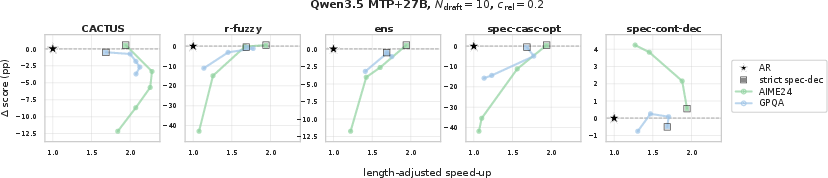
Figure 4: Relaxation hyperparameter sensitivity differs significantly across tasks (AIME24 vs GPQA)—showing that deployment calibration must consider the full target task distribution.
Theoretical and Practical Implications
The theoretical contribution is a formalization and taxonomy of per-token, training-free relaxation in speculative decoding, clarifying the design space and establishing that many "relaxed" variants are only suited for scenarios with strong drafters. Practically, deployment with MTP drafters and strict spec-dec remains the standard: relaxed decoding is not a drop-in replacement but a deployment-specific optimization whose benefits depend on drafter quality, speed/capability constraints, and evaluation overhead.
The paper’s findings challenge the narratives in much recent literature, which assume ready availability of robust drafters, ignoring community trends toward lightweight MTP modules and system-level serving limitations (see vLLM/SGLang notes). Future AI development should prioritize robust, targeted benchmarking when proposing “relaxation” strategies, and model-serving frameworks should be more flexible regarding drafter selection.
Future Directions
Areas ripe for further investigation include:
- Learning-based relaxed spec-dec with explicit semantic verification (e.g., Judge Decoding, DIVERSED), incorporating downstream task correctness;
- Hybrid drafter architectures balancing low cost and high alignment with p1;
- Direct evaluation of capability transfer and calibration stability across diverse real-world scenarios.
Resource-efficient serving stacks that support flexible drafter selection, as well as improved memory management and kernel optimization, will be crucial for realizing the full potential of speculative decoding and its relaxed variants.
Conclusion
This paper provides an authoritative empirical and theoretical investigation of training-free relaxed speculative decoding. Relaxation delivers measurable gains only with capable drafters or tightly constrained methods, while weak/lightweight drafters (such as MTP) undermine trade-offs and induce generation pathologies. Capability-speed trade-offs should be treated as deployment-specific optimizations, not universally applicable improvements. Practitioners and developers are urged to consider capability constraints, evaluation costs, and hardware-software bottlenecks when adopting or proposing relaxed speculative decoding approaches.
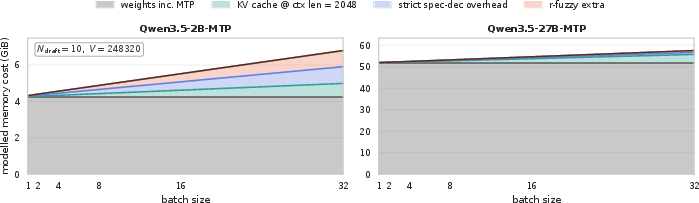
Figure 5: Memory costs for relaxed speculative decoding scale with batch size and vocabulary, with negligible overhead in larger models but notable impact in small/high-volume deployments.