- The paper introduces fractional extendibility and distributed monogamy of entanglement to rigorously characterize limits on quantum channel simulation.
- The paper demonstrates that quantum erasure channels with erasure probability greater than one-half cannot simulate less noisy channels, establishing a strict ordering in channel resources.
- The work leverages tensor product invariance and monotonicity of extendibility under local operations, expanding insights into error correction and quantum communications.
Distributed Monogamy of Entanglement and Its Impact on Quantum Channel Simulation
Introduction
The manuscript "Distributed Monogamy of Entanglement limits Quantum Channel Simulation" (2607.08591) investigates the structural limitations imposed by the monogamy of entanglement on the simulability of quantum channels, with an emphasis on quantum erasure channels. The authors introduce a refined notion of extendibility termed "fractional extendibility" and establish the distributed monogamy of entanglement (DME), which together enable a sharp delineation of when a noisy quantum channel can simulate another via asymptotically many uses. The principal technical result is the demonstration that quantum erasure channels with erasure probability greater than one-half cannot simulate less noisy erasure channels, even with infinite resources.
Background and Motivation
Quantum channel simulation plays a central role in quantum Shannon theory, quantifying the potential for one noisy channel to emulate another through encoding and decoding protocols. For the quantum erasure channel Nλ, which transmits the input intact with probability λ and otherwise flags erasure, the quantum capacity abruptly drops to zero for λ≤1/2 due to the no-cloning theorem.
It is tempting, given the zero capacity for λ≤1/2, to conjecture that all such channels are equivalent in simulability. However, as highlighted by phenomena such as superactivation and the existence of channels with private but not quantum capacity, the quantum regime provides a richer structure. Previous work ruled out simulability in some parameter regimes using integer-valued k-extendibility, but left an essential gap when the standard extendibility parameter is not sharp enough for distinction.
Fractional Extendibility and Its Properties
To overcome the inadequacy of k-extendibility, the authors generalize to fractional extendibility via the (p,q)-extendibility of bipartite states. A state ρAB is (p,q)-extendible if, for any q-subset of λ0 auxiliary B-systems, the original bipartite correlations can be reconstructed via local operations. This provides a finer grained, quantitative characterization of how entanglement can be "spread" over multiple parties.
Key structural results established include:
- Tensor Product Invariance: λ1-extendibility is preserved under tensor powers (i.e., in many-copy settings).
- Monotonicity: Extendibility is monotonic under local preprocessing and postprocessing, supporting its status as a robust entanglement-theoretic monotone relevant for channel simulation tasks.
- Relation to Quantum Erasure Channels: For quantum erasure channels with rational transmission probability λ2, the Choi state is precisely λ3-extendible.
Distributed Monogamy of Entanglement
The central conceptual tool is distributed monogamy of entanglement: for an λ4-partite state on λ5 and subset size λ6, the maximal average probability of extracting an EPR pair between λ7 and a random λ8-subset of the λ9 systems cannot exceed λ≤1/20. This upper bound (the DME limit) is shown to be tight and universal for permutation-symmetric extensions.
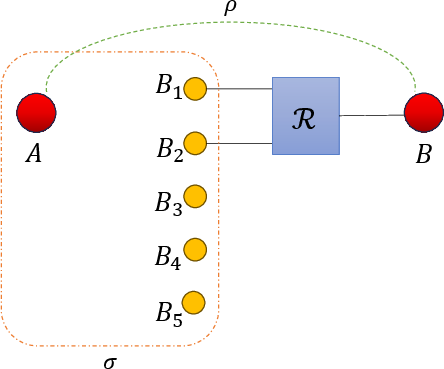
Figure 1: λ≤1/21-extension, where any two out of five λ≤1/22 subsystems can reconstruct the original bipartite state with λ≤1/23.
This distributed bound constrains the possible "sharing" of entanglement among subsystems and imposes a fundamental limit on error correction and channel simulation strategies in multi-party quantum settings.
Main Theorem: Limits on Quantum Channel Simulation
Using fractional extendibility and DME, the authors resolve a previously open problem in quantum Shannon theory: A quantum erasure channel with erasure probability λ≤1/24 cannot asymptotically simulate a channel with strictly smaller erasure probability. This holds regardless of the asymptotic coding protocol or the number of channel uses available.
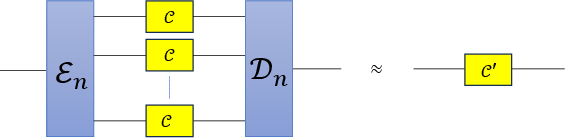
Figure 2: Schematic of simulating one quantum channel (λ≤1/25) with another (λ≤1/26), using asymptotically many uses and trace distance of Choi states as the simulation error metric.
The proof leverages the invariance and monotonicity properties of fractional extendibility to propagate the extendibility constraint through encoding, channel invocation, and decoding steps. The contradiction emerges via the incompatibility of the extendibility parameters, precluding convergence of a sequence of output Choi states to a target state with strictly less environmental entanglement leakage.
This theorem generalizes and strengthens previous simulation impossibility results, filling in the regime unaddressed by λ≤1/27-extendibility, and formalizes an intuitive resource ordering among zero-capacity erasure channels.
Theoretical Implications: The introduction of fractional extendibility provides a new axis on which to classify and compare quantum channels beyond simple capacity dichotomies. The distributed monogamy result prompts reconsideration of how entanglement constraints scale in multipartite and distributed contexts, with likely consequences for the study of quantum networks, error-correction thresholds, and quantum cryptography.
Practical Implications: The no-go result strictly prohibits the upgrading of noisy channels in certain regimes, even with complex coding or infinite resources, clarifying the limitations of error mitigation in practical quantum communication architectures targeting erasure-dominated noise. Furthermore, the extendibility and DME techniques can be straightforwardly adapted to the analysis of qubit amplitude damping channels, providing general criteria for channel simulability across a broader class of noisy quantum channels.
Future Directions: The paper suggests several avenues for extension, notably to Gaussian bosonic channels (see (Ahmed et al., 3 Jun 2026)) and general multipartite settings. The fine-grained hierarchy of fractional extendibility may yield further no-go theorems and could inform channel resource theories for tasks beyond simulation, such as entanglement distillation and distributed computation.
Conclusion
This work advances the analysis of quantum channel simulability by introducing fractional extendibility and establishing distributed monogamy of entanglement. These contributions culminate in a definitive negative answer to the question of simulating less noisy erasure channels with more noisy ones in the zero-capacity regime. The findings underscore the nuanced and restrictive role of entanglement structure in quantum information processing, providing both a theoretical toolset and rigorous limits with practical consequences for quantum communications.

