- The paper establishes a rigorous no-go theorem for Gaussian repeaters by demonstrating that purely Gaussian operations using fractional extendibility cannot boost quantum capacity over pure-loss channels.
- It introduces fractional extendibility as a novel tool to analyze Gaussian states, showing its monotonicity and compositional properties under channel concatenation and GLOCC protocols.
- The results imply that overcoming the exponential decay in quantum information transmission requires non-Gaussian resources in repeater architectures.
No-Go Theorem for Gaussian Quantum Repeaters from Fractional Extendibility
Introduction and Context
Reliable long-range quantum communication over optical channels is fundamentally hindered by photon loss, which leads to exponential decay in transmissible quantum information with increasing distance. Quantum repeaters are an essential tool for circumventing these losses, ideally enabling scalable quantum networks for quantum key distribution and distributed quantum computing. However, the predominant optical operations that are experimentally viable are Gaussian—namely, those realizable through linear optics, squeezing, homodyne detection, and feed-forward operations. It is well established that purely Gaussian error correction and entanglement distillation are impossible for Gaussian noise, but whether intermediate Gaussian repeaters could still break the exponential rate-loss scaling of bosonic attenuation channels with only Gaussian operations remained unresolved.
This work rigorously addresses this open issue. It establishes that no architecture based solely on Gaussian quantum repeaters—consisting of arbitrary Gaussian operations, homodyne measurements, and unlimited classical communication—can increase the quantum capacity of the pure-loss bosonic channel beyond direct transmission. The approach incorporates a new extension of the k-extendibility concept, termed "fractional extendibility", to continuous-variable (CV) Gaussian states and leverages its monotonicity and compositional behavior under Gaussian operations.
Main Results: No-Go Theorem and Fractional Extendibility
The centerpiece result is a structural no-go theorem for Gaussian quantum repeaters in CV quantum networks. For any concatenation of attenuation channels connected by Gaussian repeaters (as defined above), the overall quantum capacity is provably upper bounded by the quantum capacity of the direct, overall pure-loss channel:
Q(Rη)≤Q(Aη),
where Rη is the overall repeater chain (with potentially auxiliary classical registers), and Aη is the pure-loss Gaussian channel with transmissivity η.
The paper's technical contribution is the introduction and exploitation of fractional extendibility for Gaussian states. This is a generalization of Gaussian k-extendibility—central in no-cloning arguments and channel capacity proofs—to fractional values, providing a tighter, more flexible framework. Fractional extendibility is shown to be:
- Monotonic under Gaussian operations (including measurement and feed-forward): Any further Gaussian processing cannot reduce extendibility.
- Compositional under Gaussian channel concatenation: Extendibility composes multiplicatively under independent attenuators.
- Sufficient to imply vanishing quantum capacity when the extendibility parameter exceeds 1.
These abstract properties allow the authors to track extendibility through arbitrary Gaussian operations at each repeater node. The proof employs covariance matrix analysis, Schur complement monotonicity, and Choi isomorphism for Gaussian channels.
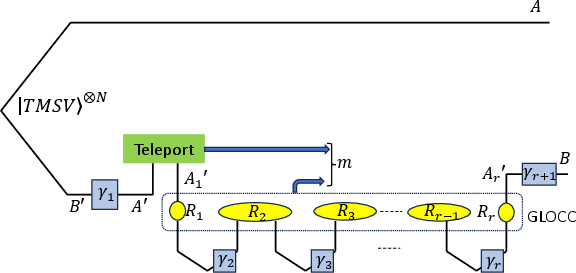
Figure 1: Choi state of the repeater chain, Rη, illustrating the mapping between message strings and Gaussian state evolution through the repeater protocol.
Operational Model and Protocols
The architecture considered consists of a sender and receiver separated by a sequence of repeaters. Each repeater can prepare local bipartite Gaussian states, communicate one half forward over an attenuation channel, then perform a global Gaussian local operation and classical communication (GLOCC) protocol, potentially involving adaptive measurements and feed-forward between nodes. Classical information generated during the protocol may be forwarded with the quantum state.
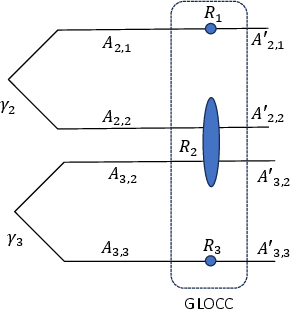
Figure 2: Each repeater node prepares a bipartite Gaussian state and transmits a share across the attenuation channel; a multipartite GLOCC is then performed across the network.
The main implication is that even the most general adaptive, measurement-inclusive, and classical-communication-assisted Gaussian protocols fail to surpass the repeaterless channel capacity, as long as the operations at repeaters remain Gaussian.
Technical Approach
The formal proof proceeds by:
- Fractional Extendibility Tracking: Showing that the initial bipartite state sent through each segment of the chain becomes more extendable as it traverses each attenuator, with the extendibility parameter multiplying by the transmissivity at each step.
- Monotonicity through GLOCC: Proving that GLOCCs and arbitrary classical communication among repeaters cannot reduce extendibility.
- Composable Structure: The output state at the receiver (joint with classical register) is shown to maintain the fractional extendibility governed by the product of all channel transmissivities.
- Capacity Constraint: Invoking quantum information-theoretic results that relate extendibility with the inability to transmit quantum information, and using the bottleneck inequality for quantum capacities, it is deduced that no protocol beat the direct channel’s quantum capacity.
This argument closes a prior loophole in the literature, which had only considered Gaussian regenerative stations without measurement or adaptive feedback. The result strictly excludes any hope of rate improvement without non-Gaussian resources.
Implications and Outlook
Practical Implication: Experimental quantum repeaters for CV quantum optics must include non-Gaussian elements—such as photon counting, nonlinearities, or other non-Gaussian ancilla states—to break the exponential rate-loss bound imposed by the pure-loss channel. This sets a clear and stringent experimental target since non-Gaussian operations are technically demanding.
Theoretical Implication: The introduction of fractional extendibility provides a robust framework for analyzing resource transformations and channel capacities in Gaussian quantum networks. It generalizes existing ideas from finite-dimensional systems (e.g., k-extendibility, monogamy) to the infinite-dimensional, experimentally relevant setting of bosonic modes. The compositional and monotonic nature of fractional extendibility may find further applications in the analysis of complex quantum networks, quantum key distribution, and channel simulation.
Future Directions: An outstanding open question is the characterization of analogous extendibility frameworks for discrete-variable (DV) architectures or for hybrid quantum networks coupling DV and CV elements. Moreover, the study of non-Gaussian quantum repeaters, including protocols blending Gaussian and minimal non-Gaussian operations, remains a vital avenue for both theoretical optimization and experimental realization.
Conclusion
This work definitively establishes that Gaussian-only quantum repeaters, even with arbitrary measurement and classical communication, cannot improve the quantum capacity of pure-loss bosonic channels. By developing a fractional extendibility framework and precisely mapping its behavior through Gaussian processing, the authors bridge a critical gap in quantum network theory. The results necessitate genuine non-Gaussian resources for scalable quantum repeaters in optical platforms and offer powerful tools for the ongoing study of resource interconversion and quantum channel capacities in continuous-variable quantum networks.
(2606.05097)