- The paper introduces DrugGen-2, an LLM-driven model that conditions molecular generation on disease ontologies and protein targets to enhance drug discovery.
- It employs a two-stage training approach, combining supervised fine-tuning on curated data with group-level reinforcement learning for efficient exploration.
- Results show significant improvements in output uniqueness, structural validity, and binding affinity compared to earlier models using quantitative benchmarks.
Disease-Aware Molecular Design: The DrugGen-2 Framework
Model Architecture and Training Paradigm
DrugGen-2 is an LLM-based generative model for disease-aware small molecule design, conditioned jointly on disease ontology (MeSH DAG) and protein target sequence. The architecture leverages a pre-trained DrugGPT (GPT-2 variant), fine-tuned via supervised learning on curated disease-target-drug data, and subsequently optimized using GRPO, a group-level reinforcement learning strategy combining reward functions for chemical validity, novelty, diversity, and PLAPT-predicted binding affinity. Model input is structured as <D><MeSH DAG><P><protein sequence><L><SMILES>, tokenized and truncated to ensure alignment for transformer-based processing.
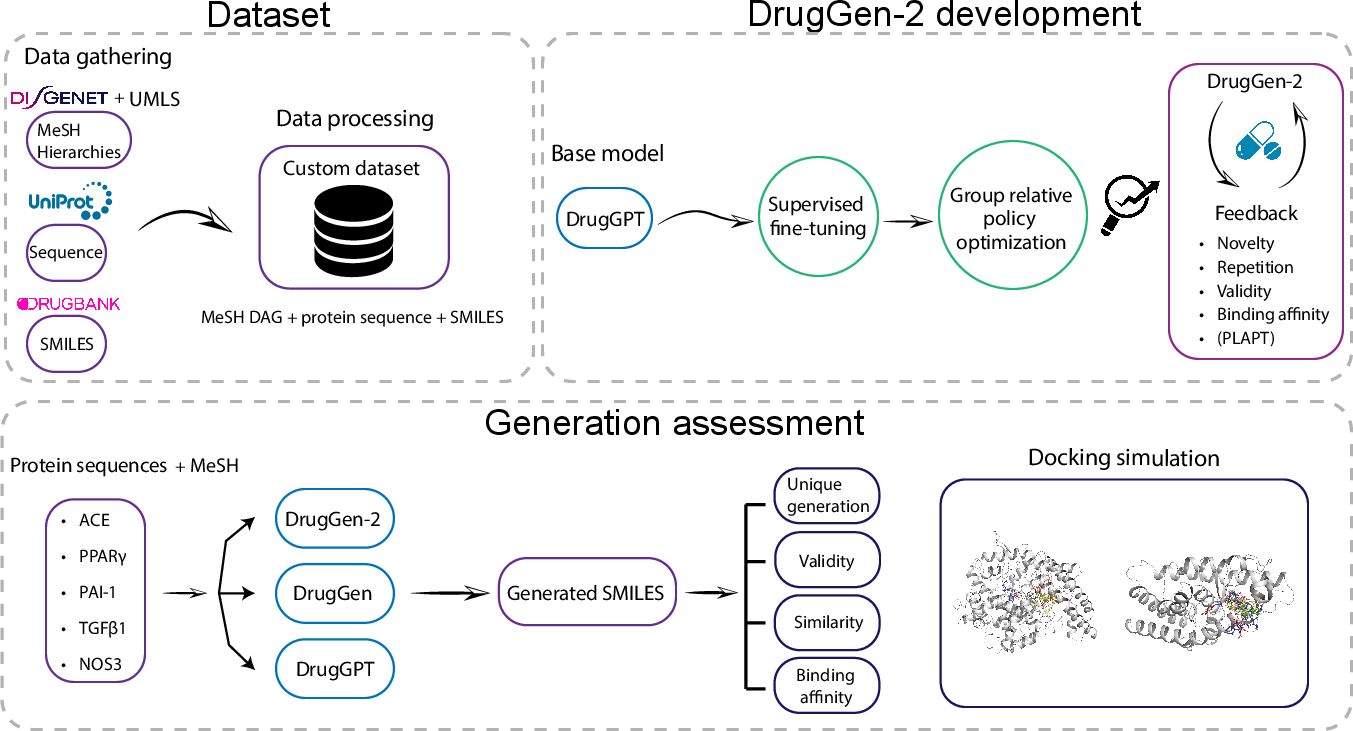
Figure 1: Development and evaluation workflow for DrugGen-2, integrating supervised fine-tuning and GRPO with domain-specific rewards and multi-level assessment criteria.
The GRPO workflow circumvents the need for a value function by using baseline group rewards, achieving computational efficiency with stable advantage estimation. KL-regularization anchors learning to the supervised prior, mitigating pathological drift away from domain-relevant chemical structures.
DrugGen-2's outputs were benchmarked against DrugGen and DrugGPT across five diabetic nephropathy-relevant targets: ACE, PPARγ, NOS3, PAI-1, and TGF-β1. Disease context is injected via MeSH DAG identifiers, capturing hierarchical semantic information to enable nuanced generation conditioned on disease biology.
DrugGen-2 outperformed comparators with respect to:
- Unique molecule generation: Up to 444/500 unique outputs (DrugGen median 50, DrugGPT median 219), demonstrating marked enhancement in chemical space exploration capability.
- Structural validity: 99-100% valid outputs, confirming robust filtering of syntactic and valence errors through the RDKit pipeline.
- Similarity to approved drugs: Median Tanimoto similarity of 0.70 versus DrugGen (0.64) and DrugGPT (0.30), aligning generated molecules closer to clinically relevant scaffolds.
- Binding affinity: Median PLAPT-predicted affinities 9.26–9.97, substantially above DrugGen (7.15–8.49) and DrugGPT (5.86–6.22), with ϵ2 values indicating strong effect sizes and P values <10−38 for all targets.
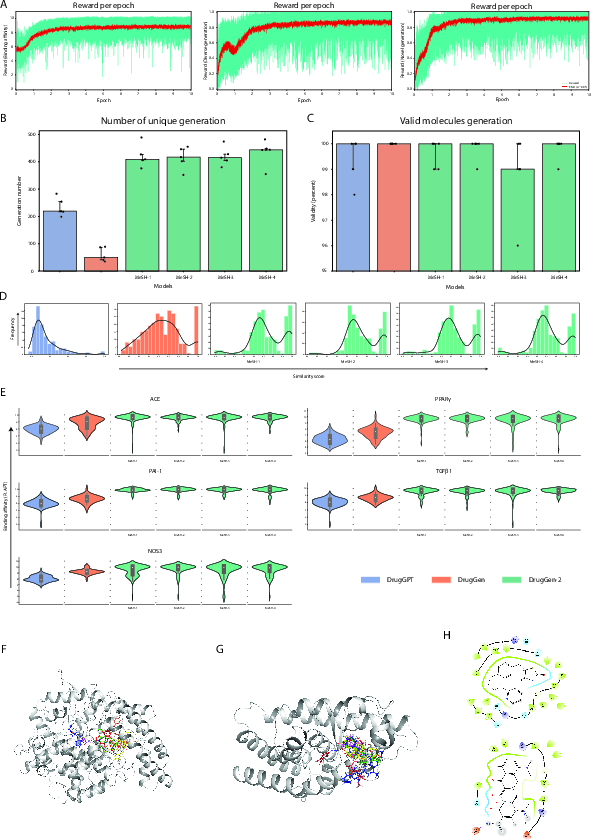
Figure 2: DrugGen-2 achieves superior reward convergence, unique and valid generation, higher similarity to approved drugs, and elevated predicted binding affinity across targets; 3D protein-ligand docking highlights conformational alignment with reference binders and shows novel interactions.
Docking simulations validated the predicted affinities: DrugGen-2 ligands for ACE demonstrated docking scores (e.g., --9.917 for P12821-293) lower than reference drugs such as enalapril (--8.283), with binding pose similarity supporting functional relevance. For PPARγ, designed ligands introduced novel pharmacophores without surpassing reference system affinity.
Reward Function Engineering and Reinforcement Strategy
Reward design integrates competitive priorities:
- PLAPT affinity: Quantitative assessment using pre-trained protein-ligand transformers, filtered by chemical validity.
- Novelty: Binary reward for SMILES absent from the approved drug dataset.
- Intra-batch diversity: Binary reward penalizing repetitive outputs to maximize local exploration of structure space.
GRPO's group-relative baseline ensures reward variance is robustly exploited, while KL divergence regularization prevents divergence from supervised chemical priors.
Methodological Implications and Scalability
DrugGen-2's modular architecture and reward strategy can be deployed to other disease ontologies and targets. Disease-conditioned generation enables context-aware drug design, potentially accounting for variable target-disease interaction semantics, such as ACE's differential roles in hypertension and neuroprotection or PPARγ's role in metabolic versus oncogenic pathways.
Docking protocol sensitivity was validated by RMSD calculations (Rosiglitazone/PPARγ: 1.44Å), supporting reliability for in silico screening. Sequence truncation (≤768 residues) imposes constraints on capturing distal allosteric interactions; future work may leverage multimodal encoding strategies (protein structure+sequence) or hierarchical reward augmentation (ADMET, synthetic accessibility).
Theoretical and Practical Impact
DrugGen-2's disease-aware approach is a departure from prior target-only conditioning, enabling generation aligned with nuanced disease mechanisms. This has implications for both de novo design and drug repurposing, providing a computational framework for personalized pharmacology. The reinforcement learning integration expedites hit-to-lead workflows while maintaining clinical candidate relevance and chemical feasibility.
The paradigm is extensible: multi-objective reinforcement strategies and broader feature reward functions (toxicity, PK/PD properties) will further bridge the gap to translational medicine. Incorporation of cell-specific or tissue-specific context via additional input modalities may enable genuine precision therapeutics.
Conclusion
DrugGen-2 constitutes a scalable LLM-based framework for disease-aware molecular generation, combining hierarchical ontology encoding and protein sequence context to outperform existing models in uniqueness, validity, scaffold similarity, and binding affinity metrics. Reinforcement learning with group-level optimization and customized reward shaping enables efficient exploration of clinically relevant chemical space. The approach demonstrates the feasibility of context-sensitive AI-driven drug discovery, with future impact on precision medicine and adaptive therapeutic development.