- The paper introduces a latent optimization framework atop a genotype-conditioned diffusion model to balance efficacy, drug-likeness, synthesizability, and mechanism plausibility.
- It employs a multi-objective reward strategy combining ensemble AUC prediction, QED and SAS surrogates, and LLM-based mechanistic scoring for targeted anti-cancer molecule generation.
- Empirical evaluation on the NCI60 panel demonstrates superior potency and chemical tractability relative to baselines, highlighting its potential in personalized drug design.
Genotype-Conditioned Molecular Generation via Evidence-Grounded Multi-Objective Latent Perturbation in Diffusion Models
Introduction
The paper addresses challenges in personalized anti-cancer drug design arising from high tumor heterogeneity and the lack of clear molecular targets. Traditional generative approaches for de novo small molecule generation—especially for oncology—have often relied on phenotype-based or target-based conditioning, which is insufficient for complex clinical contexts with ambiguous or absent drug targets. Recent diffusion-based conditional models such as G2D-Diff have introduced genotype conditioning, but lack explicit, coordinated optimization of properties such as sensitivity, drug-likeness, synthesizability, and mechanistic plausibility. This work proposes a latent optimization methodology layered atop a pretrained genotype-conditioned diffusion generative model that employs multi-objective reward balancing and a multi-agent LLM-based evidence pipeline for mechanism-grounded evaluation.
Methodological Innovations
A principal contribution is the formulation of an end-to-end optimization architecture that directly operates in the latent space of a frozen genotype-conditioned diffusion model. The pipeline begins by sampling an initial candidate molecule latent vector, to which a learnable perturbation is applied and iteratively refined via gradient ascent. The optimization objective is a composite reward function aggregating predicted drug sensitivity (AUC), quantitative estimates of drug-likeness (QED), synthetic accessibility (SAS), and an agent-assigned mechanistic engagement score grounded in biomedical literature via a multi-agent LLM system.
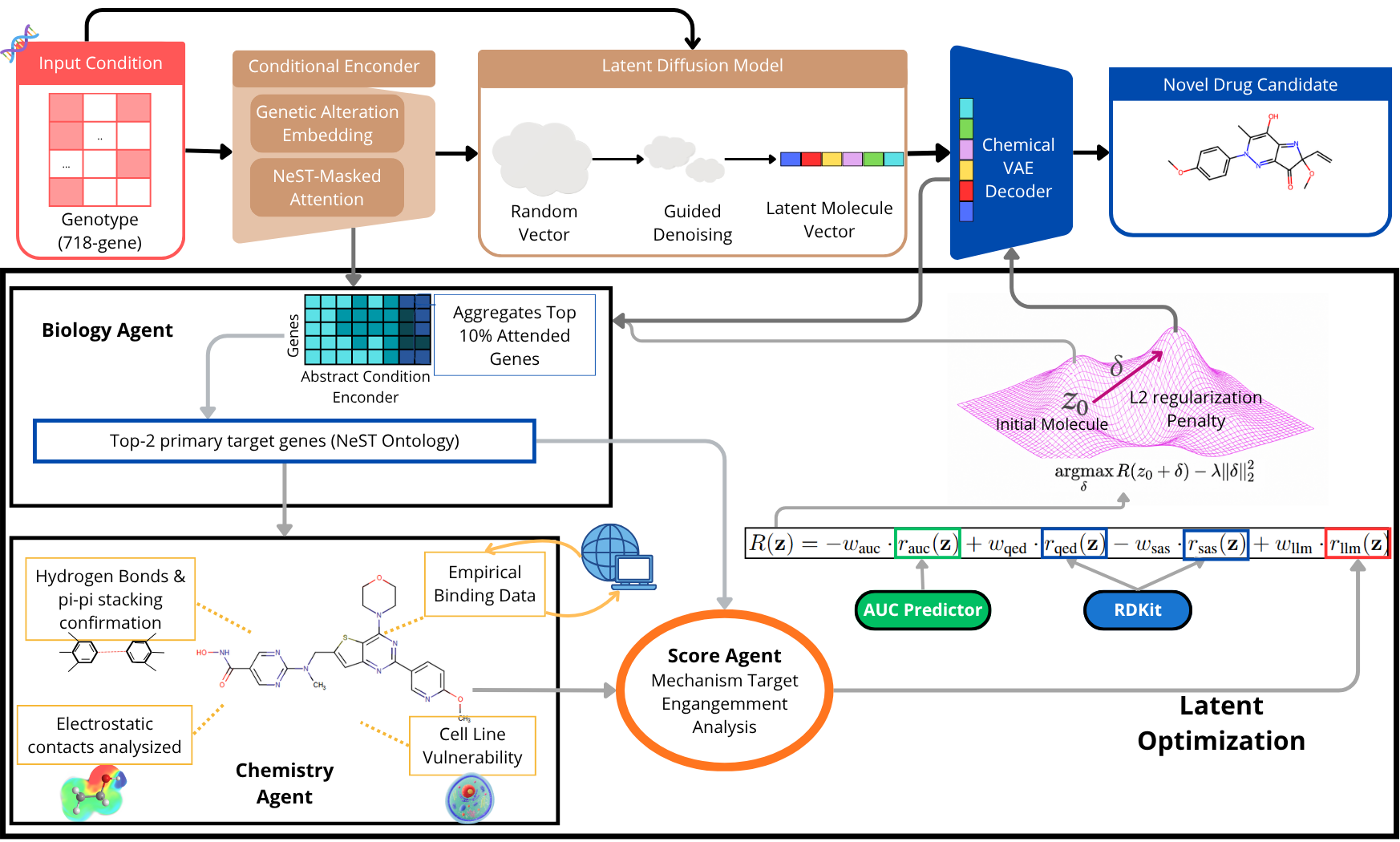
Figure 1: Architecture of the latent optimization pipeline with genotype-conditioned diffusion, mechanism-scoring, and online multi-objective optimization.
The reward structure is uniquely multi-axial: predicted efficacy (lowered AUC, as lower values denote greater sensitivity), QED, minimized SAS, and an LLM-based mechanism plausibility reward. Predicted AUC is obtained via an ensemble of response predictors from G2D-Pred, QED and SAS are calculated post-decoding using RDKit, and their non-differentiability is addressed via online-trained MLP surrogates. The LLM agent feedback, due to evaluation cost, is distilled into a dense surrogate reward, supporting efficient gradient-based optimization throughout the continuous chemical manifold.
The system is further enhanced with a biologically-grounded interpretability layer. Transformer attention maps within the conditional encoder yield per-gene importance, allowing the pipeline to detect the most implicated gene targets per genotype context. The ChemistryAgent then uses literature mining to generate a non-covalent interaction (NCI) report, and the ScoreAgent integrates all evidence into a structured final reward, which guides latent space navigation toward mechanism-supported candidates.
Empirical Evaluation
Extensive experiments evaluate the pipeline on the NCI60 panel with 15 cell lines split across data-rich, data-scarce, and zero-shot generalization sets. Baselines include PaccMannRL, G2D-Diff, and MolGen-GPT. The proposed method is shown to achieve the highest drug-likeness (QED), lowest synthetic accessibility (SAS), and the lowest predicted AUC, indicating stronger cell-line-specific potency compared to baselines that only sample from conditional distributions without active latent optimization.
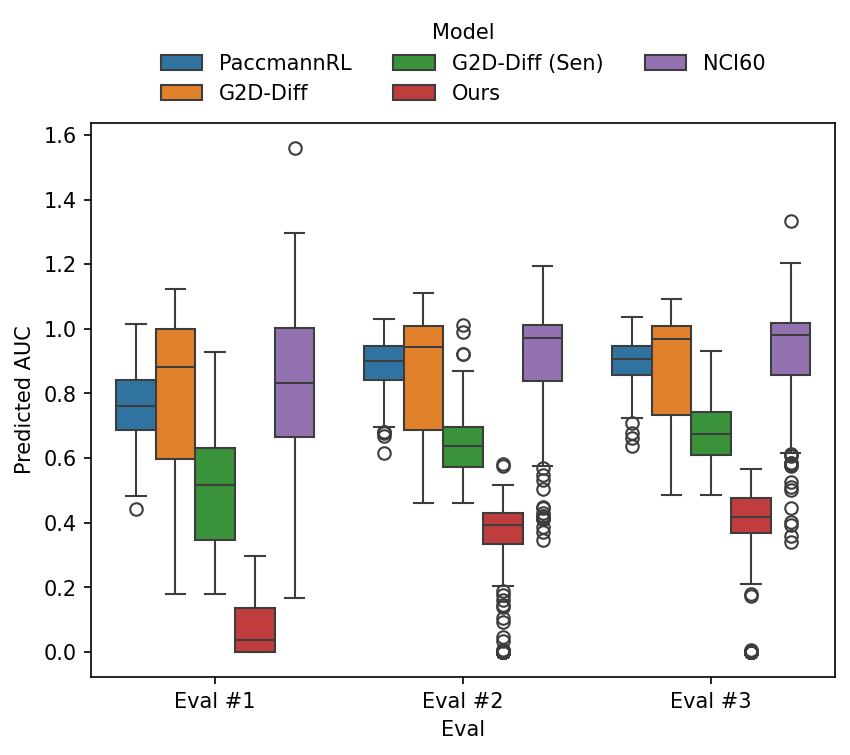
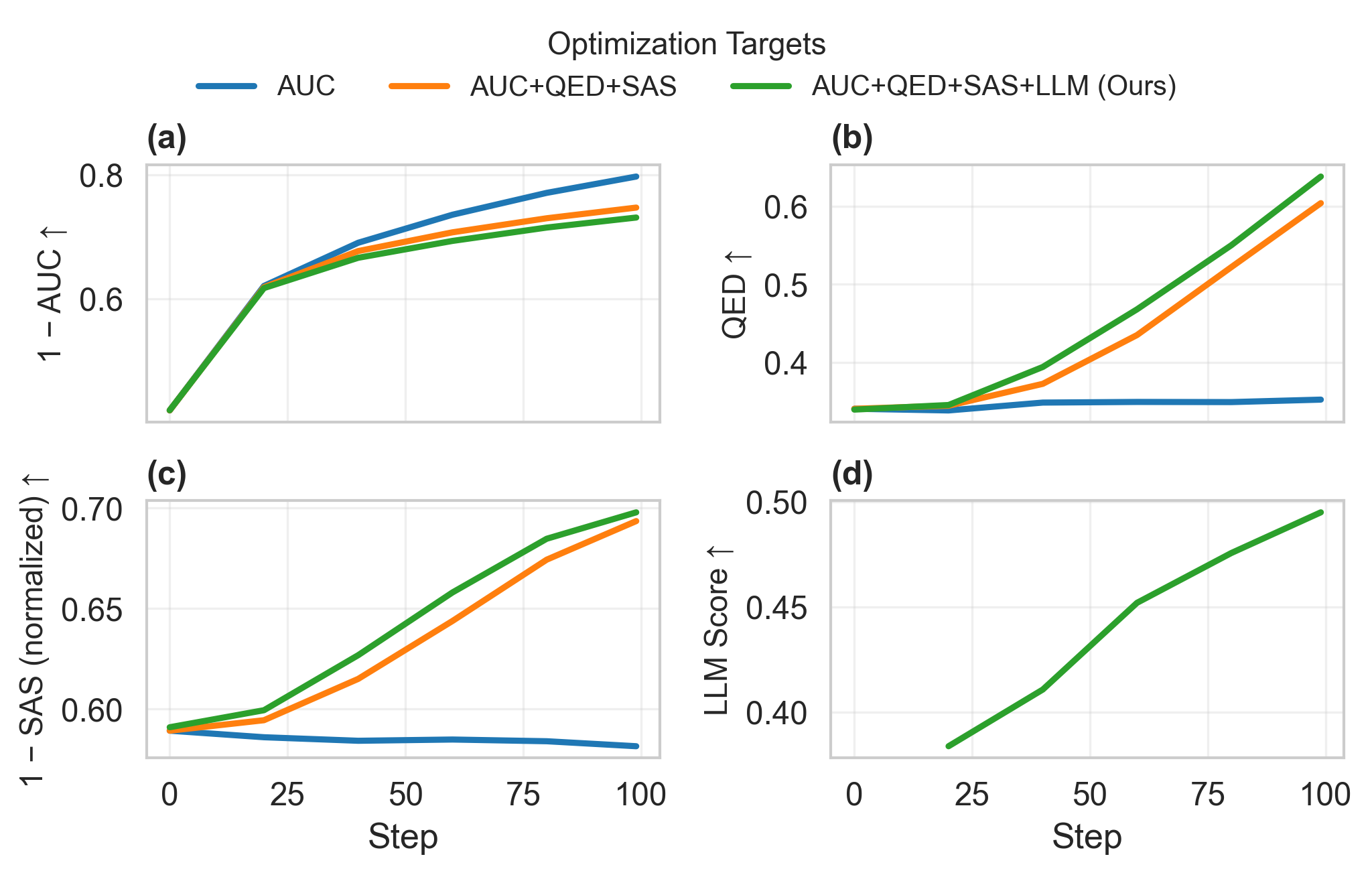
Figure 2: (a) Predicted AUC distributions for generated molecules by method and evaluation set. (b) Optimization dynamics for AUC, QED, SAS, and LLM agent score over 100 optimization steps under several reward regimes.
Agent-augmented optimization exhibits improved convergence for all primary metrics. Pure sensitivity optimization (minimizing AUC alone) leads to non-optimal chemistry in QED and SAS, demonstrating the importance of explicit multi-objective control. Inclusion of the LLM agent reward directs the search toward viable, mechanism-supported chemotypes, balancing efficacy and chemical tractability.
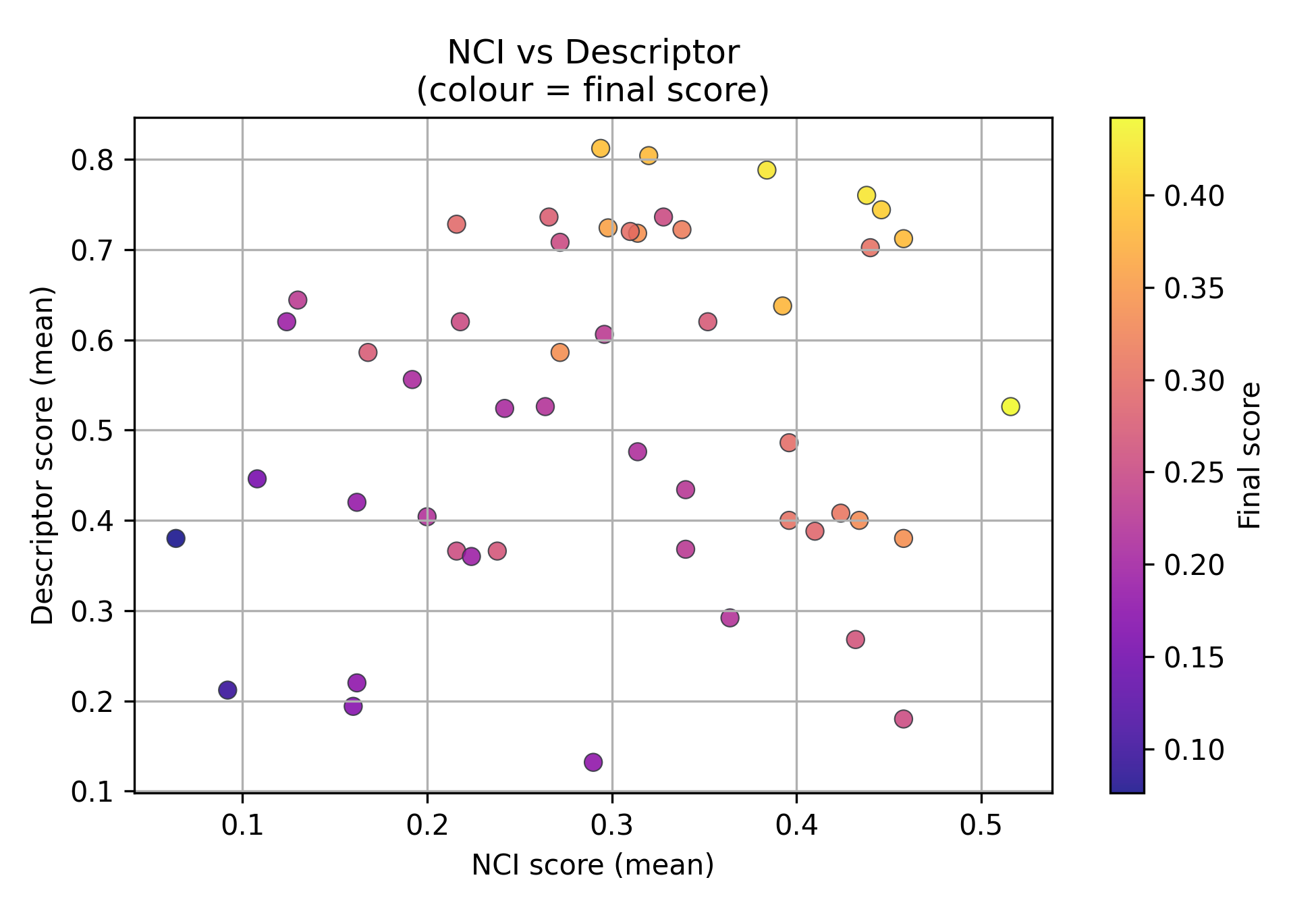
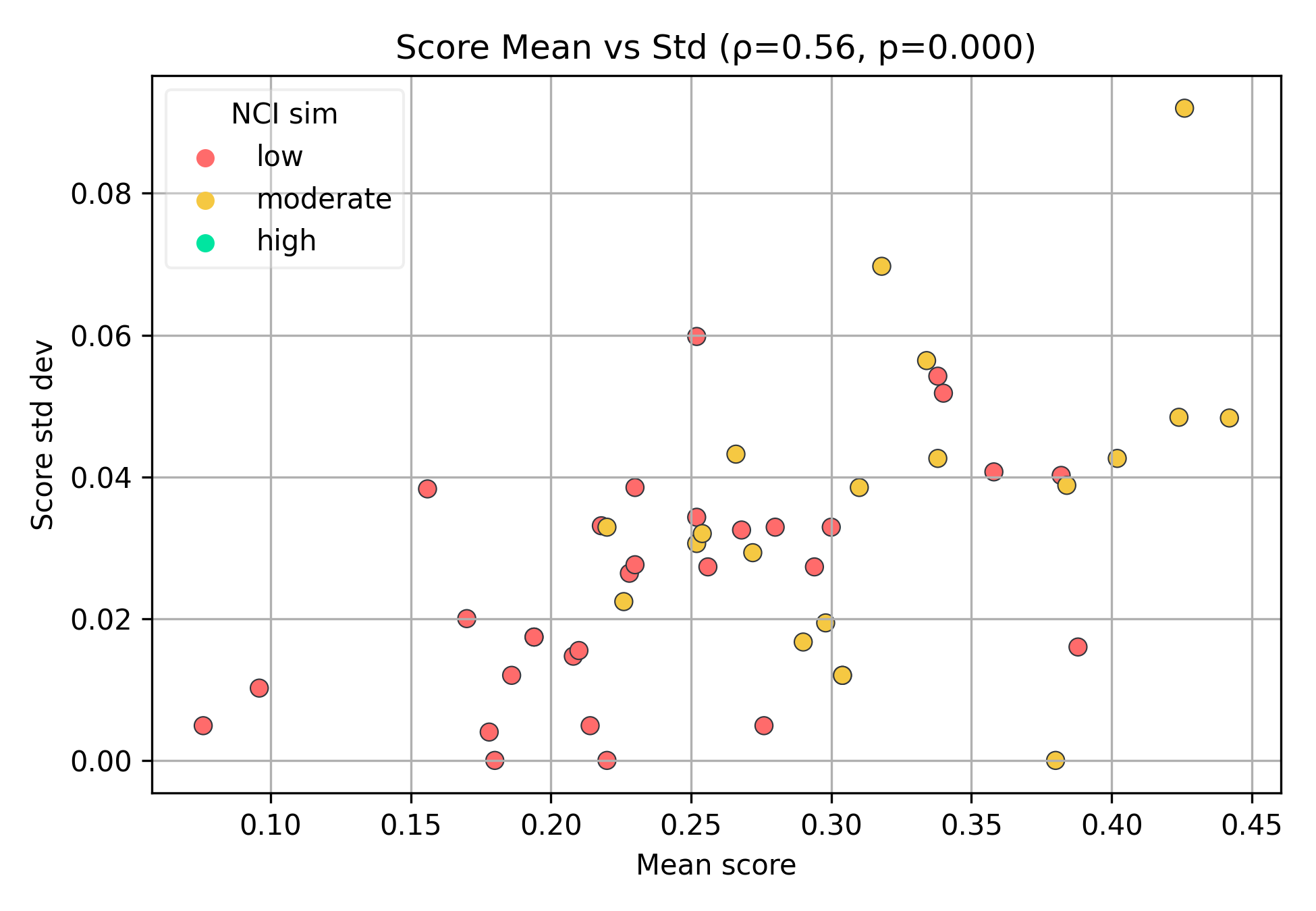
Figure 3: (a) Analysis of NCI score versus descriptor score, indicating how binding evidence and cheminformatic properties vary per candidate. (b) Score consistency across repeated agent-based evaluations.
The agent-based mechanism scoring adds consistency to the selection of candidates with plausible engagement of attention-identified targets, as established by cross-validation on known binders and robust literature mining. Ablation analysis confirms that every reward axis—agent score included—contributes usefully to downstream chemistry.
Latent Encoder Effects and Robustness
The analysis highlights a misalignment in classical VAE latent encodings of ground truth clinical binders—such as FDA-approved kinase inhibitors—due to a lack of supervised alignment with the diffusion model's sensitivity-conditioned latent subspace. The agent-based reward, by directly querying molecular features and mechanism evidence via LLMs, corrects this misalignment and robustly prioritizes clinical actives even when the generative or predictor encoder is imperfect.
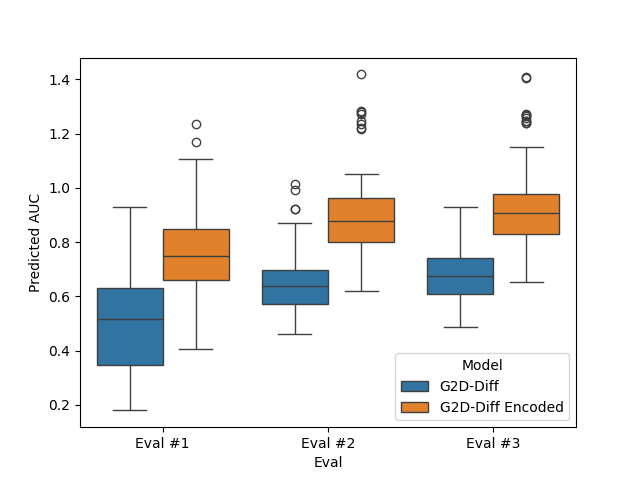
Figure 4: Predicted AUC distributions for generated molecules from G2D-Diff vs. G2D-Diff (encoded), highlighting VAE encoder bias/limitations in capturing true sensitivity distributions.
LLM scoring is shown to be stable and consistent, with low intra-run variance and strong correlation with chemical and mechanistic indices. Experiments varying the agent evaluation pool size show minimal gains beyond modest sample sizes, indicating computational efficiency is compatible with robust optimization.
Implications and Future Directions
This framework presents a practical foundation for genotype-contextualized, mechanism-informed molecular generation. By integrating explicit multi-objective optimization and evidence-grounded agent feedback at the latent optimization stage, the approach contributes compellingly towards the synthesis of candidates that are not only potent and chemically tractable but are also tailored for biological plausibility. The method directly addresses the disconnect between statistical generative modeling and real-world clinical evidence by tying generation to mechanistic interpretation and independent validation channels.
Key limitations remain: the ultimate utility of agent scoring is mediated by the fidelity of upstream predictors (AUC models), and the static gene-pathway ontology (NeST) is not yet used for full pathway-level hierarchical reasoning. Extension to pathway-centric, uncertainty-aware multi-objective optimization with inclusion of structure-derived binding simulations (e.g., AlphaFold docking) is a clear avenue for further robustness and generalization. Wet-lab validation of generated candidates remains essential, particularly as the approach is specifically tuned to optimize held-out and zero-shot genotypes, a regime where real-world molecular viability cannot be ascertained solely from in silico metrics.
Conclusion
The presented latent optimization pipeline delivers a scalable and robust framework for personalized anti-cancer molecular generation, explicitly balancing efficacy, chemical properties, and mechanistic plausibility via genotype-conditioned diffusion and evidence-integrated latent navigation. The introduction of differentiable multi-agent LLM-based mechanism scoring represents an advance towards genuine structure-mechanism reasoning in de novo design. This work forms a foundation for subsequent developments in hierarchical biological reasoning, robust out-of-distribution optimization, and AI-accelerated precision medicine.