- The paper introduces GAMP, a novel PTQ method that calibrates activation clips using guided-prediction error to close the null space and counteract branch drift.
- It demonstrates that standard gap-fidelity metrics fail to detect unconstrained drift, leading to severe degradation in guided predictions despite near-ideal alignment.
- Empirical results reveal that GAMP achieves up to a 49% FID improvement and 13% reduction in BOPs compared to uniform mixed precision allocation.
Guidance-Aware Quantization for Classifier-Free Diffusion: Null Space Analysis and Mixed-Precision Allocation
Introduction: Structural Challenges in Quantizing CFG Diffusion Models
Classifier-Free Guidance (CFG) diffusion models remain the standard approach for conditional image generation, exploiting a dual-branch architecture that combines conditional and unconditional network outputs at each denoising step. While post-training quantization (PTQ) is the dominant paradigm for compressing and accelerating deep generative models, prevailing PTQ methods fundamentally mischaracterize CFG diffusion during calibration and deployment. Existing approaches treat the model as a single-branch network, failing to account for the paired execution and linear combination inherent to CFG inference. This methodological blind spot introduces two critical challenges: (1) invisible per-step latency overhead, masked by standard efficiency metrics (parameter count, BOPs); and (2) a null-space in gap-only calibration objectives, enabling unconstrained unconditional branch drift that degrades guided predictions without being detected by gap fidelity metrics. The paper rigorously formalizes these pitfalls and presents Guidance-Aware Mixed Precision (GAMP), a principled PTQ method that calibrates with respect to guided prediction error, closes the null space by construction, and allocates activation bits per layer according to their empirical sensitivity.
Structural Measurement and Latency Overhead
Empirical latency profiling reveals that the two-pass CFG inference pattern imposes a consistent 1.99× overhead across batch sizes and floating-point formats. This "CFG tax" is invisible to standard efficiency proxies such as parameter counts and BOPs, which report single-pass costs and ignore the doubled per-step computational burden Figure 1.
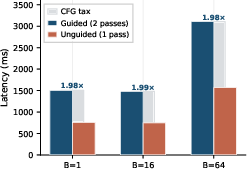
Figure 1: CFG tax: latency overhead measured across batch sizes (FP16, T4), demonstrating a persistent ≈1.99× guidance cost unaccounted for by efficiency metrics.
As a consequence, deployment practitioners must report guided-step BOPs and account for the implicit additional compute when evaluating compression and acceleration gains. Additionally, existing ONNX Runtime INT8 stacks fail to realize theoretical speedup: measured inference times are up to 147× slower than predicted by BOPs due to extensive operator-fallback and GPU-to-CPU memcopies in environments lacking TensorRT support Figure 2, establishing that software-stack limitations, not arithmetic capability, are the true deployment bottleneck.
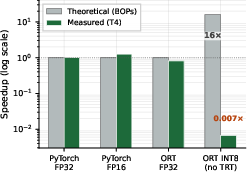
Figure 2: Theoretical BOPs speedups fail to materialize in ONNX Runtime INT8 on T4, with actual latency reflecting a 147× slowdown due to operator-fallback and memory transfer overhead.
The central theoretical contribution is the identification and proof of the branch-drift trap—a null space inherent to gap-only PTQ calibration objectives. It is shown that for any drift vector δ, quantized branch outputs can be shifted by δ while preserving perfect guidance-gap fidelity, yet corrupting the guided prediction at inference.
Specifically, minimizing the gap reconstruction error
Lgap=(uyq−u∅q)−(uyfp−u∅fp)2
admits solutions where uyq=uyfp+δ and u∅q=u∅fp+δ, so the computed gap is unaffected but both branches are arbitrarily misaligned with their full-precision reference. Guided predictions are then uniformly contaminated by the drift, and this error accumulates across sampling steps. Empirically, gap-only calibrated models (Gap-only-W4A8) achieve near-ideal guidance-gap alignment (ρ=1.004, ≈1.99×0), yet yield the worst sample quality (FID~334), exceeding even lower-bit uniform quantized baselines that lack calibration Figure 3.
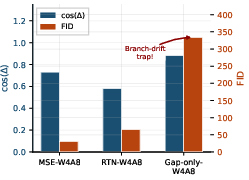
Figure 3: Guidance-gap fidelity and FID across W4A8 configurations; gap-only calibration achieves highest ≈1.99×1, yet samples are severely degenerate, validating the branch-drift trap.
This contradiction demonstrates that standard gap-fidelity metrics are necessary but fundamentally insufficient diagnostic tools for PTQ quality assurance under CFG. The problem is architectural and persists regardless of dataset or model scale.
Guidance-Aware Mixed Precision (GAMP): Null Space Closure and Sensitivity Allocation
GAMP is formulated to resolve the branch-drift trap by calibrating activation clips and thresholds directly on the guided prediction, rather than independently on the gap or branch outputs. The per-layer guided-output error
≈1.99×2
is used as both the calibration objective and the sensitivity metric for mixed-precision activation allocation. All weights are fixed to 4 bits; activation bits are greedily allocated to layers according to their impact on guided-output error, operationalized as a knapsack optimization targeting a specified average activation bit budget.
This strategy is empirically validated to outperform uniform mixed precision: GAMP-≈1.99×36 achieves FID~39.4 (49\% improvement over uniform allocation reference at equal average precision) and near-W4A8 quality at 13\% fewer BOPs Figure 4. Notably, the activation precision cliff is steeper than the weight precision cliff (per-bit FID degradation ≈1.99×4 higher for activations), justifying GAMP's design.
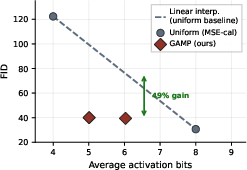
Figure 4: GAMP Pareto curve; guided-output sensitivity allocation yields substantially higher quality per bit compared to uniform precision allocation.
Practical Implications and Theoretical Extensions
For practitioners deploying CFG diffusion models under stringent compute or latency constraints, three key recommendations emerge: (1) report guided-step BOPs to correctly account for compute overhead; (2) validate PTQ calibration using guided-prediction error, not gap fidelity metrics; (3) allocate activation precision based on GAMP's sensitivity profiling, particularly as activation bits dominate quality degradation.
The theoretical null-space argument applies generically to any dual-branch CFG model, and the branch-drift trap can be closed by augmenting the calibration loss with an unconditional anchor term or by distilling explicitly on the guided prediction. As guidance scale ≈1.99×5 increases, the impact of drift intensifies, predicting more severe quality loss in high-conditioning regimes typical of text-to-image generation. Extension to latent diffusion architectures, higher-resolution calibration, and PTQD-style per-step allocation are immediate avenues for further work.
Conclusion
This paper rigorously surfaces fundamental structural and deployment-level challenges in quantizing CFG diffusion models, formalizes and validates the branch-drift trap in gap-only PTQ calibration, and introduces GAMP—a guidance-aware mixed-precision allocation framework guaranteed to close the null space and empirically Pareto-dominant over uniform baselines. The results call for a reassessment of both hardware efficiency benchmarking and calibration methodology for generative diffusion model compression, and motivate broader adoption of guided-prediction-based sensitivity and validation objectives. Future investigation should focus on scaling GAMP to large latent generative models and integrating unconditional anchoring terms to further suppress branch drift in quantized deployments.

