- The paper presents a dual-path architecture that combines cyclic embeddings with multi-scale temporal convolutions to capture diverse patterns in multivariate time series.
- It employs adaptive multi-level gating to dynamically fuse four specialized forecasting heads, achieving up to 25% error reduction compared to prior models.
- Its lightweight design with approximately 40K parameters and sub-5 ms inference latency makes it ideal for real-time applications and edge deployment.
RhyMix: Lightweight Multi-Rhythm Adaptive Architecture for Long-Term Time Series Forecasting
Architectural Innovations
RhyMix ("RHYthm MIXture") introduces a parallel dual-path neural architecture specifically designed to capture diverse temporal dynamics in real-world multivariate time series. Unlike prior approaches that rely on a single modeling strategy (e.g., transformer, CNN, MLP, or linear decomposition), RhyMix integrates two complementary encoding branches: (1) an explicit Cyclic Path incorporating multi-period cyclic embeddings (periods 12, 24, 48, 168) for seasonal inductive bias, and (2) a Multi-Scale Temporal Convolutional Network with Channel Attention (MSTCN-CA), featuring stacked dilated depthwise convolutions (dilations 1,2,4,8) to capture local to longer-range dependencies and adaptive channel interaction.
A core innovation is the multi-level adaptive gating: (a) path gate fuses four specialized forecasting heads (Direct, Trend-Seasonal Decomposition, Local Convolution, Periodic Fusion) dynamically per sample and channel, (b) hybrid gate adaptively balances Cyclic and MSTCN-CA paths, based on input temporal statistics. These gating mechanisms employ feature summaries (mean, std, slope, last value, mean absolute change) computed from each input, enabling dynamic adaptation to underlying pattern structure in each sample. The architecture is regularized via RevIN normalization, compact channel mixer (bottleneck MLP), and sample-specific fusion, with linear computational complexity throughout.
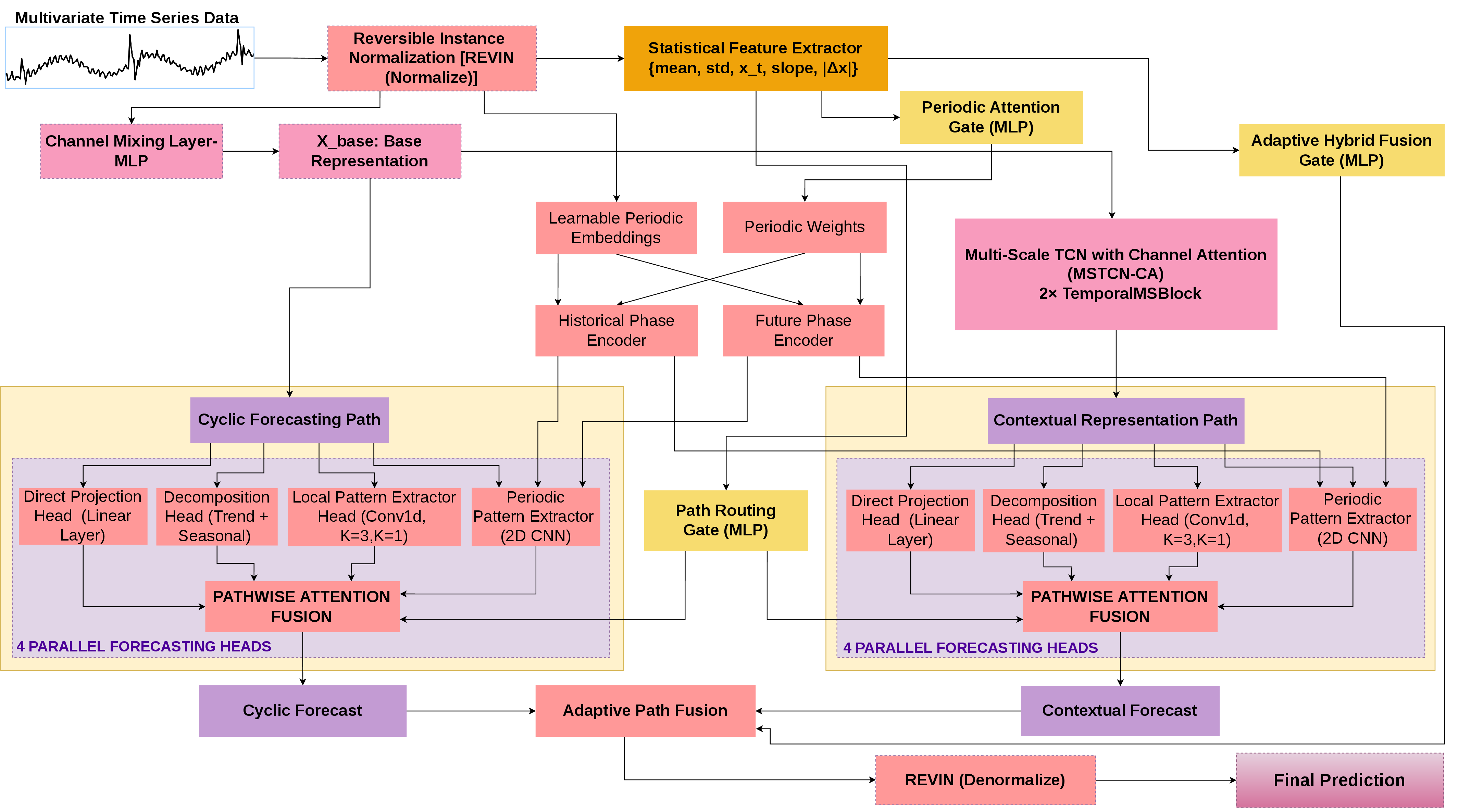
Figure 1: RhyMix architecture—parallel Cyclic and MSTCN-CA paths, adaptive gating, four forecasting heads, and channel mixer.
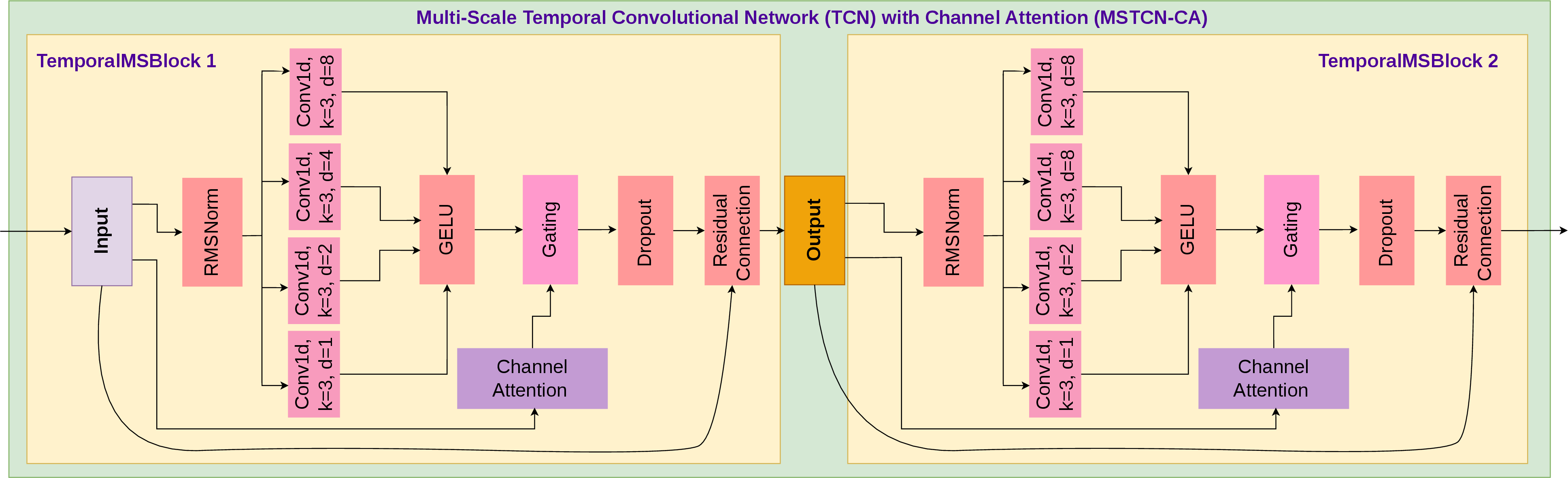
Figure 2: MSTCN-CA employs dual TMS blocks with multi-scale dilated convolutions and channel attention, enhancing context-aware representation learning.
Forecasting Heads and Temporal Pattern Extraction
RhyMix covers dominant time-series pattern types through four heads:
- Direct Linear Projection: Fast linear transformation, critical for quasi-stationary regimes.
- Trend-Seasonal Decomposition: Adaptive moving average and reflection padding for smooth trend extraction and robust seasonal separation.
- Local Convolutional Head: Depthwise Conv1D (kernel=3, residual connection, linear projection) captures short-term fluctuations and abrupt changes.

Figure 3: Local Pattern Extractor Head with depthwise convolution, residual connection, and linear projection.
- Periodic Fusion Head: Conv2D combines input with cyclic embeddings, injecting explicit seasonal information (learnable phase offsets).

Figure 4: Periodic Pattern Extractor Head fuses input and cyclic past embeddings, with cyclic future embeddings for forward prediction.
Adaptive gating dynamically weighs these heads per-sample based on normalized temporal statistics. Both Cyclic and MSTCN-CA paths apply all four heads independently, followed by sample-specific path fusion (hybrid gate).
RhyMix was evaluated on twelve established benchmarks: ETTh1/ETTh2/ETTm1/ETTm2, ECL, Traffic, Weather, Exchange, PEMS03/04/07/08. Compared to latest baselines (Time-o1, TimeMixer++, GCMNet, SEG-MOE, SOFTS, FilterNet, PatchTST, MSTN), RhyMix achieves state-of-the-art results (first rank MSE/MAE) on 10 out of 12 datasets, with improved error (up to 25% reduction vs MSTN; 7–20% vs TimeMixer++ and PatchTST) (2607.08234). Notably, it maintains these results with only ~40K parameters, linear horizon scaling O(H), and sub-5 ms inference latency (157 KB model footprint), outperforming quadratic complexity models (e.g., Time-o1 and TimeMixer++) in both accuracy and deployability.
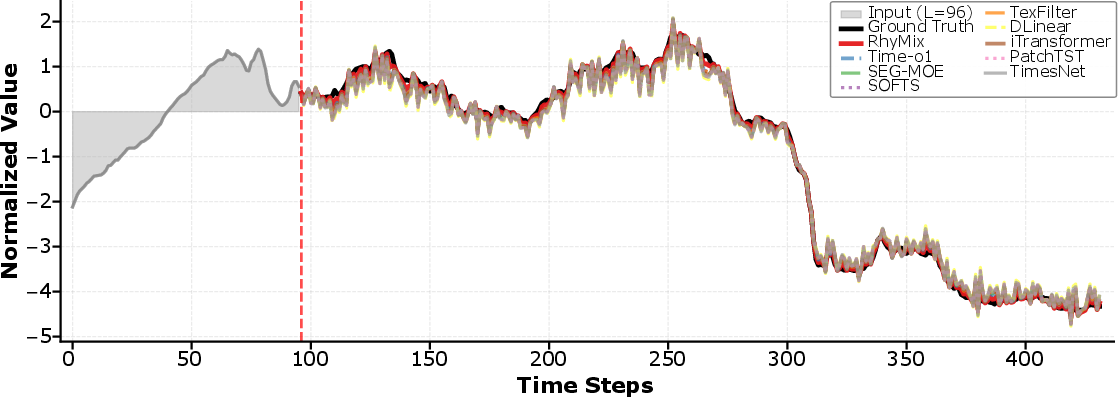
Figure 5: Visualization of Weather dataset predictions by RhyMix vs SOTA under input-96-predict-336, showing enhanced long-range periodicity and reduced error.
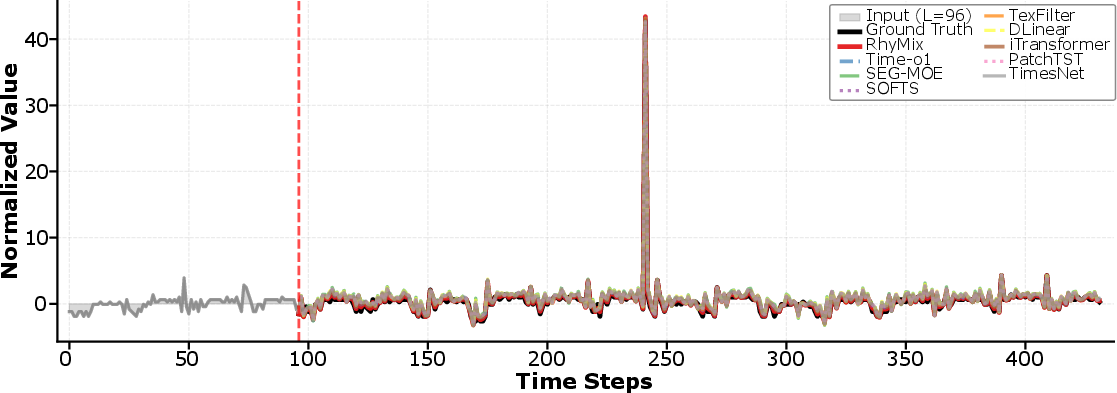
Figure 6: Visualization of ECL dataset forecasts, demonstrating accurate channel-wise trend tracking and robust seasonal cycle prediction.
Multi-Resolution and Interpretability
To support interpretability and explain the inductive bias, RhyMix reshapes 1D sequences into 2D images using multiple period lengths, making seasonal and trend patterns explicitly visible.
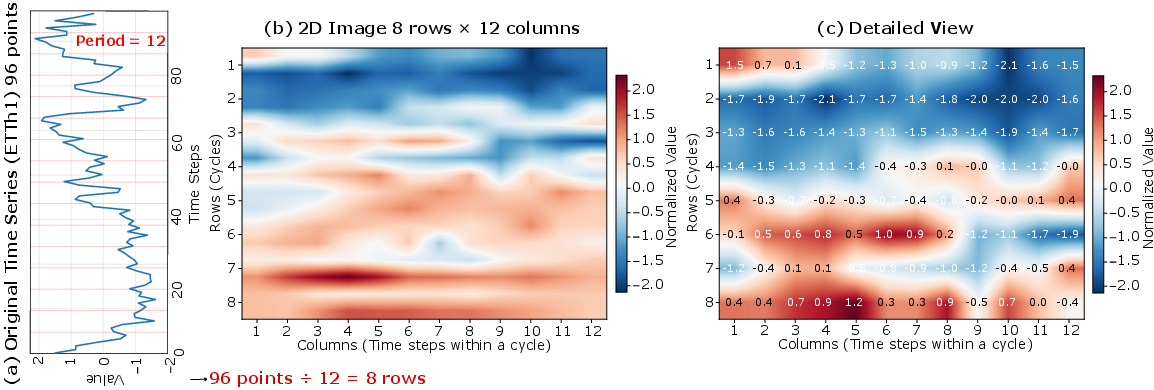
Figure 7: Reshaping ETTh1 as period-12 image; columns reveal seasonality, rows reveal trend.
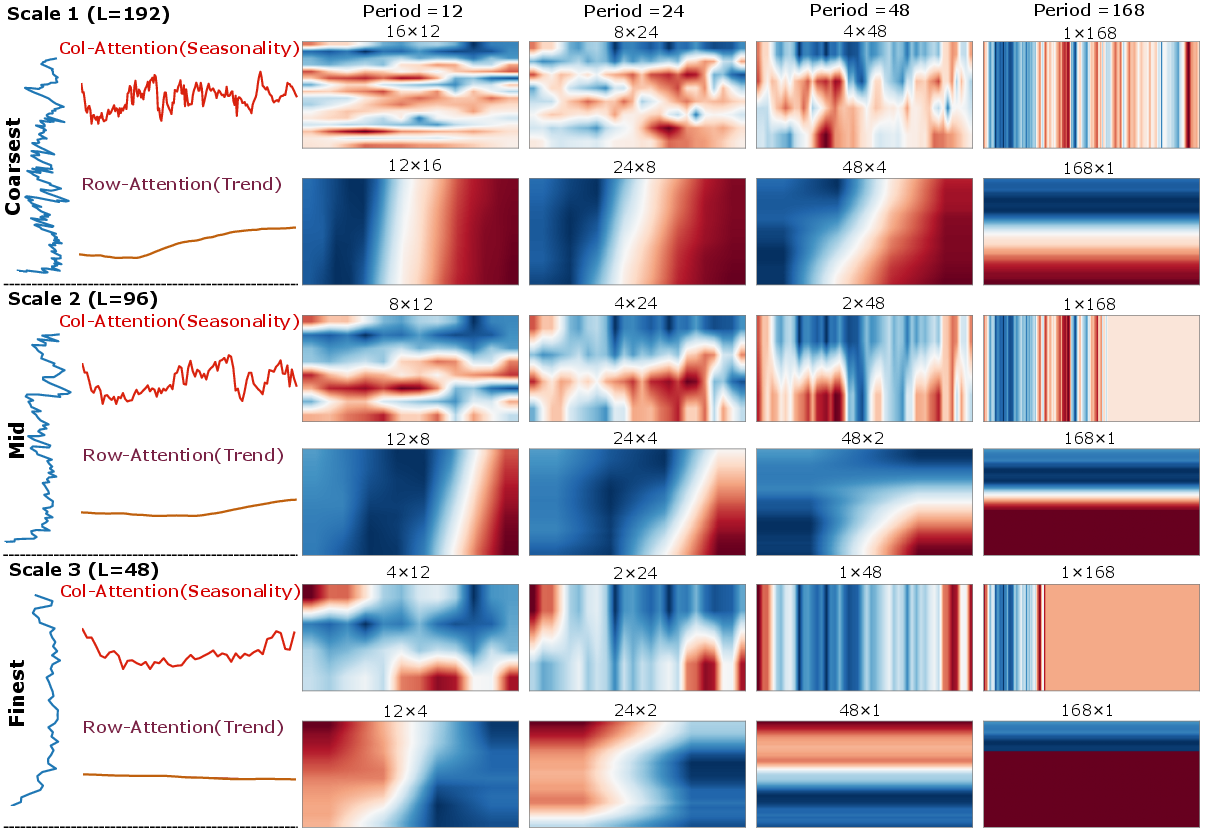
Figure 8: Multi-scale visualization (periods 12, 24, 48, 168) across L=192, 96, 48, showing layered trend and seasonality.
The model's periodic head aligns with these formations, directly supporting interpretable feature extraction. Wave visualizations of RhyMix signal flow confirm the progressive extraction of multi-scale and seasonal patterns.
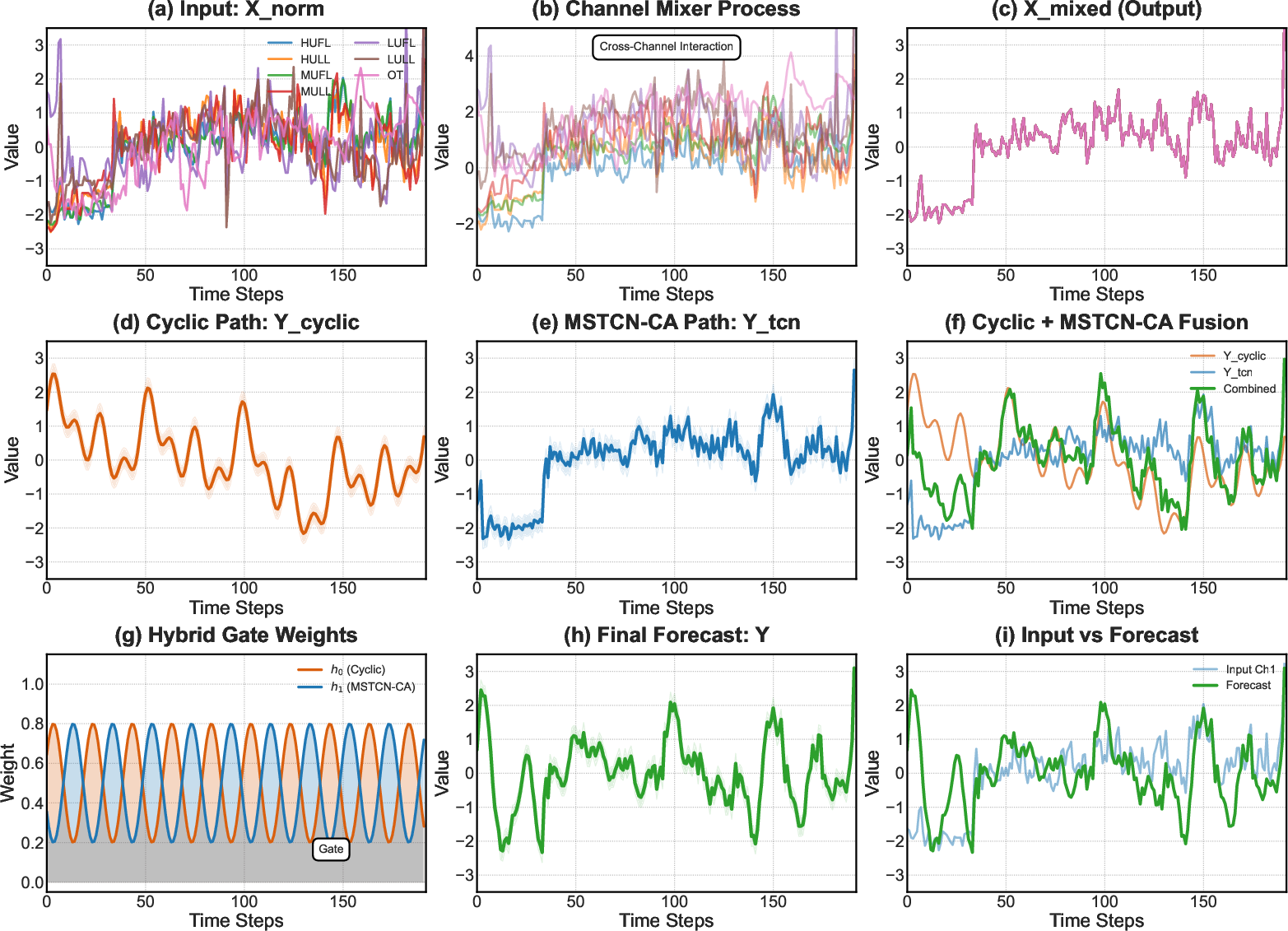
Figure 9: Channel-wise wave representations at key RhyMix stages, demonstrating transformation from raw input to fused forecast.
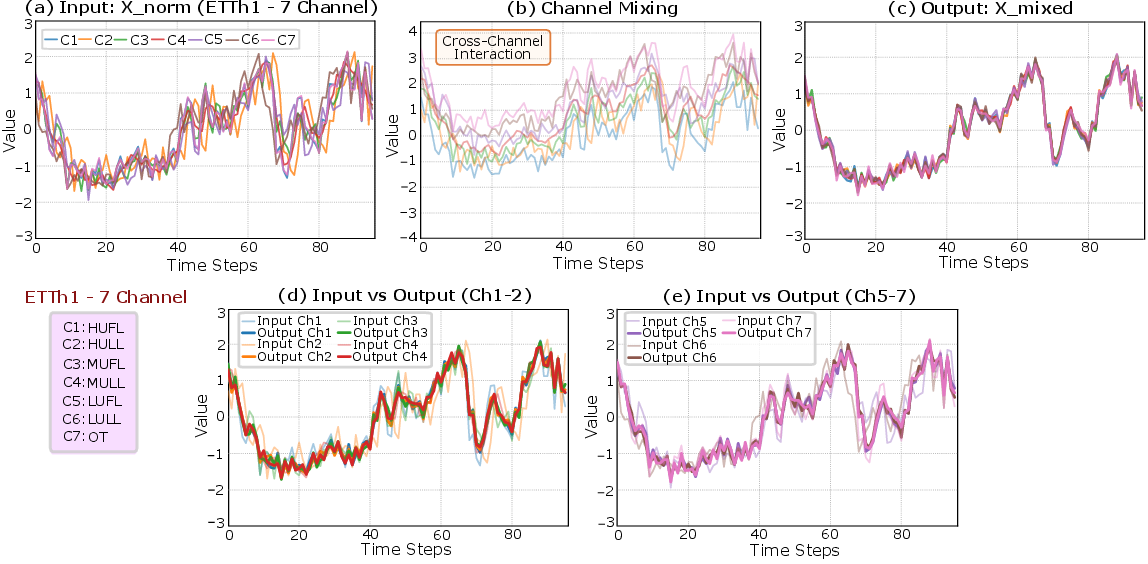
Figure 10: Channel mixer visualization confirms effective cross-channel dependency modeling without quadratic complexity.
Ablation Study and Component Validation
Systematic ablation confirms the necessity of each module: periodic features are most critical (removal degrades MSE by up to 0.05–0.09 on ECL, Weather, ETTh1); MSTCN-CA and cyclic paths provide complementary strengths; gating mechanisms, local convolution branch, and channel mixer all contribute synergistically. Component removal results in consistent performance degradation, highlighting the advantage of integrated multi-pattern and adaptive fusion.
Model Complexity and Edge-AI Implications
RhyMix maintains linear complexity O(L⋅C) via depthwise convolutions and lightweight mixing; avoids quadratic scaling (in horizon or channels) seen in transformers or SVD-based augmentations (Time-o1). Compared to PatchTST, SOFTS, TimesNet and TimeMixer++, RhyMix achieves SOTA accuracy with >7–99× fewer parameters and <10% of inference memory. Its low-latency and compact footprint make it uniquely suited for edge deployment and real-time applications.
Limitations and Future Directions
RhyMix is less optimal for datasets with dominant spatial dependencies (e.g., Traffic, PEMS04); future work may extend channel interaction via sparse graph convolution or spectral processing. Dynamic period selection (e.g., learnable periods or FFT-based discovery) could further improve cyclic modeling. Extending the path/fusion modules for imputation and anomaly detection is promising.
Conclusion
RhyMix demonstrates that a hybrid, adaptive dual-path architecture combining explicit cyclic priors, multi-scale depthwise convolution, and dynamic gating provides superior accuracy and efficiency in long-term multivariate forecasting. The careful integration of forecasting heads and per-sample fusion enables robust capture of trends, seasonality, local fluctuations, and abrupt changes, all under linear complexity and minimal resource constraints. This architecture advances both practical deployment (edge-AI, low-latency scenarios) and theoretical understanding of multi-pattern temporal modeling.
Future research directions include expanding adaptive period selection, generalizing to other time series modalities, and further optimizing channel interaction strategies for spatially correlated signals. RhyMix sets a precise benchmark for lightweight, configurable models tailored for diverse real-world forecasting tasks and resource-constrained environments.