- The paper introduces the Hamiltonian Encoding Framework (HEF) that maps classical data into fixed Hamiltonians to enable robust quantum learning.
- It demonstrates hardware-efficient implementations in both analog superconducting arrays and shallow digital circuits, achieving high classification accuracy.
- Performance scaling and hyperparameter analysis reveal resilience to noise and decoherence, effectively mitigating barren plateau issues.
Robust Quantum Learning through Hamiltonian Reservoir Computing
Introduction and Motivation
The paper "Robust Quantum Learning through Hamiltonian Reservoir Computing" (2607.08037) addresses critical challenges in quantum machine learning, including trainability, hardware efficiency, and information stability on near-term quantum platforms. The central contribution is the Hamiltonian Encoding Framework (HEF), a paradigm for quantum reservoir computing (QRP) wherein classical data is embedded directly into a fixed Hamiltonian, enabling expressive nonlinear features via quantum dynamical evolution. By leveraging the reservoir computing paradigm, the approach circumvents the endemic barren plateau problem in variational quantum circuits and offers both analog and digital realizations on superconducting qubit architectures and shallow digital quantum circuits.
Hamiltonian Encoding Framework: Structure and Expressivity
The HEF directly maps input data into a structured Hamiltonian, which subsequently undergoes unitary time evolution to produce rich, high-dimensional feature vectors. The framework is characterized by several key architectural elements:
- Input encoding achieves Hermiticity via linear transformations and symmetrization, maintaining physical compatibility.
- Temporal multiplexing generates features at multiple evolution timescales, enhancing task-agnostic expressivity and nonlinearity.
- Feature extraction is accomplished by basis measurements and informationally complete (full density matrix) readouts, providing flexibility in measurement overhead.
The expressivity of the HEF feature map is confirmed through principal component analysis (PCA) and local nonlinearity assessments: even with Hilbert space dimensions corresponding to just 5–6 qubits, the HEF achieves manifold dimensionality sufficient for competitive performance on MNIST classification tasks.
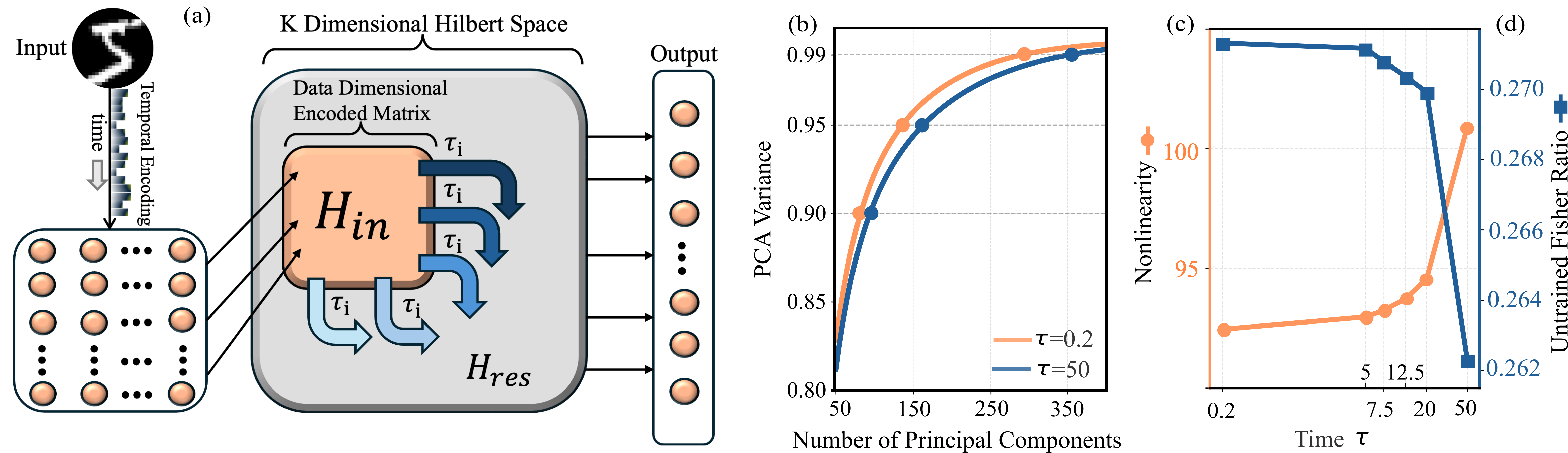
Figure 1: Schematic diagram and expressivity analysis of the Hamiltonian Encoding Framework (HEF), illustrating the architecture and feature manifold diversity.
Empirical analyses reveal:
- Accuracy scaling with system size: For Hilbert space dimension K≥64, both basis measurement and full density matrix methods converge to identical test accuracy, indicating that basis measurements alone suffice for high-fidelity learning at this scale.
- Temporal evolution: Optimal classification performance emerges for evolution times τ in [0.1,1], balancing phase coherence and avoidance of decoherence-induced information loss.
- Feature multiplexing: Increasing the number of temporal processes systematically enhances test accuracy up to saturation thresholds, demonstrating the advantage of temporal diversity.
- State purity insensitivity: The HEF remains robust across varying degrees of mixedness, suggesting resilience to realistic quantum noise and decoherence in hardware platforms.
- Hyperparameter stability: Test accuracy is nearly invariant under broad sweeps of the spectral radius and ridge regression regularization parameter α, with performance fluctuations bounded within 10−4.
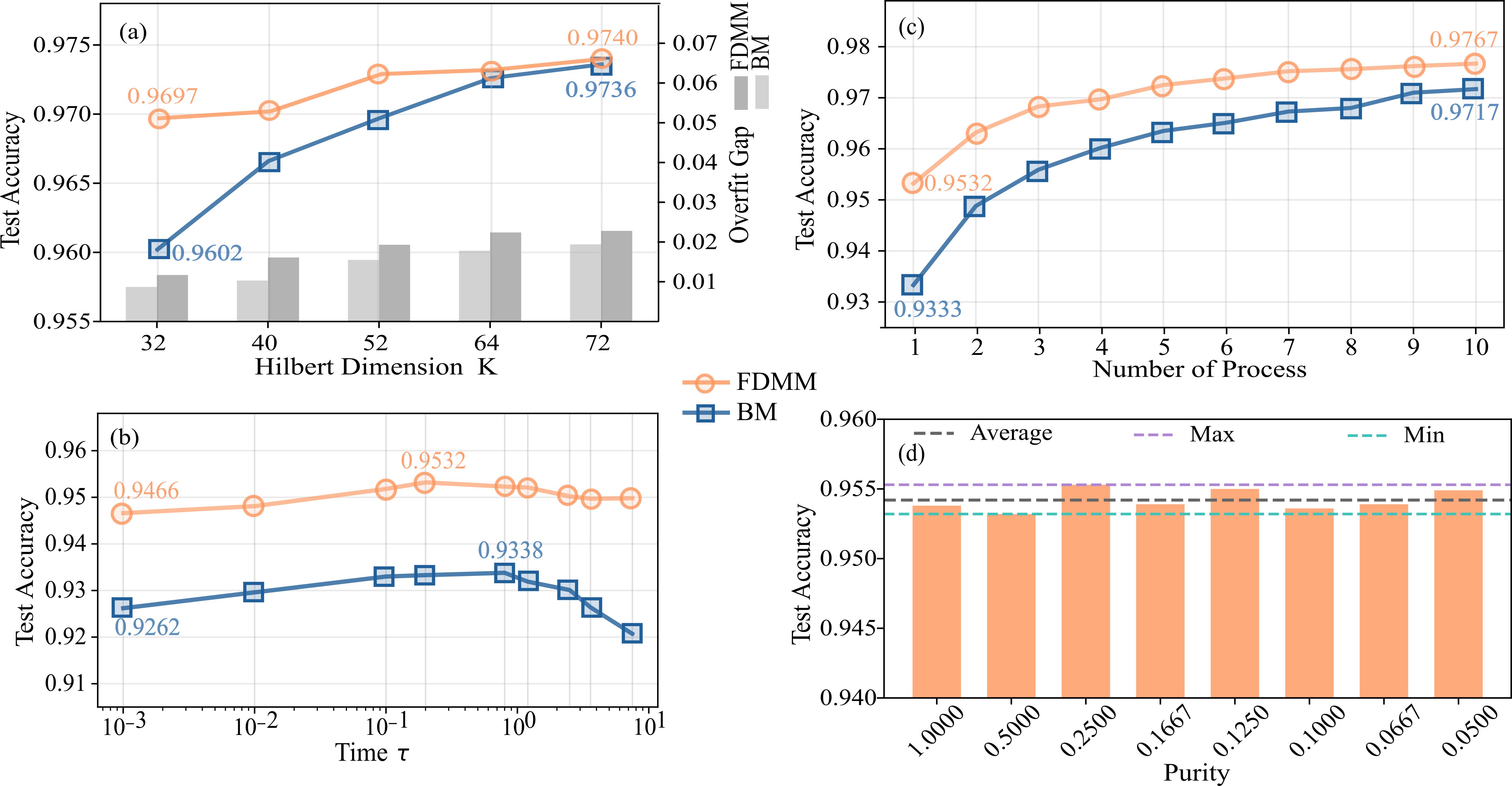
Figure 2: Performance scaling and parameter optimization of the HEF framework across Hilbert space size, evolution time, process count, and state purity metrics.
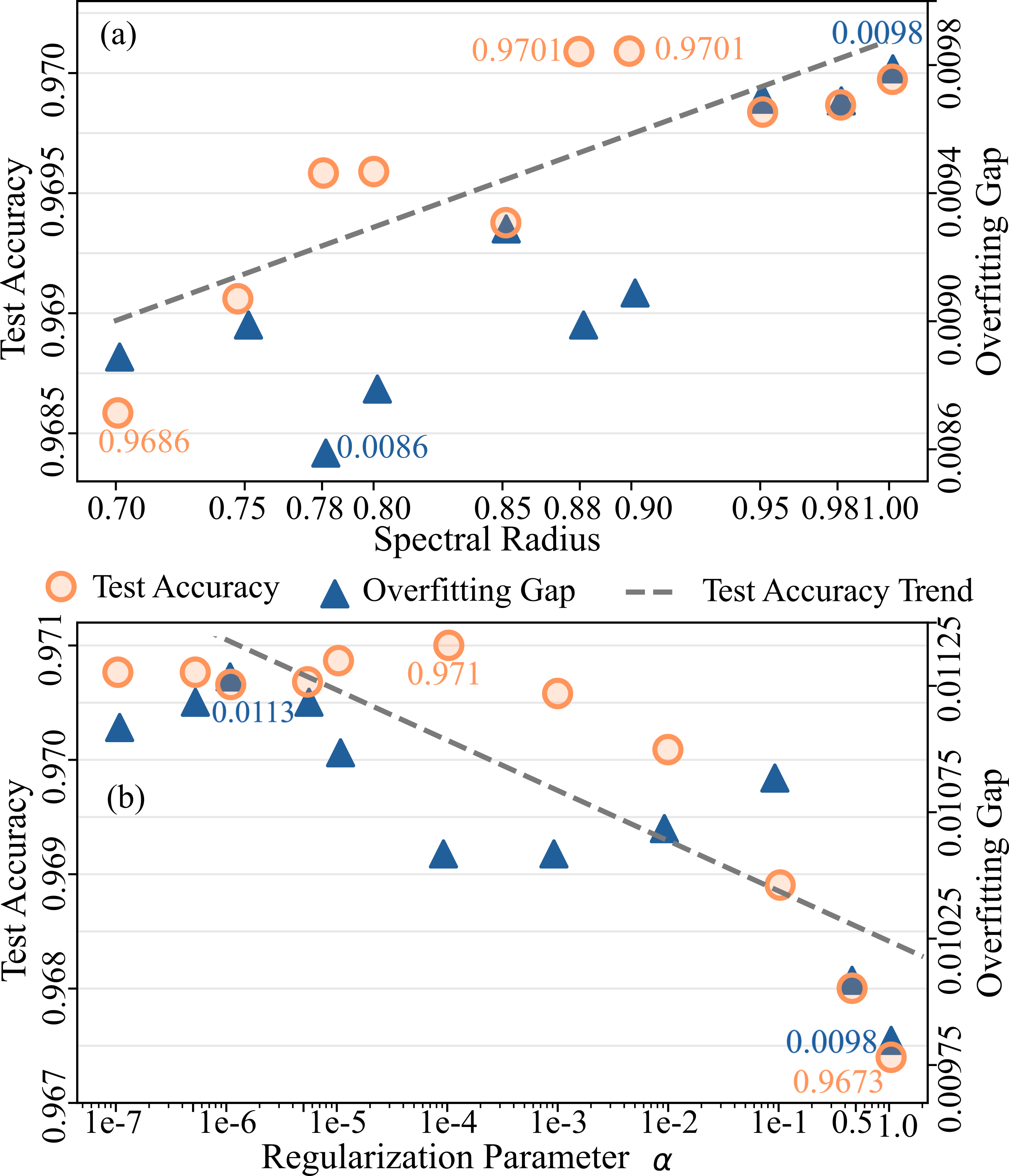
Figure 3: Hyperparameter assessment for the HEF, showing marginal sensitivity of performance to spectral radius and regularization parameter α.
Analog Superconducting Array Processor (ASAP)
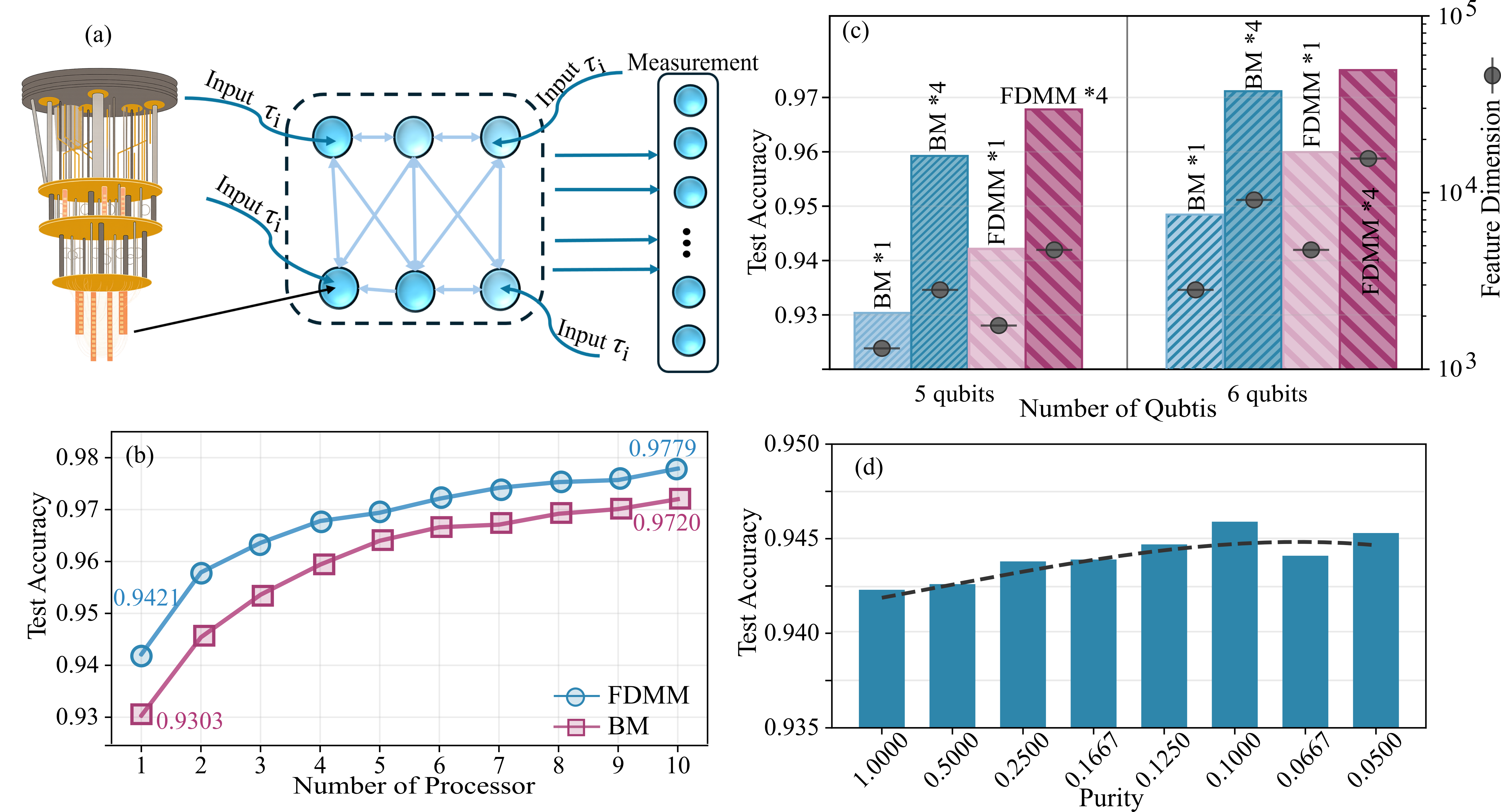
The ASAP architecture leverages the native many-body evolution in superconducting qubit arrays, eschewing gate decomposition in favor of continuous unitary operations. Data is mapped onto Hamiltonian parameters (frequency, microwave drive amplitudes), with encoding flexibility supporting various input modalities. Empirical benchmarks on the MNIST dataset demonstrate:
Quantum Circuit Implementation (QCI)
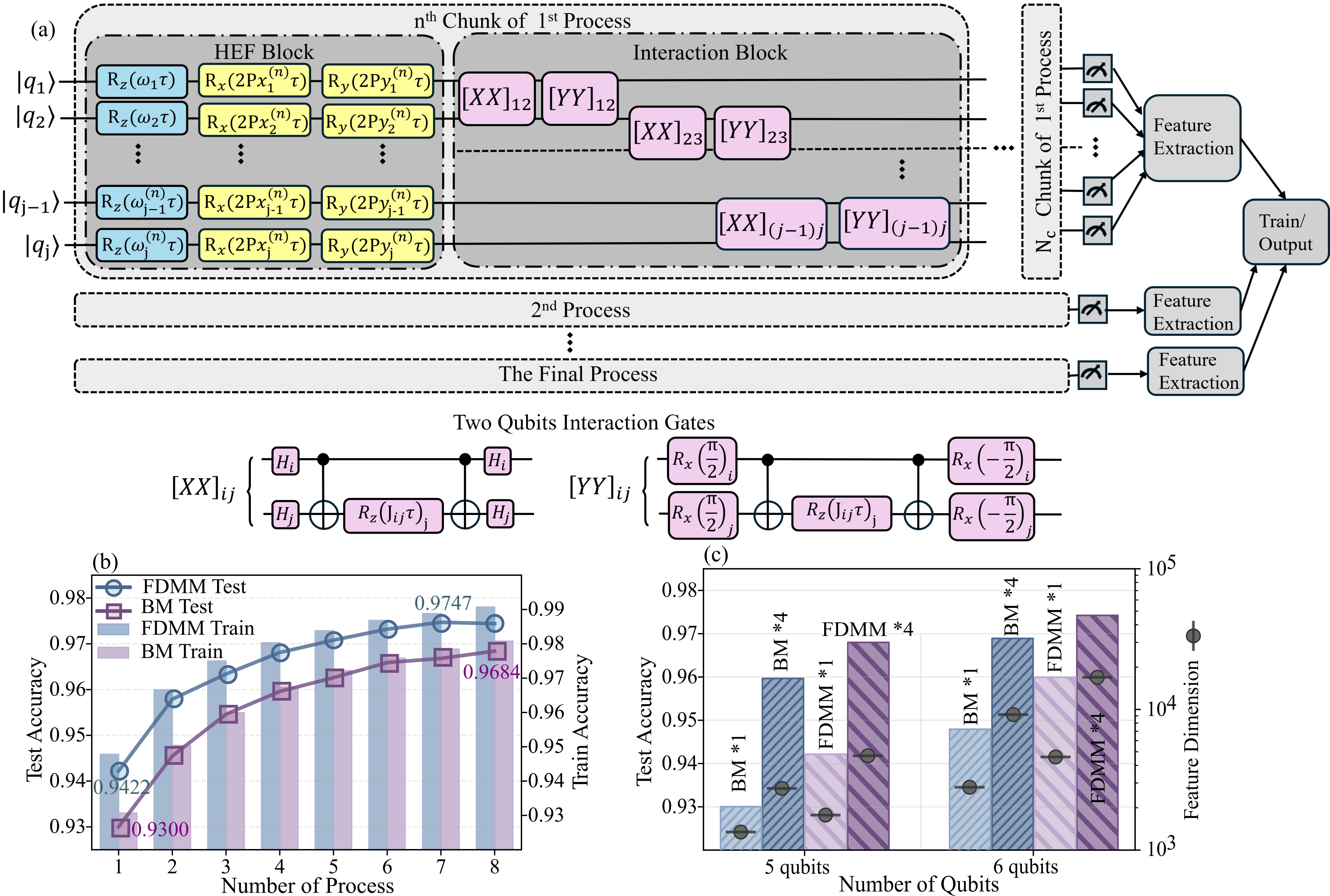
The QCI adapts the HEF scheme for shallow digital circuits, constructing linear-depth architectures with partitioned blocks:
- HEF block: data encoding via single-qubit rotations
- Interaction block: inter-qubit entangling gates (XX, YY interactions)
Feature extraction is performed post-evolution using basis or full density matrix measurement schemes. Benchmarks show:
Comparative Analysis: ASAP vs. QCI
Both ASAP and QCI achieve near-parity in classification accuracy, demonstrating that analog and digital realizations of HEF are feasible and robust. ASAP offers superior hardware efficiency—reduced temporal overhead and effective use of coherence times—while QCI provides flexibility through linear-depth digital circuits. The linear readout layer avoids variational optimization, eliminating barren plateaus and enabling stable training.
The study systematically evaluates open-system dynamics, modeling dephasing and amplitude damping using Lindblad master equations for ASAP and Kraus noise channels for QCI. Results reveal:
- Robustness at short evolution times: Accuracy deviations with dissipation rates up to γ=10−1 remain bounded below 10−3.
- Dissipation-induced mitigation of quantum scrambling: At long evolution times (τ0), controlled environmental coupling suppresses many-body scrambling, recovering test accuracy otherwise degraded to linear baselines.
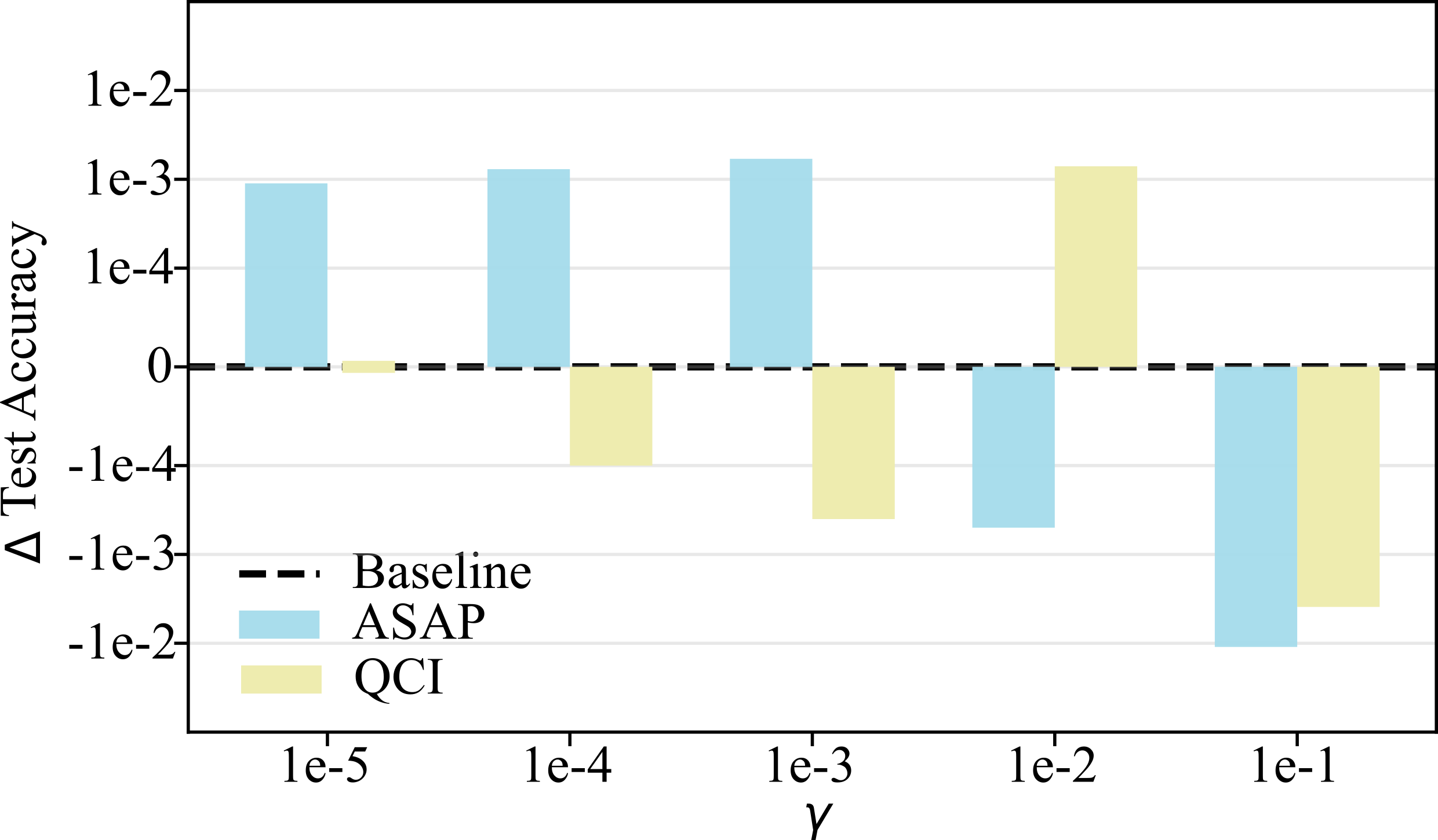
Figure 6: Effect of dissipation on ASAP and QCI at short times; accuracy deviation remains minimal across a broad dissipation rate range.
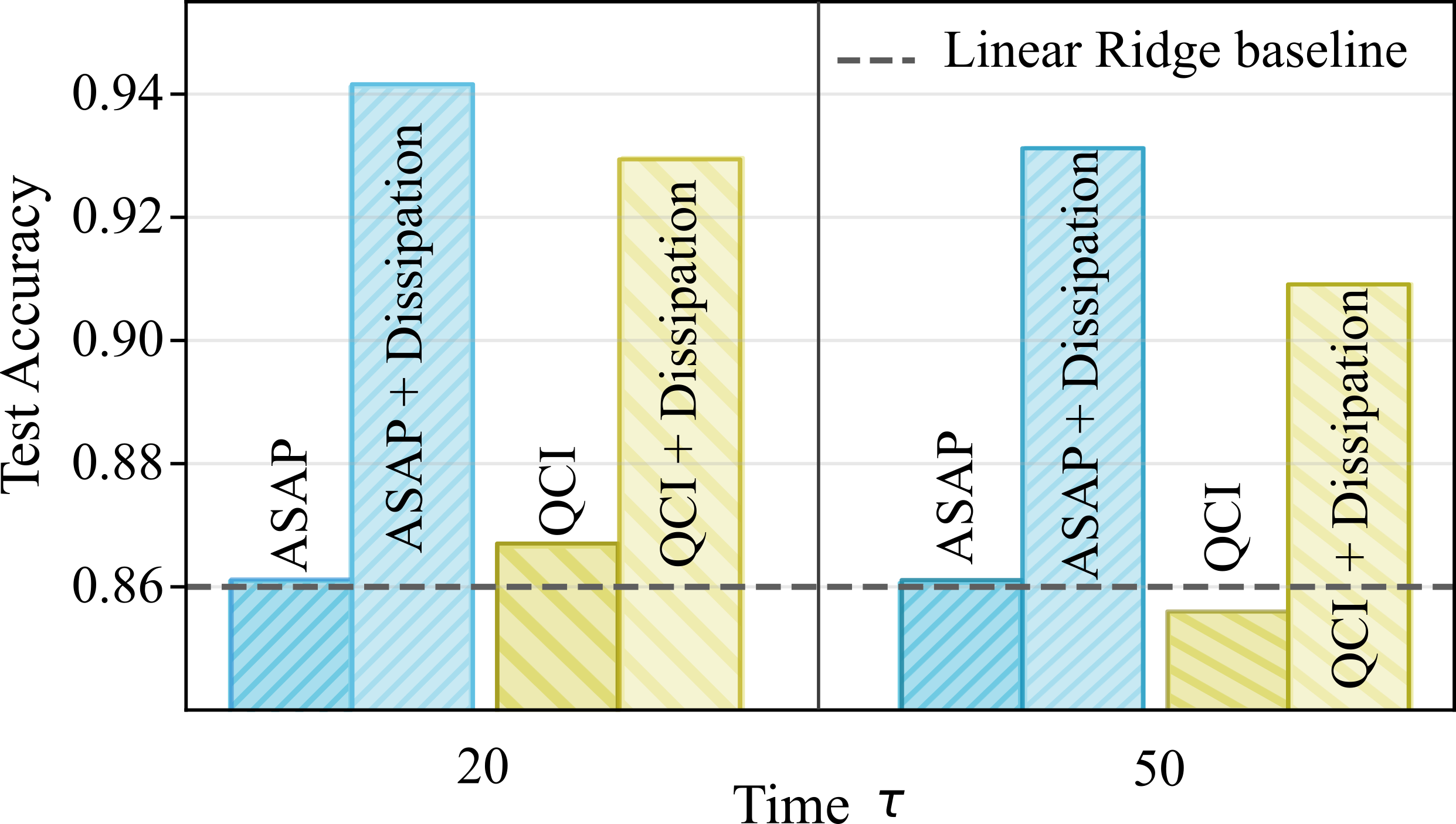
Figure 7: Dissipation-induced recovery of accuracy at long evolution times, counteracting quantum scrambling through environmental stabilization.
Implications and Future Prospects
The HEF paradigm demonstrates that competitive quantum learning performance is achievable with minimal physical resources—only five to six qubits—without requiring deep circuit architectures or extensive scaling. Basis measurement schemes enable hardware-efficient implementations, minimizing measurement complexity and susceptibility to noise. Dissipation, typically regarded as detrimental, is shown to play a constructive stabilizing role under long-time evolution. These findings open avenues for developing quantum learning protocols that dynamically balance coherence, expressivity, and environmental control, potentially informing the design of cross-platform quantum machine learning systems.
There are open challenges regarding scaling feature extraction costs, integrating classical-quantum hybrid training protocols, and harnessing dissipation in a principled fashion. Advances in photonic and superconducting readout strategies could further enhance efficiency and deployment prospects.
Conclusion
The Hamiltonian Encoding Framework unifies quantum reservoir computing across analog and digital platforms, achieving robust, expressive, and hardware-efficient learning. Empirical results validate its stability, trainability, and efficiency under realistic environmental constraints and measurement limitations. The paradigm offers a promising foundation for quantum machine learning on contemporary hardware, with implications for scalable architectures, cross-platform interoperability, and theoretical understanding of information stability in quantum dynamical systems.