- The paper introduces a feedback-driven QRC architecture that integrates classical feedback into a fixed quantum circuit for enhanced temporal encoding.
- Experimental results on Mackey-Glass forecasting show that the CPMap-based quantum reservoir consistently achieves lower MSE than classical methods.
- Analyses reveal that balanced entanglement and high two-qubit gate fidelity are crucial for optimizing memory retention and mitigating noise.
Recurrent Quantum Feature Maps for Reservoir Computing: An Expert Analysis
Reservoir Computing and Quantum Extensions
Reservoir computing (RC) utilizes a fixed nonlinear dynamical system as a high-dimensional embedding space for sequential inputs, with temporal dependencies extracted via a trainable linear readout. Echo state networks (ESNs) and liquid state machines typify this paradigm, offering efficient training by decoupling the dynamical evolution from the learning process. The desirable properties for RC include the echo state property (ESP) and fading memory—the former ensuring stability and input-driven state convergence, and the latter quantifying memory decay.
Quantum Reservoir Computing (QRC) extends RC by exploiting the exponential dimensionality and intrinsic correlations of quantum systems, with implementations across various platforms from superconducting qubits to neutral-atom processors. Existing QRC architectures demonstrate parity or superiority relative to classical recurrent neural networks in tasks such as chaotic time-series prediction, but often struggle with post-measurement memory retention and hardware-induced noise constraints.
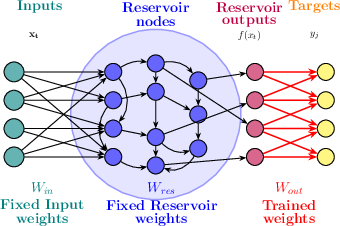
Figure 1: Classical reservoir computing transforms temporal input via nonlinear recurrent dynamics into a high-dimensional state, with linear readout enabling efficient prediction.
Proposed Architecture: Feedback-Driven Quantum Reservoirs
This paper introduces a feedback-driven QRC architecture based on reusable quantum feature maps. The key innovation is the integration of classical feedback—derived from previous outputs—into a fixed quantum circuit, thus achieving temporal recurrence without mid-circuit measurements or resets. The architecture partitions the circuit: one half encodes a sliding window of input data, and the other encodes feedback via a daggered feature map, both modulated by a tunable strength α.
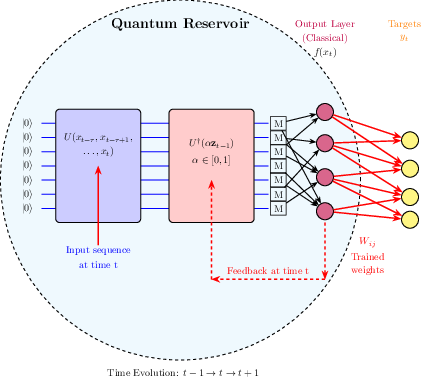
Figure 2: The quantum reservoir circuit divides input and feedback encoding across two halves, enabling structured recurrence via classical feedback vectors.
The circuit output probabilities provide regression features and feedback signals; the latter are constructed as single-qubit Pauli-Z expectations and scaled by α. A linear regression readout maps selected quantum output components (determined by parameter λ) to predictions. This approach links quantum kernel methods—typically used for static learning—to dynamical reservoir computing.
Experimental Evaluation: Mackey-Glass Forecasting
Temporal forecasting performance is evaluated on the benchmark Mackey-Glass chaotic time series, using both CPMap (a resource-efficient quantum feature map) and ZZFeatureMap circuits. For τ=17, window size 20, and prediction horizon 20, the CPMap-based QRC architecture attains lower mean squared error (MSE) than classical baselines, including ESN (with grid-optimized hyperparameters), ridge/lasso regression, and multilayer perceptrons, even in the absence of internal trainable parameters or hyperparameter tuning.
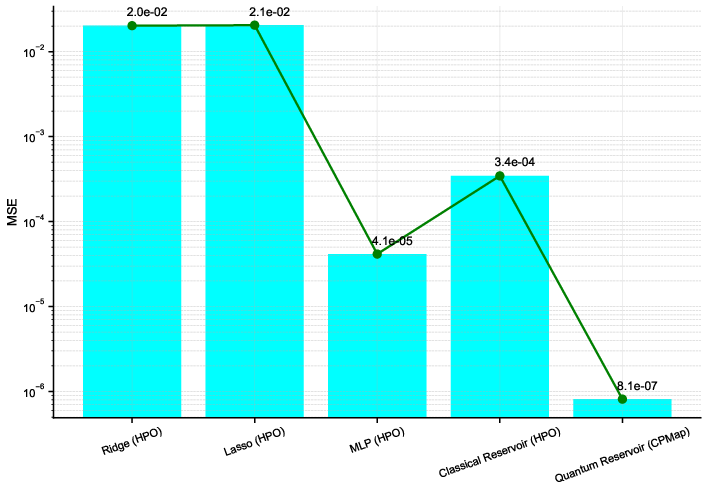
Figure 3: Quantum reservoir achieves the lowest MSE on chaotic forecasting compared to ESN and MLP, demonstrating expressive temporal encoding with fixed circuits.
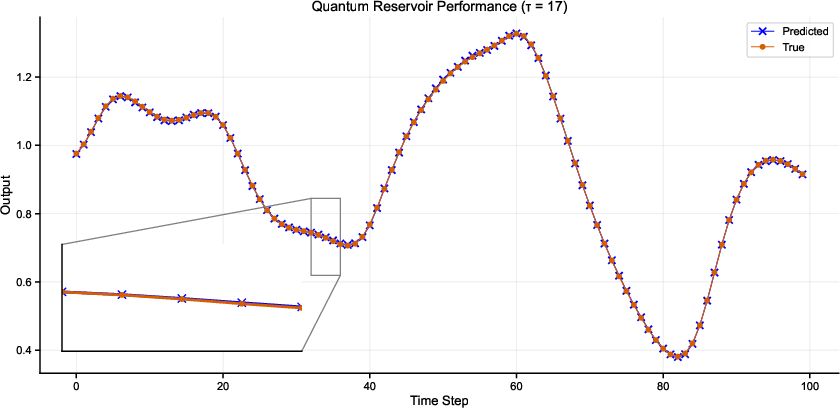
Figure 4: QRC closely tracks Mackey-Glass chaotic oscillations, maintaining high fidelity and temporal stability over extended test intervals.
Performance comparisons across varying delay parameters and prediction horizons show the CPMap circuit consistently outperforms ZZFeatureMap. The forecasting accuracy is maintained even as memory requirements increase (higher τ), underscoring the superior temporal retention of structured quantum feature maps.
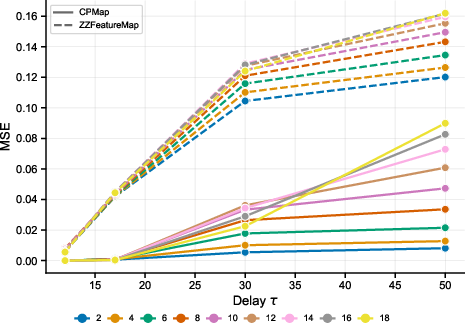
Figure 5: CPMap maintains lower MSE across delay and horizon variations, demonstrating robustness relative to ZZFeatureMap.
Entanglement, Memory, and Computational Dynamics
A sweep over a key circuit parameter θi reveals that the quantum reservoir's memory capacity, entanglement entropy, and prediction error exhibit correlated, nontrivial dependence. Enhanced memory and low MSE are observed in parameter regimes with intermediate entanglement—excessive or minimal entanglement impedes performance.
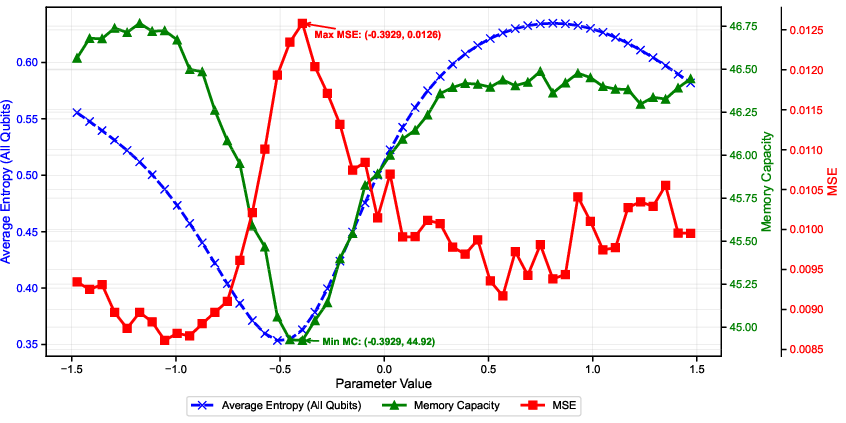
Figure 6: Structured variation in θi yields optimal regimes where memory capacity is maximized, entanglement is moderate, and prediction error is minimized.
These results indicate that task-relevant quantum dynamics arise from a balance between expressive entanglement and dynamical stability; performance is not maximized by arbitrary increases in quantum correlation.
Noise Robustness and Practical Limitations
Noisy simulations using NISQ-like device models reveal that the QRC architecture preserves coarse temporal structure but incurs strong local fluctuations, demonstrating sensitivity to device-level errors. The most deleterious effect arises from two-qubit depolarizing noise; single-qubit, readout, and relaxation channels exert comparatively minor influence. Combined noise sources further magnify performance degradation.
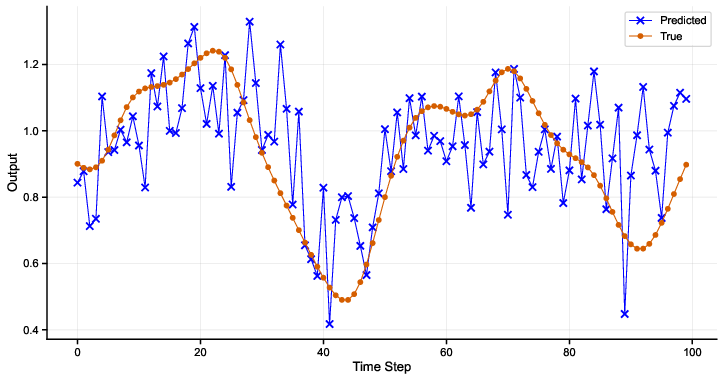
Figure 7: Under realistic noise, QRC predictions lose fine structure and become locally erratic, although coarse trends are preserved.
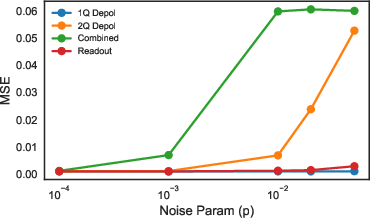
Figure 8: Two-qubit gate noise drives sharp deterioration in QRC performance; other noise channels are less impactful.
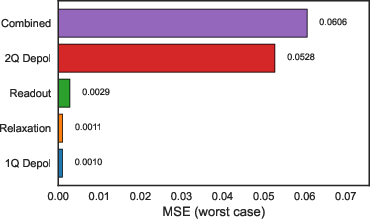
Figure 9: Worst-case MSE highlights the dominance of two-qubit and combined noise in forecasting degradation.
This analysis accentuates the centrality of entangling-gate fidelity in practical QRC deployments and motivates future work on noise-aware circuit layouts.
Parameter Sensitivity: Feedback and Readout
Forecasting accuracy is maximized at intermediate values of recurrence strength α and output fraction λ. Too little feedback impairs memory, while excessive feedback suppresses input information. Optimal performance is achieved with strong—but not maximal—feedback and full readout.
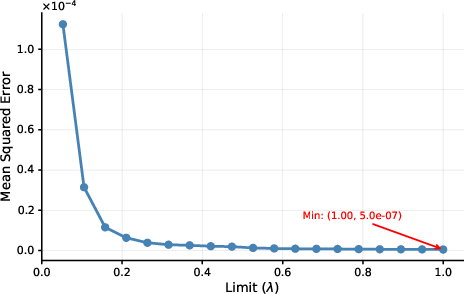
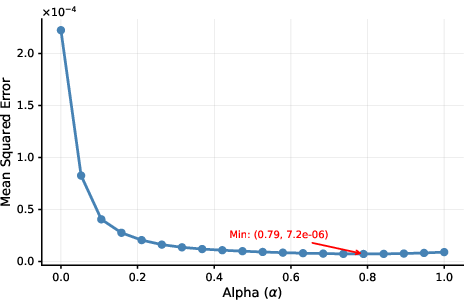
Figure 10: Test MSE is minimized at Z0, indicating balanced recurrence and maximal output utilization.
Memory Dynamics and Stability
Memory capacity scales with input window size and saturates beyond 20, confirming finite effective memory without overload. Echo state property verification shows that input-driven dynamics prevail, with rapid convergence between initially separated trajectories.
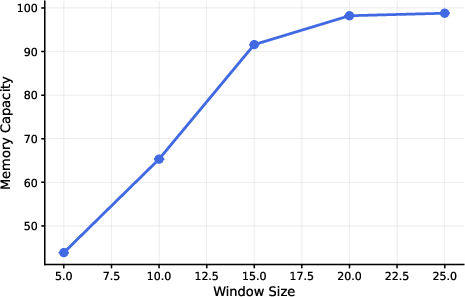
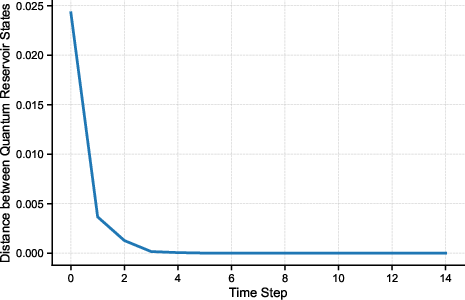
Figure 11: Memory capacity rises with input window size, saturating at practical limits.
Relaxation Noise Effects
Analysis of relaxation noise (parameter Z1) shows weak dependence on performance, reinforcing that two-qubit errors—not relaxation—present the main bottleneck.
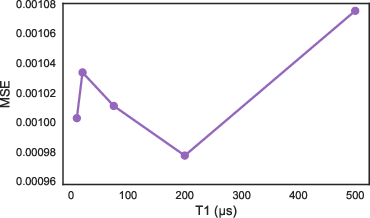
Figure 12: MSE is insensitive to relaxation time Z2, indicating robustness to this noise channel.
Full-State Feedback Variant
A simplified variant using direct measurement distributions as feedback achieves competitive performance relative to classical reservoirs and MLPs, albeit with marginally higher error than the original architecture.
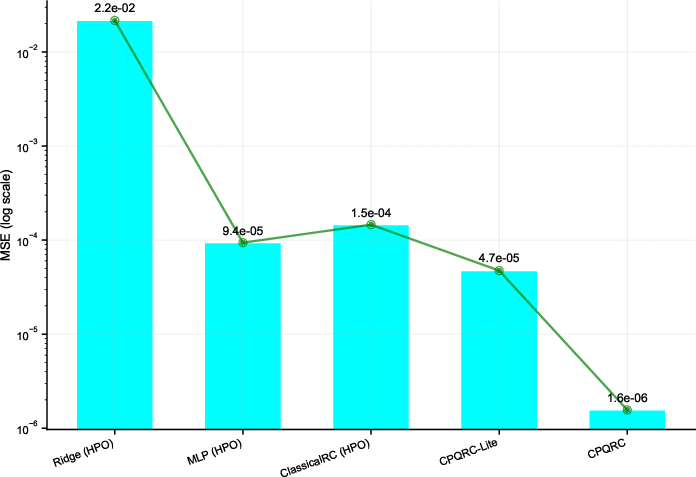
Figure 13: CPQRC-lite yields lower MSE than classical reservoirs and similar accuracy to MLP; original CPQRC remains best.
Implications and Future Directions
This work demonstrates an efficient, interpretable, and robust route to QRC by leveraging recurrent quantum feature maps in a feedback-driven architecture. The model exhibits strong temporal encoding, competitive prediction accuracy, and validated dynamical properties (fading memory, ESP) with a fixed unitary circuit. Sensitivity analyses identify structured entanglement and two-qubit gate fidelity as key operational domains.
Practically, the approach bridges quantum kernel models and real-time temporal learning, suggesting utility for low-latency, resource-limited environments pending improvements in quantum hardware. Theoretically, the findings underscore the necessity of balancing quantum expressivity and stability—maximal complexity is not optimal.
Future research should focus on noise-aware circuit design, alternative entanglement structures, error mitigation strategies, and broader benchmarks on real-world temporal datasets. Enhancements in hardware fidelity and circuit architecture are essential for advancing QRC beyond simulation.
Conclusion
The feedback-driven quantum reservoir architecture using recurrent quantum feature maps successfully integrates classical feedback and quantum expressivity for temporal learning. The results clarify the interplay between memory, entanglement, and noise robustness, providing a pathway toward practical QRC. The model's compactness, interpretability, and competitive forecasting performance position it as a promising candidate in the evolving landscape of quantum temporal machine learning.